From Woody's Couch

Our Playbook on OSU History

Category: Archival resources (page 6 of 14)

Twelve Days: Thanks to Studer, Archives finds a permanent home

(In celebration of the University Archives’ upcoming 50th Anniversary in 2015, we bring you “The Twelve Days of Buckeyes”. This is day six in a series of 12 blog posts highlighting the people who were instrumental in the creation and growth of the Archives.)

William Studer, 1986

William Studer, 1986

Until 1978, the Archives did not have a department or unit on campus to call its own. When Bruce Harding, the first professional archivist, was hired in 1965, he reported to the Secretary of the Board of Trustees, then to the Vice President of Educational Services.

In 1978, though, the Archives was reassigned to the Libraries, which was then led by William Studer, director from 1977 to 1999. It made sense: Both entities held a mission of acquiring, preserving and making available information. That year, the Archives joined the Special Collections section of the Libraries.
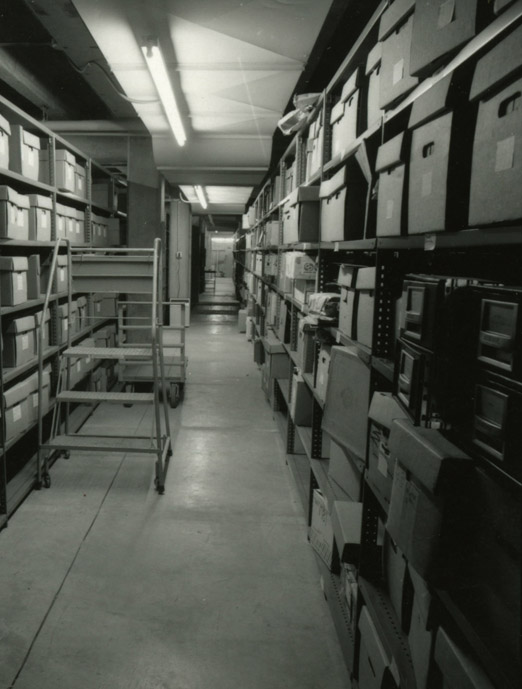
Archives stacks in Converse Hall, 1980s

The Archives stacks in Converse Hall, 1980s

It turns out that Studer had been a long-time fan of special collections like the Archives, understanding the importance they have in any academic library setting. In a 2011 oral history interview, he said “Special collections, in my view, significantly define a research library and its mission to support research and scholarship.”

(The University Archives is not the only collection added to the Libraries under Studer’s leadership; the Billy Ireland Cartoon Library and Museum was founded in 1977, and the Byrd Polar Research Center Archival Program became part of the Libraries’ special collections in 1985.)

As part of the Libraries, the Archives could be protected in times of fiscal leanness, but it would also benefit from more robust budgets, such as in 1980 when the Libraries doubled the Archives’ operating budget and added an assistant archivist.

University Archives/Library Book Depository Building, 1996

University Archives/Library Book Depository Building, 1996

Depository stacks, 1996

Depository stacks, 1996

A key turning point was when the Archives moved in 1995 to the Book Depository on Kenny Road. The Archives had been housed in makeshift facilities, located most recently in Converse Hall, where the ROTC program is housed. (One of the Archives’ reference rooms sat next to a shooting range, not exactly a winning combination.)

Under Studer’s leadership, the plans were adjusted for the building so that reference rooms and office space could be added for the Archives, while its collections shared warehouse space in back of the building with the Book Depository materials.

“I was obviously committed to the University Archives and wanted to make something of it, without realizing fully what it could and would become, wanted to make it something much more than it was. And part of this involved adequate housing,” he said in the oral history interview.

Twelve Days: Harding gave Archives official role in preserving OSU’s history

(In celebration of the University Archives’ upcoming 50th Anniversary in 2015, we bring you “The Twelve Days of Buckeyes”. This is day five in a series of 12 blog posts highlighting the people who were instrumental in the creation and growth of the Archives.)

Bruce Harding and an unidentified staff person pose in front of an Archives display, 1965

Harding and an unidentified staff person at the Archives, 1965

You may not know this but the University has an Operating Manual, which is nothing like the owner’s manual you receive with a new car, but instead is a compilation of policies, procedures and guidelines that help determine how OSU conducts business.

Inside, thanks to Bruce Harding, is a section that makes the Archives the official repository of University materials of permanent value, and gives it the authority to decide on the disposition of all of the University’s records.

Sounds pretty cool, huh?

Page from the operating manual

Page from the operating manual

Fine, it might not sound very cool, but it is, in fact, very important. Without that designation and authority, the University’s history might be spread willy-nilly all over campus or, heaven forbid, disposed of without a thought or care. Imagine the first registrar’s book – the only record of the first students who attended OSU – being tossed in the trash. Unthinkable, isn’t it? But without the Archives being the official developer of individual departments’ and other units’ records retention policies, important historical materials might be lost forever.

With its place in the Operating Manual, the Archives has an official role in preserving OSU’s historical record, and it was because of Bruce Harding that it’s there. As the first official archivist appointed to that role in 1965, Harding worked to get guidelines on records disposition into the Operating Manual as early as 1969.

Harding, 1967

Harding, 1967

Harding had been hired in 1965 from Michigan’s state archives, and he had previously worked at the Ohio Historical Society. He was the University’s first professional archivist – he had certificates in archives management and preservation administration from Harvard and American universities, respectively – but he left in 1969, saying the archives was still low on OSU’s priority list and that funds were insufficient. “Of course, the University’s primary responsibility is to teach, and the archives is naturally of far less importance,” he told The Lantern in February 1969.

It couldn’t have helped that while he was archivist, the Archives moved three times, from the top floor of Thompson Library to the law school’s basement and Hitchcock Hall. Harding subsequently worked for the National Archives and Records Service in Chicago as a field regional archivist responsible for much of the Midwest.

Twelve Days: Having the right ‘supplies’ key to planning OSU’s centennial party

(In celebration of the University Archives’ upcoming 50th Anniversary in 2015, we bring you “The Twelve Days of Buckeyes”. This is day four in a series of 12 blog posts highlighting the people who were instrumental in the creation and growth of the Archives.)

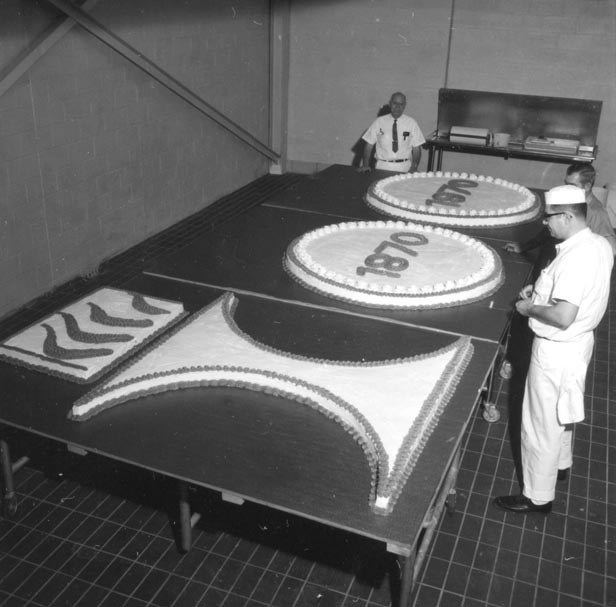
Cake made for the University's Centennial Celebration, 1970

The University’s centennial celebration cake, 1970

When you are planning a party, you always make sure that you have everything ready before it starts, right? In the case of a regular party, you see that you have enough food, beverages, plates, napkins, etc.

Same thing with the University’s centennial celebration in 1970, only in this case it had to make sure it had the historical papers, photos and artifacts to commemorate the 100th anniversary of its founding in 1970. Five years earlier, in 1965, the first University Archivist, Bruce Harding, was hired; a professional archivist was needed to properly manage the historical records as the University prepared to show off the legacy of its first 100 years. Particularly, photos were important, as they offered the basis of the “The First Hundred Years” book that was widely distributed for the event.

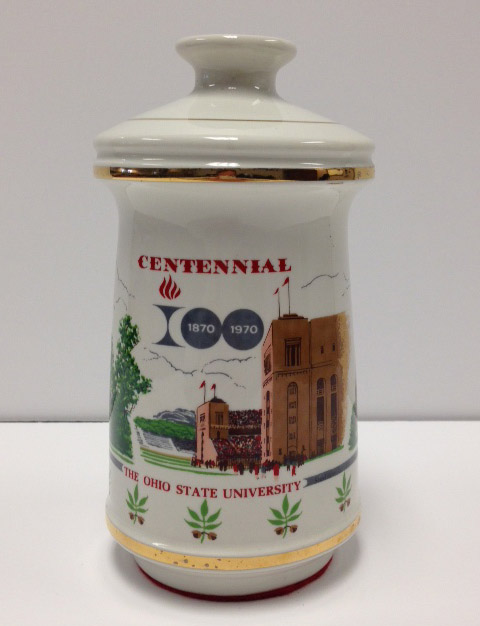
Centennial celebration container

Centennial celebration container

Coincidentally, as the University used the Archives to help it display its many historical legacies, the process of celebrating produced much-needed – and now often used – historical documents to be housed at the Archives. For instance, many OSU departments created centennial histories, which remain key resources for those doing administrative historical research.

And the celebration produced its own historical record: Not only does the Archives retain the various reports, proposals and other materials documenting the planning process, but it has a lot of really cool artifacts that demonstrate the way the University celebrated, such as a porcelain whiskey container with images of Orton Hall, Ohio Stadium and University Hall on it (at left).

Just an FYI: The University celebrates its 150th anniversary in 2020. It’s never too early to plan a party!

Older posts Newer posts