From Woody's Couch

Our Playbook on OSU History

Category: Archival resources (page 10 of 14)

University School yearbooks reflect life at OSU’s unique teaching lab

1936_university_school_yearbookWith the great assistance from the alumni of the University School, the University Libraries has digitized the full run of its high-school yearbook and placed the individual issues in the Libraries’ Knowledge Bank. It was a collaborative project between the University Archives and alumni of University School, an experimental K-12 program that ran from 1930 to 1968.

This is the first such collaboration for the Archives and a community partner, and we hope it’s not the last because the enthusiasm shown and hard work done by the University School alumni were truly amazing. We also want to note that the yearbooks only the first University School materials that will be digitized. In this ongoing project, we plan to add other materials to the Knowledge Bank that make the history of University School more accessible to our researchers and other patrons. We’ll keep you updated.

Of course, some of you may not know what University School was. In 1930, the College of Education founded the Ohio State University School as a laboratory for teaching.  Instead of college students going out into public schools to learn teaching methods, University faculty taught at the university’s own K-12 school to find ways to improve teaching in public schools. It started in temporary quarters and moved to its permanent home, Ramseyer Hall, in 1932.

University School classroom, 1950s

University School classroom, 1950s

Classes were limited to 25 students, who were allowed to have a say in what they learned. So, for instance, they were not given prompts for writing assignments, but instead were allowed to pick topics of their own choice. Grades were not awarded; students’ parents were sent letters each semester explaining the students’ progress. There was no ranking of students, but high-school seniors still took the ACT and SAT tests as well as general aptitude tests as a means of comparison to other students in other schools. The school had its own sports teams, newspaper, and school activities, such as prom. And of course, each year, yearbooks were published.

The Board of Trustees voted to close the University School in 1963. Officials cited relevancy to then-current teaching methods at the time, and financial constraints faced by the university, which funded the school. The last senior class graduated in 1967, and the elementary school was closed the following year.

To access the yearbooks, go to:  https://kb.osu.edu/dspace/handle/1811/56069

Filed by C.N.

Long Gone Campus Traditions: Hats off to the era of freshman beanies!

1940

1940

Perhaps one of the few Ohio State traditions new students may wish to stay buried is the class cap, otherwise known as the ‘beanie.’ Freshmen (men only) used to be strong-armed into wearing caps in the name of creating school spirit and class unity. If by unity the administration meant commiseration, well then they got what they set out to achieve.

The caps and rules were in use from 1912 until the mid-century. Wearing the caps was just one of the rules enforced by “all men of the upper classes;” however, the junior men’s honorary Bucket and Dipper and its members were the only people ever authorized, by the Student Senate and the President of the University, to carry out the traditional punishment: namely, throwing offenders into Mirror Lake. Ironically, if some unauthorized person attempted to chuck a freshman in the lake, Bucket and Dipper members were honor-bound to protect the freshman.

A freshman is tossed into Mirror Lake, 1926

A freshman is tossed into Mirror Lake, 1926

Freshmen men were thus required to wear the caps from Freshman Week at the beginning of the term, until Cap Bonfire on Tradition Day, in June. Students caught without their beanies, or violating one of the freshmen rules, were punished. As one Alumni Monthly article put it, “Irregular meetings of Bucket and Dipper are held when freshmen are chased from the Long Walk and from the steps of University or Derby Hall.” These meetings convened on the edge of Mirror Lake and ended with the offending freshmen taking a swim. Other rules that could earn a dunking: skipping Chapel (which was mandatory until 1926), doing something to offend an upper classman (such as the freshman who posted signs saying “Bucket and Dipper go to Hell” near the Long Walk), or setting foot on the Long Walk.

As for Bucket and Dipper, the 14 members at that time were all junior men and had been chosen for their leadership, scholarship and service. Such greats as Chic Harley and Milt Caniff were members. During their initiation, members were thrown in Mirror Lake, so perhaps they had the prerequisite experience needed.

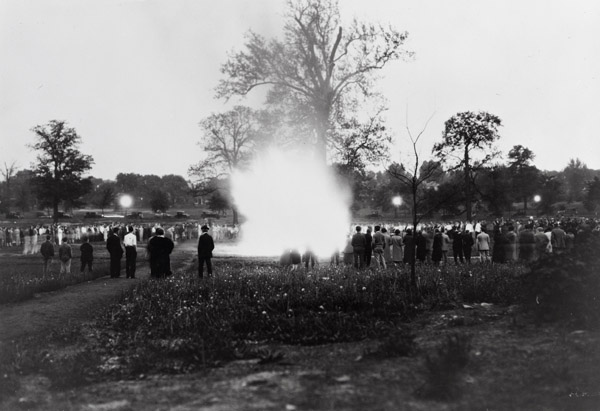
Freshman week cap burning, 1926

Freshman week cap burning, 1926

Thus, in June the freshman waged a two-day war on Bucket and Dipper. The “war” usually consisted on a tug-of-war across Mirror Lake—where the freshman consistently ended up in the lake. That night, students would gather for the Cap Bonfire, when some freshman opted to burn their beanies. (Many freshman did keep their beanies as a memento of their servitude.) Following the bonfire, many freshmen (again, ladies were excluded) went for a walk in their shirttails to cause a ruckus outside the home of then-OSU President William Oxley Thompson.

In 1926 Bucket and Dipper attempted to delay the burning; in the melee that followed, 103 freshman were thrown in the lake and the police were called. Ironically, it was a policeman that gave a freshman a concussion, not a trip into the lake. The following year, then-OSU President George Rightmire forbade Bucket and Dipper from dunking anyone, deserved or not. From then on, it seems the Bucket and Dipper initiates were the only ones to go swimming.

 As for the caps themselves, fashion in hats changed rather rapidly. Some prime examples from Ohio State include the “peanut-shaped skull cap,” “knitted toboggan” cap or “jockey-style” cap, or one with a “rolled brim topped with a scarlet button.”

Filed by C.N.

 To learn more about the tradition of freshmen beanies at OSU and other Big Ten universities, visit our web exhibit, “Beanies of the Big 10” at http://library.osu.edu/projects/beanies/.


School of Music sure cut a rug with Hopkins Hall concerts

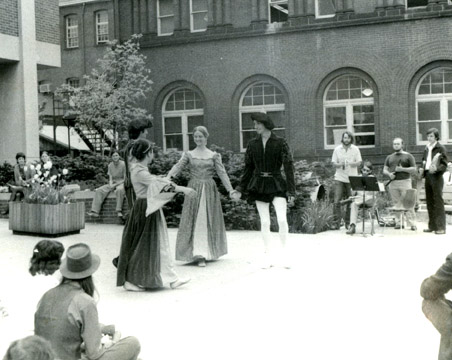
sign_rug_concert_dancingWe recently received from the School of Music a scrapbook of sorts kept by former Music Prof. Theron R. McClure, who started a series of free performances of chamber music in the Hopkins Hall Gallery he called “rug concerts.” The first concert was held in April 1974 – on the rug of the Gallery – and it featured lutes. No chairs were provided for concert-goers; they had to sit on the rug, which is another reason McClure came up with the name. When the weather warmed up, the concerts migrated outside to the Oval, and when the weather got cold again, the concerts returned to the indoor venue.

Dancers perform at the Rug Concert

Dancers perform at the Rug Concert

McClure told The Lantern in 1977 that he started the concerts because “material for several thousand concerts is just sitting on the shelves in the music department. These concerts provide an opportunity for this music to be performed.”

McClure joined the Music faculty as a part-time instructor in 1947 and he retired about the same time the concerts ended in 1979. In addition to his long career at Ohio State, he is credited with helping found the Columbus Symphony Orchestra, and he also served as a bassist in the Cleveland Orchestra. McClure died in November 2010 in Sarasota, Florida, at the age of 98. After his death, the School of Music received from his estate nine viols to enable students to be able to play a complete repertoire of music for early, period ensembles.

Older posts Newer posts