From Woody's Couch

Our Playbook on OSU History

Author: haire.14@osu.edu (page 7 of 13)

Gold-en Days of Summer Olympics Past – Part 5

Today we highlight the disparate sports of boxing and volleyball, in which the only thing in common seems to be the gold medals OSU athletes have won participating in them at the Olympics.

Although Ohio State students have pushed for boxing to be a varsity sport since the 1930s, it’s always been played on campus in intramurals and at a club level only. With the lack of support from the university, it may be surprising, then, to discover three gold medal winners from OSU’s past. Since no early records for the sport remain, though, little is known about these athletes’ participation in this sport on campus.

Charles Adkins won gold at the 1952 Helsinki Games in the light welterweight division. The win was especially memorable because it was the first boxing match between the United States and the then-Soviet Union. Adkins went on to a professional boxing career and decided to return to college to finish his education. Adkins graduated in 1974 with a bachelor’s degree in Education.

Nathan Brooks was a teammate of Charles Adkins at the 1952 Helsinki Games. Brooks boxed in the flyweight division and defeated Edgar Basel of Germany to claim his gold medal. Before the Games, Brooks was a history major at OSU but withdrew to continue boxing professionally.

Aldis Berzins, 1977

Jeremy “Jerry” Page participated in the 1984 Los Angeles Olympic Games as a light welterweight. His gold medal came with a win over Dhawee Umponmaha of Thailand. According to Rusty Wilson’s book, The Ohio State University at the Olympics, ABC announcer Howard Cosell described the match as one of the greatest fights he had seen. Page also pursued a professional career in boxing and never graduated.

Unlike boxing, which has never achieved varsity status at OSU, men’s volleyball has been a varsity sport since 1968. During that time it has had more than thirty All-Americans, and has logged more than twenty Midwestern Intercollegiate Volleyball Association and NCAA Championships, including its latest NCAA title in 2011.

Ohio State’s team yielded three Olympic gold medalists on the 1984 Los Angeles team:

Aldie Berzins, a Latvian-American, preferred to play soccer and even earned a scholarship to play at Penn State, according to Wilson’s book. He decided to attend OSU, though, because five other Latvians were on the team. The Buckeyes used their mutual heritage to their advantage and spoke Latvian during matches to conceal their plays. While at OSU Berzins helped lead the team to four straight MIVA championships and four appearances in the NCAA Final Four. In 1978 Berzins earned his bachelor’s degree in Astronomy.

Marc Waldie, 1977

At the 1984 Los Angeles Olympics, Berzins won a gold medal with fellow Buckeyes Richard Duwelius and Marc Waldie, and OSU coach Doug Beal. Berzins went on to play professionally in Italy and returned to the United States after retiring. Berzins had three sons, all of whom followed in his footsteps and played volleyball. His one son, Mik Berzins recently graduated from The Ohio State University and helped to lead the volleyball team to the 2011 NCAA National Championship. Aldie Berzins was inducted into The Ohio State University Athletic Hall of Fame in 2002.

When Richard Duwelius arrived at OSU, he had earned a spot on the basketball team but decided he would try volleyball instead. Playing with Aldie Berzins and Marc Waldie, he helped the team make it to the 1977 NCAA Championships. Duwelius graduated in 1977 with a Bachelor of Science degree in Chemical Engineering.

After winning a gold medal at the 1984 Los Angeles Olympic Games with his fellow Buckeyes, Duwelius went on to play professionally in Italy.

Marc Waldie also played on the 1977 team and went on to play for the U.S. team where he was captain from 1982 through 1984. Waldie graduated in 1981 with a Bachelor of Science degree in Health, Physical Education and Recreation.

After Waldie finished playing volleyball, he became involved in real estate development in California. In 2001 Waldie was inducted into The Ohio State University Athletic Hall of Fame.
Gold-en Days of Summer Olympics Past: Part 4

What an Olympics so far!  Today we will highlight three more former OSU Olympians: two synchronized swimmers and a rower.

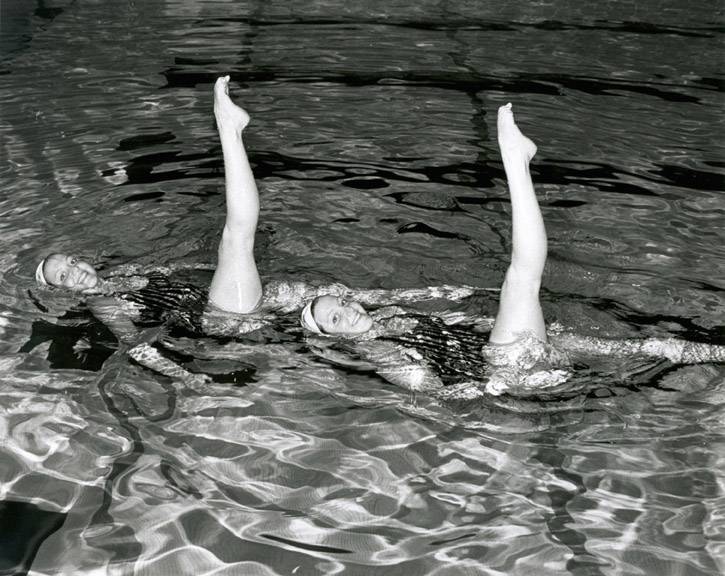
Karen and Sarah Josephson, 1984-1985

Synchronized swimmers – and twin sisters – Karen and Sarah Josephson have worked together in the pool from an early age.  Karen discussed the beginning of the dynamic duo in a 1988 Lantern interview, sayng they began competing together at age six and started in the sport because there was a local team in their hometown.

According to the OSU Alumni Magazine, while at OSU in the early 1980s, Sarah and Karen earned varsity letters for four years, helped take the team to three national championships, and each received individual honors: Karen received the USSSI Collegiate Athlete of the Year, and Sarah earned the Ohio State Female Athlete of the Year.

The sisters graduated from OSU in 1985 and went on to participate in the 1988 Seoul Olympic Games, where they won a silver medal in duet synchronized swimming. In 1992 they returned to the Olympic Games and received four perfect 10’s to win the gold medal. Karen and Sarah were named to The Ohio State University Athletic Hall of Fame in 1993, with the first class of women athletes.

The Josephson sisters arose from a team that has long history of winning at The Ohio State University.  Synchronized swimming became an NCAA-sanctioned sport in 1977, according to The Lantern, but the Buckeyes can trace their history back to the 1930s. Winning more than twenty collegiate championships, the synchronized swimming team is one of the most decorated teams on campus.

Like synchronized swimmers, experienced rowers know how to mirror their teammates exactly to move flawlessly through the water. Ironically, Bryan Volpenhein did not have much experience when he took up the sport of rowing at OSU. Rusty Wilson’s book The Ohio State University At The Olympics discusses Volpenhein’s beginning in the sport as somewhat of a fluke.  Volpenhein says he saw a flyer for the OSU Crew Club, went to a meeting, liked the team and coaches, and thus began a successful career as a rower.

Bryan Volpenhein, 2004, (Photo from OSU Alumni Magazine)

In 1998, he began rowing for the United States national team, and he later participated in three Olympic Games: the 2000 Sydney Games, the 2004 Athens Games, and the 2008 Beijing Games. A member of the men’s eight, he won gold in 2004 and bronze in 2008. In 2002, (and between Olympic appearances), Volpenhein earned his Bachelor of Arts degree in Philosophy.  In the fall of 2004, the OSU Crew Club named a boat after him, according to Wilson.

Sometimes called rowing and sometimes called crew, this sport has made its mark at Ohio State. The Ohio State University Crew Club was founded in 1978 and is open to both men and women. It  started with a boat and four oars borrowed from the University of Nebraska, according to its web site, and it has depended on private support to keep the club going. OSU women rowing athletes now have a varsity team sponsored by the athletic department. Over the years the athletes have competed in numerous regattas and Big Ten events.

As we continue looking back at past Golden Buckeyes throughout this week, the University is also following the current OSU Olympians.


An ode to OSU’s First President and No. 1 Geology Fan

In the early days,  OSU’s yearbook, the Makio, did not include photos, only illustrations to go along with annual updates on the classes and student organizations. It was seen more as a literary publication, which meant there also was plenty of fiction inside, including poetry.

Today, to celebrate “Poetry in Your Pocket Day 2012” (April is National Poetry Month), we decided to find a short OSU-related poem we could share with you from an early Makio, in case you’re desperately looking for something you can stick in your back pocket as a way to honor the day.

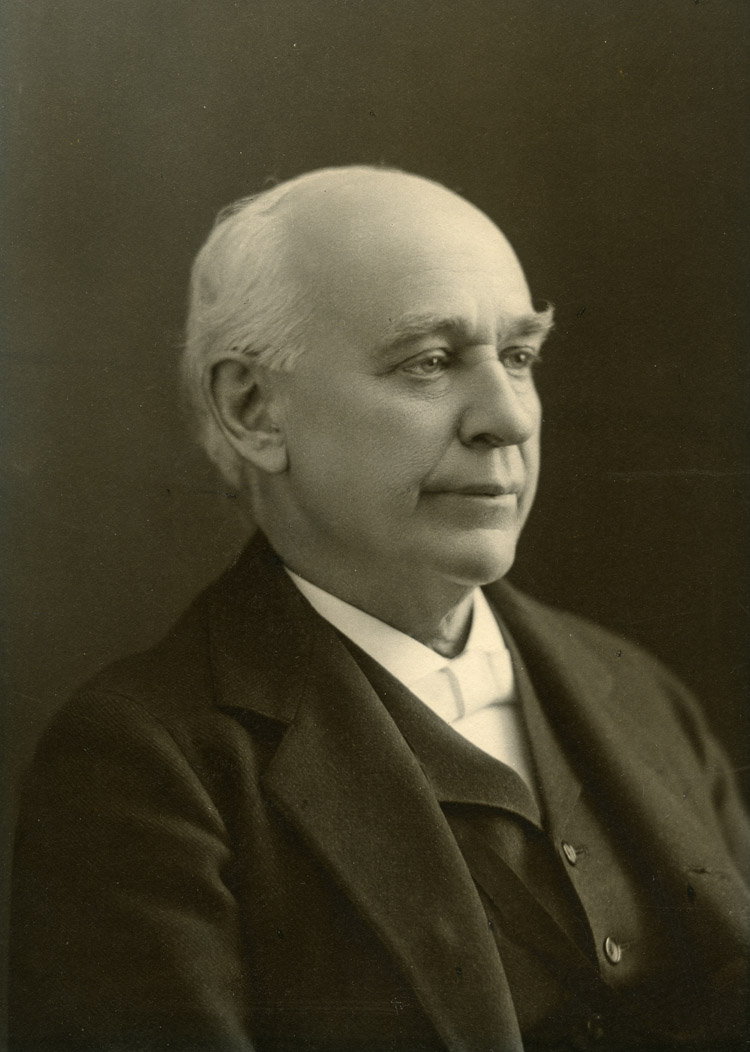
Portrait of Edward Orton Sr., 1890

Our selection comes from the second issue of the Makio – 1882 – which also happened to be the year after OSU’s first president, Edward Orton Sr., ended his tenure in this role.

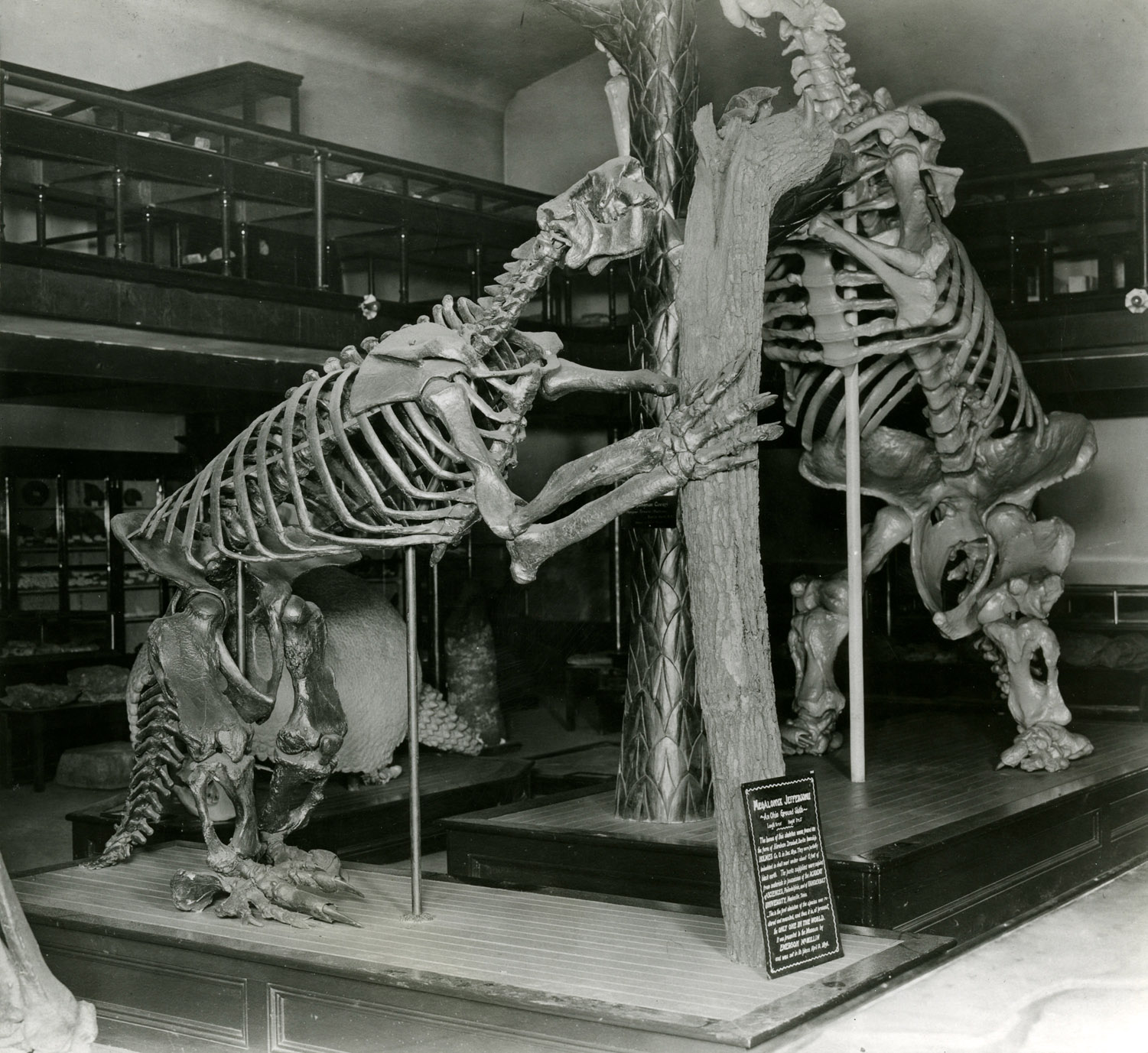
While president, he also served as chairman of the Department of Geology, and after his presidency, he served as state geologist until his death in 1899. After his presidency, he witnessed the construction of a building to house the geology department, which resulted in the aptly named Orton Hall in 1893. The building not only housed the geology department, but also a geology museum, which was started with a gift from Orton of his own collection of 10,000 geological specimens.

Skeleton of ground sloth, no date

For the geology building, Orton encouraged the use of stone native to Ohio, and in fact, the exterior stone is composed of 40 varieties of Ohio stone, placed in the order in which they appear in the bedrock. Instead of mythic gargoyles surrounding the top of the tower, there are carvings that represent various prehistoric animals,  and inside above the pillars in the vestibule, there are carvings of fossils dating from the time when Ohio was under a vast warm, shallow sea.

Are you beginning to see a theme here?

So, among the poetic “Faculty Pokes” on page 89 of the 1882 edition of the Makio, the editors have some fun with their beloved ex-president’s passion for geology:

“I conned the rocks with anxious eye,

A student meek and docile;

When a distant whisper floated by,

Oh, come and be a fossil!”

Orton Hall Tower, featuring carvings of prehistoric animals, 1982

Older posts Newer posts