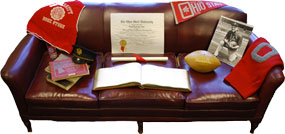
From Woody's Couch

Our Playbook on OSU History

Author: drobik.5@osu.edu (page 50 of 62)

Spring is in the air: Evolution of the Oval

University Hall, 1897

It may come as a surprise to many, but the Oval was not in the original campus design. It was, as Shakespeare would have put it, a happy accident.  The original campus design was that of an English country manor: University Hall was set on the highest point, and a long curving drive ran diagonally across what is now the Oval towards present-day Page Hall, where the drive met High Street.  It was not until the 1890s – some two decades after the University opened – that the Oval began to take shape.

In 1890 the second chemistry building (the first had burned down, and yes, the second one also would  fall victim to fire) was built on the site of Derby Hall. In 1891 construction began on both Hayes Hall and Orton Hall. The Botany Building already stood on the site of the Faculty Club. So the North and South sides of the Oval were beginning to take shape. It should also be mentioned that several of the faculty members had homes on the grounds, including one that would have stood on the Oval today.

In 1893 the master plan proposed by Captain Herman Haerlin was the first to propose an open space on campus with no roads running through it. However, this space was described as a “quadrangle.” This plan was further aided by the completion of several new buildings: Townshend Hall, Biological Hall (on the site of Hagerty Hall), and the Armory. The roads on the North and South sides of the space were changed to connect all of the buildings, so now there were two roads linking High Street and Neil Avenue in a roughly circular shape.

In 1901 the end of the Oval closest to High Street was reshaped, giving it a more curved appearance, and making the Oval an oval. The diagonal drive that cut across the space was removed in 1912, the same year the Thompson Library was completed.

So, the Oval has changed little since 1901, which largely explains how it got its name. The first reference to “the oval” came in 1910. From 1912-1913 it was usually referred to as “the campus oval.” From 1913 to 1920 it was back to “the oval.” Note that it was not capitalized until 1920.

Oval, 1916

The Oval, prior to the Long Walk, 1913


In 1914 many of the walks on the Oval were repaved, and it was at that time that the Long Walk was constructed (the “long walk” was first mentioned in 1919 and capitalized, also beginning in 1920). Another major transformation occurred in the 1970s: the roads around the Oval were made pedestrian-only walkways. This explains how you can now walk out the front doors of University, Bricker, Orton, and Hagerty Halls without getting hit by a car.

Filed by C.N.

Trip to the Final Four a familiar journey for Buckeyes

Basketball team after their National Championship victory

Overall, Ohio State has played in nine Final Four tournament games (not including the game tomorrow or the 1999 game vacated by the NCAA). Pretty impressive, huh? Here’s the breakdown:

  • The first NCAA tournament in 1939 featured Ohio State versus Villanova University in the Final Four matchup. Ohio State defeated Villanova to move on to the championship game versus the University of Oregon. Unfortunately, the Buckeyes lost that game, 46-33.
  • In 1944 the Buckeyes played their first of three consecutive Final Four games. That year, they lost to Dartmouth University, 60-53.
  • The following year Ohio State again lost in the semifinals to New York University, 70-65.
  • The 1946 tournament had Ohio State losing another Final Four game, this time against the University of North Carolina, 60-57. OSU did, however, play a third-place game, in which the Buckeyes beat University of California, 63-45.
  • In 1960 Ohio State defeated NYU, 76-54, on its way to winning the National Championship.
  • During the 1961 and 1962 seasons, Ohio State returned to the Final Four, defeating St. Joseph’s University, 95-69, and Wake Forest University, 84-68, respectively.
  • The Buckeyes returned to the Final Four in 1968, losing to North Carolina, 80-66, but once again winning a third-place game against the University of Houston, 89-85.
  • The last official Final Four appearance came in 2007 with a win over Georgetown University, 67-60.

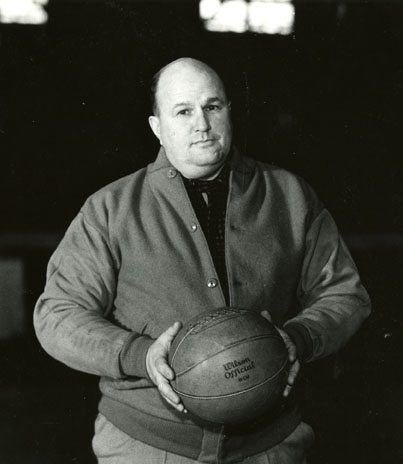
Harold Olsen, 1935

And one more quick fact about the NCAA tournament and Ohio State:

Did you know Ohio State’s longest tenured basketball coach, Harold G. Olsen, played a pivotal role in the creation of the NCAA Men’s Basketball Tournament? While head coach at Ohio State (1922-1946), Olsen organized a push for a postseason national playoff tournament. The first year of the tournament featured eight teams, including Ohio State, and was played at Northwestern University.

Olsen led the Buckeyes to four Final Four appearances during his tenure as head coach. Olsen also led the Buckeyes to five Big Ten Championships in 1925, 1933, 1939, 1944, and 1946. As president of NABC (National Association of Basketball Coaches), chair of the NCAA Basketball Committee for eight years, and a member of the 1948 Olympic Committee, Olsen earned a place in the Naismith Memorial Basketball Hall of Fame.

Tracking the early history of African-American fraternities at OSU

Patrons sometimes are baffled that we don’t know the exact chronology of certain individuals, organizational entities or student groups on campus. They wonder aloud, “Haven’t you made a list?”

And the answer usually is, “No, we haven’t.” We’re archivists, so we’re very busy collecting, organizing and preserving our materials. We rarely have time for research; we rely on our patrons for such things.

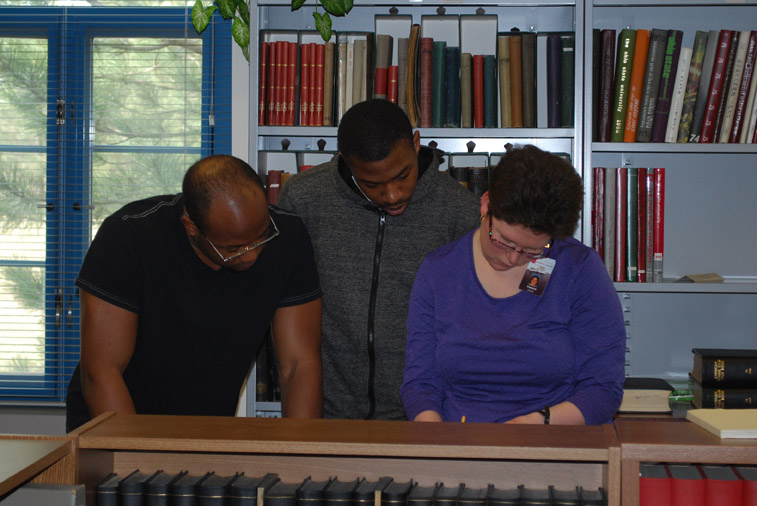
Keith Johnson and Herman Jones Jr. work with University Archivist Tamar Chute

Such was the case when two students – Keith Johnson and Herman Jones Jr. – walked in one afternoon looking for information about the first African-American fraternity on campus. They didn’t assume we had a list; we’re pretty certain they had no expectations at all. But what a find they ended up making to add to our chronology of African-American Greek life on campus.

They had in their hand a book called Black Greek 101: the culture, customs and challenges of Black fraternities and sororities, by Walter M. Kimbrough (2003). Inside was a comment from the author citing a 1906 article in The Chicago Defender about a new African-American fraternity at OSU called Pi Gamma Omicron. The two students’ professor had posed a challenge to them and their classmates: Anyone who can find evidence of this group here at OSU gets extra credit.

Unfortunately, there is little evidence left of student groups at Ohio State from the time that Pi Gamma Omicron was founded. This means the Archives has very little information about African-American Greek Life from this period. The Alpha Phi Alpha fraternity’s web site states that it was chartered at Ohio State in 1911, although the earliest reference of the fraternity here at the Archives is 1918. The Archives also has found references dating back to 1919 of another African-American fraternity, Kappa Alpha Psi, as well as the African-American sorority, Delta Sigma Theta.

So when Herman and Keith told us what they were seeking, we weren’t sure we would be able to help them.

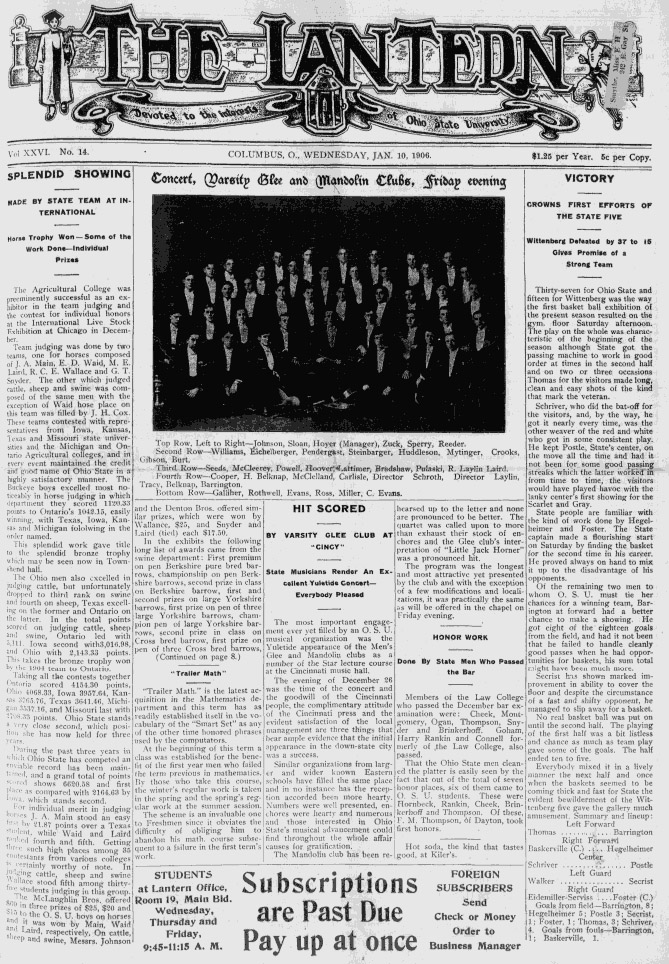
Lantern cover, 1906

This is where technology comes in: Recently, the OSU Libraries digitized the full run of The Lantern, OSU’s student newspaper. Every issue from 1881 through 1997 is now available in a searchable database. (The Lantern’s online archives can be found as a link on the right-hand side of our home page at go.osu.edu/archives.) So after looking through our paper records here at the Archives and finding nothing, University Archivist Tamar Chute decided to try The Lantern’s online archives. And there, she found it. (Click here to see the story.)

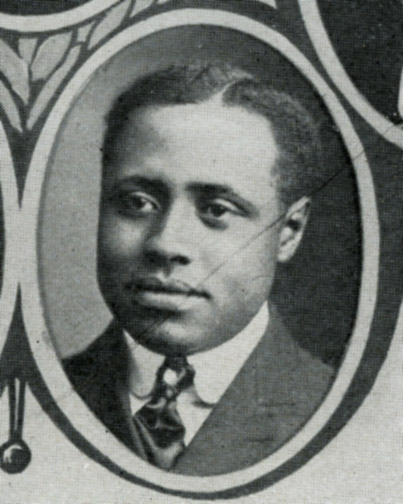
W.E. Davis, 1908


A story in the Jan. 10, 1906, issue said that a new fraternity called Pi Gamma Omicron had been founded, and it listed all of the founding members’ names. Herman and Keith had discovered the evidence they needed to show their professor that the book citation was correct. But they wanted to know more – who were these founding members?

This is where our patrons help us out tremendously in our reference service. The Archives has a copy of a 1983 dissertation by Pamela Pritchard, “The Negro Experience at Ohio State University in the First Sixty-five Years, 1873-1938,” in which she had compiled a list of African-American OSU graduates from 1892 to 1950. Some of the founding

Elmer Shackelford, 1906

members of Pi Gamma Omicron were listed in the dissertation – W.E. Davis and Elmer Shackelford – and we were subsequently able to find their graduation photos. (Pritchard’s dissertation lists Shackelford as the first African American at OSU to earn a certificate of law – then the equivalent of a law degree.)

With the other fraternity members, we were able to find how long they attended OSU, what their majors were, where they lived and some of their extracurricular activities. (See the list here.)

Near the end of their afternoon of research, one of the students said, “I’ve never had so much fun doing research in my life.” We were very proud!

Herman and Keith later made a class presentation, which we were very happy to attend, after which they received not only extra credit but applause from the entire class and their professor.

It might seem like a small thing to have found just one article about a fraternity; after all, we don’t have any evidence – at least, yet – of how long Pi Gamma Omicron was on campus. But every such find pieces together the historical puzzle of this University’s past. We thank Herman and Keith for their research, copies of which we’ve placed among our reference materials so future patrons can build on it. Who knows what else they might find?

Keith Johnson and Herman Jones Jr. pose with the book that started it all: "Black Greek 101"


Older posts Newer posts