From Woody's Couch

Our Playbook on OSU History

Author: drobik.5@osu.edu (page 36 of 63)

Twelve Days of Buckeyes: Six who’ve attended OSU have led as Ohio’s governor, too

John Bricker, 1916

John Bricker, 1916

The list of high achievers who have attended OSU is incredibly long, so today we focus just on those six who have reached the pinnacle in Ohio politics – the governor’s office.

John W. Bricker received his bachelor’s degree in 1916 and his law degree in 1920, demonstrating along the way how active he would later be in politics: He was a member of the political science club, on varsity debating team and baseball team, a member of Varsity “O,” class president his junior year, chairman of the senior memorial committee, YMCA president and a member of the senior honorary, Sphinx.

After he received his law degree, Bricker went into politics. Among the high offices he held were Ohio Attorney General, Ohio Governor (three two-year terms) and two terms as U.S. Senator. He also served as the Republican nominee for Vice President in the 1944 presidential election between Thomas Dewey and Franklin D. Roosevelt.

He was a member of OSU’s Board of Trustees from 1948 to 1969, serving his last year as chairman. Because of his long service to the University, the former Administration Building was renamed for him in 1983.

Thomas J. Herbert didn’t graduate from OSU, but he did attend the University’s Ground School training program during World War I. Before he was elected governor, Herbert served as Ohio Attorney General. After the end of his single-term governorship, President Dwight Eisenhower appointed him chair of the federal government’s Subversive Activities Control Board, an agency formed to hear testimony regarding charges of communism in the U.S.

Though Herbert didn’t receive an academic degree from OSU, his son, John D. Herbert did graduate from OSU in 1949. Another son, David J. Herbert, followed his in his father’s political footsteps and served as state treasurer for three terms.
John Kasich

John Kasich

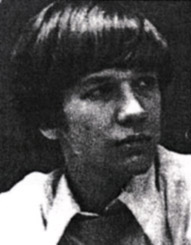
John Kasich, Ohio’s current Republican governor, has had much more success running for state and national offices than he did when he was a student at Ohio State. He ran twice for president of the Undergraduate Student Government, but was defeated both times. He protested the second election, citing voting irregularities, but nothing came of his appeal. He graduated in December 1974 with a bachelor of arts degree in political science.

At age 26, Kasich became the youngest person ever to be elected to the Ohio Senate; he then ran for U.S. Congress and ultimately served nine terms. From 2001 to 2009, Kasich served a number of roles as a private citizen, including as a host of “Heartland with John Kasich” on the Fox News Channel. In 2010, he ran for governor, defeating then-incumbent Ted Strickland.

C. William O’Neill actually began his political career while attending OSU’s College of Law. Before entering law school, he had campaigned for other Republican candidates, but in 1938, he decided to campaign for himself, for a seat in the Ohio House of Representatives. Winning the election made him the youngest General Assembly’s youngest representative, at age 22. A member of Phi Beta Kappa while in school, he earned his law degree in 1942.

During a 40-year political career, O’Neill lost only one race – the gubernatorial election of 1958. But he more than made up for that one loss, ultimately becoming the only person to serve as Ohio’s Supreme Court Chief Justice, Governor, Speaker of the House and Attorney General. He died after a heart attack in 1978 while serving as Chief Justice. At that time, he also was serving on the OSU Alumni Association’s Board of Directors as immediate past president.

Governor Rhodes, 1969

Governor Rhodes, 1969

James Rhodes only briefly attended OSU in the mid-1920s before he had to drop out to help support his family, according to the alumni magazine. His first election victory came as Republican ward committeeman in Columbus, thus beginning a long political career in the state capital. His highest office was as Ohio Governor – for four terms, making him one of the longest-serving governors in U.S. history.

Though Rhodes is remembered for sending the National Guard to quell student protests on various Ohio campuses, including OSU (on May 4, 1970, four students were shot to death by Guardsmen at Kent State University), he is also credited with developing a network of community and technical colleges around the state to increase opportunities for vocational education.

Rhodes also promoted OSU as a major center for medical training and research; in 1976, the Rhodes Hall addition to University Hospitals was named after him.
George Voinovich, 1961

George Voinovich, 1961


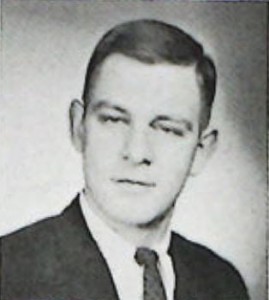
George Voinovich graduated in 1961 with a law degree from The Ohio State University. He got his start in political leadership roles while still on campus, serving as president of both his class and the campus Young Republicans.

After graduation, Voinovich went on to serve the state of Ohio in a wide variety of offices as a state representative, as Lieutenant Governor under fellow Buckeye James Rhodes, as the Mayor of Cleveland, the Governor, and, most recently, as U.S. Senator. His 2004 Senate victory was won by a landslide with all 88 Ohio counties selecting him to serve.
Not so long ago, in an OSU engineering lab nearby…

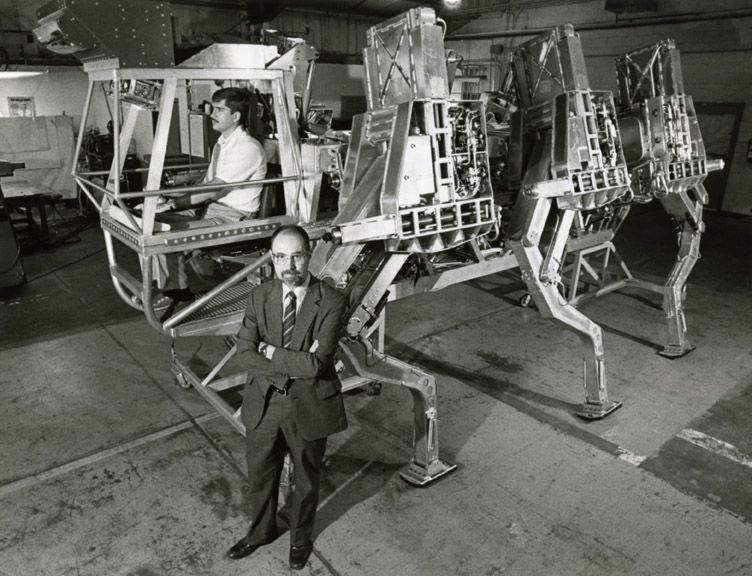
What do you get when you combine 20 years of research, $5 million, and a Star Wars Imperial all-terrain vehicle? Ohio State’s Adaptive Suspension Vehicle (ASV), nicknamed the “Walker.”   Developed by electrical engineer Robert McGhee and mechanical engineer Kenneth Waldron, along with a 60-member team of students and technical assistants, the ‘Walker’ was developed under a research contract from the Defense Advanced Projects Research Agency (DARPA).

Robert McGhee with the “Walker”, 1985

The ASV was 17 feet long, 8 feet wide, and 10.5 feet high, and had six legs to support its three-ton aluminum body.  It was designed to carry cargo for industrial and military applications over rough, mountainous, icy or muddy terrain, and was capable of crossing 9-foot-wide ditches or 7-foot-high walls.  A forward mounted radar system scanned the terrain ahead, and fed that data, along with instructions from the operator’s joystick, into the 16 onboard computers that coordinated and controlled the ASV’s legs. From there, the computers moved each leg individually across its individual axes of motion (up and down, forward and back, and closer or farther from the ASV’s body).

According to press clippings here at the Archives, McGhee, the developer, had long held an interest in the relationship between living creatures and machines, and the inspiration for the ASV came from the legs of a horse named Teddy he had bought for his daughter’s 10th birthday. Much of what McGhee learned from his time as an engineer and from Teddy went into the design of the ASV.

Research testing, 1986

After difficulties with cold-weather tests, DARPA began to lose interest in the ASV.  After failing to win a competition for an autonomous rover for NASA, Ohio State later began exploring the vehicle’s use in the logging industry. Unfortunately, that’s where the paper trail ends here at the Archives. If anyone knows the rest of the story, give us a shout!

Trimmings from the delicious OSU-Michigan rivalry

Michigan game action (from left to right), 1928, 1932, 1952

For more than 100 years OSU has been playing the University of Michigan in football, and from that long rivalry, the Archives has accumulated a lot of stories, from the mundane to the unexpected to the downright dangerous.

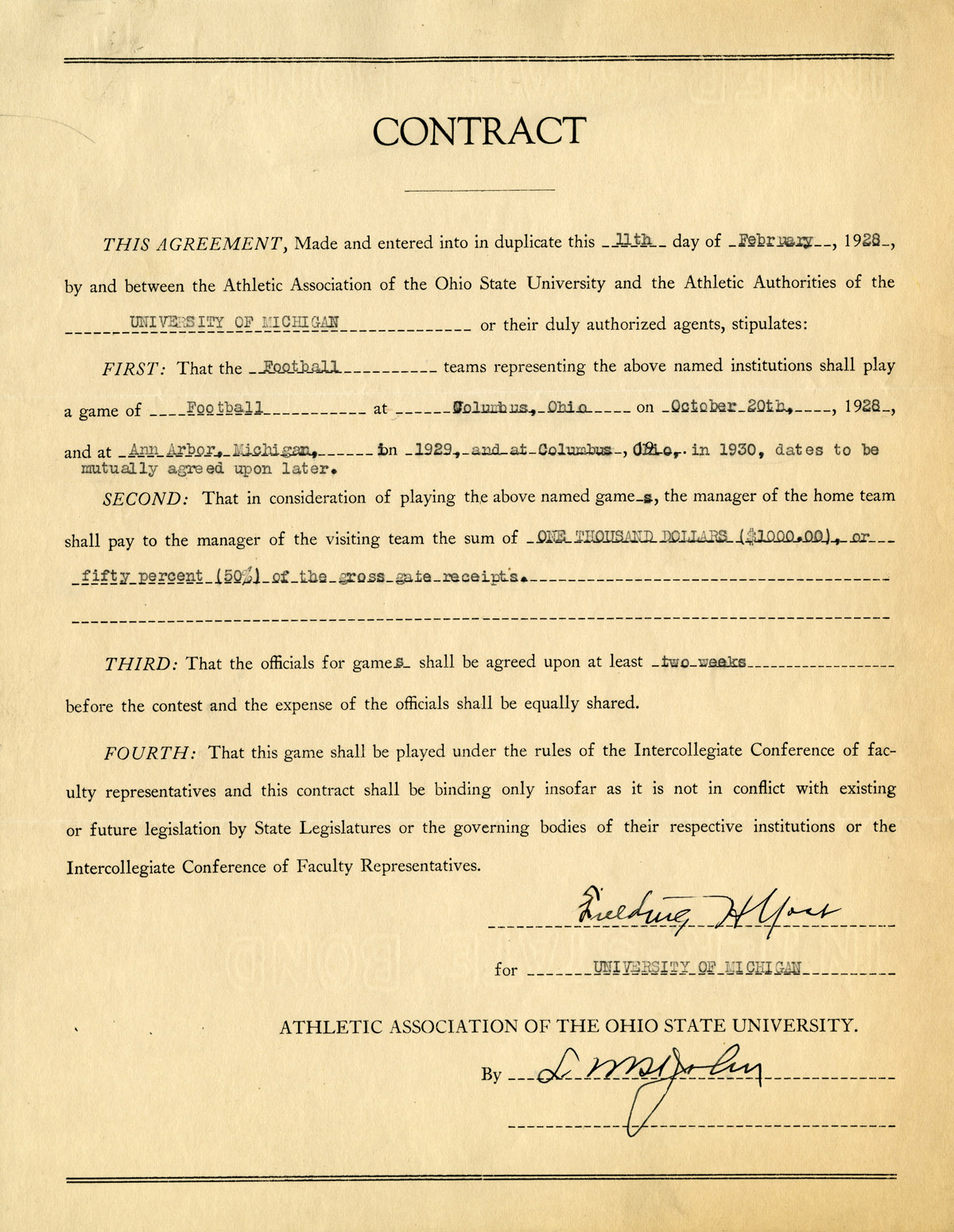
#1 – Contract, 1928

First the mundane: Click on the first image and you’ll see how the contracts outlining how gate receipts would be distributed looked in the old days. We particularly love the clause that starts: “THAT the Football teams representing the above named institutions shall play a game of football…” Well, what else were they going to play – water polo? But these things must be specific in order to be legally enforceable, we suppose. Can you imagine how such a contract might read today?

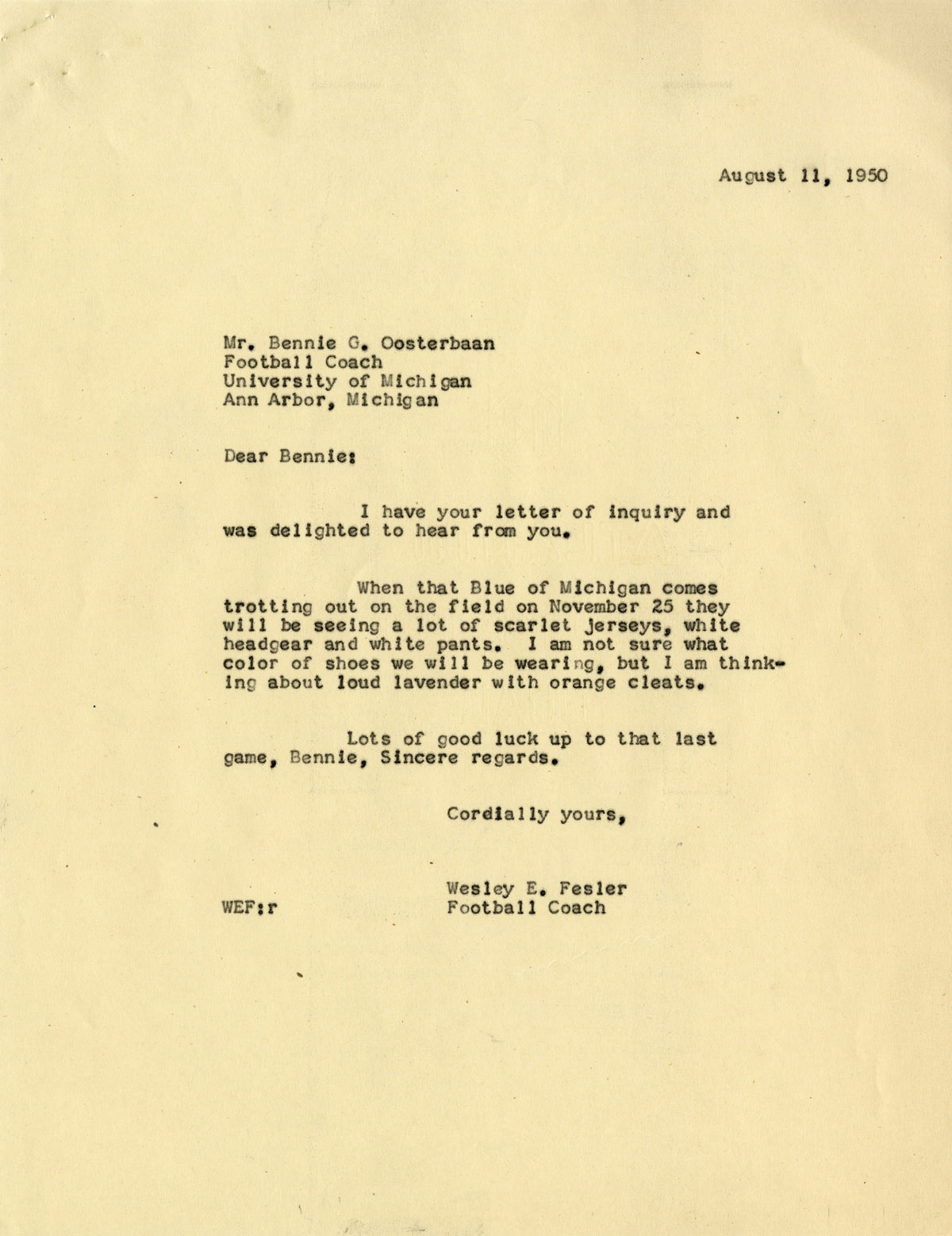
Now for the unexpected: Some of the game preparations by the coaches that were very ordinary for the time, would seem downright bizarre now. Today’s example is in a 1950 letter, (#2 on right), from then-OSU Coach Wes Fesler to then-University of Michigan Coach Bennie Oosterbaan, a letter that seemed quite lighthearted, considering it concerned the biggest game of what would be Fesler’s last season with the Buckeyes.

#2 – Letter, 1950

In any case, in the letter, Fesler describes the color of each article of clothing the OSU players will be wearing at the game. You might ask, why in the world would he do that? Remember that in 1950, television was relatively new, and programs were still broadcast exclusively in black and white. So each team’s uniform combinations had to contrast sufficiently enough with the other team’s for the home audience to be able to tell which team was doing what on the field.

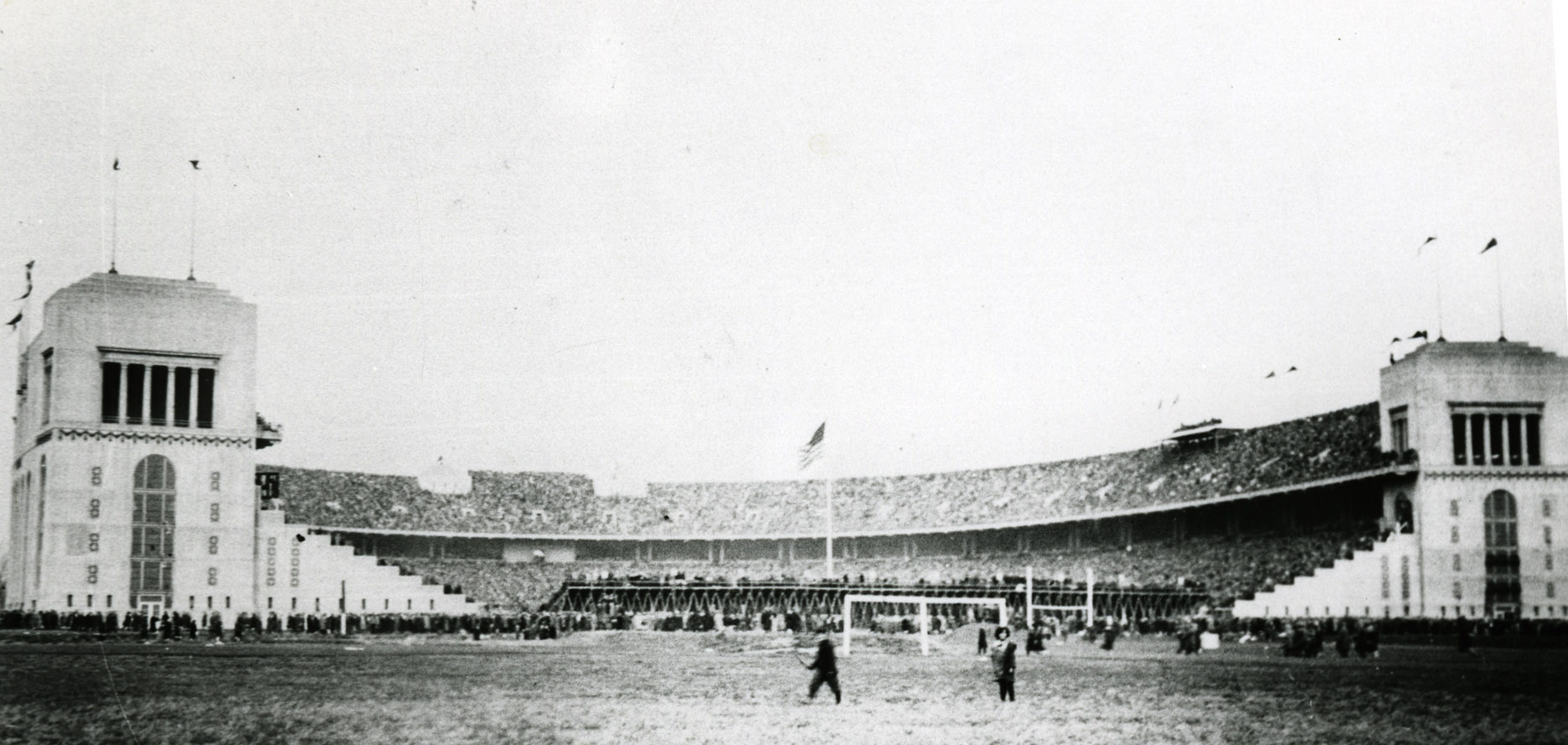
And now, for the dangerous: We all know the rivalry between The Ohio State University and “That State Up North” can become heated, but in 1926 the rivalry took a backseat to a dangerous incident in the stands. During the November 13 game, a defective pyrotechnic bomb was shot off by the military department. The shot was supposed to explode in the air and reveal a flag with Ohio State’s emblem; instead, it fell into temporary bleachers. Three people were seriously injured and remained in the hospital for an extended period of time, while several others experienced minor burns to their skin and clothing. The University reimbursed each spectator for his or her clothing and medical expenses, totaling more than $12,000.

The Stadium is shown here during the 1926 Michigan game. The temporary bleachers are in the foreground of the photo.

And the last item really has nothing to do with the OSU-Michigan game, but it does have to do with Thanksgiving weekend, and both teams were involved:

In 1931 President Hoover thought he would help tackle the unemployment issues of the day by asking colleges and universities to donate their profits to local charities from a football game played on Thanksgiving. According to athletic director Lynn St. John’s papers, the Western Conference schools were not in favor of scheduling charity games. Pressure was placed on the schools, however, and the decision was made to add extra games at the end of the 1931 season. A round-robin game between Chicago, Iowa, Indiana, and Illinois was scheduled for Thanksgiving Day at Staff Field in Chicago. The remaining teams played head-to-head on the Saturday after Thanksgiving: Northwestern versus Purdue, Wisconsin versus Michigan, and Ohio State versus Minnesota.

The Buckeyes, unfortunately, lost the game to the Golden Gophers and in doing so, lost a chance at a piece of the Western Conference title. The games did raise more than $137,000 for the unemployed, though, with more than $30,000 donated to the Ohio State Relief Commission.

Read more about the OSU-Michigan rivalry in our web exhibit:

http://library.osu.edu/projects/OSUvsMichigan/index.htm

Older posts Newer posts