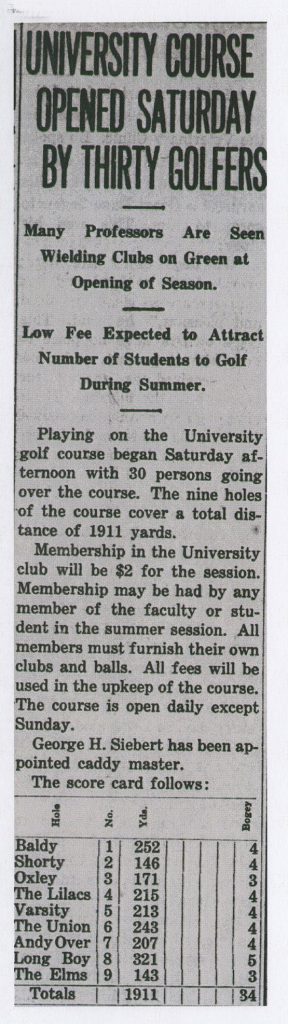
Lantern, June 30, 1920
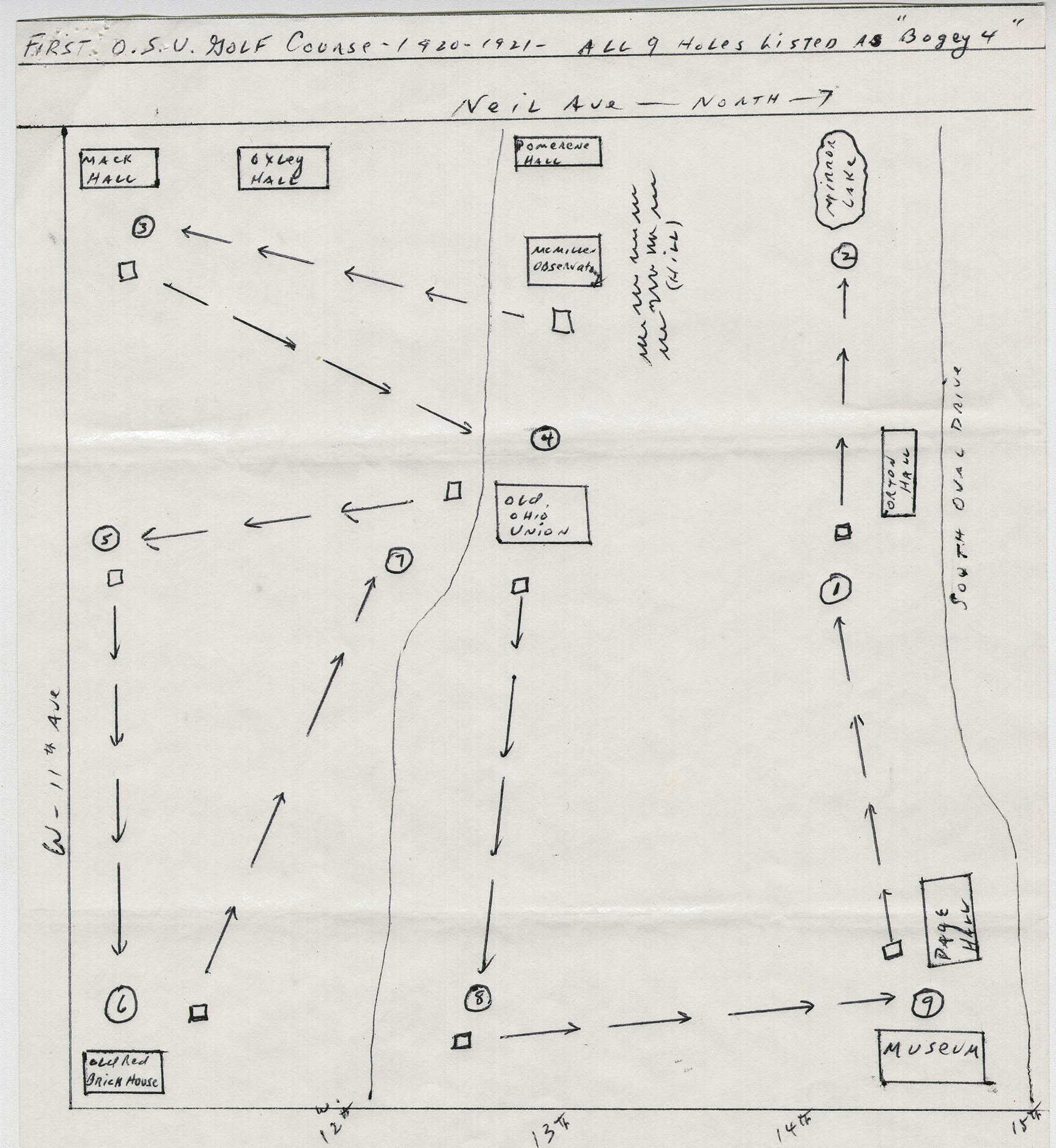
Today, Ohio State’s popular and renowned golf course sits about two miles from the Oval, but did you know there used to be a golf course a stone’s throw from the center of campus? Thanks to a detailed letter written by Howard E. Wentz in 1973, the Archives has a clue to the course’s existence.
In the summer of 1919, a series of articles appeared in The Lantern that suggested a peaked interest in golf among faculty and students alike. According to the student newspaper, spring and summer classes were offered to students that allowed them to learn about the technical game of golf, with subjects such as “the fundamentals, principles, and strokes.” At this point, Ohio State had already offered classes in different sports, such as baseball, tennis, swimming, and boxing—all of these subject areas already had designated practice fields. Until the summer of 1919, Ohio Field was the only practice area where golf students could swing. But that July, a five-hole course was proposed, a direct result of the interest displayed by the Ohio State student and faculty body.
A committee of three professors, Alonzo H. Tuttle, John W. Wilce, and Joseph S. Myers joined together to form the first Ohio State University Golf Club in 1919. The push for a new course became even stronger, as faculty and students could join the group for just two dollars. If a course were built, faculty could play Mondays, Wednesdays, and Fridays for two hours and 45 minutes, or 4:45 p.m. until 7:30 p.m.; students were permitted to play every Tuesday and Thursday. Only serious players were permitted, as they had a strict “no practice” policy during these days.

The University Golf Course as sketched
by Howard Wentz in 1973
The new University Golf Course opened on Saturday, June 26, 1920. Described in the Lantern as “in excellent condition” and “a wonderful opportunity for members of the faculty and students to participate in wholesome recreation,” the finished product had nine holes in total (as opposed to its initially proposed five holes) and a distance of 1,911 yards. Unfortunately, there is no information that describes the physical construction of the course, although the task was completed and overseen by Tony Aquila, the caretaker of Ohio Field.
In his series of letters in 1973, Howard E. Wentz describes his time as a young caddy at the University Golf Course. Wentz details the different types of people who played at the course during his summer:
“I recall many former notable O.S.U. professors and their wives whom I caddied for. Among them were Leonard Goss, Oscar Brumley, Howard Snook, George Eckleberry, Lou Morrill, Joe Taylor, Billy Graves and others.”
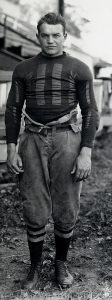
Chic Harley, 1919
Wentz also recalls being star-struck when OSU football star Chic Harley came to play. He recalled Harley having a golfing stance that was completely “unorthodox” but could easily “beat any of us kids at our own game.” In the same paragraph, Wentz discusses how Dudley Fisher, a famous cartoon artist for The Columbus Dispatch, frequented the course.
With no photographs of the course, the University Archives only has one map that exists solely from Wentz’s memory. There is, however, one cross-matched piece of evidence of the course: Both The Lantern and Wentz agree on the location of hole one, which was directly behind Page Hall.
There is no solid evidence to suggest when the golf course closed permanently, but a letter to then-OSU President William Oxley Thompson, published in The Lantern on March 1, 1921, states the course was still standing. However, there’s no information on the course after that letter.












Recent Comments