From Woody's Couch

Our Playbook on OSU History

Author: drobik.5@osu.edu (page 14 of 62)

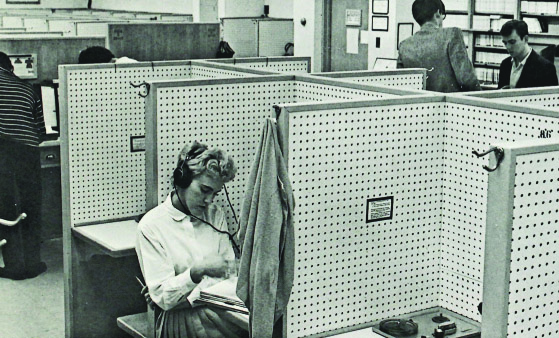
Languages, lectures or light operas – students could hear them all at the Listening Center

Student at the Listening Center, 1964

Student at the Listening Center, 1964

Back in the old days, students who wanted to learn a language or listen to music for class, had to go to one spot on campus – the Listening Center, located in the basement of Denney Hall. Created in 1960, the center held 150 booths with radio-style tuners. Students could tune into 11 “program channels” that were had the required listening assignments for various foreign language and music courses. Two years after its opening, roughly 5,000 language, speech and music students were using the facility each week, more than double the attendance of the year before.

In 1965 the Center premiered a dial-access phone system that allowed 40,000 calls a week to over 90 “channels” for homework and private study use. Other departments, including English, education and military science took advantage of the Center to teach students with recorded lectures and supplemental materials. At the time, students could dial in from an Instructional Material Center in Denney Hall, Cunz Hall, or the West Campus Learning Center.

Later that year, at a cost of $292,000, 118 new private listening booths were added in eight more locations on campus, including the Ohio Union, the Main Library and several dorms. In 1978, the University introduced an updated dial-access system that enabled students to dial directly into the Center from any telephone and listen to classroom assignments.

1963

1963

The Center’s first director was Prof. Paul Pimsleur, who transferred to OSU from the University of California at Los Angeles. Pimsleur was also a professor of Romance languages and taught applied linguistics, with an emphasis on language laboratories. In 1965, he was chosen as a Fulbright Professor of Applied Linguistics to teach at the then-new Speech Cybernetics Research Center at Heidelberg University in Germany. A frequent traveler to Europe, Pimsleur died on a visit to France in 1976.

– Filed by C.N.

OSU Extension celebrates 100 years of agricultural outreach


Original farm plots of the Agricultural Experiment Station.  This field was located north of the original University Hall, 1880s

This photo shows one of the original farm plots of the Agricultural Experiment Station in the 1880s. This field was located north of the original University Hall.

In 1914, Congress passed a law that created a system of cooperative extension services to be run through land-grant institutions like OSU. Enacted on May 8, 1914, it was called the Smith-Lever Act, and it aimed to inform people about current developments in agriculture, home economics and related subjects. Officially, OSU’s Ohio Cooperative Extension Service was founded when the law went into effect, but OSU had been reaching out to the state’s residents long before that time with useful research and information.

In 1881, the University became the home of the Agricultural Experiment Station (now known as OARDC in Wooster), where faculty conducted research and studied methods that would be passed onto the state’s agriculture community. Then, in 1895, students at Ohio State formed the Agricultural Students Union, tasked with encouraging cooperative research and demonstrations of new technology for the public.

A.B. Graham, 1911

A.B. Graham, 1911

In 1902, OSU alumnus A.B. Graham founded the first 4-H Club in Springfield. At that time, he also was working with OSU and the Ohio Agricultural Experiment Station at Wooster to test seed varieties and various agricultural methods. In 1905, OSU created the position of superintendent of agricultural extension for Graham, nearly ten years before the federal law was enacted establishing cooperative extension services.

This postman prepares seeds to be mailed to agricultural clubs in Ohio, (1906).  This project was initiated by A.B. Graham and utilized the Agricultural Extension Service.

This postman prepares seeds to be mailed to agricultural clubs in Ohio, 1906. This project was initiated by A.B. Graham and utilized the Agricultural Extension Service.

In 1912, OSU’s extension service took to the rails by making a 100-day tour on the New York Central Railroad. The aim was to reach small farming communities. There were multiple train cars, one for lectures and at least one other for demonstrations involving crops or livestock. They also distributed seeds and literature. At this time there were also extension agents in place in each of the counties, running youth programs, giving farm demonstrations, and providing information back to the University regarding problems with crop health and possible solutions.

An Ag. Extension Agent works talks with a farmer, 1976

An Ag. Extension Agent talks with a farmer, 1976

Now known as the OSU Extension Service, the program has changed over the years. Originally a key resource for farmers, it still plays a big role within the agricultural community but now aims some of its services at more urban targets. Need gardening advice on which plants to use, which varieties of vegetables to plant, or how to can the vegetables once harvested? The extension service can help. Have a problem with rogue geese or other wildlife? The extension service can offer some tips. The extension also helps support such programs as 4-H, and has formed coalitions with urban gardening organizations, as well as the energy and agricultural industries to support new farming technologies and improve the environmental impact of such industries.

For more information on OSU Extension go to: http://extension.osu.edu/.

Commencement speakers talk of tough world grads head out to tackle

1968 graduates

1968 graduates

Broadcast journalists and commentators have a national stage from which they share information and sometimes opinions on the world. Some of them have traveled to OSU over the years to give their thoughts on current news and events on a different stage – the one temporarily raised on Ohio Stadium’s football field for Spring Commencement.


The first to visit Ohio State was none other than then CBS News Anchor Walter Cronkite, who spoke at the June 1968 Commencement. It was a dark period in the nation’s history – the Vietnam War was escalating, Martin Luther King Jr. had been assassinated in April of that year, and just three days before Commencement, Robert Kennedy Jr. was shot and killed as well. Not surprisingly, Cronkite’s comments reflected the national mood:


Walter Cronkite, 1968

Walter Cronkite, 1968

“There are a lot of things wrong with this world. We can scarcely stand here in the shadow of the tragedy that has overwhelmed us, without acknowledging that there is a great deal wrong. … Violence and the most cowardly of crimes – assassination – are high on the list. But the list is so long of real or alleged wrongs: …”


He then went on to list a long litany of depressing aspects of the then-current affairs, then shifted to why there was so much student dissent and questioned whether it would have a positive outcome. After all of that, Cronkite, who was speaking to thousands of young people facing an unknown future, apparently decided he should somehow lift their spirits in the end:


“…while the challenges of today seem frightening in their complexity, there is no reason for despair. The more and the greater the challenges, … the more exciting the prospect of the combat and the sweeter the taste of victory.”


Barbara Walters, 1971

Barbara Walters, 1971

In 1971, Barbara Walters, who will retire this month after a 38-year career in broadcast journalism, decided to tackle just one of the many issues Cronkite discussed: women’s rights. “There is work to be done to improve and equalize the status of women in education, occupation, salary, property rights and marital laws. …,” she said. At the time, she determined that the women’s liberation movement had accomplished much of what it set out to do and the need to continue the debate was not that great:


“We are the women in our thirties and forties who are saying, ‘Is that all there is?’ You [the female graduates] are not, need not, and probably will not ever have to ask that question. You can work or not as you wish … marry or not … have children or not… without being condemned in any way by society.”


Of course, forty-plus years later, that debate still rages on. (For example: “Lean In” by Sheryl Sandberg, chief operating officer of Facebook, a manifesto for working women, was met with a great furor when it was published last year.) So it would be interesting to see what the Barbara Walters of today thought about her speech in 1971.


Erin Moriarity, 2004

Erin Moriarty, 2004

In 2004, Erin Moriarty, a CBS News correspondent, also listed the various ills facing the world – it was, after all, only three years after the terrorist attacks of Sept. 11, 2001 – but she told graduates that they could overcome the many obstacles facing them by embracing their “inner Buckeye.” An OSU graduate herself, she listed the many terrifying stories she had covered during her career, but said that the risks were worth taking. Then she did something unexpected: She told graduates to turn off the TV.


“What I mean is don’t live your life as a spectator who changes the scenery with a click of that remote control … Don’t be a ditto head, think for yourself. Here at Ohio State you have learned how to learn. Use those skills to educate yourself. Knowing you have those skills, don’t be afraid to take some risks. … And never forget where you came from.”


Naturally, Moriarty ended her speech with “Go Bucks.” Four years later, NBC News Anchor Brian Williams began his with “O-H.” And his speech was peppered with jokes (mostly about the University of Michigan) and other moments of levity. Like Cronkite fifty years earlier, though, Williams talked about how broken the nation was. “We need you to fix this country,” he said.


He then went on to talk about the then-117 million blogs being written on a regular basis and how most of them were about the people writing them. “And the problem is, we need to start talking about us, all of us. We need to start thinking of us as the collective, the United States we used to know. It is going to require a lot of work.”


He said, though, that the soon-to-be OSU graduates would be up to the task.

“And ladies and gentlemen, members of this graduating class, members of graduate studies, wherever you go, please tell them you’re a Buckeye. There is nothing wrong with America that someone from Ohio State can’t fix.” 


For a list of these and other commencement speeches, and links to their texts, visit:


http://library.osu.edu/find/collections/the-ohio-state-university-archives/buckeye-history/commencement-addresses/

Older posts Newer posts