

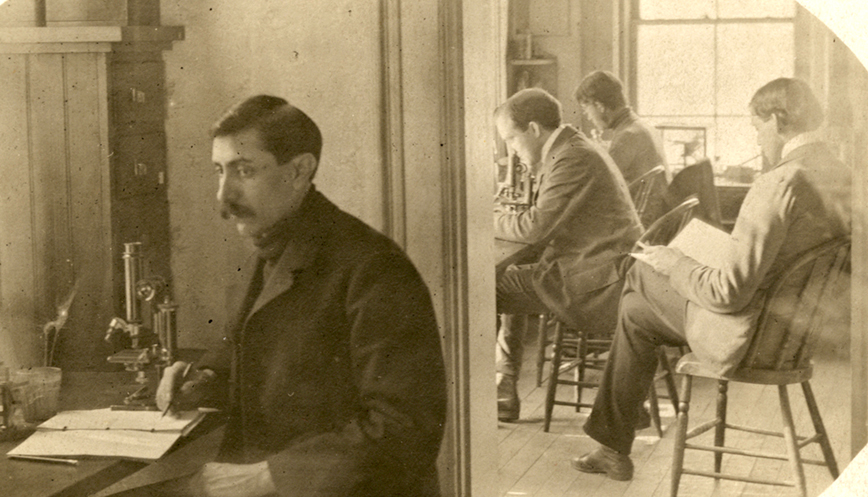
By the time this Botany class was held in the early 1900s, students would have still been receiving an “M” for passed with merit through an “F” for failed.
Recently, a patron asked us why in the world OSU issues an “E” instead of an “F” for a failing grade in a class. So we investigated, and here is what we discovered:
When the university opened its doors in 1873, the marking system for classes was “Pass,” “Fail,” “Conditional,” or “Passed with merit.” This continued until 1894 when the Office of the Registrar added “Absent” as an additional mark.
Around 1890 the first individual permanent academic record cards were kept for students and the grading system was changed. Students then received “M” for passed with merit, “Cr” for credit, “P” for passed, “C” for condition, and “F” for failed. This grading system continued with few changes until 1914 when the system incorporated “G” for good and “A” for average, and removed “Cr.”
A more traditional grading system, “A-E,” was adopted July 1, 1922, when the University switched its academic calendar to quarters. In 1955 the university added, among others, the marks of “F” for filed absent, “I” for incomplete, and “P” for progress.
While researching the grading system, we came across an article in the April 1923 Ohio State University Alumni Monthly explaining the university’s decision to incorporate a point system with the grades given to students. According to an excerpt entitled “Incentive to Scholarship” faculty wished to “stimulate a higher grade of scholarship through a more exacting requirement for a degree.” It seems many students were doing the minimum amount of work needed to pass a class, and by changing to a point system faculty could place a more exact, numeric value on the output of each student. This would allow for the university to deny diplomas to those whom the faculty felt did not deserve such an achievement.
The excerpt ended by stating “The superior student should be given an opportunity to reach his goal unhindered by the drag of mediocrity in his classmates.” Indeed.




Recent Comments