From Woody's Couch

Our Playbook on OSU History

Year: 2012 (page 22 of 25)

March Madness Part I: The offbeat side of OSU

The NCAA Men’s Basketball Tournament is about to begin, and there will definitely be times when collectively we might say, “That didn’t just happen, did it?” So we thought we’d tell a few stories from OSU’s past to elicit a similar response of disbelief:

Saints and Sinners
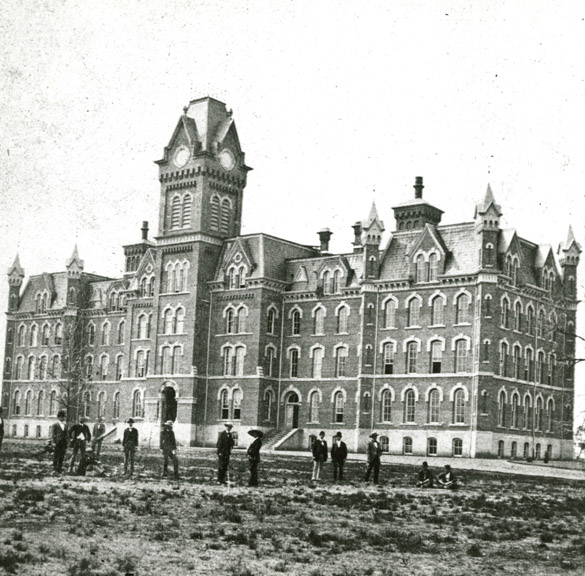
University Hall, 1874

It may be hard to imagine but when the University first opened, there were only seven faculty members and about two dozen students. More incredibly, many of the first faculty members resided in University Hall, along with many of the college’s first male students. The faculty’s quarters were mostly on the upper floors, known as the “Saints’ Roost,” and many of the students lived in the cellar, otherwise known as “Purgatory.” Of course, sharing close quarters was bound to lead to some disturbances. One former student’s account mentioned that residents of Purgatory occasionally made their way up the stairs at night; they formed a line and the leader would tap on certain faculty members’ doors at odd hours of the night. When the unsuspecting faculty member opened the door, the line would start forward and each passing student would hit the Saint with a pillow until he shut the door. Sounds like fun, huh? Clearly, the Internet had not yet been invented.

The Chemistry Building curse?
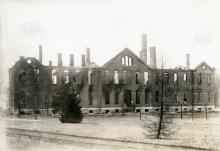
Chemistry Building #1 fire damage, 1887

OSU’s chemistry department got off to a rocky start: Originally housed on the third floor of University Hall, it was soon moved to a newly constructed building on the site of, most recently, Brown Hall. When a fire started in the building in 1887, the whole structure burned down because of a lack of water to extinguish the flames.

The next chemistry building was built two years later on the site of the present Derby Hall.
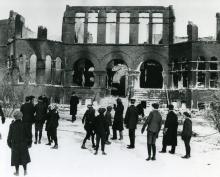
Chemistry Building #2 fire damage, 1904

It burned down in 1904. A recounting of the incident said there were “ludicrous happenings due to excitement” that occurred that night.

Apparently the firefighters were afraid of the chemicals housed in the building, so they did not try to put out the flames (whether or not the chemicals were a threat is not known). However, that did not stop students from entering the burning building and attempting to save the contents, including bottles of distilled water.

The third chemistry building, now known as Derby Hall, was rebuilt in 1906 on the site of its predecessor. It too, caught fire soon after it was completed; however the building was saved. Its first addition was, of course, a fire-proof storage shed for the chemicals. No doubt this helped to break the curse.

Hairy men in dresses

Scarlet Mask group

It’s likely someone has written a thesis about why people laugh when men dress up in women’s clothing. The entertainment method surely worked for OSU audiences during the first half of the 20th century, given the long run of a student acting group called Scarlet Mask. The men’s musical comedy club that later evolved into an honorary dramatic organization was started in 1919 by a group of five OSU students. Most of the plays were comedies, and they were a source of entertainment for students and local residents before the advent of television. Some of the early plays (prior to 1925) were penned by none other than humorist James Thurber. One of the group’s signature pieces was to have very big, hairy men—such as members of the football team—come out on stage dressed in frilly women’s clothing. Another key member was Milton Caniff, creator of long-running comic strips, “Terry and the Pirates” and “Steve Canyon.” Who knows? If he had not become a renowned cartoonist, he might have his career on stage. The Scarlet Mask Club disbanded in the 1930s, primarily due to a lack of funding, but the club was periodically resurrected for the next decade or so. Its last run ended in 1953.

OSU basketball legend Katie Smith still setting records

Katie Smith, 1993-1994

There’s been a lot of talk lately about Samantha Prahalis, the stand-out guard for the OSU Women’s Basketball team. And for good reason: The 5-foot-7 senior was just named Big Ten Player of the Year on Tuesday, just four days after she broke the scoring record for the team, with a 42-point run against Minnesota.

Still, she has a lot of accolades to accumulate to beat the previous record-setter: Katie Smith, OSU’s highest-achieving women’s basketball player ever.

Smith, who first played basketball in fifth grade on a boys’ team in Logan, played for the women’s team from 1992 to 1996. During that time, she racked up plenty of achievements, including:

  • Named to the academic All-Big Ten three times
  • Chosen Big Ten Player of the Year in 1996
  • Tallied an OSU single-season record of 745 points her senior year
  • Set a Big Ten career record of 2,578 points

With 10 career, six single-season and six single-game records under her belt, Smith was inducted into the OSU Athletic Hall of Fame in October 2001. Earlier that year, her jersey number – 30 – was retired. She is the only woman basketball player to have achieved that honor.

Smith, who graduated from OSU in 1996 with a bachelor’s degree in zoology, went on to play for three professional women’s basketball teams: the now-defunct Columbus Quest, the Minnesota Lynx and the then-Detroit Shock (now in Tulsa). She helped the Quest win both American Basketball League championships in its three years of existence, and she was named the Most Valuable Player of the 2008 WNBA Finals, when the Shock beat the San Antonio Silver Stars in a three-game sweep for the national championship. In 2005, she became the first women’s basketball player to reach 5,000 career points, then became the first to move past the 6,000-point mark in 2007.

Smith also was a three-time Olympic gold medalist as a member of the USA women’s basketball team in 2000, 2004 and 2008.

Now a member of the Seattle Storm, she participates in the WNBA Cares program, holding basketball clinics for children in India. She also has had a more local impact, having organized youth basketball camps in her hometown of Logan.

Filed by C.N.

Bleeds Scarlet and Grey: Col. George L. Converse

Col. George L. Converse, n.d.

The Reserve Officers’ Training programs for the Army, Navy and Air Force are such fixtures at OSU that it would be difficult to imagine the campus without them. There was a time, however, when there was no such thing as the ROTC program. With the help of George Converse, and several other OSU leaders, the national ROTC program was created and the OSU program flourished.

Converse, who grew up on a farm near present-day Cleveland Avenue, enrolled as a freshman at OSU at age 17, in 1874. After his first quarter, however, he received an appointment to West Point, and eventually graduated in 1880. Two years later, he was a member of the 3rd U.S. Cavalry in Wyoming, when his company was sent to Arizona to combat the uprising by the Apaches, led by Geronimo. In one battle, Converse was shot in the eye and had to ride on horseback for 40 miles to receive medical treatment. The bullet was never extracted, and the rest of his life he wore a black eye patch. University lore said that he could see more with his single eye than most men could see with two.

Due to his injury, he retired from active duty in 1884 and returned to Columbus. He was later called back to serve in the Spanish American War, but returned again to Ohio State in 1900 to serve as the University’s first Commandant of Cadets in the Department of Military Science. He held that position, as well as a professorship and subsequently chairmanship, of that department for 18 years. During his tenure, enrollment grew from 400 to almost 3,000 students. Commandant Converse, whom students affectionately referred to as “Commy,” also gave regular Thursday morning talks to male freshmen. (On Wednesday mornings, the freshmen listened to President William Oxley Thompson.)

Converse Hall, 1949

With the outbreak of World War I, Converse returned to active-duty status, this time as examining officer for all Ohio officer training camps. During that period, as he continued his teaching duties at OSU, he also co-authored the Ohio Plan, along with Pres. Thompson, Gen. Edward Orton Jr. (professor of ceramic engineering) and OSU alumnus Ralph D. Mershon. That plan, which outlined university civilian training programs, became part of the 1916 National Defense Act, which established the ROTC as a national program.

In 1918, he left OSU when the military promoted him to district inspector, overseeing officer training camps in Ohio, Indiana, West Virginia and Kentucky. In 1920, he retired from the military—for good—and returned with his wife, Effie, to their house on Neil Avenue. (Effie had served as interim Dean of Women during the 1918-19 academic year.) He died on November 16, 1946.

Five years before he died, ground broke on the ROTC building, on February 17, 1941. In 1973, the Board of Trustees voted to re-name the building after Converse, who had served longer than any other Commandant at OSU.

Filed by C.N.

Older posts Newer posts