From Woody's Couch

Our Playbook on OSU History

Year: 2012 (page 17 of 25)

End of an era: Classroom bells go silent for semesters

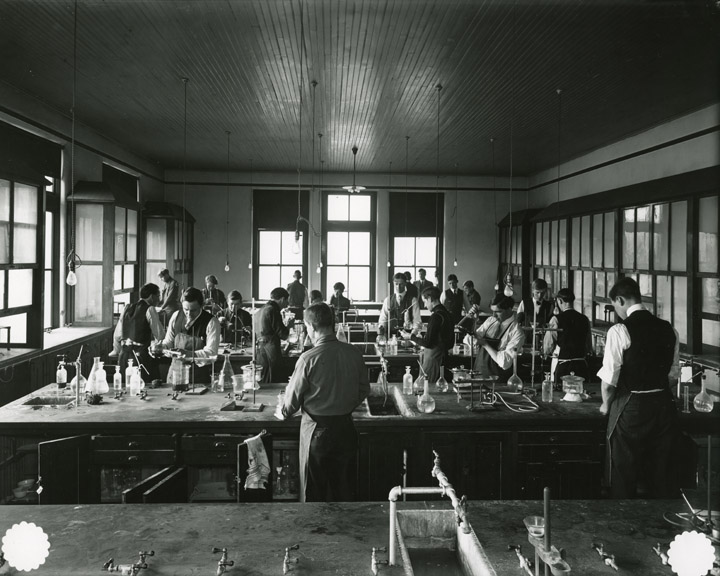
Metallurgy lab in Lord Hall, 1910

Someday, we’ll be noting in our blog, as we do with other historical campus events, the anniversary of this date – June 1, 2012 – the day the classroom bells stopped ringing permanently. With the conversion to semesters, and the subsequent wide variations in class times, the University decided to shut down the bell system with the end of this quarter. Today’s 4:18 p.m. bell will be the last.

It’s an end to what appears to be more than 100 years of bells signaling the start and end of classes in various buildings around campus.

The first reference to bells can be found in the minutes of the Board of Trustees’ Building Committee for the meeting of June 14, 1906. An appropriation of $45 was listed for bells to be installed in what later became Lord Hall, the home of the School of Mines and Engineering. Other expenses listed were electrical fixtures, electric lamps, motors, shades and chairs. At a similar meeting two years later, the minutes state that the committee approached the E. Howard Clock Company on the matter of obtaining a “Watchman’s Clock System for the various buildings of the University…for ringing the class bells…for the sum on $520.”

In 1920 John Coven, a master mechanic at the University Power House, explained to a Lantern reporter how the clock system worked. The bells are regulated from a clock in the chief engineer’s office. A wiring system linked that clock with all of the classroom bells. A spring, attached to the clapper, was wound every two weeks in every bell so that it would spring – and ring – when called to do so.  This system also tracked the night watchman and the campus policeman before the age of telephones. Stations were set up around campus with a button that would record the time and the station location so that, in the event of an emergency, an official could be located.

There’s been talk before of disabling the bells for good – most recently in 1993. The Classroom Coordinating Council and the Scheduling Office went so far as to conduct an experiment: Bells were disconnected in five buildings for a quarter. Surveys were then sent to 400 faculty and 300 students to see what they thought about the change. More than half responded, and in the end, the bells kept ringing.

To learn more about the disabling process, read this Columbus Dispatch story:

http://www.dispatch.com/content/stories/local/2012/06/01/at-ohio-state-its-o-h-bye-o-to-classroom-bells.html

Commencements past: A four-day graduation? Are you kidding me?

For many graduates, the commencement ceremony – particularly on a sweltering day in June – might seem like it lasts for days and days. There have been years when it actually did. That’s just one of the many interesting things you’ll learn about Commencement in Raimund Goerler’s history of the University, “The Ohio State University: an Illustrated History.” Tidbits from his history, and some others are:

Helen Parkhurst, the first female commencement speaker, walks with Dean Wilbur Siebert, 1928

  • In 1882, commencement took four days, beginning with a baccalaureate sermon and address by then-OSU President Walter Q Scott and including lectures, a parade, and a closing reception at the home of the President. In 1899, an event lasting several days included a sunrise ivy planting and accompanying address.
  • “Pomp and Circumstance” was first played in 1928, but as a recessional. Two years later, it switched to a processional.
  • That year, at the August 1928 ceremony, Helen Parkhurst became OSU’s first female commencement speaker. She was a nationally known educator focusing on alternative elementary-school instruction.
  • World War II caused a four-year lapse in Commencement being held at Ohio Stadium. The war also had an effect on that spring’s graduation class: there were no candidates for degrees in veterinary medicine, the College of Medicine presented only one candidate, and dentistry presented two candidates, according to the June 1946 alumni magazine.
  • WOSU first broadcast a commencement in 1949.
  • Branch Rickey, 1950

    Commencement speakers have included not only astronauts and actors, as we recounted in our previous blog, “A Who’s Who of Speakers.” In 1950, Branch Rickey, then-general manager of the Brooklyn Dodgers, spoke to Spring Commencement graduates. He is most known as breaking the color barrier in Major League Baseball by signing African-American player Jackie Robinson.

  • The conferring of honorary degrees also has been a feature of the ceremony, and recipients have included such notables as Robert Frost, Orville Wright, and Jesse Owens.


Commencements past: Held at fairgrounds, fortresses and football fields

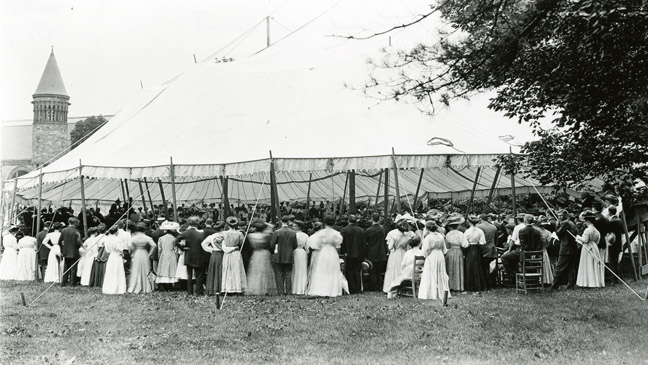
Oval, 1909

Because there were so few students, the University’s first commencement ceremonies were held in University Hall’s chapel, from 1878 when the first class graduated, to 1908. That venue grew too small, so the University tried going outdoors, first in 1909 with a tent on the Oval. (Exercises also were held under a tent there in 1918 and – sans a tent – in 2001, when the Stadium was under renovation.) In 1910, a tent was erected again, this time next to Mirror Lake.

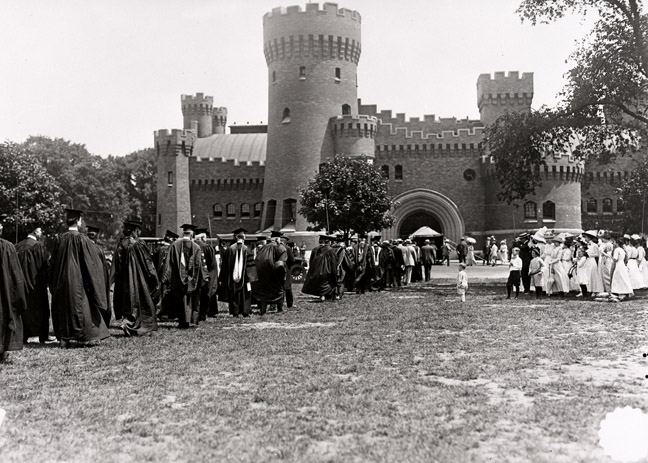
Next up was the Armory, a fortress-like building that once stood where the Wexner Center is now located. Exercises were held there from 1911-1912 since the interior of the building consisted mostly of one huge gymnasium.

Armory, 1912

By 1922, however, the number of students graduating had outgrown even that facility, so for the next five years, the ceremony was held off-campus at the Coliseum on the Ohio state Fairgrounds.

Finally, in 1928, Ohio Stadium became home, at least to the spring Commencement ceremony where thousands receive their diplomas. It has been home to nearly every spring commencement ceremony since then, and has witnessed a variety of pageantry, firsts and unusual student displays.

In 1986, graduating dentists, doctors and optometrists got a little too rowdy during the spring graduation ceremony. The dentists, with high-flying balloons announcing “We ain’t afraid of no teeth” were seemingly outdone by the optometrists, who had hired an airplane to fly over the Stadium, hauling the message “Optometry ‘86, You Look Mahvelous”. The horseplay caused OSU President Ed Jennings to advise the College of Dentistry to have a separate ceremony the next year, with hopes to avoid the disruptive behavior. (They apparently behaved the next year.)

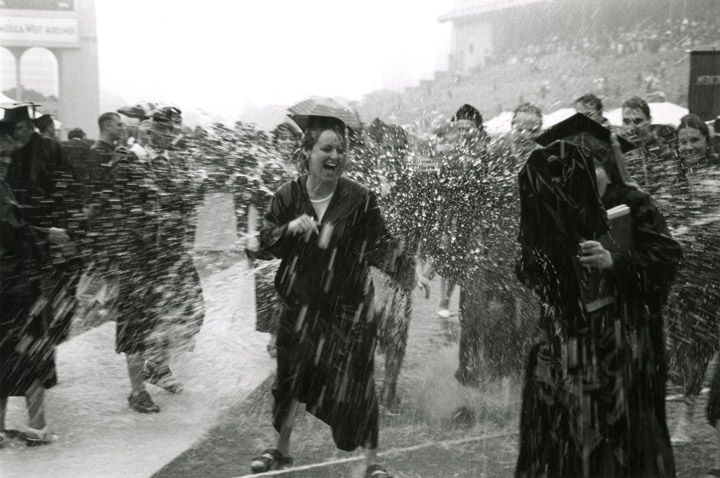
Ohio Stadium, 1997

But sometimes, the outcome of an outdoor ceremony is beyond anyone’s control. Shortly after commencement exercises started on Friday, June 13th, 1997, a downpour caused the ceremony to be cancelled – for only the second time in University history (The first rain cancellation was in 1941.) Soaked graduates waded in knee-deep water in the end zone before relocating to the French Field House to receive their degrees. In a follow-up letter to the graduating students, President E. Gordon Gee noted that “One graduate remarked that she wasn’t sure she had graduated, but was certain she had been baptized.”

Older posts Newer posts