

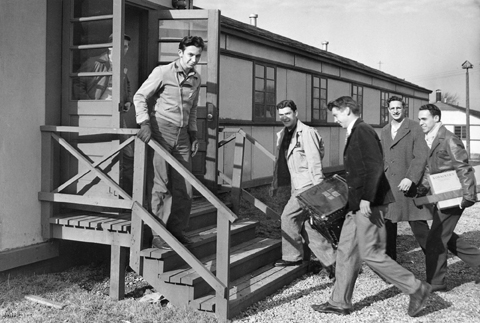
Veterans moving into GI Village, 1946
When World War II ended, young veterans taking advantage of federal financial support for getting a college degree, flooded university campuses, including Ohio State. The influx created a housing crisis here:
- a huge debate raged over whether the women who occupied Baker Hall during the war should be kicked out for the men to live there again;
- men were bunked all the way out at Port Columbus and were transported to campus by bus;
- 185 trailers sat on the state fairgrounds, mostly occupied by married students who could not find accommodations elsewhere.

State Fairgrounds trailer park, 1946
Needless to say, OSU had a problem.
In honor of Veterans’ Day, we thought we would post something about the G.I. or Veterans’ Village, which we now recognize as Buckeye Village on Olentangy River Road. The G.I. Village got its start after WWII, when OSU was going through a housing crisis. There were already men bunked at the Stadium and at Port Columbus. There were arguments as to whether men or women would occupy Baker Hall and other dorms. There were also 185 trailers parked at the State fairgrounds as of May, 1947, mostly
The solution was a number of housing projects, the largest of which was the GI Village, which would house 810 men in barracks-like emergency housing units. Using federal grants, the T-shaped structures were built on University-owned farm land – where Buckeye Village stands today – and ready for occupancy before autumn quarter of
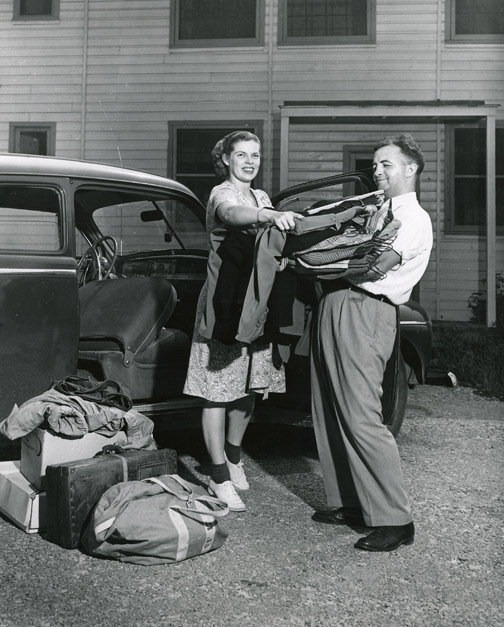
GI Village couple
1947. At the same time, another project to put student housing under the west side of Ohio Stadium was also in progress; that project added yet another 390 beds for men.
It was not until the autumn of 1948 that apartment-style accommodations for married veterans were available. These facilities were also built at the GI Village, and were in high demand: 800 applications were received for the 152 family housing units in 1947. An additional 200 units were available the following spring. Rent for the students was between $29 and $43 per month and was based on the size of the unit. The units also came partially furnished, and were awarded based on the veteran’s present housing conditions and number of years at the University and in service.
Filed by C.N.





Recent Comments