From Woody's Couch

Our Playbook on OSU History

Page 51 of 105

Twelve Days: With Stuckey, it was always safety first

Wilbur Edward Stuckey, 1965

Wilbur Edward Stuckey, 1965

Wilbur Edward Stuckey, better known as “Bill” to many Ohio farmers and students, was all about safety. He lectured on how to prevent Christmas tree fires, sent students out to campus buildings to look for potential accident hazards, and gave helpful tips on how to have fun safely on holidays like Memorial Day. (“Play Safe – Increase the Fun,” was the title of this talk.)

His most recognizable contribution was his steadfast promotion of the orange triangle ‘Slow Moving Vehicle’ sign now found on the backs of tractors, buggies and farm equipment across the nation. Here at the Archives, he’s also known as inventor of “The Convincer,” a wooden contraption that demonstrated the hazards of not wearing a seat belt. 

Stuckey was born February 8, 1911, in Bloomville, Ohio and enrolled in Ohio State in the fall of 1929. As a student, he was involved in Glee Club, the All Agriculture Council, and he was elected as President of the Townshend Agricultural Education Society for his senior year. He graduated from Ohio State with his B.S. in Agriculture in 1933.

"The Convincer"

“The Convincer”, Stuckey’s invention which used an egg on the seat to represent a person. Without the seat belt the egg would hit the box and break. With the seat belt, the egg would not break. The Convincer is held at the Archives.

After graduation, Stuckey accepted a position as a vocational agriculture teacher, but he returned to OSU in 1941 as a faculty member, teaching evening classes in Summit Station, Ohio. He received his Master’s degree Agriculture Education in December 1944, and he continued to serve on the faculty while working in the Division of Safety and Hygiene in the Industrial Commission of Ohio.

In 1955, he began working full-time in OSU’s Extension Service as a farm safety specialist, and he held that position until he retired in 1976.
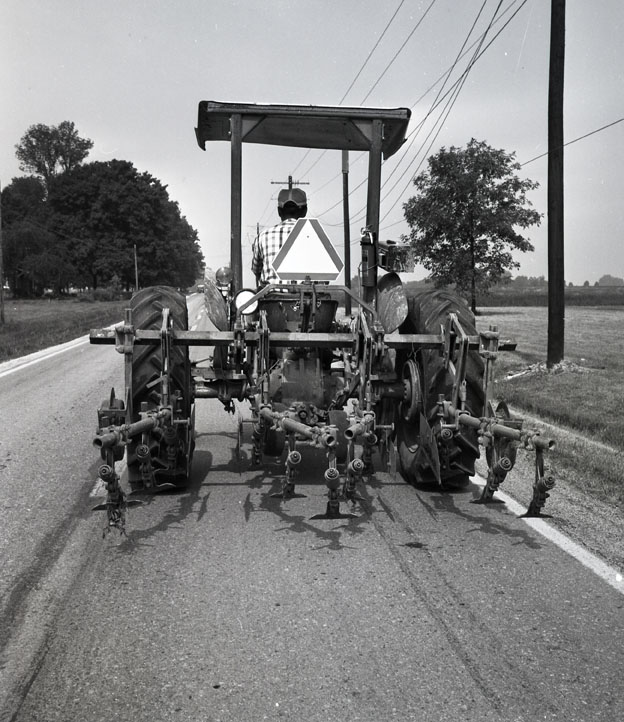
Tractor with the slow moving vehicle sign on the back

Tractor with the slow moving vehicle sign on the back

Stuckey began tracking farm accidents in 1957, and this research led him to teach farmers and students across the state about the dangers of farm equipment and how to use such equipment more safely. He is credited with reducing the deaths on Ohio farms by half in the time he was safety director. In fact, he spearheaded the movement in the mid-1960s to adopt the “Slow Moving Vehicle” sign.

Stuckey died on January 12, 1981. In 1988, Stuckey was inducted posthumously into the Ohio Agricultural Hall of Fame. That same year, the Ohio Farm and Home Safety Committee established an endowment fund at OSU in his name, designated for research in farm and home safety.

 – Filed by C.N.

Twelve Days: Newton put School of Nursing on the map

Mildred Newton, 1960

Mildred Newton, 1960

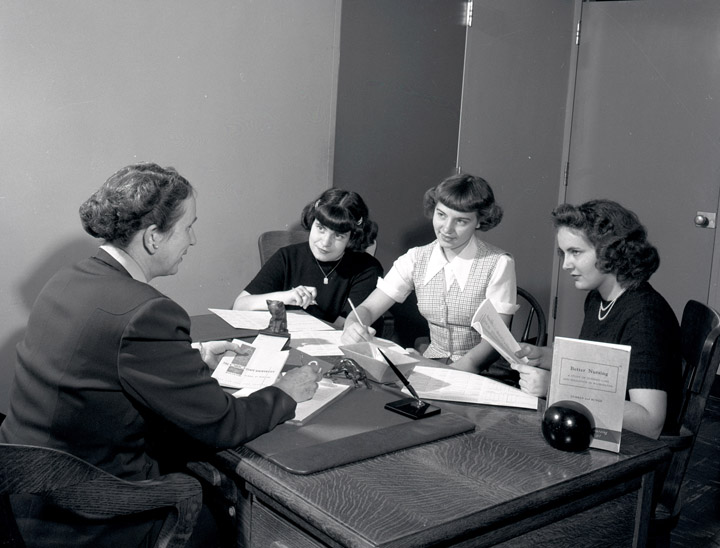
Mildred Emily Newton was born on July 3, 1901 in Cedar Fall, Iowa. After receiving degrees in nursing and education from Northwestern, USC and Stanford, Mildred Newton came to Ohio State as director of the School of Nursing in 1951, a position she held until her retirement in 1968. She was credited for making the nursing program at Ohio State what it is today.

Under her supervision the program gained national accreditation, expanded its baccalaureate program and started a graduate program and a program in nursing research. Besides her academic achievements, Ms. Newton was in demand nationally as a volunteer. She worked closely with the Kellogg Foundation, the National League of Nursing as well as working for the U.S. Department of Defense.

Newton meets with student nurses, 1951

Newton meets with student nurses, 1951

Throughout it all, she continued to teach. One of her passions was the history of the profession, particularly the life of Florence Nightingale, and she conveyed that to generations of students. She also was an avid collector of stamps related to medicine and nursing, and she donated her collection to the Health Center Library shortly before her death. She organized it into four volumes that depict the history of the Red Cross, the history of medicine and nursing, world attempts to eliminate diseases, and individuals’ contributions to health.

Newton Hall, 1983

Newton Hall, 1983

Recognition for her work came in the form of the National League of Nursing’s Adelaide Nutting Award in 1969 and one of Ohio State’s 1970 Centennial Achievement Awards. She was also given emeritus status upon her retirement in 1968.

Her personal legacy was that of a caring mentor who always had an open door and a sense of humor. She was also an advocate of patient rights. In a Nov. 11, 1958 article in The Lantern she identified the following as particularly critical to the nurse-patient relationship: “The patient’s welfare must always come first. Nothing a patient needs to have done is beneath the dignity of a doctor or nurse to perform.” She passed away on July 25, 1972. The School of Nursing’s building was renamed “Mildred E. Newton Hall” in her honor.

Twelve Days: Stone’s rock-solid support of OSU led to Lake Erie research lab

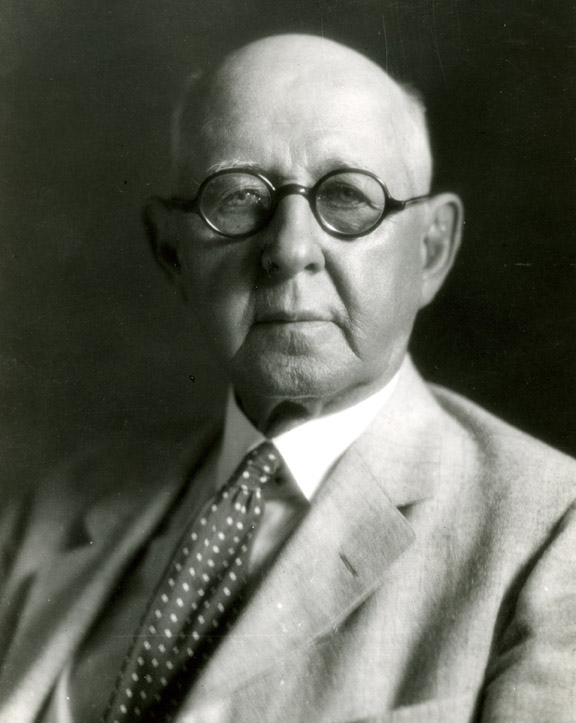
Julius Stone

Julius Stone

If you learn nothing else about Julius Stone, know that he laughed often, learned much, and shared both of these gifts with everyone he knew. He is also a wonderful example of the American archetype of the self-made man who tries to give back as much as he gets.

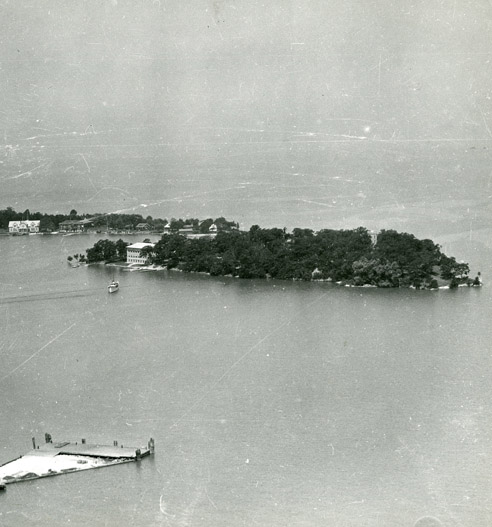
That was certainly true with his support of the University. He purchased Gilbraltar Island on Lake Erie and donated it to Ohio State to support the marine research conducted there by OSU faculty and students. He served two terms on the Board of Trustees for a total of 20 years. Even in small ways, his support had a long-lasting effect: He convinced a New York financier to build an observatory on OSU’s grounds.

Gibraltar Island, 1926

Gibraltar Island, 1926

Stone was born on June 1, 1855, on a farm in Michigan to emigrant parents. As one of eleven children, though, Stone did his part to support the family. Julius left school at 13, working first for a grain purchaser. By the age of 16, he was a telegrapher for the railroad. He then worked in the coal industry and focused on manufacturing sometime around the turn of the century.

Besides having a great aptitude for business, Julius Stone also possessed both a keen scientific mind and a desire for adventure.  He was a fellow of the American Geographical Society, the Explorer’s Club of New York, and the Royal Astronomical Society in England. He lectured on astronomy and geology frequently. He traveled all over the globe, from the Galapagos Islands, to South Africa. He led the first major expedition through the Grand Canyon, and he went white-water rafting when he was 84 years old.

Stone Lab, 1958

Stone Lab, 1958

He was also an ardent philanthropist, although most of his work went unknown until his death. For the most part only he and his personal staff knew which charities he was supporting and how much he was giving. One of the few occasions on which he was publicly recognized was at the dedication in 1925 of the Franz Theodore Stone Laboratory on Gibraltar Island in Lake Erie. The lab was named for Stone’s father, after Stone purchased the island for the University.

Before the purchase, the fresh-water research institute was housed in temporary quarters on Put-in-Bay. OSU Zoology Prof. Raymond C. Osburn had heard that Gibraltar Island was for sale, so he wrote to Stone, then a former Board of Trustees member, what he thought of finding someone to buy the island, possibly as a memorial gift. Stone decided to buy it himself, which he did, but he had the deed made out to the university before he received the deed from the seller, then handed both over to Osburn. Stone Lab is now the oldest freshwater biological field station in the United States.

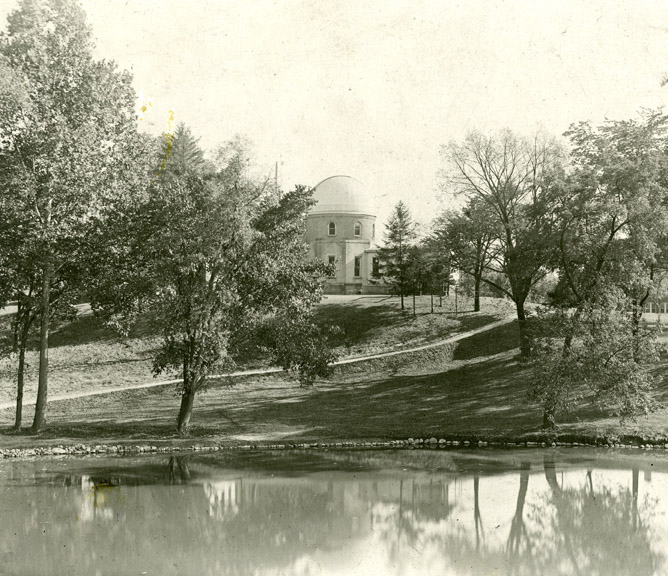
McMillin Observatory, n.d.

McMillin Observatory, n.d.

Long before he bought Gilbraltar Island, Stone was having dinner in New York one evening and struck up a conversation with Emerson McMillin, a New York financier. They both shared a love of astronomy, and when McMillin mentioned he’d like to build an observatory, Stone told him of the perfect place: Ohio State. So McMillin donated $10,000 to the University to build the observatory, which opened in 1895 near the Faculty Club. Before construction began, McMillin gave another $5,000 to beautify the area around the observatory, including Mirror Lake. Good thing he did: the University had been pondering laying a new road right through the Mirror Lake area. If Stone hadn’t convinced McMillin to build the observatory at OSU, who knows what the area might look like today.

Stone died on July 25, 1947, at the age of 92. According to the Columbus Dispatch, Stone instructed before he died that postcards to be mailed out on the day of his death. On the front was a picture of a snuffed-out candle; on the back was the following poem:

With a ripple of merry laughter,

A smile and a gay goodbye

To all who made life worth living;

Back to the dust go I

« Older posts Newer posts »