Manga

...bibliographic notes about manga...

Tag: history

Jiji Manga’s New Year Humor In Interwar Japan

Guest post by Anqi Chen

A comic showing an enormous crowd of people celebrating the beginning of spring

Full image of The Bustle of the Beginning of Spring (Click Image to Enlarge)

If you enjoy Japanese manga, history, and politics, OSU Libraries has something especially compelling for you. In January 1902—more than a century ago—a cartoon series titled Jiji Manga (時事漫画, literally Current Manga) was launched as a supplement to the newspaper Jiji Shinpō (時事新報, Current Events). The series was edited by the renowned manga and nihonga artist Yasuji Kitazawa—better known by his pen name Rakuten Kitazawa (北澤楽天, 1876–1955)—a pioneering figure in the development of modern manga.

Founded by Fukuzawa Yukichi (福澤諭吉, 1835–1901), one of the most influential intellectuals of modern Japan, Jiji Shinpō had a wide national readership. Jiji Manga, issued as a separate illustrated supplement, adopted a distinctly visual and experimental approach, presenting political news and social criticism through humor and caricature. According to the Bujalance Collection, Jiji Manga was the first periodical to use the term “manga” in its title in a modern sense. Each issue featured a single full-page editorial cartoon, often accompanied by ironic dialogue that reflected Rakuten’s sharp, satirical take on contemporary politics. As the creator of thousands of early editorial cartoons and comic strips that influenced generations of artists, Rakuten is now widely regarded as the founding father of modern manga. 

Cartoon of a crowd of people speaking in Japanese

Fig. 1: Close-up on the upper left

Continue reading

Teaching Postwar Counterculture with Japanese Gekiga

Sample set of 4 gekiga publications

Sample set of four gekiga titles used for “Group 9”
in a recent class on post-war Japanese counterculture

It’s been a while since the last blog post, but never fear, we are still working hard to build and activate our cool manga collection! Speaking of “cool” — we recently had a cool opportunity to explore our manga sub-collection of gekiga (劇画) during a class visit with Professor Keita Moore this semester. In his course “Elements of Japanese Culture” (DEALL 2231), Prof. Moore brought his students in to the BICLM to view some of our gekiga and to learn more about Japanese postwar protest and opposition.

Known for its more mature themes and cinematic flow, gekiga (often translated as “dramatic pictures” in English) is a type of avant-garde manga that departed in style from mainstream Japanese comics in the late 1950s. In contrast to the prevailing manga that were drawn for children (jidō manga or kodomo manga) by artist Tezuka Osamu, gekiga emerged with new content for adult readers, many of whom harbored doubts about the postwar status quo.  In many ways, the genre of gekiga gave shape to these doubts, and spoke to societal issues of the times, ranging from economic and social inequality, Japan’s Cold War military alliance with the United States, and the threat of nuclear warfare.

Continue reading

Glimpses from the Vault: The Tokyo Puck (Tōkyō pakku) Originals and Reprints

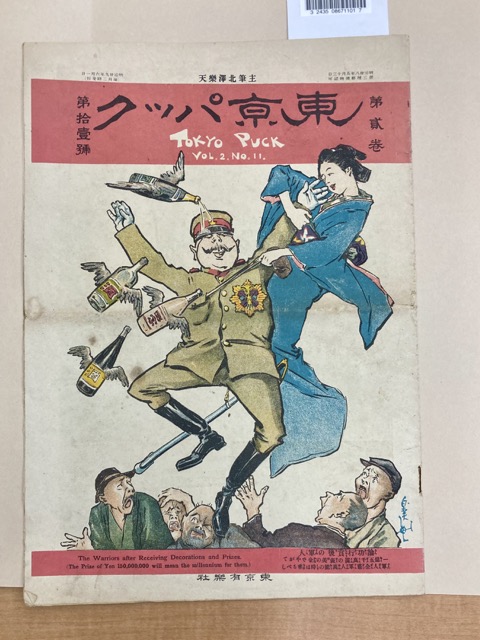
Among the many unique manga serials held at OSU’s Billy Ireland Cartoon Library & Museum (BICLM) are three original issues of Tokyo Puck (東京パック), an early Japanese satirical comic newspaper launched by Kitazawa Rakuten (北沢楽天, 1876-1955) and published from 1905 to 1923 (with a 5-year interruption circa the First World War). This Japanese manga newspaper was inspired by the American magazine Puck (published from 1877 to 1918), one of the earliest humor magazines in the US to solely feature cartoons, caricatures, and political satire.

Colorful newspaper cover page with a geisha, flying beer bottles and a drunken soldier

The cover page of an issue of Tokyo Puck (Volume 2, Number 11, published June 1, 1906), held at the BICLM. PN6790.J32 T65 v.2:no.11

Recently I had the opportunity to click some pictures of two of our Tokyo Puck issues during a class visit with students from “The Art of Colonial Taiwan,” (ArtHist 5002). In addition to our Tokyo Puck samples, the students in this class browsed a variety of materials depicting Taiwan and other Japanese colonies in historical cartoon maps, water colors, and artist scrolls created by famous manga artists of the early 20th century.

Continue reading

Checking out Manga – “This is Gakushū Manga, too!”

Written by Chase Conner (Class of 2021), with intro by Ann Marie L. Davis

Last March, shortly after the pandemic lockdown, I posted the blog “Manga Resources While Teaching and Learning from Home.” Since then, I have wanted to explore its many sites and share what I learned with everyone here. This semester, with the help of manga enthusiast and Japanese Studies major, Chase Conner (Class of 2021), we’re finally able to do this! In the new blog series, “Checking out Manga,” Chase will evaluate online manga resources as well as relevant print manga that can be checked out (literally!) from OSU Libraries. With each post, the series will highlight at least one open access manga site as well as related print manga available at our library. For the very first post in this series, Chase explores the site Kore mo gakushū manga da (これも学習マンガだ, or “This is Gakushū Manga, too”) below.


Image of the “This is Gakushū Manga, too!” home page.

Hello, everyone! It’s autumn already, and you know what that means: it’s the perfect time to relax somewhere cozy with a good book or comic to read and appreciate the scenery. Hopefully, we can help you find something interesting while furthering your studies along the way! Today we’re going to be looking into one of the websites included in the wonderful list of online manga resources compiled by Michiko Ito of the University of Kansas. Since many students and faculty are looking for interesting teaching and learning tools, I feel that the best place to start is with the site Kore mo gakushū manga da (これも学習マンガだ).

What is Gakushū Manga?

First things first — What is gakushū manga (学習マンガ)? Translated as “educational manga” or “manga study guides,” gakushū manga is a sub-genre of Japanese comics intended to teach readers about a specific topic in a variety of academic disciplines.  In addition to targeting elementary and high school students (studying history, math, art, or literature, for example), gakushū manga is also written for adults seeking information on topics from home improvement to budgeting, folk crafting, and more!

A List of 200 Recommended Gakushū Manga and Manga Learning Supplements

The web site Kore mo gakushū manga da offers a nifty compilation of manga titles that are not strictly gakushū manga, but that cover various academic topics that can be used as learning supplements. Compiled by the Nippon Foundation, its listings are tailored to promote manga that offer “fun while learning,” an idea known as “edutainment.” Its list currently includes 200 titles divided into eleven different categories (such as history, lifestyle, literature, and sports).  Visitors to this website can view the list at a glance by downloading the website handbook, or they can browse these categories online. Though the website is written entirely in Japanese, its recommendations are created with both native Japanese speakers and language learners in mind. Therefore, it can be a great learning resource whether you’re interested in reading comics in Japanese or finding English translations. Kore mo Gakushū Manga itself is not a resource that links to actual full text manga. Instead, it points readers to different works for use in Japanese Studies and language acquisition.

Browsing the List of Manga

One of the first things users will see when visiting Gakushū Manga is the genre search bar, which lists the Foundation’s eleven different categories.  Clicking on any one of these will show you all the manga within that category.
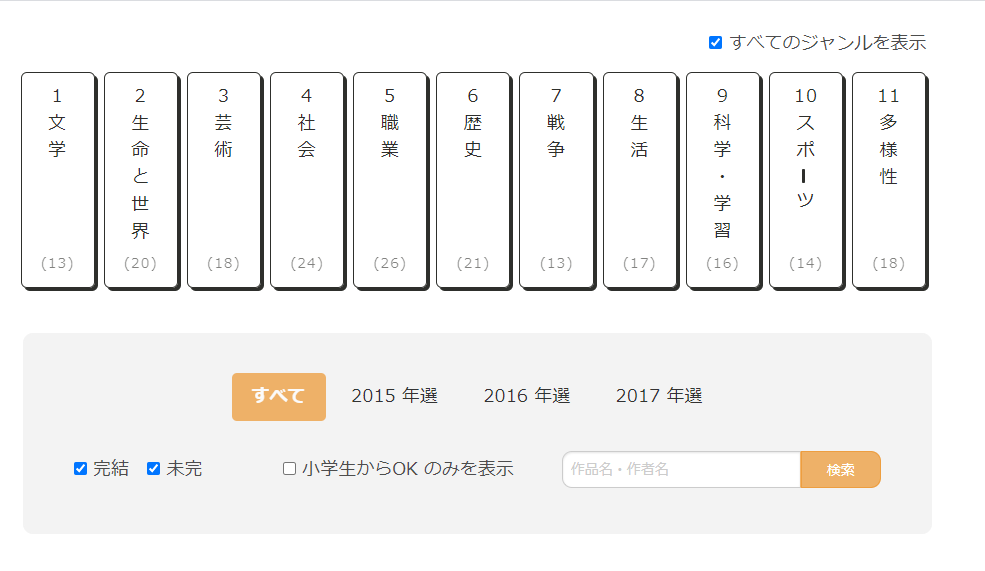
From right to left, the categories are Literature, Life and World, Art, Society, Work, History, War, Living, Science and Learning, Sports, and Diverse Topics. If you have a good idea what you’re looking for, you can narrow your search even more, with options to choose the date when the work was added to the collection, whether its series has ended or is still ongoing, and whether its age appropriate for younger readers (though it may do well to keep in mind that what is considered appropriate for younger audiences may differ across cultures)! When the search engine returns its results, each title has a handy hyperlink to a page with author and artist info, as well as a short blurb about the contents of the work and the reason for its inclusion in the list of recommendations.

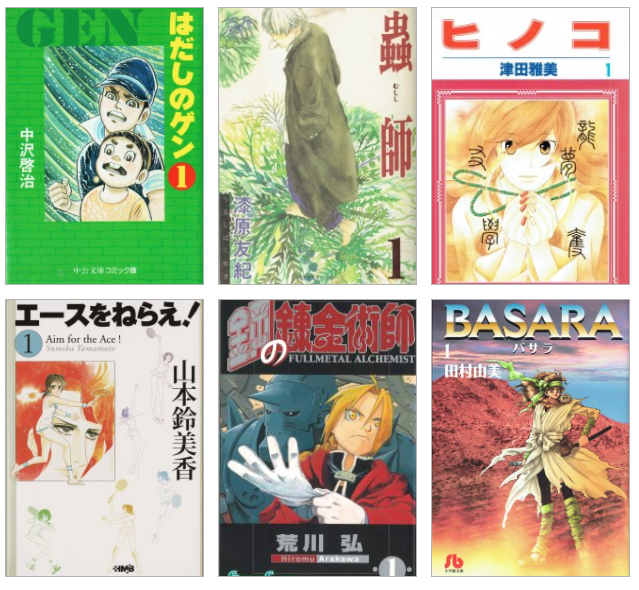
The collection includes familiar titles to fans of modern manga, such as Fullmetal Alchemist and Mushishi, as well as older classics

Keeping in mind the intent of the site, any of the recommended manga would serve as great resources for learning Japanese language, history, culture, and much more!

Accessing and reading these manga at OSU Libraries

If anything piques your interest, the site provides further information on how to purchase the titles from several online Japanese retailers. Moreover, a good number of these comics can be found in Japanese and English translation in OSU’s manga collection! Therefore, we encourage our users to have a look! Most of these titles (about 65% of OSU’s manga collection) are circulating and therefore can be freely borrowed from OSU Libraries.  Still others might be housed in special collections and can be viewed in the Reading Room (with an appointment during the pandemic) at the Billy Ireland Cartoon Library and Museum. For titles that are not yet part of our manga collection, OSU students and faculty are strongly encouraged to reach out and make a request! You can provide suggestions and feedback to help build our manga collection by contacting OSU’s Japanese Studies Librarian, Ann Marie Davis, anytime at davis.5257@osu.edu.

Additional links and resources:

For a closer look into gakushū manga available at OSU Libraries: Educational manga (学習漫画) at Ohio State Libraries:

For those interested in English translations of Koremo gakushū manga da’s contents, one need look no further than that of the the Japan Foundation: Japan Foundation’s “Kore mo gakushū manga da” catalogue.


Genshi Sugoroku: Kagaku Kyōiku Manga (Atomic game board: Comics for science education)!

Images details, counterclockwise, from upper right corner: 1. Original envelope containing the fold-out  print;  2. The foldout print in its entirety; 3. Print detail of the game goal (“agari, “上り), flanked by descriptions of Hideki Yukawa and Alfred Nobel;  4. Print detail of “No more Hiroshimas!” located above the goal.

As of today our exhibit, “Creative Responses to the Cold War,” has come to an end.  It was bittersweet when I worked this morning with colleagues in the Thompson First Floor Gallery to empty all of the exhibit cases. 

One of my favorite exhibit pieces, which will soon makes its way back to the Billy Ireland Cartoon Library and Museum, is called Genshi Sugoroku (原子双六, which translates roughly as “Atomic Game Board”), a colorful manga that celebrated the physicist Yukawa Hideki (湯川秀樹: 1907-1981), Japan’s first recipient of the Nobel Prize in physics. 

Continue reading

Kanto Earthquake Orihon Book of Watercolors

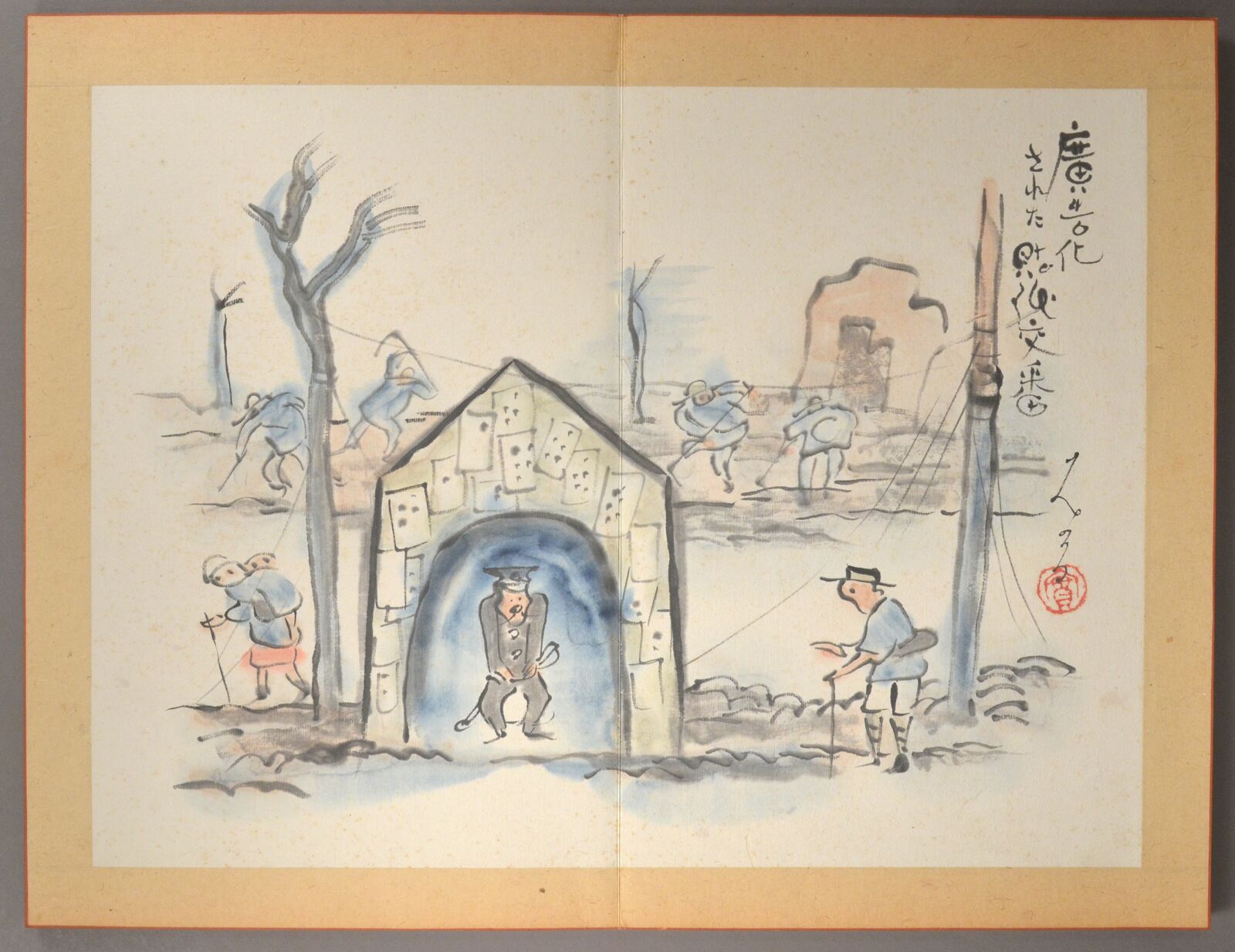
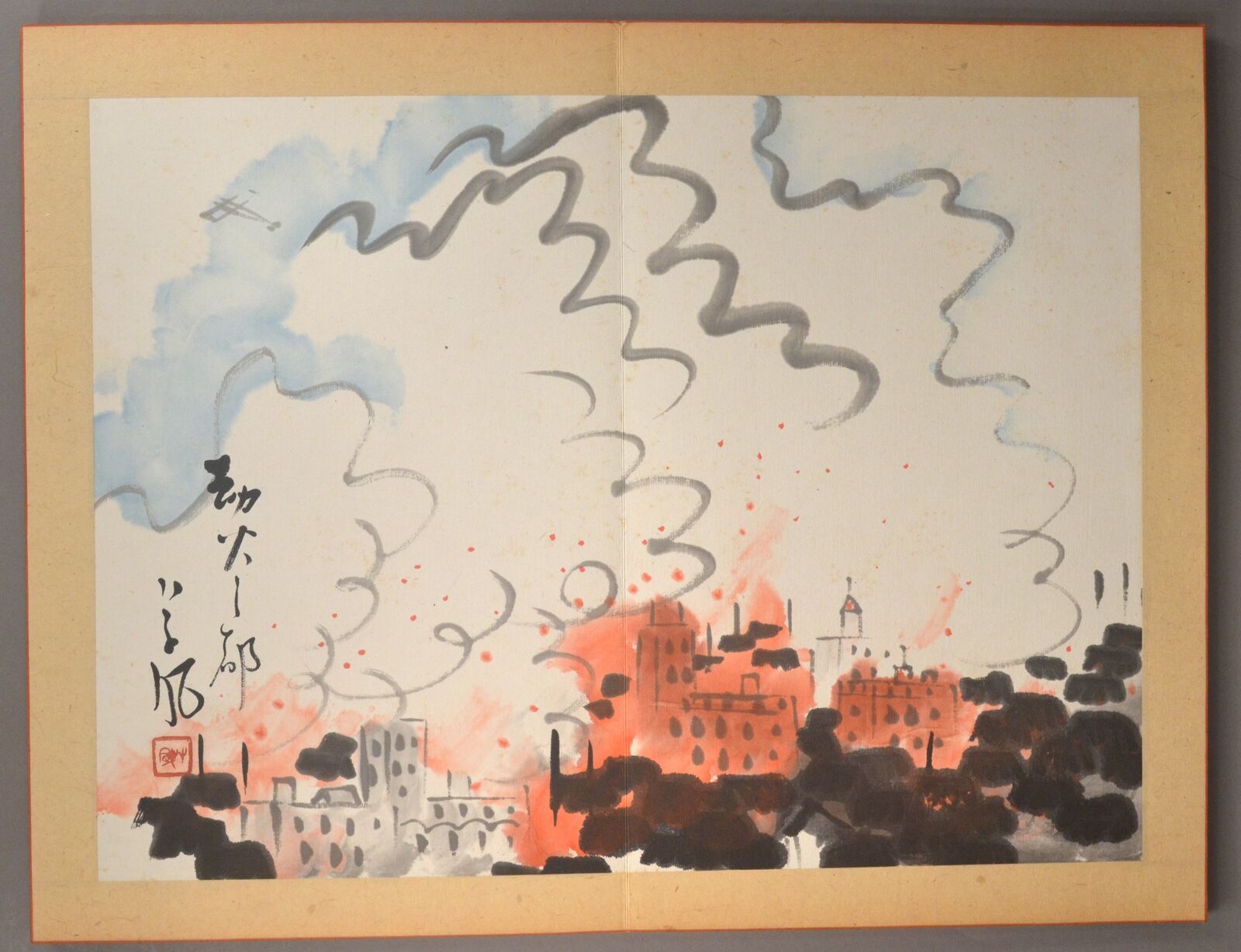
Japanese Studies at OSU Libraries is excited to announce the acquisition of “Kanto Earthquake Watercolors.”  This rare book, which has no official title, includes twelve pages of original paintings depicting the 7.9 magnitude earthquake that hit Japan in 1923. This earthquake devastated several areas and resulted in a large fire, causing the death of an estimated 100,000 to 140,000 people. The paintings, created by Nakazawa Hiromitsu (中沢弘光), a well-known Nihonga and watercolor painter from Kansai, as well as other contemporary manga artists, focus exclusively on  scenes from the aftermath of the historic disaster.

Kanto Earthquake Destruction

Kanto Earthquake Fire


This book, which forms part of the world-class manga collection at OSU Libraries, is now housed at the Billy Ireland Cartoon Library and Museum (BICLM).  For those interested in viewing this rare book, please contact Japanese Studies Librarian Ann Marie Davis at davis.5257@osu.edu

Continue reading

Educational manga (学習漫画) at Ohio State Libraries

Manga is not often associated with education, but there is actually an entire genre dedicated to it: 学習漫画 (gakushū manga or educational manga).

The format has a number of inherent advantages over traditional media.  With both written and pictorial elements, manga can often succeed in conveying complex ideas in easy-to-understand ways better than just diagrams or text alone. Manga’s serialized format also naturally lends itself to step-by-step instructions, giving readers a deeper feeling of sequential order. Finally, the narrative nature of manga often sticks in reader’s minds and helps them to create a framework for understanding the new material.

An educational manga that teaches Japanese history to grade school children. Other examples include manga for adults studying tea ceremony, automobile repair, and cooking.

Continue reading