

Guest post by Anqi Chen

Full image of The Bustle of the Beginning of Spring (Click Image to Enlarge)
If you enjoy Japanese manga, history, and politics, OSU Libraries has something especially compelling for you. In January 1902—more than a century ago—a cartoon series titled Jiji Manga (時事漫画, literally Current Manga) was launched as a supplement to the newspaper Jiji Shinpō (時事新報, Current Events). The series was edited by the renowned manga and nihonga artist Yasuji Kitazawa—better known by his pen name Rakuten Kitazawa (北澤楽天, 1876–1955)—a pioneering figure in the development of modern manga.
Founded by Fukuzawa Yukichi (福澤諭吉, 1835–1901), one of the most influential intellectuals of modern Japan, Jiji Shinpō had a wide national readership. Jiji Manga, issued as a separate illustrated supplement, adopted a distinctly visual and experimental approach, presenting political news and social criticism through humor and caricature. According to the Bujalance Collection, Jiji Manga was the first periodical to use the term “manga” in its title in a modern sense. Each issue featured a single full-page editorial cartoon, often accompanied by ironic dialogue that reflected Rakuten’s sharp, satirical take on contemporary politics. As the creator of thousands of early editorial cartoons and comic strips that influenced generations of artists, Rakuten is now widely regarded as the founding father of modern manga.

Fig. 1: Close-up on the upper left
This article takes a closer look at the cover of a Jiji Manga issue published on New Year’s Day, January 1, 1926 (Taishō 15). The featured cartoon was created by Hisao Kawamori (河盛久夫, 1898–1968), a prominent manga artist trained under Rakuten Kitazawa who began contributing to Jiji Manga in 1921. To mark the new year, Kawamori produced a lively composition titled The Bustle of the Beginning of Spring (初春の賑い). The scene depicts a crowded New Year’s celebration filled with diverse characters and activities. Rather than using Western linear perspective, Kawamori employs a traditional Japanese flat perspective, presenting the festive environment within a richly detailed two-dimensional space.
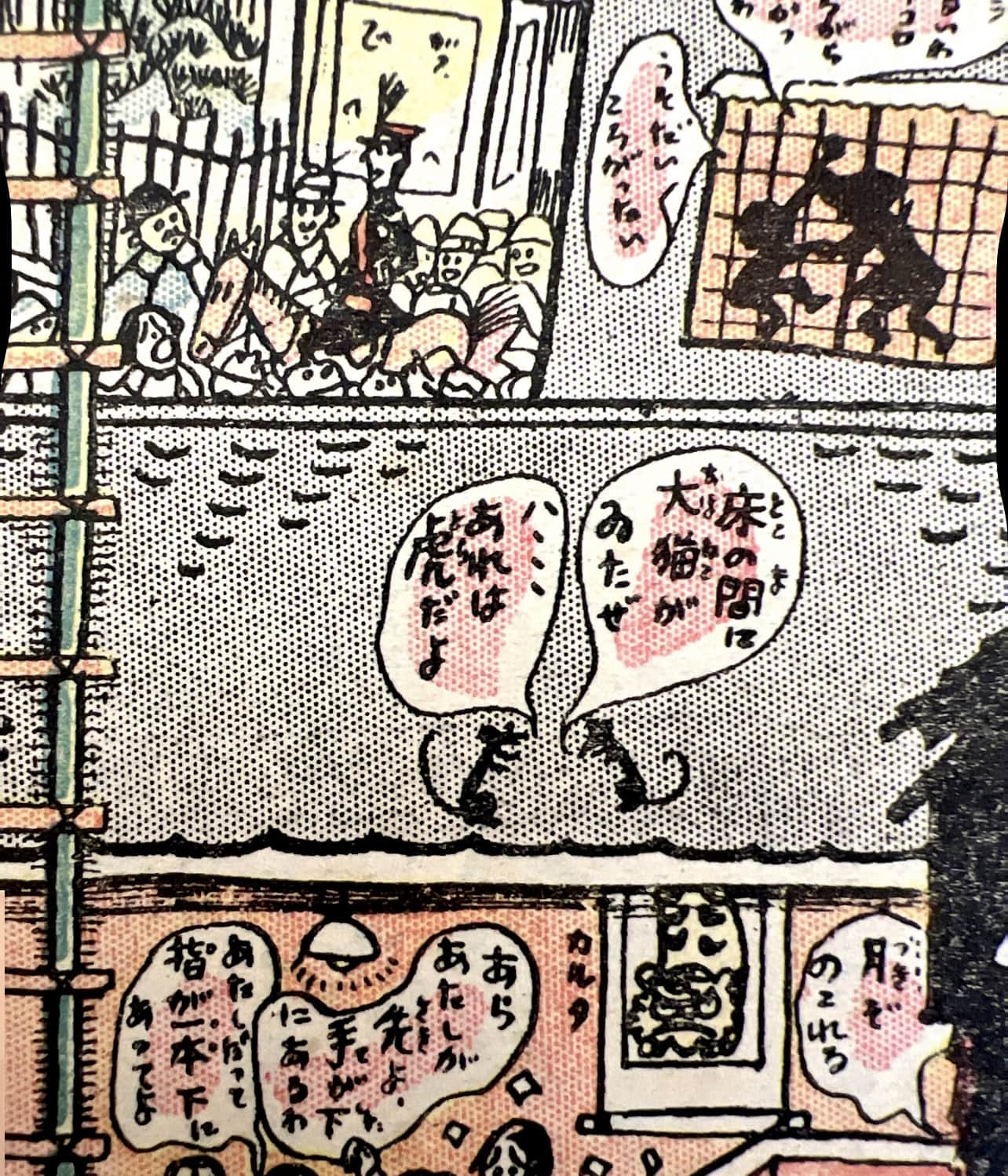
Fig. 2: Close-up on the middle right
The image rewards careful looking, with speech bubbles scattered throughout the scene that add layers of humor and irony. In the upper-left corner, a house labeled “The Family of Prohibitionists” (Fig. 1) depicts a wife pouring sake for her husband, casually justifying the moment by saying, “It’s New Year’s.” On the middle-right side of the roof, two mice converse in Japanese, debating whether the creature they spotted earlier in the alcove was a large cat or a tiger (Fig. 2). Other playful details emerge with closer inspection, including Santa Claus standing on the roof beside a tall ladder (Fig. 3). Below, the crowd’s attire blends traditional Japanese dress with Western fashions—kimono appearing alongside tailcoats and top hats—capturing a society shaped by both longstanding customs and foreign influence.
Cartoons like this are not only humorous but also valuable visual records. They offer insight into everyday life in Japan following the Meiji Restoration, a period marked by rapid modernization and increasing Western cultural influence. The dense layering of witty exchanges and comical scenes within a single image highlights the artist’s creativity and exemplifies a hallmark of Jiji Manga: current events and social realities rendered with humor, irony, and meticulous detail.
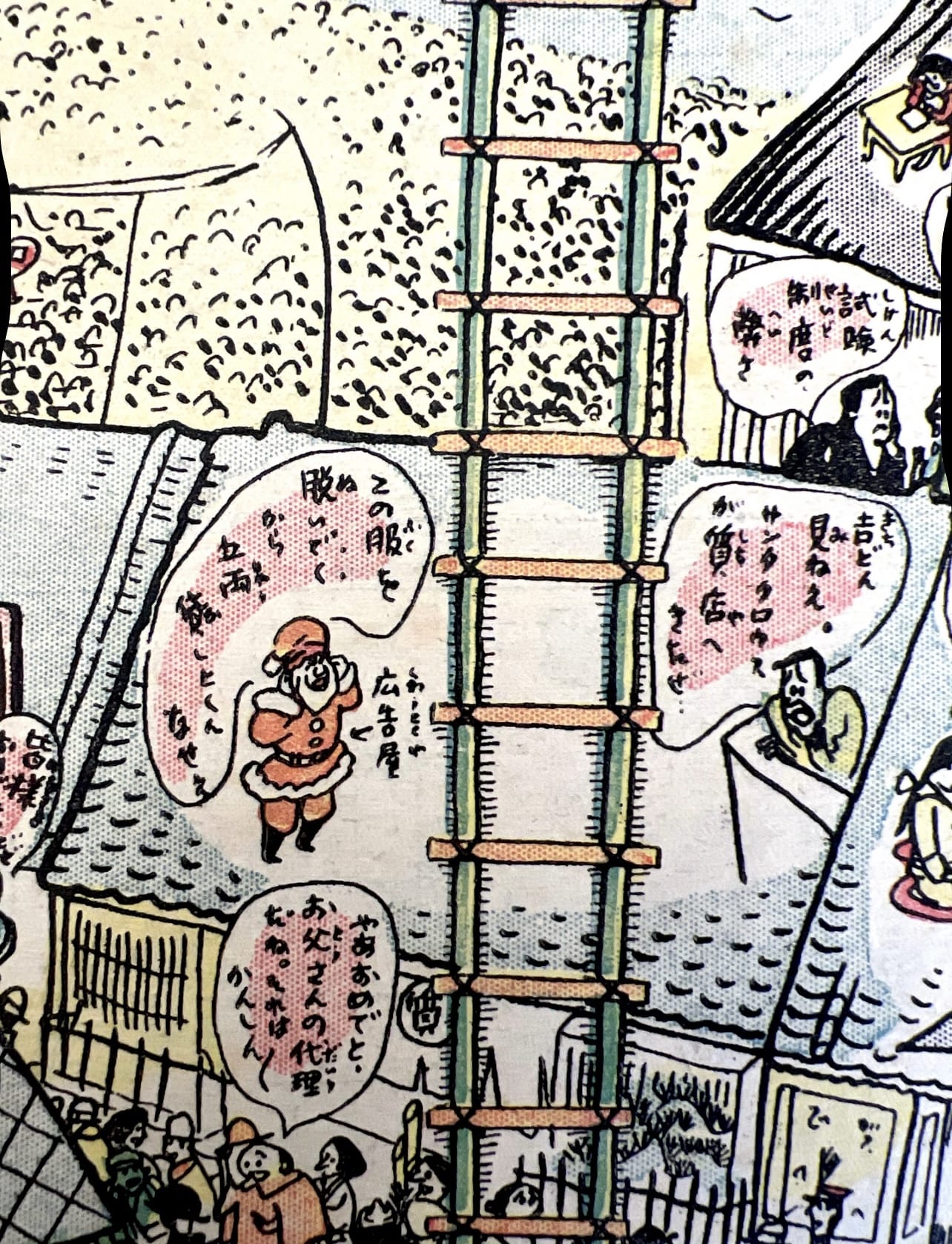
Fig. 3: Close-up on Santa Claus
Like many Jiji Manga cartoons, this New Year’s illustration is notable for its vibrant colors and engaging dialogue—and it is just one of many entertaining works found throughout the series. We will continue to share selections from Jiji Manga on this blog, so please stay tuned.
For more information about these issues and others, visit our Jiji Manga Wiki, which provides cover thumbprints and information about each issue in the collection.
For more information regarding this collection, please contact Area Studies head and Japanese Studies Librarian Dr. Ann Marie Davis at davis.5257@osu.edu or contact the Billy Ireland Cartoon Library and Museum at cartoons@osu.edu.
Find this Issue on our Wiki:
Jiji Manga Volume 246. New Year’s Issue 1926.
Further Reading:
- Comics and the Origins of Manga: A Revisionist History by Eike Exner (Rutgers University Press, 2022).
- Jiji Manga, by Google Arts & Culture (ND).
- Since when has there been the ‘manga-ka’ manga artist? by Natsume Fusanosuke (The Comics Journal, 2024).
- Manga no rekishi by Isao Shimizu (Tōkyō: Iwanami Shoten, 1991).
