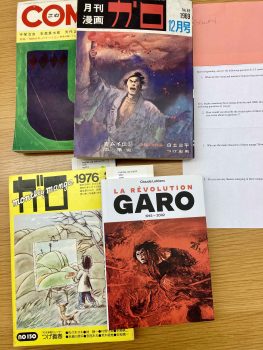
Sample set of four gekiga titles used for “Group 9”
in a recent class on post-war Japanese counterculture
It’s been a while since the last blog post, but never fear, we are still working hard to build and activate our cool manga collection! Speaking of “cool” — we recently had a cool opportunity to explore our manga sub-collection of gekiga (劇画) during a class visit with Professor Keita Moore this semester. In his course “Elements of Japanese Culture” (DEALL 2231), Prof. Moore brought his students in to the BICLM to view some of our gekiga and to learn more about Japanese postwar protest and opposition.
Known for its more mature themes and cinematic flow, gekiga (often translated as “dramatic pictures” in English) is a type of avant-garde manga that departed in style from mainstream Japanese comics in the late 1950s. In contrast to the prevailing manga that were drawn for children (jidō manga or kodomo manga) by artist Tezuka Osamu, gekiga emerged with new content for adult readers, many of whom harbored doubts about the postwar status quo. In many ways, the genre of gekiga gave shape to these doubts, and spoke to societal issues of the times, ranging from economic and social inequality, Japan’s Cold War military alliance with the United States, and the threat of nuclear warfare.
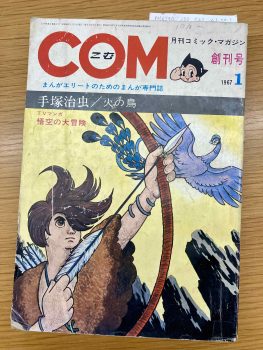
In exploring these themes, we were thrilled to dig into BICLM’s holdings and choose from hundreds of examples of gekiga. Starting with a truly sizable run of the famous monthly anthology magazine Garo (ガロ) (over 260 volumes, from the inaugural issue in 1964 to issue 402, published in 2000) as well as significant holdings of Tezuka’s rival alternative magazine called Com (コム, Komu) (with 68 issues, from the inaugural issue in 1967 to the final issue in 1971), the gekiga sub-collection offers a rich treasure trove of primary source materials for scholars and students alike. Additionally, we were able to tap into numerous secondary sources as well as anthologies and stand-alone books (tankōbon) produced by key gekiga artists including Sanpei Shirato (白土三平, 1932-2021), Saito Takao (さいとう たかを 1936-2021), Yoshiharu Tatsumi (辰巳ヨシヒロ, 1935-2015), Tadao Tsuge (つげ忠男, 1941- ) and Shigeru Mizuki (水木しげる, 1922-2015), among others
-
-
Another sample set of gekiga for “Group 4”
used on the day of the class visit
-
-
Inaugural cover of Com magazine,
published in January 1967
For Prof. Moore’s recent class, we curated several small sets of books and serials (2 Garo magazines, 1 Com magazine, and 1 secondary manuscript or anthology each) for the students to peruse and study. The students were encouraged to identify the more common narrative features, themes, and visual styles of gekiga during their visit. In sum, while sharing gekiga as a fascinating phenomena of global counterculture in the mid- to late-twentieth century, we were thrilled to give students this hands-on opportunity to truly appreciate the diversity of Japanese comics.