Manga

...bibliographic notes about manga...

Tag: pre-war manga

Jiji Manga’s New Year Humor In Interwar Japan

Guest post by Anqi Chen

A comic showing an enormous crowd of people celebrating the beginning of spring

Full image of The Bustle of the Beginning of Spring (Click Image to Enlarge)

If you enjoy Japanese manga, history, and politics, OSU Libraries has something especially compelling for you. In January 1902—more than a century ago—a cartoon series titled Jiji Manga (時事漫画, literally Current Manga) was launched as a supplement to the newspaper Jiji Shinpō (時事新報, Current Events). The series was edited by the renowned manga and nihonga artist Yasuji Kitazawa—better known by his pen name Rakuten Kitazawa (北澤楽天, 1876–1955)—a pioneering figure in the development of modern manga.

Founded by Fukuzawa Yukichi (福澤諭吉, 1835–1901), one of the most influential intellectuals of modern Japan, Jiji Shinpō had a wide national readership. Jiji Manga, issued as a separate illustrated supplement, adopted a distinctly visual and experimental approach, presenting political news and social criticism through humor and caricature. According to the Bujalance Collection, Jiji Manga was the first periodical to use the term “manga” in its title in a modern sense. Each issue featured a single full-page editorial cartoon, often accompanied by ironic dialogue that reflected Rakuten’s sharp, satirical take on contemporary politics. As the creator of thousands of early editorial cartoons and comic strips that influenced generations of artists, Rakuten is now widely regarded as the founding father of modern manga. 

Cartoon of a crowd of people speaking in Japanese

Fig. 1: Close-up on the upper left
Continue reading

Leveling Up the Jiji Manga Wiki: Fresh Updates + Video Walkthrough

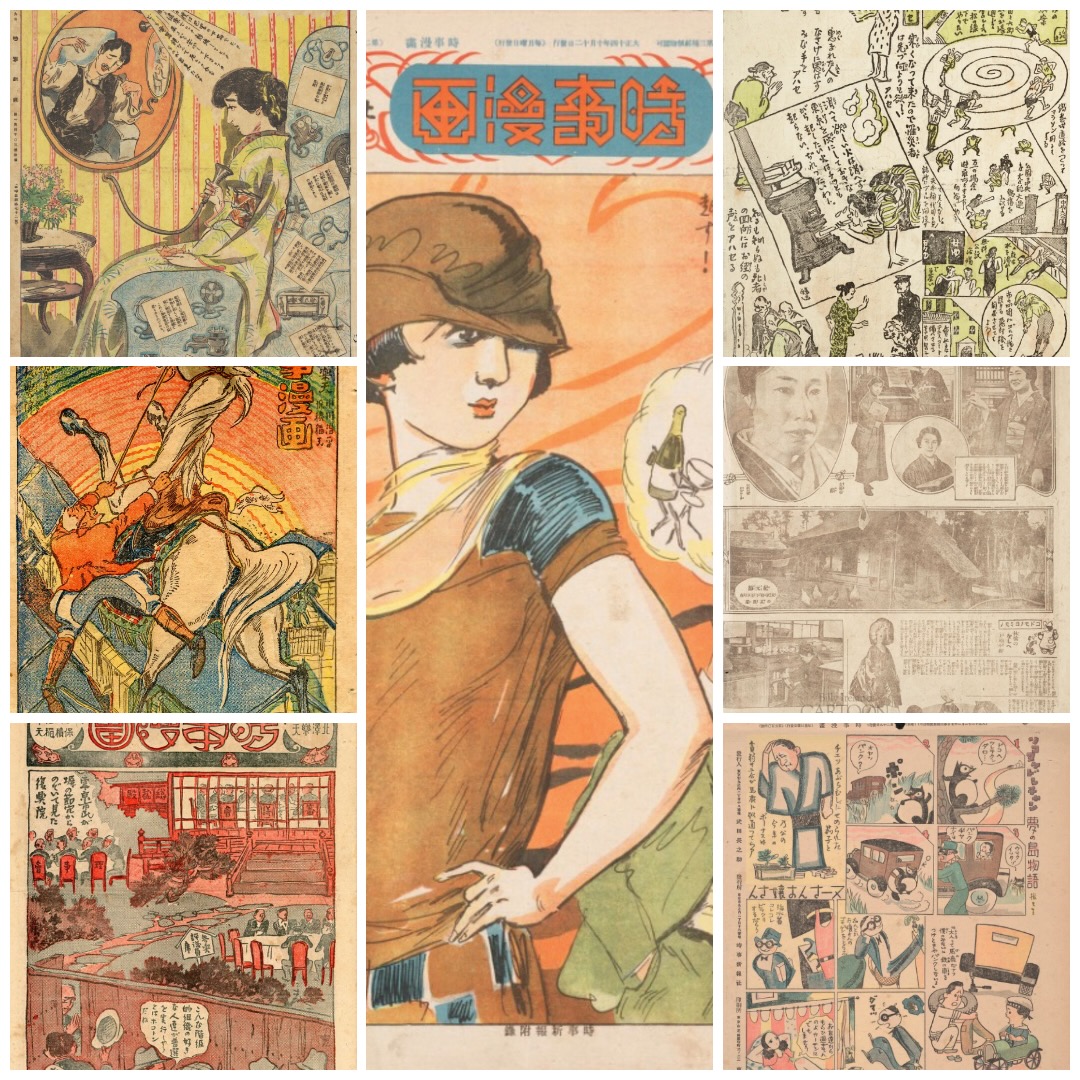
Collage of Jiji Manga Covers

A collage of Jiji Manga covers retrieved from the University Libraries’ Digital Collections

Inspired by American-style newspaper comic supplements, Jiji Manga was one of Japan’s first modern comic strips. It featured cartoons by Kitazawa Rakuten (北澤楽天) and his contemporaries, translations of foreign comics, as well as puzzles, photographs, and editorial articles. The Billy Ireland Cartoon Library & Museum holds 476 of the 504 published volumes—making it one of the most complete runs in the world.

To help make this remarkable resource more discoverable, our library launched the Jiji Manga Wiki over fifteen years ago (a project still in progress). This past summer, thanks to the dedicated efforts of student workers Anqi Chen and Joseph Santiago, many gaps in the Wiki were finally filled. Their careful reading of prewar, non-standardized Japanese texts has allowed us to add complete contents transcriptions for almost every volume of the magazine—bringing us closer than ever to completion.

Jiji Manga Video Tutorial Transcription

Continue reading

Glimpses from the Vault: The Tokyo Puck (Tōkyō pakku) Originals and Reprints

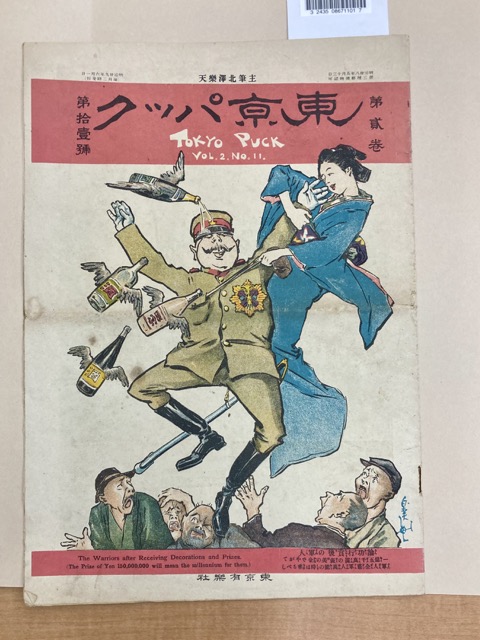
Among the many unique manga serials held at OSU’s Billy Ireland Cartoon Library & Museum (BICLM) are three original issues of Tokyo Puck (東京パック), an early Japanese satirical comic newspaper launched by Kitazawa Rakuten (北沢楽天, 1876-1955) and published from 1905 to 1923 (with a 5-year interruption circa the First World War). This Japanese manga newspaper was inspired by the American magazine Puck (published from 1877 to 1918), one of the earliest humor magazines in the US to solely feature cartoons, caricatures, and political satire.

Colorful newspaper cover page with a geisha, flying beer bottles and a drunken soldier

The cover page of an issue of Tokyo Puck (Volume 2, Number 11, published June 1, 1906), held at the BICLM. PN6790.J32 T65 v.2:no.11

Recently I had the opportunity to click some pictures of two of our Tokyo Puck issues during a class visit with students from “The Art of Colonial Taiwan,” (ArtHist 5002). In addition to our Tokyo Puck samples, the students in this class browsed a variety of materials depicting Taiwan and other Japanese colonies in historical cartoon maps, water colors, and artist scrolls created by famous manga artists of the early 20th century.

Continue reading

Genshi Sugoroku: Kagaku Kyōiku Manga (Atomic game board: Comics for science education)!

Images details, counterclockwise, from upper right corner: 1. Original envelope containing the fold-out  print;  2. The foldout print in its entirety; 3. Print detail of the game goal (“agari, “上り), flanked by descriptions of Hideki Yukawa and Alfred Nobel;  4. Print detail of “No more Hiroshimas!” located above the goal.

As of today our exhibit, “Creative Responses to the Cold War,” has come to an end.  It was bittersweet when I worked this morning with colleagues in the Thompson First Floor Gallery to empty all of the exhibit cases. 

One of my favorite exhibit pieces, which will soon makes its way back to the Billy Ireland Cartoon Library and Museum, is called Genshi Sugoroku (原子双六, which translates roughly as “Atomic Game Board”), a colorful manga that celebrated the physicist Yukawa Hideki (湯川秀樹: 1907-1981), Japan’s first recipient of the Nobel Prize in physics. 

Continue reading

Kanto Earthquake Orihon Book of Watercolors

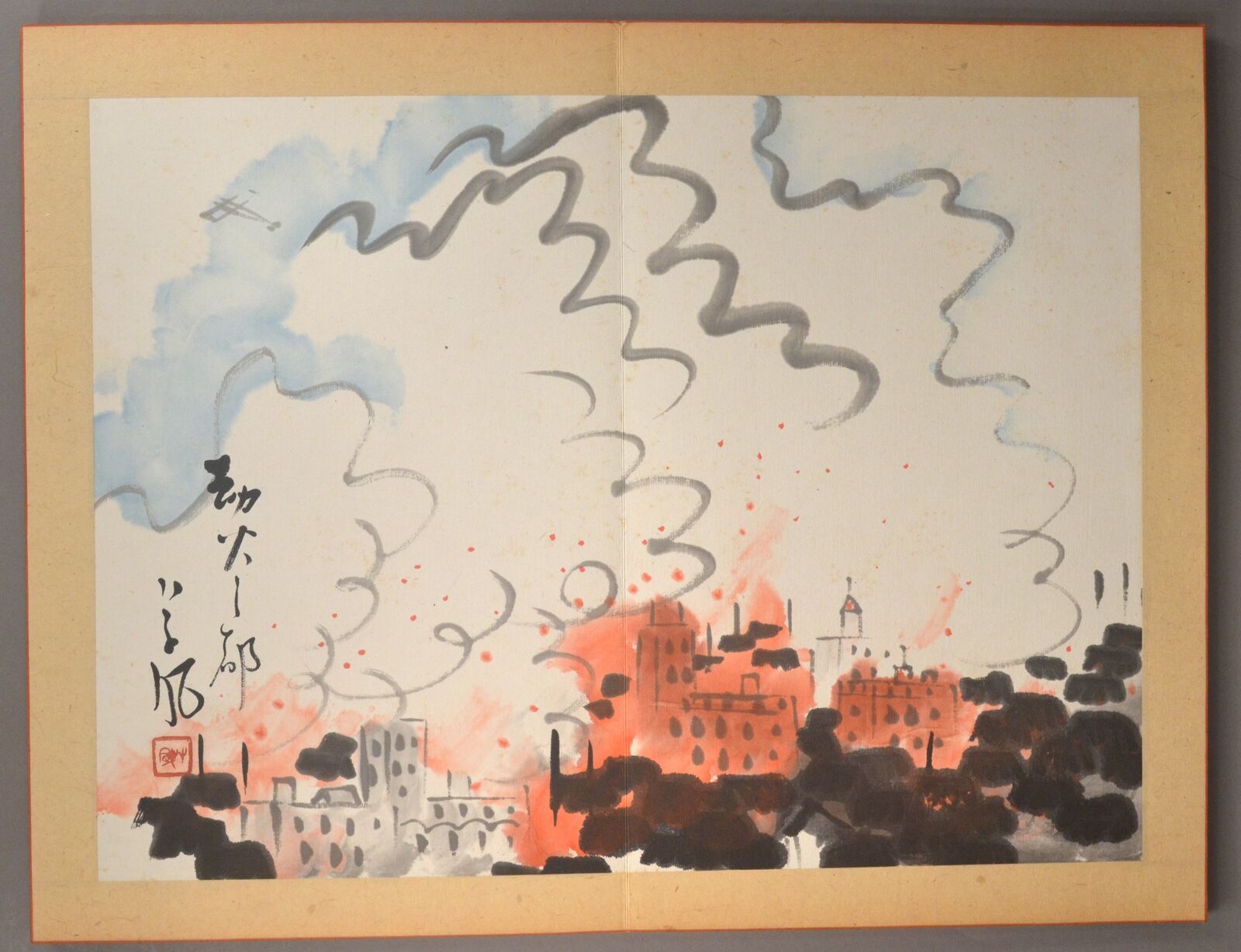
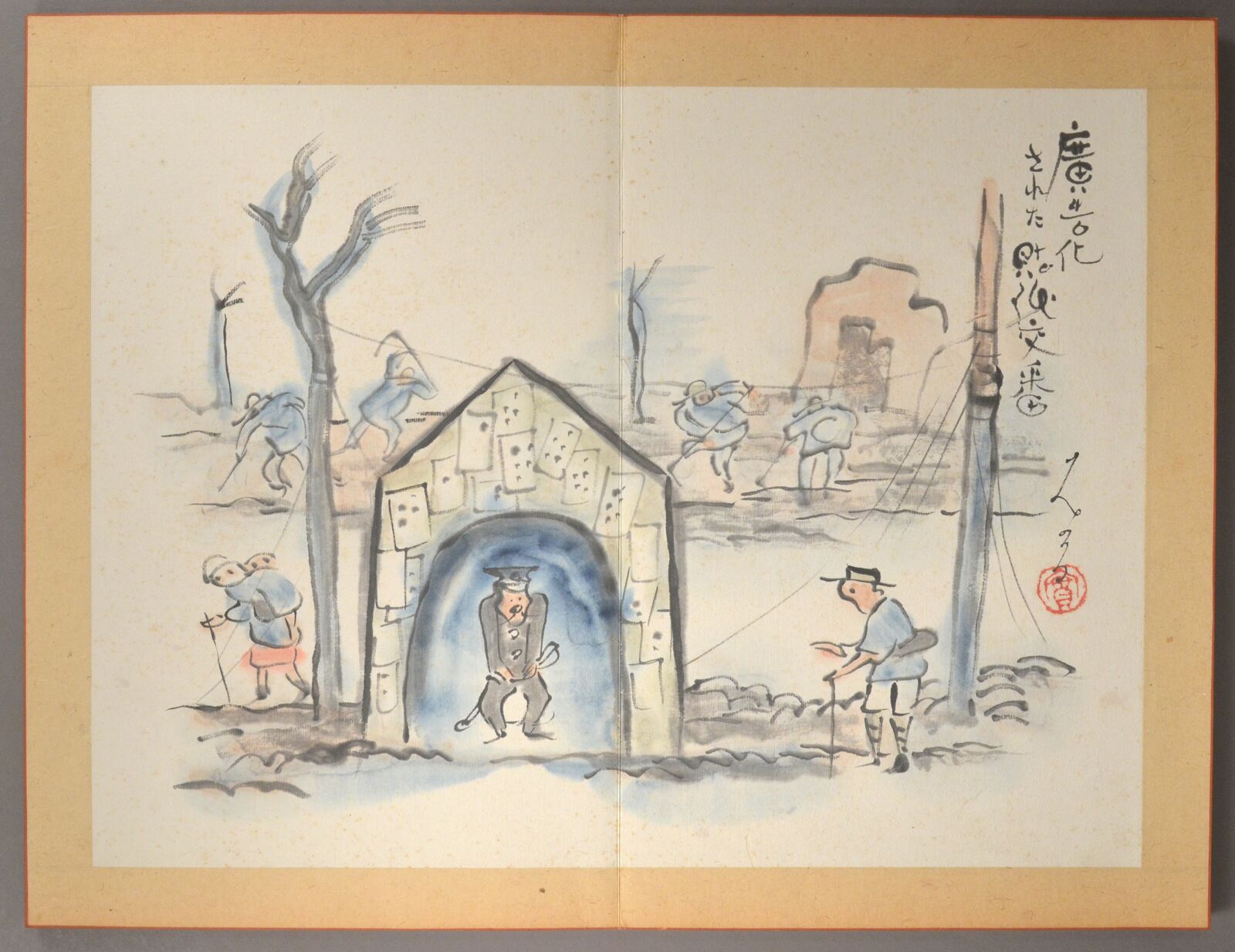
Japanese Studies at OSU Libraries is excited to announce the acquisition of “Kanto Earthquake Watercolors.”  This rare book, which has no official title, includes twelve pages of original paintings depicting the 7.9 magnitude earthquake that hit Japan in 1923. This earthquake devastated several areas and resulted in a large fire, causing the death of an estimated 100,000 to 140,000 people. The paintings, created by Nakazawa Hiromitsu (中沢弘光), a well-known Nihonga and watercolor painter from Kansai, as well as other contemporary manga artists, focus exclusively on  scenes from the aftermath of the historic disaster.

Kanto Earthquake Destruction

Kanto Earthquake Fire


This book, which forms part of the world-class manga collection at OSU Libraries, is now housed at the Billy Ireland Cartoon Library and Museum (BICLM).  For those interested in viewing this rare book, please contact Japanese Studies Librarian Ann Marie Davis at davis.5257@osu.edu

Continue reading