ScriptoriaSlavica

Medieval Slavic Manuscripts and Culture

Page 6 of 15

Midwest Slavic Conference, March 28-30, 2014, Ohio State campus


The Midwest Slavic Conference begins Friday, March 28th, at 5:30 pm with a keynote lecture by Eric McGlinchey (George Mason University): “A Theft So Nice, They Did it Twice: Fleecing Local Populations and Foreign Investors in Central Asia” in Page Hall, Room 10, followed at 6:45 pm by a reception on the first floor landing of Page Hall.

Panels will be held on Saturday, March 29, from 8:30 am to 5:30 pm, and Sunday, March 30th from 8:30 am to 1 pm in Mendenhall Laboratory, which is located on the Oval.

outline of states that comprise the "Midwest Slavic Association" with a sepia photo of red square in the centerThe Midwest Slavic Conference this year coincides with the celebration of the 50th Anniversary of the founding of the Department of Slavic and East European Languages and Cultures at The Ohio State University. Professor Todd Armstrong (Grinnell College), alumnus of Ohio State’s Slavic Department, will give the 50th Anniversary lecture, “Russian Mad Men: Valery Todorovsky’s Teleserial Ottepel’ as a Window on Russian Culture,” on Saturday, March 29th, from 12:15 to 1:45 in Mendenhall Laboratory 100.

View the Conference program.

Source: Website of the Ohio State Center for Slavic and East European Studies

New Acquisition on South Slavic Linguistics

In honor of the approaching 17th Annual Kenneth E. Naylor Memorial Lecture in South Slavic Linguistics, this blog entry spotlights a new book about South Slavic linguistics that has recently been acquired by the East European and Slavic Collection of the William Oxley Thompson Memorial Library (see below).

This year’s Naylor Memorial Lecture “Reimagining the Balkans and Widening the Bund: Does Moldova Belong?” by  Donald L. Dyer (University of Mississippi) will be held in the Campus Reading Room on the 11th Floor of the Thompson Library, The Ohio State University, April 11th at 3:30pm.

The title below was just received from Motoki Nomachi. Please note that Wayles Browne, author of the article on clitics in West and South Slavic languages, gave the 3rd Naylor Memorial Lecture, What Is a Standard Language Good For, and Who Gets to Have One?, in 2000.

Slavic and German in Contact: Studies from Areal and Contrastive Linguistics

Edited by Elżbieta Kaczmarska and Motoki Nomachi
Sapporo, Japan: Slavic Research Center, Hokkaido University, 2014

Preface by Elżbieta Kaczmarska and Motoki Nomachi, 1

Chapter 1: Verbs and Their Constructions

“Wechselbeziehung zwischen Präfixen und Präpositionen bei slowenischen präfigierten Verben, ergänzt durch übersetzungen ins Deutsche,” by Andreja Žele and Eva Sicherl, 1

“On the Kashubian Past Tense Form jô bëł ‘I was’ from a Language Contact Perspective,” by Motkoi Nomachi, 27

“Burgenland-Croatian — First Signs of Language Decay,” by Sabine Pawischitz, 59

Chapter 2: Issues on Clitics

“Groups of Clitics in West and South Slavic Languages,” by Wayles Browne, 81

“Haplology of Reflexive Clitics in Czech,” by Alexandr Rosen, 97

Chapter 3: Lexical and Grammatical Changes

“Germanismen im Serbischen: von systemeigenen zu abweichenden morphosyntaktischen Eigenschaften,” by Milivoj Alanović, 117

“German Elements in the Silesian Ethnolect,” by Jolanta Tambor, 135

List of Contributors, 165


CFP: Seminar on the Turkish Straits


Svenska Forskningsinstitutet i Istanbul

“The Straits – Inquiries into a Crossroad” Seminar at the Swedish Research Institute in Istanbul, November 1-7, 2014

Deadline to submit abstract: May 15, 2014

The Turkish Straits between the Mediterranean and the Black Sea are often described as a symbolic dividing line between Europe and Asia, but historically their function has been uniting and not separating. At the crossroads of land routes between the Balkans and Anatolia, and the sea route between the Mediterranean and the Black Sea, they have constituted a natural meeting place for peoples and cultures since ancient times. Two world empires, the Byzantine and the Ottoman, were ruled from the straits and left their marks on the two main world religions of Christianity and Islam. Greeks, Slavs, Scandinavians, Italians, Turks and Englishmen have tried to gain control over the Straits and sometimes succeeded; but the prize has remained contested and been a recurrent source of dispute. As such, the straits have also been at the core of Eastern and Western political discourses at least since the accession of the Persian king Xerxes 2500 years ago, and their significance to the outbreak of the First World War in 1914 has come to the foreground in recent years. To mark these historical convergences, and to initiate an interdisciplinary platform for future research about the history of the Straits, we invite junior (pre-doc and post-doc) scholars to present their own research and exchange perspectives on the topic during a one-week seminar with excursions at the Swedish Research Institute in Istanbul, November 1-7, 2014. We welcome submissions from different areas of research, such as the Ancient, Byzantine and Ottoman eras, art history, archaeology and memory studies, studies in the religious, cultural and political relations, as well as the topography, landscape and environment history of Eastern Europe, the Mediterranean and the Middle East.

Applicants should submit abstracts of no more than 500 words to nbneidolon@gmail.com no later than Friday, May 15, 2014, together with a CV and a few lines about their interest in the topic, from a subject specific as well as from an interdisciplinary point of view. For those who are accepted, the stay in Istanbul, the excursions and most meals will be arranged and paid for by the seminar. In addition to this, we may consider reimbursing the cost of travel to and from Istanbul for a strictly limited number of applicants (those who wish to be considered for such travel funding should specify it in their application and explain why other sources are not available).

Olof Heilo, Lund / Vienna

Tonje Haugland, Sørensen / Bergen

Monica White, Nottingham

Alexandros Tsakos, Bergen / Berlin

Source of announcement: M. White, Early Slavic Listserv

50th Anniversary of the Department of Slavic and East European Languages and Cultures at The Ohio State University


Founded in 1964, Ohio State’s Department of Slavic & East European Languages & Cultures is celebrating its 50th anniversary with a slate of lectures and presentations.

50th Anniversary Celebration

Monday, March 24

  • Public Roundtable on Polish-Jewish Studies at 5:30 p.m. Location: Page Hall 0020
  • Slavic Dinner with special presentation on Russian slang by Marina Pashkova at 6:30 p.m. Location: Jennings Hall 60

Thursday, March 27

  • Kapustnik – 7:15 p.m. in Hagerty Hall 180

Friday March 28

  • Video Conference with Murmansk, Russia at 8:00 a.m. in Hagerty Hall 145
  • Midwest Slavic Conference Keynote address by Eric McGlinchey (George Mason University) followed by reception in Page Hall.

Saturday, March 29

  • Midwest Slavic Conference, 8:30 a.m.-5:30 p.m. in Mendenhall Laboratory
  • George Kalbouss presenting the history of the Department
  • Luncheon Speech by Todd Armstrong

Sunday, March 30

  • Midwest Slavic Conference, 8:30 a.m.-1:00 p.m. in Mendenhall Laboratory

CFP: Textual Heritage and Information Technologies El’Manuscript-2014


Textual Heritage and Information Technologies

El’Manuscript-2014

Varna, Bulgaria

15-20 September 2014


Izhevsk State Technical University and the Cyrillo-Methodian Research Centre at the Bulgarian Academy of Sciences invite submissions of abstracts for the El’Manuscript-2014 international conference on the creation and development of information systems for storage, processing, description, analysis, and publication of medieval and early modern hand-written and printed texts and documentary records. Any person involved in the creation or analysis of these resources is welcome to participate.

El’Manucsript-2014 is the fifth in a series of biennial international conferences entitled “Textual Heritage and Information Technologies” (http://textualheritage.org). The program of the conference traditionally includes tutorials, lectures, and computer classes for young scholars and students. The working languages of the 2014 conference are English, Bulgarian and Russian, and papers presented at the Conference will be published in a volume of proceedings and on the http://textualheritage.org website. Selected papers in English will be published in a special issue of the Digital Medievalist Journal (http://digitalmedievalist.org/journal/) and, if written in Bulgarian, English or Russian, Palaeobulgarica.

The fifth conference is a joint event of the Textual Heritage and Digital Medievalist scholarly communities. It is co-organized by Izhevsk State Technical University (Russia) and the Cyrillo-Methodian Research Centre at the Bulgarian Academy of Sciences and supported by the Sustainable Development of Bulgaria Foundation.

Source of announcement: Textual Heritage website, via Olga Mladenova


CFP: Andalusian Symposia on Slavic Studies

4th INTERNATIONAL CONFERENCE

ANDALUSIAN  SYMPOSIA

ON SLAVIC STUDIES

GranaSlavic2014

www.ugr.es/~feslava/granaslavic2014/

UNIVERSITY OF GRANADA, SPAIN

June 4-6, 2014


The Organizing Committee is pleased to announce the 4th International Conference “Andalusian Symposia on Slavic Studies” (GranaSlavic2014), which will be held in June 4-6, 2014 at the University of Granada. This event is organized to celebrate the 20th anniversary of the founding of the Department Section of Slavic Studies at the University of Granada.

The goal of the Conference is to promote both theoretical and applied research in the field of Slavic Studies, and bring together scholars who are interested in the different topics of the Conference :

  1. Learning and Teaching of Slavic Languages and Cultures
  2. Slavic Literatures and Cultural Expressions
  3. Media, Political Discourse and International Relations
  4. History, Culture and World View
  5. Linguistic  Studies
  6. Translation to and from Slavic Languages

The official conference languages are any Slavic language, Spanish, and English.

Abstract   (300-350   words,   not    including    references)    must    be    submitted    online    via  http://linguist list.org/easyabs/granaslavic2014   by March 3, 2014.

Important dates:

  • Abstract submission: March 3, 2014
  • Notification of acceptance: March 18, 2014

After acceptance of your abstract:

  • Registration deadline: April 18, 2014.
  • Program Announcement: May 20, 2014.
  • Conference dates: June 4-6, 2014.
  • Paper submission to be published in the book “Trends in Slavic Studies” (Editorial URSS): June 16, 2014. Further details about paper publication requirements will be posted at the conference URL:  www.ugr.es/~feslava/granaslavic2014/.

For more information, see cfp_GranaSlavic


Call for Papers: 2014 Midwest Slavic Conference


The Midwest Slavic Association and The Ohio State University (OSU) Center for Slavic and East European Studies (CSEES) are proud to announce the 2014 Midwest Slavic Conference, to be held at OSU March 28-March 30, 2014.

Conference organizers invite proposals for panels or individual papers addressing all disciplines related to Eastern Europe and Eurasia. The conference will open with a keynote address by Eric McGlinchey (George Mason University) and a reception on March 28th, followed by two days of panels.

Please send a one-paragraph abstract in PDF format and brief C.V. to csees@osu.edu by January 13, 2014. Undergraduate and graduate students are encouraged to participate. Limited funding is available for student lodging. Participants can elect to have their abstract, paper, and presentation included in the conference’s Knowledge Bank community. Those opting for inclusion in Knowledge Bank can also choose to receive a brief peer review by the conference committee. Please indicate by email when submitting your abstract whether you want to be included in the Knowledge Bank and have your submission reviewed.

outline of states that comprise the "Midwest Slavic Association" with a sepia photo of red square in the center

Abstract and C.V. Deadline: January 13, 2014
Notification of Acceptance: February 5, 2014
Panels Announced: February 28, 2014
Paper Submission Deadline: March 14, 2014

The Midwest Slavic Association also would like to announce Between Shots, a series of panels within the conference dedicated to East European/Eurasian film and visual culture. A Central/Southeastern European film will be screened with a corresponding panel discussion. Limited support for travel and lodging may be available to Between Shots participants. Please indicate your participation interest in Between Shots via email when submitting your abstract and C.V.

Center for Slavic and East European Studies at OSU
303 Oxley Hall, 1712 Neil Avenue
Columbus, OH 43210
(614) 292-8770

CSEES@osu.edu
SlavicCenter.osu.edu


OSU Mt. Athos Photo Exhibit by Aristides (Art) Chakalis

Mt. Athos Greece: Present day monks in ancient monasteries

Photographs by Aristides (Art) Chakalis

November 30 – December 30, 2013

OSU Northwood ARTSpace Room 100


Photo of mount Athos (on the left 2/3s of the photo) set in the Aegean sea (bottom half of image) with small boat and three men on the left middle of the photo. Deep blue sky above with white fluffy clouds near the sea level.

Fishing the Aegean off the coast of Mt. Athos. Photography by Aristides (Art) Chakalis, 2008.


Northwood ARTSpace is located in the Northwood-High Building Room 100, 2231 N. High Street, Columbus, Ohio. The gallery is open Monday-Saturday, 8am to 7pm except when meetings are held there – check the gallery’s calendar online at http://www.universitydistrict.org/room-100-calendar.html.

“Art Chakalis shares a series of photographs he took in 2008 while visiting monasteries of Mt. Athos Greece. Unless otherwise noted, all photographs are 11×14 inches and matted to 16×20 inches.

1)  Fishing the Aegean off the coast of Mt. Athos

2)  Gregoriou from the sea

3)  Monks at the Gregoriou Monastery

4)  Cat enjoying a sunny afternoon in Karyes

5)  Walkway to a chapel in Karyes

6) Church along the path between Karyes and Xeropotamou

7)  Cemetery at Xeropotamou

8)  Nurturing God’s Bounty

9)  Flowers on the Mountainside

10)  The Refectory

11)  The Outer Narthex

12)  The Inner Narthex

13)  Inner Narthex Chapel

14)  Peering into the Nave

15)  The Nave

16)  Christ Pantocrator

17)  The Icon Screen

18)  Altar within the Sanctuary

19)  Yesterday’s worship is complete and a new day begins with the setting of the sun

20)  Simons Petras from the sea

21)  Monks preparing to travel the steep path home from the sea

22)  Life between mountain and sea

23)  Solitary cross along the shoreline”


Image source: Art Chakalis

Text source: Catalog list of photographs

Texts and Contexts Conference, November 15-16, 2013


The annual Texts and Contexts conference, sponsored by the Center for Epigraphical and Palaeographical Studies at The Ohio State University, was held Friday and Saturday, November 15-16, 2013, in Columbus, Ohio. Three panels convened on Friday, with the evening devoted to the Virginia Brown Memorial Lecture and a reception. The two remaining panels were scheduled on Saturday.

Friday, November 15, 2013

Session I: Texts and Their Progeny

Moderator: Anna A. Grotans (Department of Germanic Languages and Literatures, The Ohio State University)

Caroline Stark (Department of Classics, Howard University): Lorenzo Bonincontri as Commentator

Amanda J. Gerber (Department of Languages and Literature, Eastern New Mexico University): Grammatical and Rhetorical Paraphrases in Rome, Biblioteca Casanatense 1369 and Oxford, Merton College 299

Michael Meckler (Center for Epigraphical and Palaeographical Studies, The Ohio State University): Designer Dogs’ in an Illustrated Manuscript of Ps.-Oppian’s Cynegetica

Session II: Script and Manuscripts

Moderator: Quinn Radziszewski (Department of Classics, The Ohio State University)

Ainoa Castro Correa (Postdoctoral Fellow, Pontifical Institute of Mediaeval Studies): The Galician Visigothic Script, A New Regional Variant?

Heather C. Key (University College Cork): The Eponymous Goddesses of  Lebor Gabála Érenn

Erika Nuti (Università degli Studi di Torino, Italy): Lost and Found: The Turin National Library and the Achievements of the Greek Books Project

 Session III: Medieval Latin Texts

Moderator: Michael Jean (Department of Classics, The Ohio State University)

Scott G. Bruce (Center for Medieval and Early Modern Studies, University of Colorado at Boulder): Relatio sancti Maioli de duobus ducibus: Prayer for the Dead and its Rewards in an Unstudied Cluniac Story Cycle from the Twelfth Century

Tomás O’Sullivan & Alexander Giltner (Department of Theological Studies, Saint Louis University):The Reference Bible’s  Praefatio euangelii: Editing the Principal Textual Witness to an Amorphous Tradition

Tina Chronopoulos (Classical and Near Eastern Studies, State University of New York Binghamton): A Latin-German version of the Passion of St. Katherine of Alexandria

Virginia Brown Memorial Lecture

Introduction: Richard Fletcher (Department of Classics, The Ohio State University)

Julia Haig Gaisser (Eugenia Chase Guild Professor Emeritus in the Humanities, Bryn Mawr College): Excuses, Excuses: Racy Poetry from Catullus to Joannes Secundus


Saturday, November 16, 2013

Session IV: Medieval Vernacular Texts

Moderator:  John Richards (Department of Classics, The Ohio State University)

Jos A.A.M. Biemans (Department of Book History and Manuscript Studies, Universiteit van Amsterdam): The Manuscript Tradition of Jacob van Maerlant’s Spiegel historiael

Jacob Thaisen (Department of Cultural Studies and Languages, University of Stavanger, Norway): A Survey of Middle English Allographs

Delphine Mercuzot (Département des Manuscrits, Bibliothèque National de France): Caxton’s Recueil and ulterior manuscripts

Session V: Varia

Moderator: William Little (Department of Classics, The Ohio State University)

Giorgi Kavtaradze (Department of History, St. Andrew the First Called Georgian University): Prester John: Identity in Greek and Georgian Medieval Manuscripts

Thomas Bredehoft (Independent Scholar): Elliott Van Kirk Dobbie’s Copy of The Anglo-Saxon Poetic Records


With the conclusion of the official conference program, Jos A.A.M. Biemans (Amsterdam), accompanied by Erika Nuti (Torino), and Giorgi Kavtaradze (Tblisi) received a guided tour of the Rare Books and Manuscripts Library (RBMS) and the Hilandar Research Library (HRL) from Dr. Eric J. Johnson, RBMS Curator of Early Books and Manuscripts, and from the HRL’s Associate Curator.


Source: Program from the Texts and Contexts conference, and the conference website.


Myroslava M. Mudrak, OSU History of Art Professor Emerita, Honored


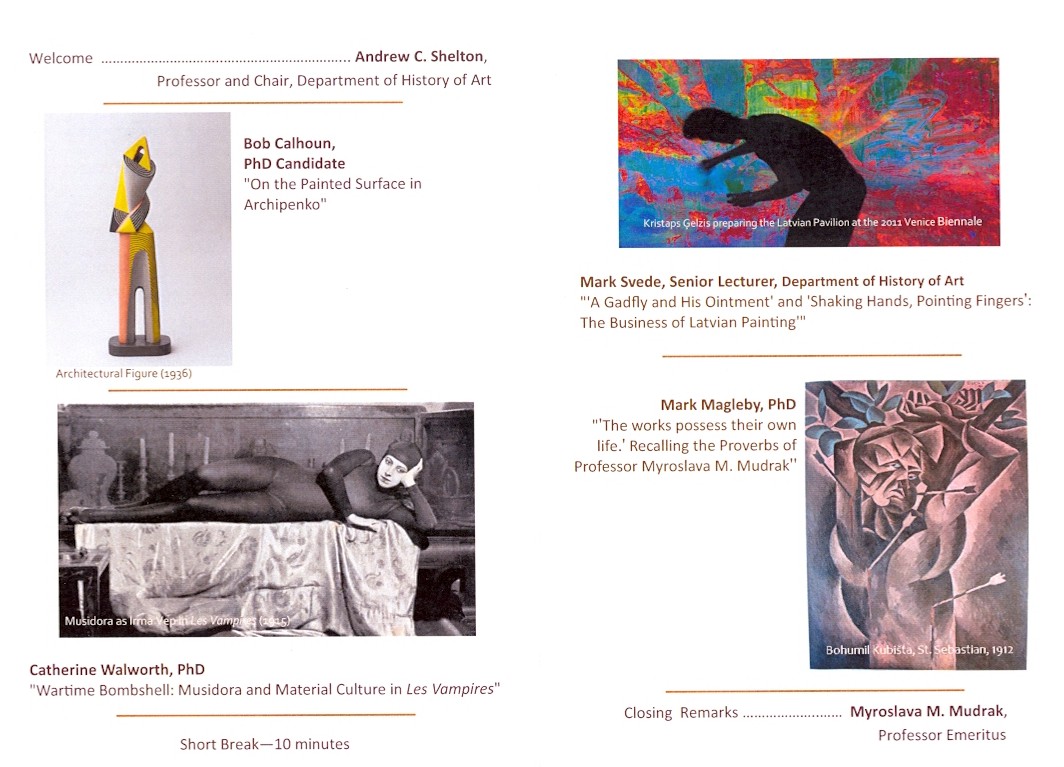
The OSU Department of History of Art organized a Symposium in Honor of Myroslava M. Mudrak on Saturday, October 5, 2013.  Professor Andrew C. Shelton, chair of the Department of History of Art, opened the venue with a heartfelt encomium to Professor Mudrak, who retired from the department June 1st after 31 years. The symposium was composed of presentations by four of Professor Mudrak’s former students (see the program below). Myroslava Mudrak responded to the tribute in the closing remarks of the symposium, and then the participants and the audience of students, colleagues, friends, and staff members adjourned to the graduate students’ reading room in Pomerene Hall for refreshments and more laudatory remarks – from colleagues both on site and from others who sent best wishes via email.

Professor Mudrak has been a friend and supporter of the Hilandar Research Project from the time of her arrival on campus, and has served on the Advisory Board for the Resource Center for Medieval Slavic Studies since its inception.

The Department of History of Art has established in tribute the “Myroslava M. Mudrak Graduate Research Fund in the History of Art,” fund #314565. “In the spirit of Dr. Mudrak’s teaching and mentoring, the fund supports research for graduate students in the Department of History of Art who have demonstrated intent to pursue professional work related to the visual arts after graduation.” If you wish to make a donation, contribute online at giveto.osu.edu.


Front cover of the program for the Symposium in Honor of Myroslava M. MudrakMudrak0002Back page of the program for the Symposium in Honor of Myroslava M. Mudrak


« Older posts Newer posts »