ScriptoriaSlavica

Medieval Slavic Manuscripts and Culture

Page 5 of 15

Books from the Russian National Library


Among the books that we have added to our collection in the past year are a half a dozen that came to us thanks to Zhanna Levshina of the Manuscripts Division of the Russian National Library, St. Petersburg. We are also grateful to Robert Romanchuk, professor of Russian, Slavic and medieval studies at Florida State University (Tallahassee), for bringing the books to us from Russia. This post highlights a book of research on the Ostromir Gospel.

Front cover of the book - midnight blue with a color image of the miniature of St. Luke from the Ostromir Gospel on the front, with the title of the manuscript above the image, and the subtitle of the book below the image

A collection of scholarly articles on the Ostromir Gospel (St. Petersburg: RNB, 2010)

E.V. Krushel’nitskaia, otvet. red., A. A. Alekseev, M. IU. Liubimova, i dr.; sostav. Zh. L. Levshina, Ostromirovo Evanglie i sovremennye issledovaniia rukopisnoi traditsii novozavetnykh tekstov: Sbornik nauchnykh statei (St. Petersburg: Russian National Library, 2010).

This is a collection of articles on the Ostromir Gospel, the earliest extant dated East Slavic manuscript, published on the occasion of the 950th anniversary of the creation of codex (1056-1057).

Содержание/Contents

Осторомирово Евангелие: вопросы изучения и восприятия памятника/The Ostromir Gospel: Questions regarding the Study and Reception of the Monument

От редколлегии/’From the editors,’ 7-11
Е. В. Крушельницкая, “Остромирово Евангелие и Российская национальная библиотека: хранение и изучение памятника”/’The Ostromir Gospel and the Russian National Library: the Housing/Preservation and Study of the Monument,’ 15-40.
A. A. Aлексеев, “Остромирово Евангелие и византийско-славянская традиция Священного Писания”/’The Ostromir Gospel and the Byzantino-Slavic Tradition of the Holy Scriptures,’ 41-59
О. С. Попова, “Остромирово Евангелие: Миниатюры и орнаменты”/’The Ostromir Gospel: Miniatures and Ornamentation,’ 60-84
А. В. Сиренов, “Мнение старообряцев о подложности Остромирово Евангелия”/’The Opinion of the Old Believers on the Spuriousness of the Ostromir Gospel,’ 85-94
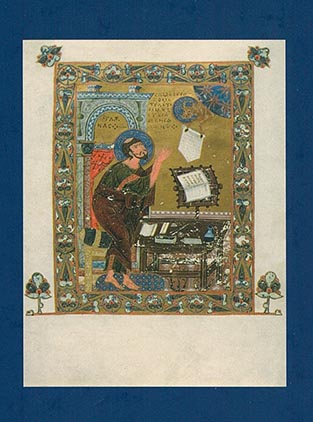
Image of the full-page illumination of St. Luke

Miniature of St. Luke from the Ostromir Gospel

Книжная традиция новозаветных текстов: разные аспекты исследования/’The Literary Tradition of New Testament Texts: Various Aspects of Research’

К. Попконстантинов, “Евангельские тексты в эпиграфических памятниках средневековой Болгарии”/’Gospel Texts in the Epigraphical Monuments of Medieval Bulgaria,’ 97-105
В. А. Есипова, “Новозаветные тексты в составе рукописей из сибирского собрания XIII‒XVIII веков”/’New Testament Texts in the Structure of a Siberian Collection of the 13th-18th Centuries,’ 106-116
А. А. Турилов, “Из какого евангельского кодекса происходит послесловие анагноста Радина?” 117-127
С. Г. Жемайтис, “Спиридоний—диакон, протодиакон, писец Киевской Псалтири и Евангелия 1393 года: опыт реконструкции биографии,” 128-147
В.А. Ромодановская, “Маргиналии в Евангелиях Геннадиевской Библии 1499 года (на примере Евангелия от Иоанна)”/’Marginalia in the Gospels of the Gennadii Bible of 1499 (for example, the Gospel According to John),’ 148-161
Е. К. Братчикова, “Сийское Евангелие XVII века—’редчайший образец иллюстрированного апракоса’ (особенности текстовой и изобразительной композиции),” 162-171
О. В. Чумичева, “Символы евангелистов в русской рукописной традиции,” 172-180
И. Д. Соловьева, “К истории живописного оклада русских напрестольных Евангелий,” 181-190
О. А. Белоброва, “Дневникове записи военного моряка Д. П. Белоброва на Евангелии, изданном на церковнославянском языке в Киево-Печеской лавре в 1900 году,” 191-197
Г. Импости, “Два знаменитых библиотекаря: Джузеппе Меццофанти и Александр Востоков,” 198-209
В. Н. Алексеев, Е. И. Дергачева-Скоп, А. Ю. Бородихин, А. В. Шабанов
, “Цифровая версия Острожской Библии: к проблеме максимального функционального приближения электронного образа к живому к ‘живому’ памятнику,” 210-218

Евангельский текст и древнерусские нотированные рукописи/’The Gospel Text and Old Russian Notated Manuscripts’

Н. В. Рамазанова, “Остромирово Евангелие и древнерусские нотированные рукописи,” 221-238
А. Н. Кручинина, “Евангельский текст в древнерусских песнопениях,” 239-249
А. Н. Гаевская, “Неделя о мытаре и фарисее: евангельское чтение, гимнография, роспев,” 250-263
Ю. В. Жилина, “Евангельские чтения в службе Сретения Господня,” 264-274

Юбилейные выставки в Отделе рукописей Российской национальной библиотеки/’Jubilee Exhibitions in the Manuscripts Division of the Russian National Library’

Е. В. Крушельницкая и В.А. Ромодановская, “Обзор,” 277-279
Остромирово Евангелие и рукописная традиция новозаветных текстов:
И. Н. Лебедева, “Греческие рукописи евангельских текстовVI–XIII веков,” 280-285
Ж. Л. Левшина, “Южнославянские рукописные Евангелия,”286-301
О. С. Сапожникова, Е. Э. Шевченко, “Рукописные Евангелия в Древней Руси и Новой России: XI–XIX веков,” 302-322
Н. В. Рамазанова, “Певческие рукописи XII–XVII веков,” 323-332
М. Г. Логутова, “Евангелие в западноевропеŭскоŭ рукописноŭ традиции: от слова к образу,” 333-339
О. В. Васильева, “Рукописи Нового Завета на восточных языках,” 340-349

Список сокращений/’List of Abbreviations,’ 350-352
Иллюстрации/’Illustrations,’ 353-416.

Beautiful, full-color plates

Other titles include:

Brown background with two white strips in the lower half of the book, one with the name of the author, the other with the title. Above the white strips is a black and white photograph of a young Vladimir Mošin

Front cover of “Archpriest Vladimir Mošin” (St. Petersburg, 2012)

Протоиереŭ Владимир Мошин, Воспоминания/’Reminiscences’ (Санкт-Петербург Цветослов, 2012). Издание подготовили Ж. Л. Левшина и Е. А. Пережогина.
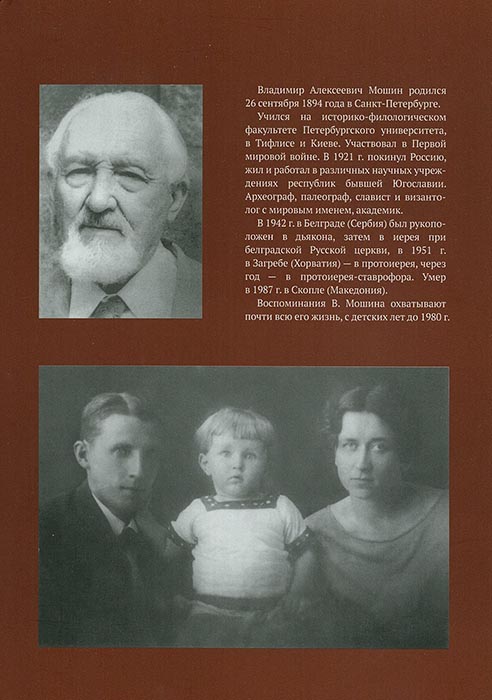
Back cover in brown with two black and white photos - one of Mošin as an elderly man, one of a blond boy between his parents.

Back cover of “Archpriest Vladimir Mošin” (St. Petersburg, 2012)


Ж. Л. Левшина, ред. Жития, Святитель Николай Жичский: Служба—Житие—Житије (Санкт-Петербург Цветослов, 2013). The book includes a tribute to Hrizostom, Bishop of  Žiča (1939-2012), and a former librarian of Hilandar Monastery

Red front cover with title and publisher's name in white, in the middle is a color photo of an icon of the saint - on a gold background

St. Nicholas, Bishop of Žiča (Serbia): Office – Life (St. Petersburg, 2013)


Menaia and Tropologia from St. Catherine’s Monastery in Sinai


Aleksandra IUr’evna Nikiforova’s book, Iz istorii Minei v Vizantii: Gimnograficheskie pamiatniki VIII-XIi vv. iz sobraniia monastyria sviatoi Ekateriny na Sinae, focuses on the history of the Menaion liturgical book in Byzantium, specifically the hymnographical texts of the 8th-12th centuries from the manuscript collection of St. Catherine’s Monastery, Mount Sinai.

Image of the front cover the book which is a photograph of the Mt Sinai with photo inset over the horizon of the monastery itself. Above the inset image, in top right is the title of the book in Russian, with the author's name at the very top.

Moscow 2012


Nikiforova examines the Sinai Greek Tropologia and Menaia from the 8th-16th century, housed in both St. Catherine’s and in Moscow’s State Historical Museum and Russian State Library. Manuscripts from other Russian repositories, the Austrian National Library (Vienna) were also consulted, as were microfilms held in the Patristic Greek Institute (Vlatadon) in Thessaloniki of manuscripts from Philotheos Monastery on Mt. Athos.

Nikiforova’s book includes a preface, three chapters (“Menaia before Menaia: the Tropologia”; “The Birth of the Menaia: Sinaiticus gr. 607, 9th-10th cent.”;
“Menaia 9th-12th centuries”), and extensive appendices, such as a description of one of the early Greek Tropologia, the hymnographical texts found in a daily readings from a Menaion, and calendars of saints with information about the authors and hymnographers of Menaion texts.

Donated: Brief History of Saratov (Russia)


Among the recently cataloged books for the Hilandar Research Library (HRL)  is a title that was previously owned by a faculty member of The Ohio State University. From the collection of Charles E. Gribble, Professor Emeritus, Department of Slavic and East European Languages and Cultures, comes the book ‘Pages of the Chronicle of Saratov,’* which gives a brief history of the city of Saratov, its historical significance, its administrative,  urban and cultural growth, and brief sketches of individuals who had an impact on the city’s development.

front cover of the book: dark green, with an outline of of rectangle in brown topped by outline of 3 domes; authors name in brown just inside the domed area; title in gold in old style manuscript letters in the rectangular part.

Страницы летописи Саратова (Moscow, 1987)

The HRL has among its microform holdings 294 manuscripts from the collection of Saratov State University’s Research Library,** which has been a very fertile source for manuscript research since the HRL acquired the microfilms as part of a Title II-C grant of the National Education Act that was submitted in 1993-1994. Страницы летописи Саратова describes the establishment of the university, and the names of several individuals are referenced, who appear to be connected to the provenance of some of the Saratov manuscripts.

Researchers in the HRL have reported on the significance of the Saratov manuscripts in issues of the RCMSS/HRL newsletter Cyrillic Manuscript Heritage for a number of years. Here is a sample of some of the research:

Victor Alexandrov, “Tracing the Slavic Syntagma of Blastares,” CMH 11 (May 2002): 5, 8.

Adelina Angusheva-Tihanov, “Tracing Byzantine Rhetorical Sources of the Sermons of Gregory Camblak,” CMH 21 (June 2007): 5.

Brian J. Boeck, on the Life of St. Philip, Metropolitan of Moscow, see CMH 14 (December 2003): 4.

Margaret Dimitrova, “Prayers for Newborns, Mothers and Midwives,” CMH 11 (May 2002): 8, 11.

Margaret Dimitrova, “Bulgarian Scholar Receives Fulbright to Examine HRL Collection,” CMH 25 (June 2009): 4-5, 8.

Eve Levin, “Researching Physical and Spiritual Approaches to Healing,” CMH 13 (May 2003): 4, 7.

William R. Veder, “Saratov Collection Provides Missing Key,” CMH 9 (May 2001): 6.


*Б. И. Казаков, Г. Д. Казакова, и Л.Н. Любомирова, Страницы летописи Саратова (Саратов: Привожское книжное издательство, 1987).

**Note that the contractual agreement between the HRL and SGU allows only for the viewing of the microfilms on site – no reproductions from the HRL films may be made without the permission of SGU.


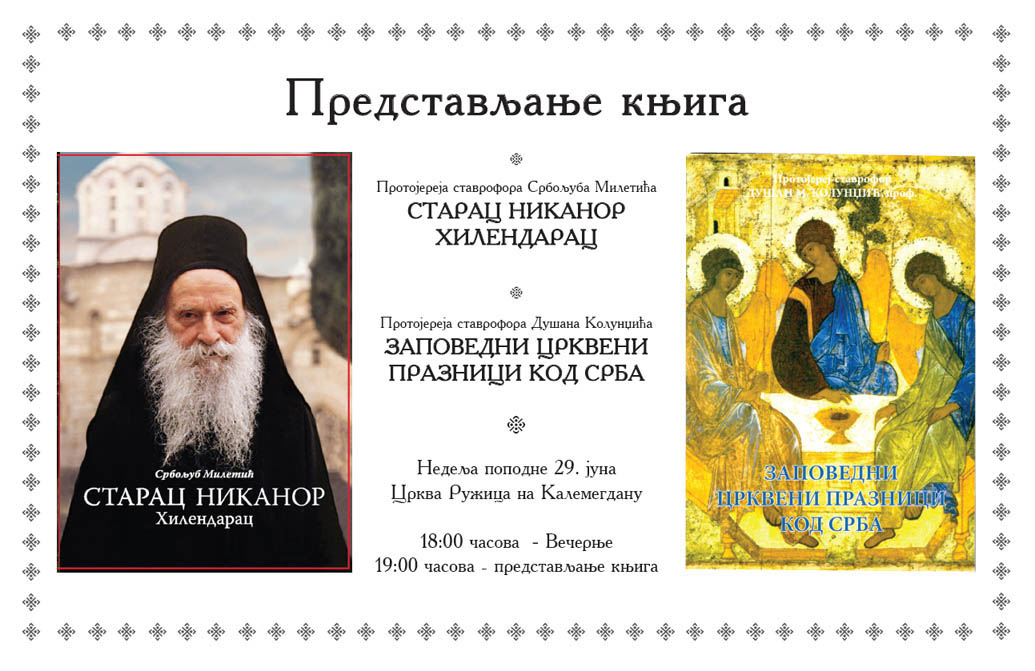
Book Launch in Serbia includes Biography of Elder Nikanor of Hilandar


Sunday, June 29, 2014 in the afternoon in the Ružica Church in the Kalemegdan Fortress in Beograd, there will be a book launch of two new titles:

Starac Nikanor Hilendarac by Protojerej stavrofor Srboljub Miletić, and

Zapovedni crkveni praznici kod Srba by Protojerej stavrofor Dušan Kolundžić.

E-invitation for a book launch with a photograph of the book cover (picture of Monk Nikanor) and the cover a book about church feast days in Serbia with image of Andrei Rublev's Holy Trinity

Invitation to a book launch for a biography of Elder Nikanor of Hilandar


Elder Nikanor was at Hilandar Monastery when the Very Rev. Dr. Mateja Matejic, Walt Craig, and later Predrag Matejic were filming the manuscripts in Hilandar Monastery’s library. There are photos of Father Nikanor among the Hilandar Research Library’s slide collection, some of which were incorporated into the video interview of Predrag Matejic’s visits to Mount Athos that formed a part of the Thompson Library exhibit (Summer 2013) at The Ohio State University: “Travelers to and from Mount Athos: The Translation of Culture, Knowledge, and Spirituality.” The Very Rev. Miroljub Ružić also mentions Father Nikanor in the interview he gave for the same exhibit.


Recent Acquisitions: Authority in Byzantium

dustjacket of the book - red with circular mosaic of Christ in black and white

Authority in Byzantium, edited by Pamela Armstrong (Ashgate, 2013)


Authority in Byzantium is volume 14 in the series of publications by the Centre for Hellenic Studies, King’s College, London. In addition to a preface (xxi) and introduction (1-6) by editor Pamela Armstrong, the book contains twenty-five articles that are divided among the nine sections. There is an index.

Part I The Authority of the State

Jonathan Shepard, “Aspects of Moral Leadership: The Imperial City and Lucre from Legality,” 9-30
Ruth Macrides, “Trial by Ordeal in Byzantium: on whose Authority?”, 31-46
Sergey Ivanov, “A Case Study: The Use of the Nominative on Imperial Portraits from Antiquity to Byzantium,” 47-58
Susan Reynolds, “Response,” 59-61

Part II Authority in the Marketplace

Cécile Morrisson, “Displaying the Emperor’s Authority and Kharaktèr on the Marketplace,” 65-82
Johannes Koder, “The Authority of the Eparchos in the Markets of Constantinople (according to the Book of the Eparch),” 83-108
Chris Wickham, “Response,” 109-110

Part III The Authority of the Church

Jane Baun, “Coming of Age in Byzantium: Agency and Authority in Rites of Passage from Infancy to Adulthood,” 113-135
Günter Prinzing, “The Authority of the Church in Uneasy Times: The Examples of Demetrios Chomatenos, Archbishop of Ohrid, in the State of Epiros, 1216-1236,” 137-150
Miri Rubin, “Response,” 151-152

Part IV Authority within the Family

Christine Angelidi, “Family Ties, Bonds of Kinship (9th-11th Centuries), 155-166
Anne P. Alwis, “The Limits of Marital Authority: Examining Continence in the Lives of Saints Julian and Basilissa, and Saints Chrysanthus and Daria,” 167-179
Janet Nelson, “Response,” 181-183

Part V The Authority of Knowledge

Paul Magdalino, “Knowledge in Authority and Authorised History: The Imperial Intellectual Programme of Leo VI and Constantine VII,” 187-209
Charalambos Bakirtzis, “The Authority of Knowledge in the Name of the Authority of Mimesis,” 211-226
Dionysios Stathakopoulos, “On Whose Authority? Regulating Medical Practice in the Twelfth and Early Thirteenth Centuries,” 227-238
Alexander Murray, “Response,” 239-243

Part VI The Authority of the Text

Albrecht Berger, “Believe It or Not: Authority in Religious Texts,” 247-258
Alicia Simpson, “From the Workshop of Niketas Choniates: The Authority of Tradition and Literary Mimesis,” 259-268
Marc D. Lauxtermann, “‘And many, many more’: A Sixteenth-Century Description of Private Libraries in Constantinople, and the Authority of Books,” 269-282

Part VII Exhibiting Authority in Provincial Societies

Leonora Neville, “Organic Local Government and Village Authority,” 285-295

Part VIII Exhibiting Authority in Museums

Maria Vassilaki, “Exhibiting Authority: Byzantium 330-1453,” 299-323

Part IX Authority in Byzantine Studies

Ljubomir Maksimović, “George Ostrogorsky St Petersburg, 19 January 1902–Belgrade, 24 October, 1972,” 327-335
Vera von Falkenhausen, “Hans-Georg Beck,” 337-343
Elizabeth Jeffreys, “Robert Browning,” 345-353

Workshop on Women and Holiness in the Slavic Middle Ages


Today, at the University of Sofia, Bulgaria, a workshop was held on “Productive Methods in Interdisciplinary Studies of Women and Holiness in the Slavic Middle Ages.” The conference is dedicated to the 160 anniversary of the death of Elena Muteva (1829-1854), a Bulgarian poet, translator, and folklorist, and is sponsored by the “Encyclopaedia Slavica Sanctorum: Saints and Holy Places in Bulgaria” project, Sofia University “St. Kliment Ohridski,” and Manchester University in the UK.

Iskra Khristova-Shomova opened the conference, which consists of nine panels, where each speaker is given 10 minutes. The closing remarks were moderated by Maria Yovcheva.

Below is a list of the participants and their presentation titles. Click on this link for the abstracts of the talks in English.

photo of one of the buildings of the university, a side view taken from a major thoroughfare; there are trees in the from of the building and on the street light pole is a sign advertising "Dunkin Donuts"

Sofia University “St. Kliment Ohridski”

Tsvetelin Stepanov, “The Sanctity and the Capital: Trajectories of Women’s Protection”
Catherine Pancheva-Dikova, “How to Translate ‘Pokrov bogorodichen'”
Ana Stoykova, “‘Why have you come here? There are monks here, and you are a woman!’ (Women and Mount Athos in Byzantine and Slavonic Sources)”
Margaret Dimitrova, “Childbirth, Mothers and the Church: What Can We Learn from Medieval Euchologia?”
Julia Zlatkova, “Gender Specifics of Female Patronage and Charity in Late Antiquity”
Diana Atanasova-Pencheva, “The Betrothed and the Bride: Female Martyrdom as a Transformation of Social Roles”
Anisava Miltenova, “The Texts about Evil Women: Deviations of Biblical Stories”
Biliana Kourtasheva, “The Rehabilitation of the Stepmother”
Maya Petrova-Taneva, “Theodora the Queen of Tŭrnovo, Byzantine Empress Theophano, and the Bdinski Zbornik
Elka Bakalova, “Women Intellectuals in Byzantium: St. Catherine of Alexandria”
Dilyana Radoslavova, “The Semantics of Book Compilation or Topics as a Key in Composing Calendar-Oriented Collections”
Iliana Chekova, “The Repertoire and the Topoi of Women’s Holiness”
Adelina Angusheva-Tihanov, “The Rhetoric of Womanhood: Women in Hagiographical and Medical Discourse in the Slavic Orthodox Middle Ages”
Maria Yovcheva, “Abbas Zosimas from the Vita of St. Mary of Egypt”
Maria Schnitter, “The Specifics of Women’s Holiness in the Orthodox Tradition: The Question of the Saint-Prostitute”
Radoslava Stankova, “The History of the Cult of St. Petka of Tŭrnovo (Paraskeva of Epivat) according to South Slavic Written Sources”
Evelina Mineva, “Byzantine Hymnographic Works of St. Paraskeva of Epivat and their Slavonic Translation”
Desislava Lilova, “Secular and Church Geography in the Imagination of the Period of the Bulgarian Revival”
Vladimir Dimitrov, “Identity Transformations of the Women Saints in Bulgarian Lands at the Time of the Late Revival Period”
Katya Staneva
, “Reception and Ideology: the ‘Turkish Tales’ in Bulgarian Booklets (Bŭlgarski knizhnitsi)”
Olga Todorova, “Maiden in Prison: Women’s Martyrdom in the Time of the Ottoman Rule – the Historical Realia and the Literary Folk Fictions”


Slavia Islamica: Language, Religion and Identity


Slavia Islamica: Language, Religion and Identity edited by Robert D. Greenberg and Motoki Nomachi (Sapporo, Japan: Slavic Research Center, Hokkaido University, 2012). Slavic Eurasian Studies No. 25.

Motoki Nomachi, Foreword, I-II

Robert D. Greenberg, Introduction, 1-8

Articles

Cover of the paperback book with the title, editors, publishing information and two columns of Arabic script overlaid a background of a spectrum of blue sky with the top of a mosque in the right corner

Slavia Islamica: Language, Religion and Identity (Sapporo, 2012)

Бранко Тошович [Branko Tošović], “Особенности боснийского/ бошняцкого языка по отношению к сербскому и хорватскому” [‘The features of the Bosnian/Bosniak language in relation to Serbian and Croatian’], 9-64

Hanka Vajzović, “Jezik i identitet slavenskih muslimana: Bošnjaci između lingvistike i politike”  [‘Language and Identity of Slavic Muslims: Bosnians between Linguistics and Politics’], 65-114

Радивое Младенович [Radivoje Mladenović], “В поисках этнического определения славянские мусльманские группы на юго-западе Косово и Метохии” [‘Slavic Muslim Groups of Southwest Kosovo and Metohija in Search of Ethnic Definition’], 115-147

Vemund Aarbakke, “Pomak Language Usage and the Spell of Nationalism: The Case of the Pomaks in Greece,” 149-177

Йоанна Кульвицка-Каминьска [Joanna Kulwicka-Kamińska],” К проблематике перевода библейских, а также коранических названий ангелов и духовных существ (в письменных памятниках татар Великого княжества Литовского и польских переводах Библии и Корана)” [‘On problems of biblical translation, as well as Qur’anic names of angels and spiritual beings (in written monuments of the Tatars of the Grand Duchy of Lithuania and Polish translations of the Bible and the Qur’an’)], 179-205

Review Article

Чеслав Лапич [Czesław Łapicz], “Ivano Luckevičiaus Kitabas, Lietuvos totorių paminklas. Китаб Ивана Луцкевича. Памятник народной културы литовских татар” [‘Kitab of Ivan Lutskevich: a monument of the folk culture of the Lithuanian Tatars’], 207-216

Book Reviews

Victor Friedman, The Pomaks in Greece and Bulgaria: A Model Case for Borderland Minorities in the Balkans (Südosteuropa-Studien 73). Ed. by Klaus Steinke and Christian Voss. Munich: Verlag Otto Sagner/Südoosteuropa Gesellschaft. 278 pp., 217-225

Svein Mønnesland, Hanka Vajzović: Jezik i nacionalni identitet. Sociolinvističke teme [‘Language and National Identiy: Sociolinguistic Subjects’], Fakultet političkih nauka Sarajevo, Sarajevo 2008, 391 p. ISBN 978-9958-12-8, 227-234

Recent Book Donations, Spring 2014


The Hilandar Research Library has received a number of books as gifts in kind this spring from various donors. Among the donors are researchers who have worked with HRL materials both recently and in the past, anonymous gifts from the local Greek Orthodox community, donors who are adding to existing collections, as well as a colleague once removed who want to find a good home for her books. We greatly appreciate the spirit of the support and patronage that all offers of book donations imply, but we are limited by space and our collection development policy by what we can accept. Happily, the books offered to us below were ones we did not already have and all of them enhance our collection of secondary source material. Below is a selection of the most recent donations.

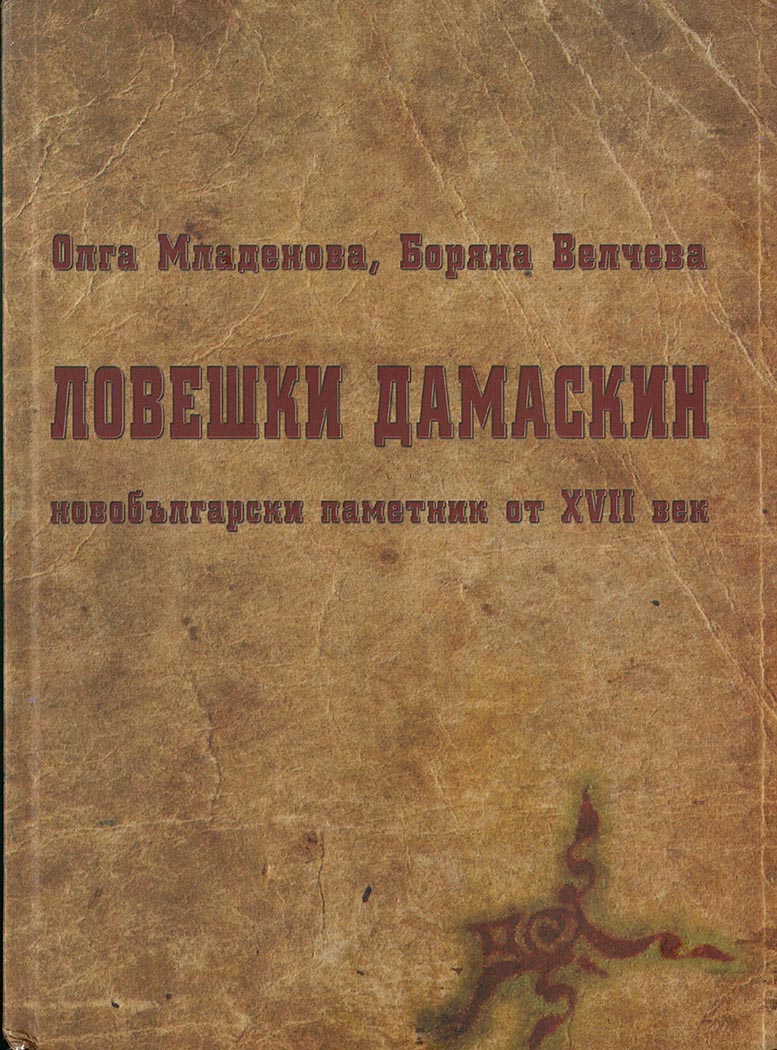
Picture of the cover of the book- light brown cover with the authors' names and the title in a reddish brown

Loveshki Damaskin: A “Vernacular” Monument from the 17th Century (Sofia, 2013)

Olga Mladenova, professor in the Department of Linguistics, Languages, and Cultures at the University of Calgary, Canada, was invited to The Ohio State University in March 2013 to present the 16th Annual Kenneth E. Naylor Memorial Lecture in South Slavic Linguistics. Her talk “The Rise of Modern Bulgarian Literacy in the Seventeenth Century: New Facts and Interpretations,” focused on the texts found in the Bulgarian damaskini, compilations of excerpts from religious and liturgical works that are written in the vernacular of the 17th-18th centuries, rather than in Church Slavonic. While here, she spent a few days in the Hilandar Research Library looking at available resources on the damaskini, which she has incorporated into this gift book, Ловешки дамаскин новобългарски паметник от XVII век, co-authored by Boriana Velcheva (Sofia, 2013). Professor Mladenova vowed to return! She spent 10 days here last month, continuing her work on the damaskini, so there will likely be a companion volume to the Loveshki Damaskin in the near future.

Dust jacket of the book with author's name and the title on a yellowish-green background above a picture of a mosaic bird

Averil Cameron’s Byzantine Matters (Princeton, 2014)

We received two books as part of an anonymous donation from someone we know to be from the Greek Orthodox community here in Columbus, Ohio. One is Averil Cameron‘s most recent publication, Byzantine Matters, five essays on controversial themes related to Byzantine studies. The second book is the exhibition catalogue for Treasures of Mount Athos, co-sponsored by the Holy Community of Mount Athos, the Organization for the Cultural Capital of Europe (Thessaloniki 1997), and the Museum of Byzantine Culture of the Greek Ministry of Culture. The exhibition catalogue is in English, and full of beautiful photographs of the items that were on display.

Cover of the book is an image of the Byzantine Emperor Alexios III Comnenos and St. John the Baptist, circa 1375 - the front of a two-sided icon from Dionysiou Monastery on Mount Athos

Treasures of Mount Athos (Thessaloniki, 1997)

In addition to commentary on the Exhibition itself and the Exhibition Catalogue, there are messages from various dignitaries included, an introduction, and sections on Painting (Monumental Painting, Portable Icons, Anthivola, Paper Icons, and Illuminated Manuscripts), Sculpture (Byzantine Sculpture, Stone-Carving, Wood-carving), Minor Art – Church Embroidery (Minor Art, Ceramics, Church Embroidery, Antimensia), Historical Archives (Greek Documents, Ottoman Documents, Slavonic Documents, Romanian Documents, Monastery Seals), and Libraries (Greek Manuscripts, Slavonic Manuscripts, Georgian Manuscripts, Music Manuscripts, and Incunabula).

Cover of the book is a photograph of an ancient fortress with the mountains behind it viewed from an archway; the title is written in white letters on a maroon band horizontally across the middle of the cover, below the band is a photograph of a stone with a Cyrillic inscription on it.

The Ancient Bulgars: The Discussion Continues (Sofia, 2014)

Tsvetelin Stepanov (Centre for Cultural Studies, Faculty of Philosophy, Sofia University, Bulgaria), who spent some time in Spring 2005 conducting research in the Hilandar Research Library, sent us his latest book: a selection of articles compiled and edited by him, entitled The Ancient Bulgars: The Discussion Continues (= Bŭlgarska vechnost 106) (Sofia, 2014). Besides Stepanov’s introduction (7-15) and article on the origin of the Bulgarian aristocratic titles – “(Indo-)Iranian, Turkic or Other?” (119-134), this compilation includes articles by Atanas Stamatov on the Christianization of  the Armenian Bulgars (16-26); Petŭr Goliiski on Bulgars near the Caucasus during the 2nd-5th centuries according to Armenian sources (27-35), Boris Zhivkov on the legend of Kubrat (36-49), Aleksandŭr Aleksiev-Khofart on Indo-Iranian mythological and religious traces in several Old Bulgarian monuments (50-65), Todor Chobanov on pagan temples in Danube Bulgaria (66-90), Oksana Minaeva on the legacy of the Sassanid culture and its parallels in Bulgarian metalwork during the 7th-9th centuries (91-118), and Alexandŭr Moshev on new epigraphical data on the presence of the Bulgars in the Black Sea area in the 2nd-5th centuries (135-141).


Recently Cataloged Books – January-March 2014

Picture of the front cover of the brochure

Donated by the Very Rev. Dr. Mateja Matejic


Personality Traits and the Life of Metropolitan Filaret of Moscow: On the 90th Anniversary of his Death. 1958


Double title page - one in English and one in Serbian

Donated by Bariša Krekić, Professor Emeritus, History, UCLA


Vizantijski i srpski Ser u XIV stoleću. 1994


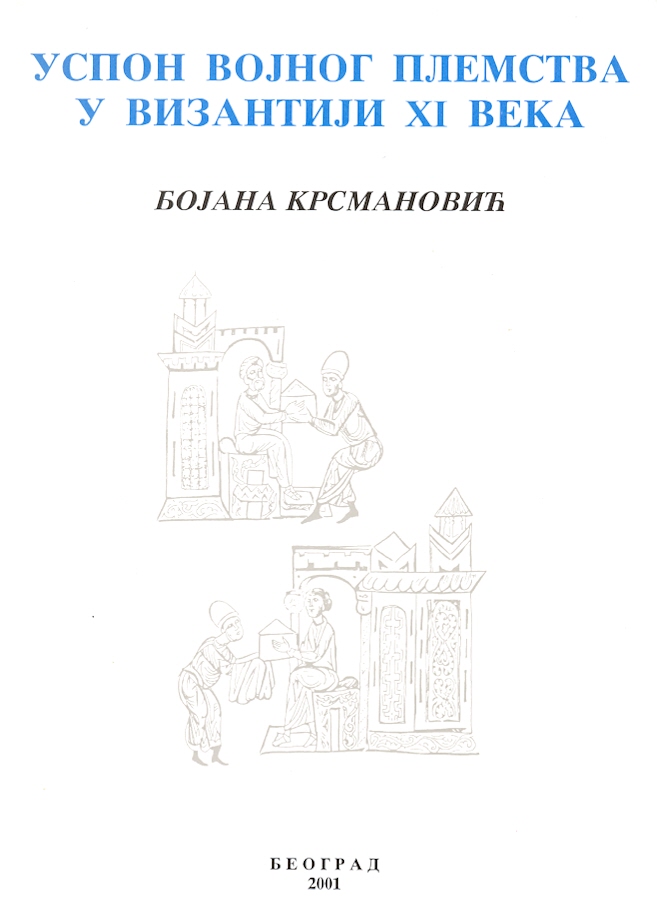
Scan of front cover

Donated by Bariša Krekić, Professor Emeritus, History, UCLA


Uspon vojnoj plemstva u Vizantiji XI veka / The Rise of the Byzantine Military Aristocracy in the 11th Century. 2001


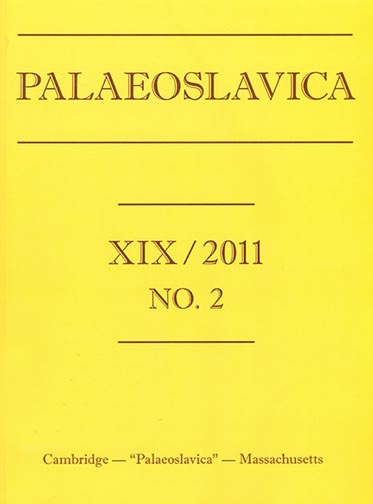
Front cover of the journal

Recently cataloged issue of Palaeoslavica 19.2 (2011)


Postgraduate Studentships in Slavonic Studies at the University of Nottingham

MA, MRes and PhD Studentships in Russian and Slavonic Studies
at the University of Nottingham for 2014-2015

Submitted to Early Slavic Listserv by Monica White (MSSI 2001)

The School of Cultures, Languages and Area Studies are pleased to announce a number of doctoral (PhD) studentships which will cover tuition fees at the University’s UK/EU level and a contribution towards maintenance for three years, subject to satisfactory progress. The school is also able to offer a number of MA studentships (stipend plus fee waiver) and MA fee waivers. The deadline for completed applications is 12th May 2014 but to be eligible for consideration for one of these awards you must first have been accepted for a place on the course.

Members of the Department of Russian and Slavonic Studies can supervise research students in the following areas:

  • 19th and 20th Century Russian Literature and Culture
  • Russian Cinema
  • Russian and Slavonic Linguistics
  • Serbian/Croatian/Bosnian Literatures and Cultural Studies
  • Slovene Literature and Culture
  • Medieval Russian and Byzantine History and Culture
  • Translation Studies

Further details about research in the Department can be found here: http://www.nottingham.ac.uk/slavonic/research/staff-research.aspx

For details of the application procedure for these awards and of other funding for which you may be eligible, please consult our funding webpage: http://www.nottingham.ac.uk/clas/studywithus/postgraduate/pg-funding/schoolstudentships.aspx

If you require any further information, please contact the School Postgraduate and Research Office on: t: +44 (0)115 846 8316/7 e: pg-clas@nottingham.ac.uk

« Older posts Newer posts »