ScriptoriaSlavica

Medieval Slavic Manuscripts and Culture

Page 13 of 15

Found in the Archives: Newsletter of the Hilandar Project


Among the archives of the Hilandar Research Library and the Resource Center for Medieval Slavic Studies are copies of a newsletter that was published sporadically from 1979-1986. The inaugural issue of the “Newsletter of the Hilandar Project at The Ohio State University” was edited by Charles E. Gribble, now professor emeritus of the OSU Department of Slavic and East European Languages and Cultures. Issue number 1 appeared in January 1979 with the following stated purpose:image of the first page of the newsletter - a densely typed 8.5 x 11 inch page

“This is the first issue of a new publication designed to keep both scholars and the general public informed of the work going on in the Hilandar Project at The Ohio State University…. We will try to provide a running bibliography of publications, both books and articles, which treat materials contained in the Hilandar Collection, or which touch on related topics.”

The issue includes a description of the formal dedication of the Hilandar Room in the William Oxley Thompson Memorial Library on December 2, 1978, and reproduces the remarks made on that occasion by Father Mitrofan of Hilandar Monastery, Riccardo P. Picchio (Yale University), Richard Pope (York University, Toronto), and Dr. Predrag Matejic. The speech that Father Mitrofan gave at the banquet that evening is also included in this issue.

Issues No. 2 (Oct. 1979) and No. 3 (Aug. 1980) were also edited by Charles E. Gribble.
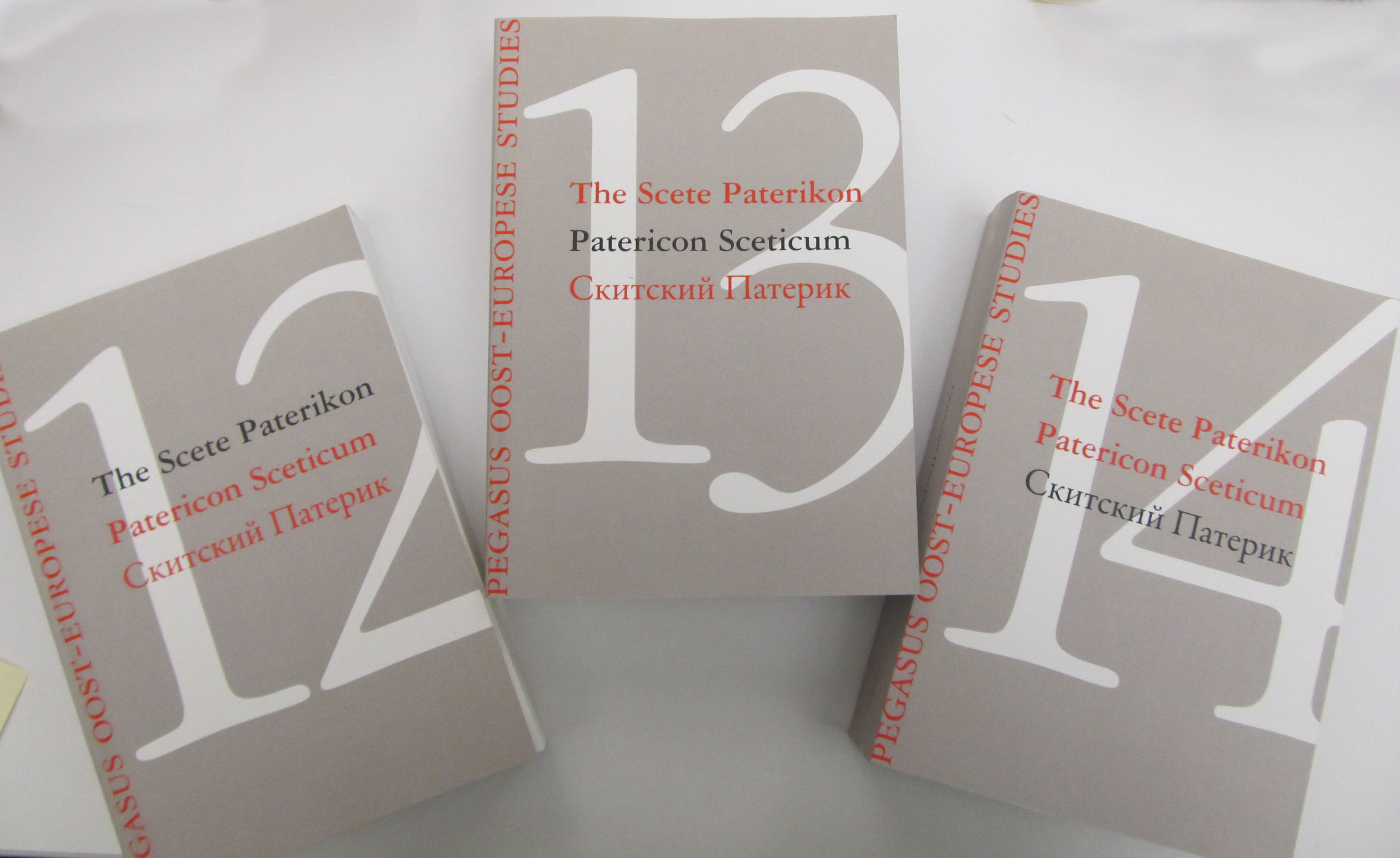


Recent Acquisition: The Scete Paterikon


William Veder’s The Scete Paterikon/Patericon Scepticum/Скитский Патерик, published as vols. 12-14 in the Pegasus Oost-Europese Studies series, is a recent addition to the HRL’s extensive print library. The first volume includes an introduction to the Apophthegmata Patrum, and the Scete Paterikon. The apparatus of the three volumes is reviewed – and a list of manuscripts used and references consulted are included. Maps of Egypt and Sinai, Alexandria, and the Nile Delta from the 3rd-5th centuries are provided. Next are the indices: Names (61-65), Biblical Quotations and References (66-70), Apophthegms (Armenian – according to Louis Leloir; Coptic – Marius Chaîne; Greek – Lucien Régnault, Viktoros Matthaiou, and Jean-Claude Guy; Latin – José G. Freire; Syriac – Ernest A. Wallis Budge; and Slavic – William R. Veder), alphabetical listings of incipits for the Greek (80-105), Latin (106-125), and Slavonic texts (126-153), with the bulk of the volume devoted to a word index to the Slavonic text (154-494).

Photo of the 3 volumes of The Scete Paterikon front covers - gray background with the number of each volume in large white numerals on top of the gray, then overlaying the numerals in alternating red, black and red horizontal lines is the name of the work in English, Latin and Russian. Vertically oriented to the edge of the spine on the front cover is the name of the series in red

The second volume contains the Greek text of the Scete Paterikon, the Latin translations of the 6th cent., and the English translation of the Slavonic textus receptus (“received text”).

Volume three includes the Slavonic translation of the Scete Paterikon as well as a reconstruction of its Glagolitic archetype.


Iosif-Volokolamsk Monastic Library: the Eparchal Collection


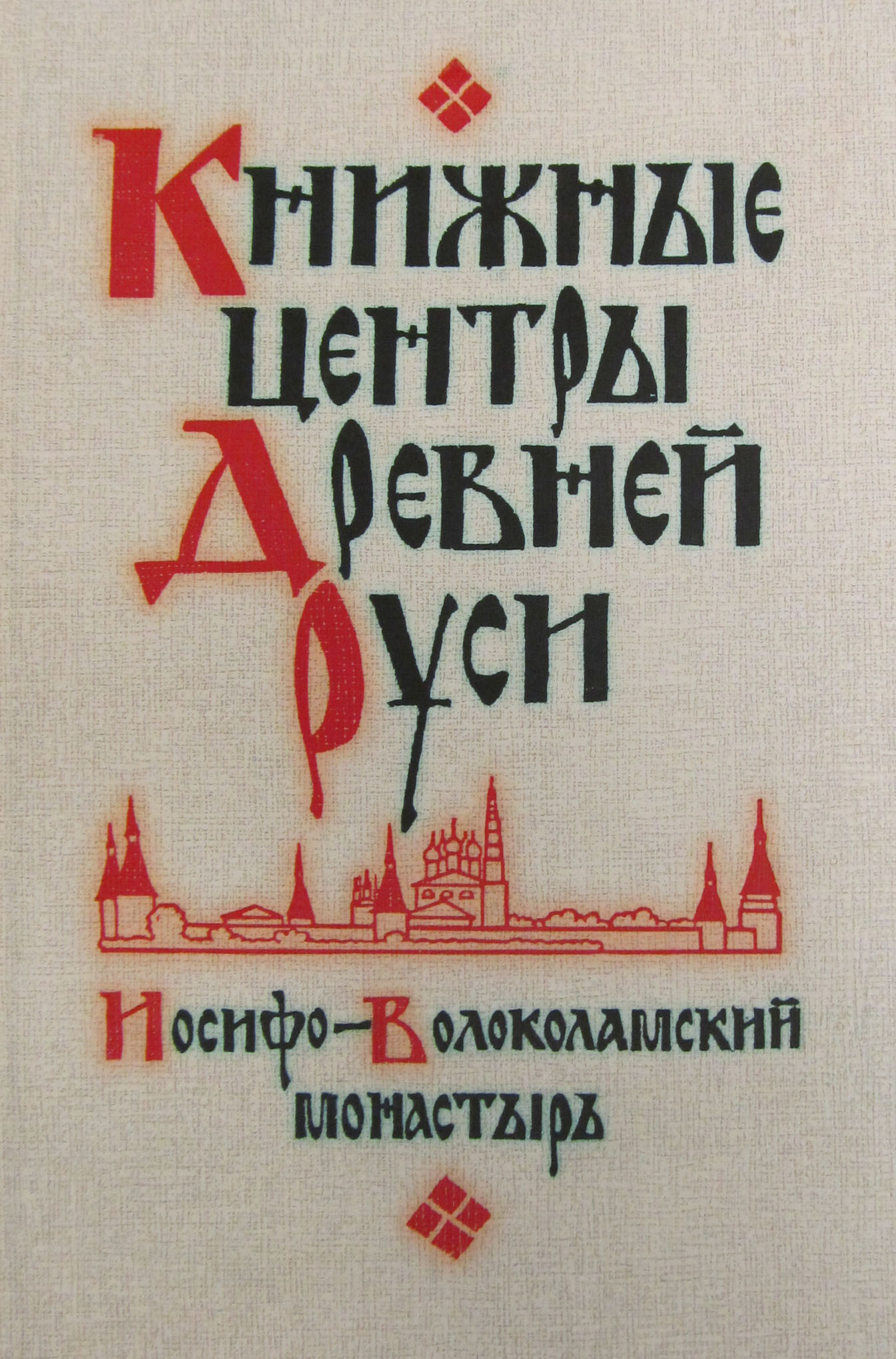
The Iosif-Volokolamsk Monastery retained a very large and impressive library of manuscripts and old printed books – over 700 items – until the mid-19th century. In 1859 part of the collection (236 items) was transferred to the Moscow Theological Academy and, from there, in the 1930s to the Manuscripts Division in the Lenin Library, now known as the Russian State Library. This portion of the Iosif-Volokolamsk library was described by Hieromonk Iosif (“Опись рукописей, перенесенных из библиотеки Иосифова монастыря в библиотеку Московской духовной академии,” ЧОИДР 1881, кн. 3 [Москва, 1882]).Image of the front cover of the book on Scribal centers of Ancient Russia, the Iosifo-Volokolamsk monastery.

In 1863, 432 manuscripts from the Iosif-Volokolamsk monastic library became part of the Moscow Eparchal Library, which were later transferred, in 1921, to the Manuscripts Division of the State Historical Museum (GIM) in Moscow. There are now 428 manuscripts, numbered between 1-432, in GIM. (Mss. 42, 378, 382, and 428 are not part of this collection.)

The Hilandar Research Library has 427 of the Eparchal GIM manuscripts on microfilm. Eparkh.431, a Stoglav, is damaged and was judged too fragile to photograph for preservation purposes.

The manuscripts are described in Dianova, Kostiukhina and Pozdeeva (see below). For the most part, the collection contains Russian manuscripts from the 14th-19th centuries, with the bulk of the materials dating to the 16th century. There are three manuscripts that are designated as Bulgarian: a 15th-century Tetraevangelion (Eparkh. 6), a Psalter with Supplement dating in part to the 14th cent. and in part to the 16th cent. (Eparkh.144), and a Miscellany from the first quarter of the 15th cent. (Eparkh.376).

Sources:

Дианова, Т. М., Л. М. Костюхина, “Рукописные книги Иосифо-Волоколамский библиотеки (По материалам Отдела рукописей Государственного Исторического Музея),” в кн. Книжные центры Древней Руси: Иосифо-Волоколамский монастырь как центр книжности, 100-121. Ленинград: Наука, 1991.

Дианова, Т. М., Л. М. Костюхина, И.В. Поздеева. “Описание рукописей библиотеки Иосифо-Волоколамского монастыря из Епархиального собрания ГИМ,” в кн. Книжные центры Древней Руси: Иосифо-Волоколамский монастырь как центр книжности, 122-475. Ленинград: Наука, 1991.


Conference: ASEC, March 8-9, 2013, Georgetown


The Association for the Study of Eastern Christian History and Culture (ASEC, Inc.) will hold its fifth biennial conference at Georgetown University in Washington, DC, on March 8-9, 2013.

The theme of the conference is “Antecedents and Subsequents of Iosif Volotsky: Exploring Eastern Christian Concerns” (2015 marks the 500th anniversary of the death of Iosif Volotsky, founder of the Iosif-Volokolamsk Monastery), yet it is designed to “embrace topics from any period, and all regions related to Eastern Christian groups…. The topic is broadly conceived to address the interests and concerns of Iosif, a monastic reformer, whose life and work influenced the religious culture of Muscovy as well as modern scholarship of his period. Iosif’s interests encompassed the multi-faceted issues of religious and spiritual life and ranged from monastic reform to patristics, liturgics, education, administration, spirituality, heresy, and secular Christian life, among others.”

Registration is $50 ($25 for graduate students) and participants must be members of ASEC by the time of the conference.

To become a member of ASEC, please contact ASEC treasurer, Lucien Frary (lfrary@rider.edu).

Source: “Call for Papers” issued by the ASEC.


Research Query: Sinai Greek Manuscripts


Several recent inquiries have referenced Greek manuscripts of the Holy Monastery of St. Catherine at Mount Sinai. In 1950 the Library of Congress co-sponsored an expedition to St. Catherine’s to microfilm manuscripts in the monastery’s library: 1,687 of the 3,300 manuscripts and 1,742 firmans were filmed. The microfilms of Sinai manuscripts held by the Library of Congress are enumerated in the Checklist of Manuscripts in St. Catherine’s Monastery, Mount Sinai, edited by Kenneth W. Clark.

Image of the front cover of Clark's checklist of manuscripts - beige paper cover, with title in blue over the seal of The Library of Congress

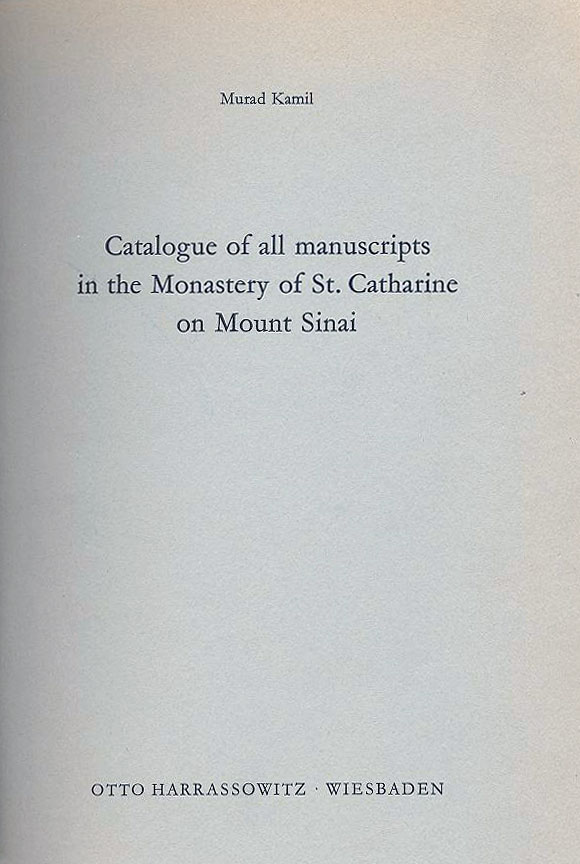
In 1970 Murad Kamil published a Catalogue of all manuscripts in the Monastery of St. Catharine on Mount Sinai. Wiesbaden: Otto Harrassowitz. Kamil (1) describes the collection as containing “3329 manuscripts in twelve languages and a collection of Arabic and Turkish scrolls, totaling 1742.” Kamil organizes the manuscripts in his catalog first according to language and then by genre, with the Arabic and Turkish scrolls listed at the end. A brief description precedes each section, and it is here in the description of the Greek Collection that Kamil notes (61), “The [American Foundation Mt. Sinai] Expedition microfilmed 1083 codices, 400 of which were of Biblical texts, out of 2319 Greek manuscripts.”Image of the front cover of Kamil's catalog of Sinai manuscripts - a dull blue/gray paper cover with the author, title, and publisher i

In May 1975 additional manuscripts leaves and fragments were discovered in a tower of the monastery. The “New Finds” have been described in various publications, e.g. The New Discoveries in St. Catherine’s Monastery: A Preliminary Report on the Manuscripts by James H. Charlesworth and George Zervos (Cambridge, MA: American Schools of Oriental Research; Winona Lake, IN: Distributed by Eisenbrauns, 1981) and Ioannis C. Tarnanides, The Slavonic Manuscripts Discovered in 1975 at St. Catherine’s Monastery on Mount Sinai.


South Slavic Fragment NB SPbGU E III 141


In the collection of the research library of St. Petersburg State University there is a parchment fragment from the Gospels dated to the 14th century. A. A. Savel’ev, the SPbSU local cataloger, describes the manuscript:

NB SPbGU MS E III 141

Tetraevangelie, fragment. 14th cent., 4 (26 x 19), 4 ff., uncial

Parchment.

Text in two columns, initials and notes in cinnabar.

Contains a fragment from the Gospel according to Matthew: 5:25-6:23. Bulgarian recension (?).

Without binding.

On f. 1 is an owner’s inscription dated 1858 “бысть в руце агаряна и избависе”; on f. 2 in the same hand is an inscription that indicates the Gospel belonged to Holy Trinity Monastery.

Literature: “Предварительный список славяно-русских рукописей ХI-XIV вв., хранящихся в СССР.” Археографический ежегодник за 1965 г. Москва, 1966.  177-272, № 1025.


Fire on Mount Athos, August 8-12, 2012


Athens News reported on a fire that broke out Wednesday, August 8th, on Mount Athos and spread to a forest near Hilandar Monastery: “Mount Athos Wildfire Still Raging.”

Greek soldiers and Serbian firefighters worked to put out the fire, as did a contingent of Bulgarian firefighters. Rain on Sunday, August 12th, helped extinguish the embers – “Showers Come to Mount Athos Rescue.” See also “Greek, Serbian firefighters battle flames near Mount Athos.”

On March 4, 2004, a fire broke out at Hilandar Monastery and burned more than half of the monastery. For more about that fire, see  Cyrillic Manuscript Heritage 15 (May 2004): 1, 9.  For articles about the restoration of Hilandar Monastery, see Cyrillic Manuscript Heritage 20 (December 2006): 11 and Cyrillic Manuscript Heritage 24 (December 2008): 1.


Research Query: Descriptions of Hilandar Monastery Greek Manuscripts


Several recent research queries have referenced the Greek manuscripts of Hilandar Monastery. Below is a selected bibliography of descriptions of these manuscripts. If you know of additional publications about the Greek codices, please let us know.

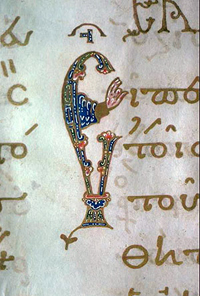
Color image of leaf 85 verso in Hilandar Greek manuscript 105. It's a close up of an illuminated letter E, where the middle bar of the capital letter is a hand drawn in the position used to make the sign of the cross. the Greek lower case letters appear to be in gold ink.

Tetraevangelion, Illuminated letter “E” from the end of the 13th cent.


Lampros, Spyr. P. Catalogue of the Greek Manuscripts on Mount Athos. Cambridge: University Press, 1895-1900. Reprinted Amsterdam: A. M. Hakkert, 1966.

Hilandar Greek manuscripts are described in vol. 1: 28-30.

Јаковљевић, Андрија. “Инвентар музичких рукописа манастира Хиландара.” Хиландарски зборник 4 (1978): 193-234ff, plates 1-24.

Jakovljević includes descriptions of Greek music manuscripts in Hilandar.

Color image of an illuminated letter Tau from a Greek manuscript in Hilandar Monastery.

Litsas, Euthymios. “The Greek Manuscripts at Chilandar.” Кирило-Методиевски студии 3 (1986) 191-193.


Litsas, Efthymios. “The Mount Athos Manuscripts and their Cataloguing.Polata Knigopisnaia: an Information Bulletin Devoted to the Study of Early Slavic Books, Texts and Literatures 17-18 (December 1987): 106-118.

In this general article on the Greek manuscripts on Mount Athos, Litsas gives a brief survey of the libraries on Mount Athos and their holdings. He also discusses the catalogues of the manuscripts to date.

color image of an illuminated letter from a Greek Hilandar Monastery manuscript

Ε. Κ. Λίτσας & Δ. Κ. Κύρου, “Συνοπτικός συμπληρωματικός κατάλογος των ελληνικών χειρογράφων της μονής Χιλανδαρίου,” Τεκμήριον 7 (2007): 9-87, 8 (2008): 229-256 with pls. 1-14.

Thanks to Georgi Parpulov (Oxford) for bringing this publication to our attention.

Image source: Photos of illuminated letters from the collection of  Hilandar Monastery Greek Manuscripts by Mateja and Predrag Matejic, 1975.


Recent Acquisition: Mara Branković


A recent acquisition to the Special Collections Stacks of the Hilandar Research Library is Mihailo St. Popović’s Mara Branković: Eine Frau zwischen dem christlichen und dem islamischen Kulturkreis im 15. Jahrh. Peleus: Studien zur Archäologie und Geschichte Griechenlands und Zyperns 45. Mainz und Ruhpolding: Verlag Franz Philipp Rutzen, 2010.

Image of the front cover of the book on Mara Brankovic. The book is black with the lettering in white: author's name, title, series title, publisher. Between the title and series title is an image from a manuscript illumination that purports to be Mara Brankovic. The image is in black and white.

Mara Branković is mentioned in four of the Hilandar Monastery edicts, HM.SDS.76, dated October 5, 1405; HM.SDS.79 and 80, dated 1408; and HM.SDS.84 (April 15, 1479).


Happy Birthday, Predrag!


Photograph of Dr. Matejic, a priest seated at table with his back to the camera; a young Predrag Matejic is standing opposite his father and preparing to turn the page of a manuscript that is position on a table with a camera overhead (being photographed).

Photographing manuscripts at Hilandar Monastery

Today is the 60th birthday of Predrag Matejic, Curator of the Hilandar Research Library and the Director of the Resource Center for Medieval Slavic Studies at The Ohio State University.

It was on this date in 1971, to the best of his recollection, that Predrag and his father, the Very Rev. Dr. Mateja Matejic, left Greece with over 3,400 rolls of film used to photograph and microfilm the manuscripts of Hilandar Monastery. They flew together to Germany; Father Matejic continued on to Columbus, Ohio, with the films, while Predrag flew on alone to Yugoslavia, thus spending his 19th birthday in three different countries. He had birthday cake in both Munich and Beograd.

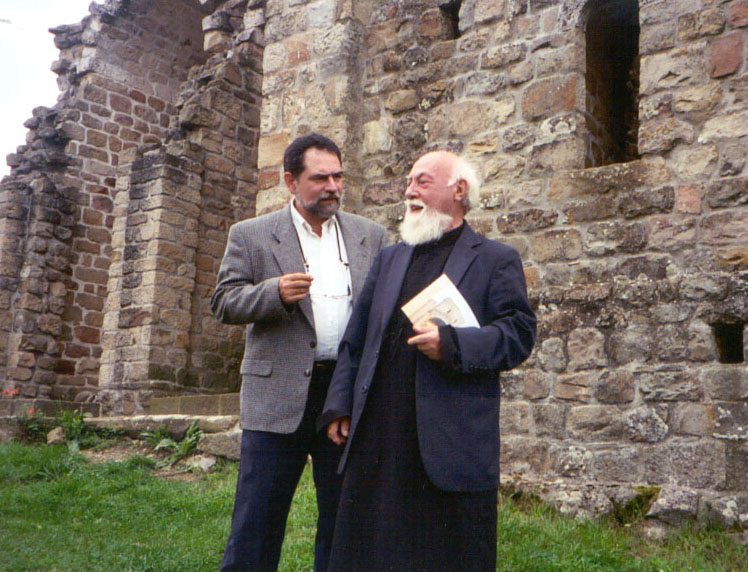
photograph and Predrag Matejic and Father Matejic standing and talking to each other in front of a building of the monastery Djudjevic Stupovi in Serbia, 2002. The grass is green, Father is wearing his black priest's shirt and coat; Predrag is in dark slacks, a gray jacket and white shirt.

Excursion to Đurđevi stupovi during the 5th International Hilandar Conference, Raška, Serbia


Happy Birthday, Predrag!


Image Source: The photo above was taken by a monk of Hilandar, 1971; the photo at right was taken by Pasha in 2002.


« Older posts Newer posts »