ScriptoriaSlavica

Medieval Slavic Manuscripts and Culture

Page 14 of 15

Watermarks: Identification of Hilandar Fragment 739.III


Prior to the publication of his catalog of the Cyrillic manuscripts of Hilandar Monastery, Dimitrije Bogdanović identified fragments HM.SMS.758.IX and 759.VII as being part of HM.SMS.646 Lestvica (circa 1360-1370), so there is not a separate entry in his catalog for either fragment (cf. Bogdanović 1978: 222, 255 and 256). The fragments were placed with the original manuscript №646.

Напомена. Рукопису придружени листови које су били нађени и заведени као фрагменти 758/IX и 759/VII.” Bogdanović 1978: 222.

Therefore, there is also not a separate record for HM.SMS.758.IX or 759.VII in the two-volume print version of the Matejic & Thomas Catalog (2: 662, 743-746), the OSU Library Catalog, or WorldCat. When the Hilandar manuscripts were photographed, these two fragments thus appear on the reel of microfilm of HM.SMS.646 and not on the reel containing fragments HM.SMS.757.1-III, 758.I-VIII,X, and 759.I-VI, VIII-X.

Image of the description of watermarks in manuscript No. 646 from Bogdanovic's catalog, with the watermark "dragon" and the reference to the watermark album underlined in yellow.

Subsequent research by Predrag Matejic on the watermarks of the Hilandar Monastery manuscripts revealed that fragment HM.SMS.739.III was also from manuscript №646. The publication of this discovery, however, appeared with several critical typos that are now corrected below (noted in boldface):

“Први доказ ваљаности овог метода атрибуције је чињеница да сам помоћу њега утврдио да два фрагмента, бр. 739/III и бр. 759/X припадају хиландарским рукописима бр. 646 и бр. 396 [односно]. У ствари, фрагмент 739/III је део фрагмента 759/VII за који је Димитрије Богдановић утврдио да је део хиландарског рукописа бр. 646.” P. Matejic 1995: 288.
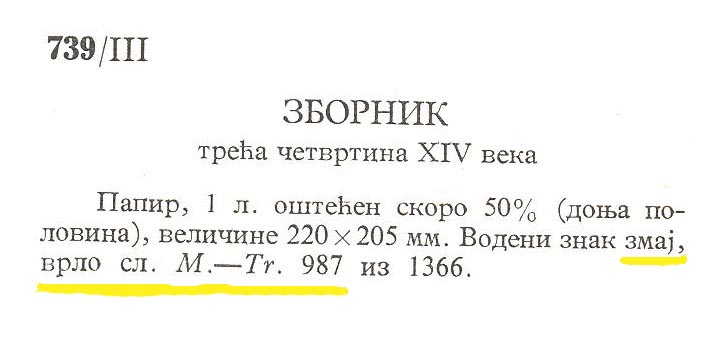
Image of description of Hilandar fragment 739.III from Bogdanovic's catalog, with watermark "dragon" and reference to watermark album underlined in yellow

Tatiana G. Popova today identified fragment HM.SMS.739.III as part of the Lestvica text “Слово к пастырю.”


Image Sources: Bogdanović 1978: 222 and 243.

Sources:

Богдановић, Димитрије. Каталог ћирилских рукописа Манастира Хиландара. Београд: Српска Академија Наука и Уметности и Народна Библиотека Србије, 1978.

Matejic, Predrag, and Hannah Thomas, comp. Catalog: Manuscripts on Microform of the Hilandar Research Library (The Ohio State University). 2 vols. Columbus, Ohio: The Resource Center for Medieval Slavic Studies (The Ohio State University), in cooperation with the “Ivan Dujchev” Research Centre for Slavo-Byzantine Studies (Sofia, Bulgaria), 1992.

Матеич, Предраг. “Атрибуција рукописа помоћу анализе папира Хиландар у XIV веку.” В књ.: Проучавање средњовековних јужнословенских рукописа: Зборник радова са међународне хиладнарске конференције одржане од 28. до 30. марта 1989, уред. Павле Ивич, 287-299. Београд: Српска академија наука и уметности, одељенње језика и књижевности, 1995.
 

Recent Acquisition: A Catalog of Slavic Manuscripts of John Climacus’ “The Ladder”


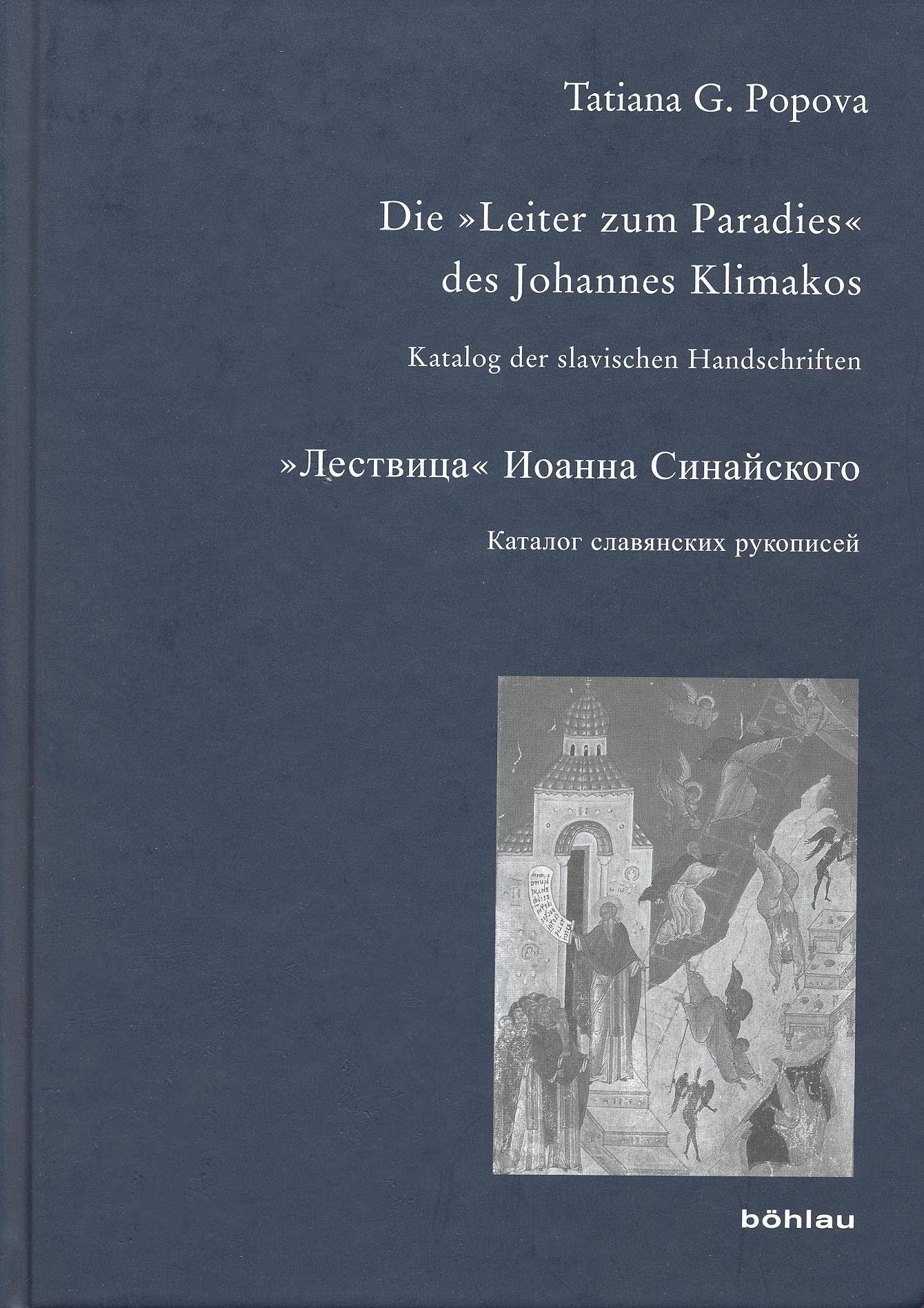
Tatiana G. Popova presented the Hilandar Research Library with a copy of her latest book on the Slavic text of The Ladder by St. John Climacus (6th cent.), Die “Leiter zum Paradies” des Johannes Klimakos: Katalog der slavischen Handschriften / “Лествица” Иоанна Синайского: Каталог славянских рукописей  (Köln: Böhlau Verlag, 2012). The 1073-page tome provides descriptions of extant and lost Slavic manuscripts containing the entire text of The Ladder, as well as manuscripts such as miscellanies, prologs, paterika, the Pandects of Nikon Chernogorets, etc., that include excerpts from The Ladder.Photo of the front cover of Tatiana Popova's book - it is dark blue cloth, with "Tatiana G. Popova" written at the top, with the title in German written below the author's name on the upper right-hand side of the front cover; below the author and title is a small grayscale image from a medieval Slavic manuscript or icon of men climbing "the ladder" to heaven with angels flying around the ladder, an Orthodox church on the left side of the image with a saint holding a scroll with Slavic words standing on the top step of the church, turned twoards a crowd of people. There are also what may be a couple of demons flying on the right side of the image; and at least two people appear to be falling off of the Ladder

The 40-page, two-column bibliography on The Ladder includes works in Slavic, Greek, English, German, Romanian, and several other languages. The indexes arrange the manuscript data according to chronology; recension and language; repository location; the names of people connected to the history of the manuscripts; geographical names and the names of monasteries and churches. There’s also an index of proper names and subjects, an alphabetical index of manuscript sigla, and two appendices: 1. pre-revolutionary Russian editions of The Ladder, and 2. Greek manuscripts of The Ladder.

This work follows Tatiana Popova’s 2010 publication Славянская рукописная традиция Лествицы Иоанна Синайского: Монография (Северодвинск, Россия) – another gift from the author to the Hilandar Research Library.

Postscript, July 31, 2012: Tatiana Popova requests that readers notify her if they find errors in her book or if they have any questions or comments – lestvic@mail.ru.


The First (and Only) Annual Hilandar Research Project Conference, 1984


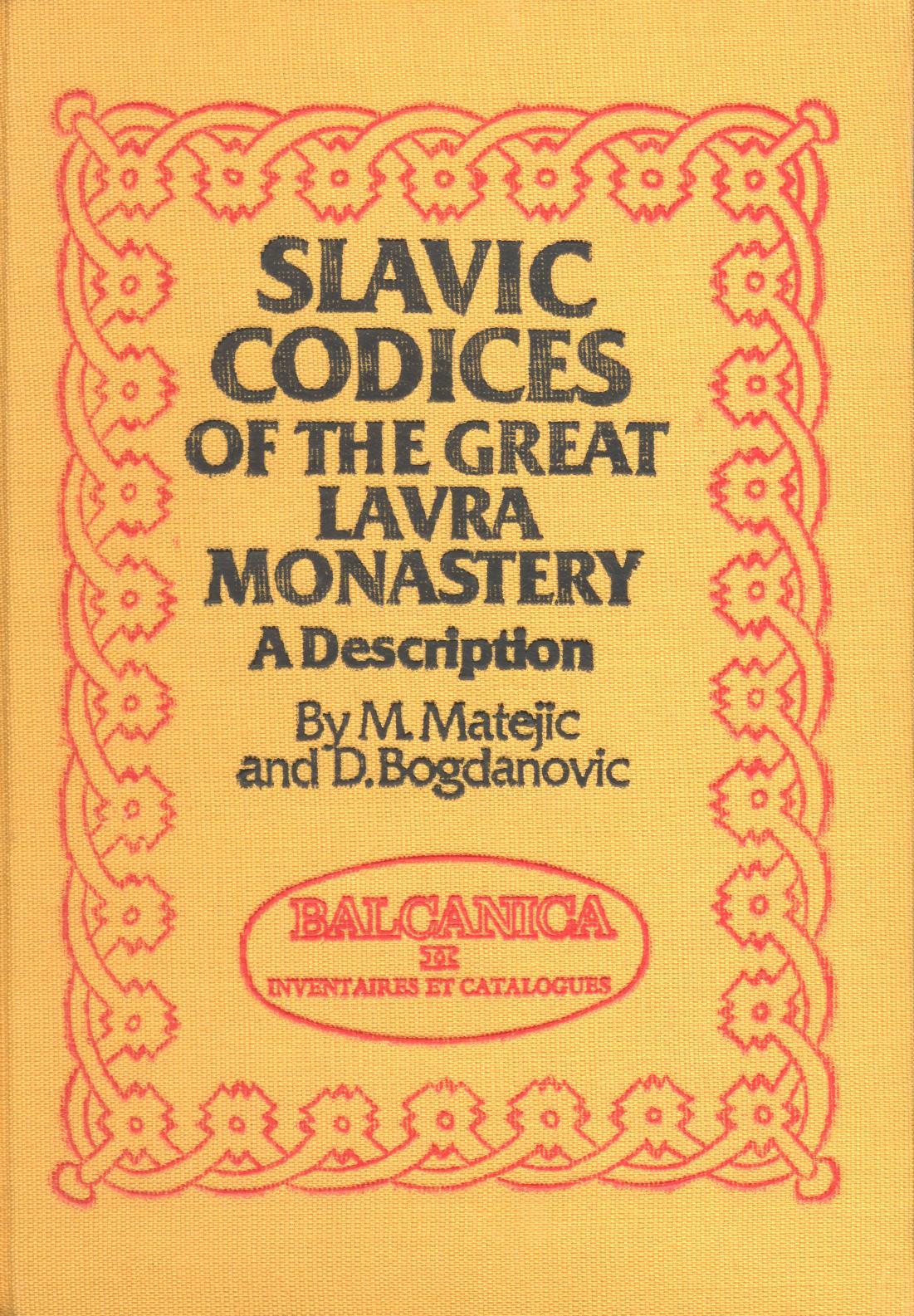
The First – and what turned out to be the only – Annual Hilandar Research Project Conference was held May 3-4, 1984. The major goals of the conference were to provide an update of the Hilandar Research Project’s activities and financial status, and to offer concrete proposals for the expansion and development of the  Hilandar Research Project. Among the future goals enumerated by the Very Rev. Dr. Mateja Matejic were: “(1) the continuing acquisition and development of the collection of microform and reference materials; (2) the publication of a Supplemental and Cumulative Checklist of the holdings of the Hilandar Room (now over 2,000 items); (3) the publication of a detailed description of the Slavic codices of the Great Lavra Monastery on Mount Athos…” (Polata knigopisnaia 13: 71).

Photograph of the cover of the catalog of manuscripts in the Great Lavra monastery on Mount Athos. A yellow cover with an ornamental frame in red, and in the frame in black letters is the title and also the names of the authors. Under the authors' names in a circle are the words "Balcanica II Inventaires et catalogues"

Sofia: CIBAL, 1989

Among the ten presentations given, Robert Mathiesen (Brown University) reported on “The Present Status of Medieval Slavic Studies in the USA and Canada,” and concluded, among other things, that “North American scholars should concentrate on the treatment of problems less actively treated elsewhere in the world, such as Biblical textology” (Polata knigopisnaia 13: 27).

The report on the conference ends with the announcement that “On 5 May 1984, following the conclusion of the Conference, a new and completely furnished and reequipped Hilandar Room was dedicated by Robert Rade Stone, President of the Serb National Federation, and presented with the first original manuscript, a late XVIIIth century copy of Paisij Hilandarskij’s Istoria slavjanobǎlgarskaja by Mrs Esther N. Clarke(Polata knigopisnaia 13: 74).

Source: Matejic, Predrag. “Chronicle: 3-4 May 1984: Columbus. The First Annual Hilandar Research Project Conference.” Polata knigopisnaia 13 (December 1985): 71-74.

Image source: Cover of the book, M. Matejic and D. Bogdanovic, Slavic Codices of the Great Lavra Monastery: A Description (Sofia: CIBAL, 1989).


Reserved Manuscript Numbers in Hilandar Monastery’s Library


Dimitrije Bogdanović’s catalog of the Cyrillic manuscripts of Hilandar Monastery includes descriptions of three manuscripts that are no longer in Hilandar Monastery’s library: HM.SMS.297, 298, and 435.

Bogdanović quotes from the Hilandar Archives where it is indicated that these shelfmarks are reserved from the time that a Bishop Dimitrije borrowed the manuscripts on June 14, 1896, in order to study them in Beograd. The manuscripts were listed in Hilandar Library’s catalog under the numbers 9, 80, and 174. (Bogdanović 1978: 129)

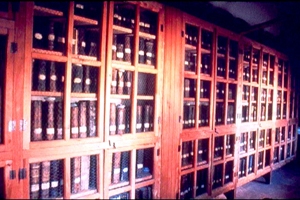
A photograph of a wall of wooden bookcases in the library of Hilandar Monastery, circa 1970. The bookcases have glass doors and the bound volumes of the manuscripts on the shelves are visible through the glass.

Hilandar Monastery Library (circa 1970)

HM.SMS.297, Teodul’s copy of Teodosij’s Life of Saint Sava (1336) was originally no. 9. “Its fate is not known.” (Bogdanović 1978: 128)

HM.SMS.298, Monk Mark’s copy of the Lives of Simeon and Sava (circa 1360-1370), formerly no. 80, was first listed as no. 1366 in the National Library in Beograd before WWII. The National Library was destroyed during the bombing of Beograd on April 6, 1941, but this manuscript was not in the library at that time, so it survived and is now listed as Ps 17.

HM.SMS.435, Danil’s Miscellany (1553) has also been lost and its fate is unknown. Bogdanović reproduces Sava Hilandarec’s description of the scribal colophon (f. 210r) and the titles of the lives of the Serbian kings contained in the manuscript. (Bogdanović 1978: 167)


Source: Богдановић, Димитрије. Каталог ћирилских рукописа Манастира Хиландара. Београд: Српска Академија Наука и Уметности и Народна библиотека Србије, 1978.

Image Source: Photo by Walt Craig, circa 1970


Job Posting: Oxford University


Departmental Lecturer in Eastern Christianity c.400-c.1500

HISTORY FACULTY and THEOLOGY FACULTY

Grade 7: £29,249 – £35,938 p.a.

Applications are invited for a three-year fixed-term Departmental Lecturership in the History of Eastern Christianity c.400 – c.1500 in the Faculties of History and Theology. The appointment is made possible by a donation from the Leventis Foundation over 3 years from October 2012, and is non-renewable. Applications are invited from those with active research interests in the history of Eastern Christianity in the period c.400-1500.

Applications for this vacancy are to be made online. To apply for this role and for further details, including the job description and selection criteria, please go to the url listed below:

https://www.recruit.ox.ac.uk/pls/hrisliverecruit/erq_jobspec_version_4.jobspec?p_id=103365

The closing date for applications is midday (UK time) on Thursday 26 July 2012.


Colophon: Monk Iov, fl. 1360-1390


In 1990 Lucija Cernić published her article on the “circle” of a scribe Iov (Їωвь) who worked on manuscripts over a thirty-year period in the 14th century: “Круг писара Јова,” Arheografski prilozi 12 (1990): 129-180. Famous for her ability to recognize scribal hands, Cernić listed twenty different manuscripts that had been written solely or partially by Iov – eight of which were attributed to Iov as a result of her research. Ten of the manuscripts remain in the collection of Hilandar Monastery on Mount Athos; others are found in the collections of St. Catherine’s Monastery on Mt. Sinai, the Vatican, Dečani Monastery, Krk Monastery, and in Sofia, Novosibirsk, and Vienna.

The images below are of the scribal colophon in HM.SMS.392, a miscellany of homilies (“Zlatoust”) for the Lenten cycle, circa 1385, which forms a set with HM.SMS.388 and HM.SMS.389, two volumes of a “Zlatoust” miscellany for the Festal cycle of services, which are also attributed to Iov and circa 1385.

Image of leaf 521 verso of Hilandar Monastery Slavic manuscript no. 392

HM.SMS.392, f. 521v
Circa 1385

Image of leaf 521 recto of Hilandar Monastery Slavic Manuscript no. 392, the colophon of the scribe Iov

HM.SMS.392, f. 521r
Circa 1385


Iov mentions that when he began writing this book, Grigorii was hegumen, but when he ended the book, the head of the monastery was Hieromonk Iosif (last two lines on f. 521r). Iov’s name appears on the first line of f. 521v: Писавшааго сию книгоу, таха їωва монаха….


Image source: HM.SMS.392, f. 521r-v – from microfilm in the HRL.


Conference: Hilandar Monastery and Other Repositories, 1981


A working conference devoted to “Hilandar Monastery and Other Repositories of Medieval Slavic Manuscripts: Research Needs and Opportunities” was held April 11-13, 1981 at Ohio State University [sic], Columbus, Ohio. Image of the cover of the booklet containing the reports of the Working Conference on the Hilandar Research Project, April 1981The Very Rev. Dr. Mateja Matejic presented an update on the Hilandar Research Project, representatives from various countries reported on the status of Slavic and medieval studies, and recommendations regarding the future work and development of the Hilandar Research Project were made by working groups composed from 45 scholars of 31 institutions of higher education in North America and Europe.
Reports were presented on collections in Belgium (Francis Thomson), Bulgaria (Petŭr Dinekov), Canada (Richard Pope), repositories holding Croatian Glagolitic manuscripts (Anica Nazor), Italy (Mario Capaldo), Macedonia (Lidija Slaveva), the Netherlands (Anton Van den Baar), Serbia (Dimitrije Bogdanović), and the United States (Riccardo Picchio).

Other participants from Europe included: Matej Cazacu and Paul-Hubert Poirier (France); Aksiniia Džhurova, Ivan Dujčev, Stefan Kožuharov, Kujo Kuev, Krumka Sharova, and Borjana Velcheva (Bulgaria); David Huntley (Canada); Vera Mutafčieva (Austria); Aleksander Naumow and Jerzy Rusek (Poland); Andrei Robinson (USSR); Antoine-Emile Tachiaos (Greece); and William Veder (the Netherlands).

Attendees from the US were: Julia Allisandratos (MIT); John Fine,  Ladislav Matejka, and Benjamin Stolz (University of Michigan); Priest-monk Ioannikios (Holy Trinity Monastery, Jordanville, NY); Edward Kasinec (University of California, Berkeley); Maxine Lebo (Reston, Virginia); Horace Lunt and Hugh Olmsted (Harvard University);  Robert Mathiesen (Brown University); Gordon McDaniel (Seattle, WA); Olivera Nedić (Chicago); Philip Shashko (University of Wisconsin); Daniel Waugh (University of Washington); and Dean Worth (UCLA).

Participants from OSU were: Bert Beynen, Sharon Fullerton, Charles Gribble, Predrag Matejic, David Robinson, and Leon Twarog.


Recent Acquisition: Mussolini-era Booklet on the Divine Liturgy, Greek Rite


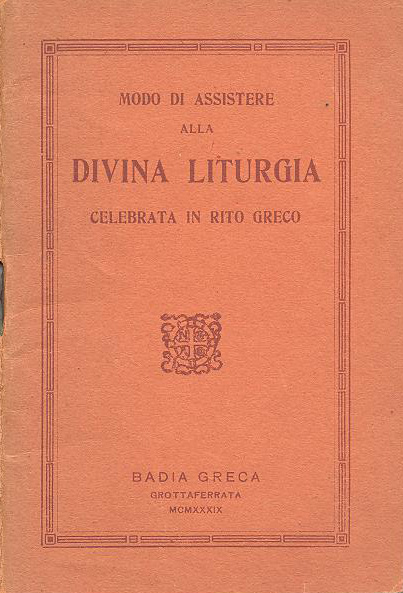
A copy of the booklet, Modo di assistere alla Divina Liturgia celebrata in rito greco (Grottaferrata: Scuola tipografica Italo-Orientale “S. Nilo,” 1939), was donated in May to the Hilandar Research Library by Allen M. Johnson.

Photo of the front cover of the booklet on the Divine Liturgy, Greek Rite, published in Italy 1939Dr. Johnson studied Slavic languages and literatures at Harvard College under Samuel Hazzard Cross, when the “Slavic Department there was just the carrel Professor Cross had in Widener Library.” On the faculty were Tsarist Count Leonid Strakhovsky, Waclaw Lednicki, S. Znamenski and Francis J. Whitfield.

The book was  purchased in Rome during 1946-48 when Dr. Johnson was working as a reporter/sports editor for the Rome Daily American.

A longtime friend of the HRL and a supporter of the Kenneth E. Naylor Professorship, Dr. Johnson first met Professor Mateja Matejic in the 1970s at a Slavic conference, when he was a graduate student at Tulane University.

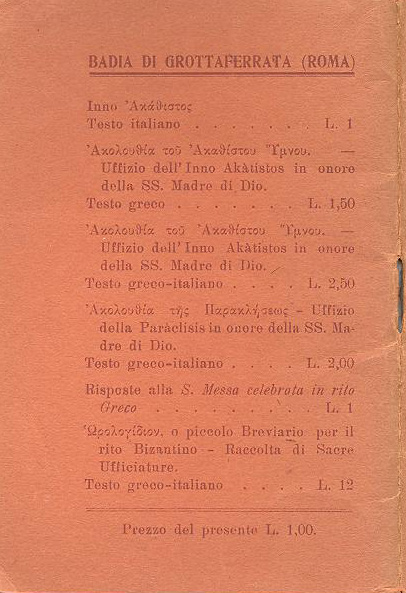
Photo of the back cover of the booklet on the Divine Liturgy, Greek Rite, published in Italy, 1939Dr. Johnson received his doctorate in Russian History (Tulane University) with a dissertation entitled Moscow Dispatches, 1921-1934: the Writings of Walter Duranty, William Henry Chamberlin and Louis Fischer in Soviet Russia.


Medieval Slavic Summer Institute 2013


The Hilandar Research Library (HRL), the Resource Center for Medieval Slavic Studies (RCMSS), and the Department of Slavic and East European Languages and Cultures (DSEELC) at The Ohio State University will host a four-week intensive Summer Institute for qualified graduate students in Columbus, Ohio, June 24 July 19, 2013. The Medieval Slavic Summer Institute (MSSI) will offer: Practical Slavic Palaeography (Slavic 814) and Readings in Church Slavonic (Slavic 812). All lectures will be in English.

Photo of MSSI 2011 class with manuscripts and gloves

MSSI 2011

Manuscript material on microform from the HRL’s extensive holdings forms a large part of the lectures and exercises. There is also a program of lectures on related topics, and other activities. Time permitting, participants may have the opportunity to work with original manuscripts and to conduct their own individualized research on manuscript collections/materials found in the HRL.

The Sixth Annual Hilandar Conference will be held in Columbus, Ohio, immediately following the end of the MSSI 2013.

Photo of 4 MSSI participants working at a table in the Special Collections Reading Room

MSSI 2011

Applicants must be graduate students with a BA degree and with a reading knowledge of Cyrillic and of at least one Slavic language. Preference will be given to applicants with reading knowledge of Old Church Slavonic or some other pre-modern Slavic language.

Photo of a student at the MSSI 2011 looking at a manuscript

MSSI 2011

The HRL, the largest repository of medieval Slavic Cyrillic texts on microform in the world, includes the holdings from over 100 monastic, private, museum, and library collections of twenty-three countries. There are over 5,000 Cyrillic manuscripts on microform in the HRL, as well as over 700 Cyrillic early pre-1800 printed books on microform. The holdings range from the eleventh to twentieth centuries, with a particularly strong collection of manuscripts from the fourteenth to sixteenth centuries. About half of the manuscripts are East Slavic, with much of the remainder South Slavic in provenience.

For further information about the HRL and RCMSS, see their websites go.osu.edu/Hilandar and rcmss.osu.edu. See issues of Cyrillic Manuscript Heritage, for accounts of MSSI 1999 (CMH 6), MSSI 2001 (CMH 10), MSSI 2003 (CMH 14), MSSI 2006 (CMH 20), MSSI 2008 (CMH 24), and MSSI 2011 (CMH 30). The DSEELC website address is http://slavic.osu.edu.

For further information on eligibility, credit, housing, financial aid, and to obtain an application to the MSSI, please contact the HRL and RCMSS either by email hilandar@osu.edu or by regular post: The Hilandar Research Library and the Resource Center for Medieval Slavic Studies, The Ohio State University, 119 Thompson Library, 1858 Neil Avenue Mall, Columbus, Ohio 43210-1286.

Image source: Photos by Daria Safronova, CMH 30 (2011): 10.


Recent Acquisition on St. Clement of Rome


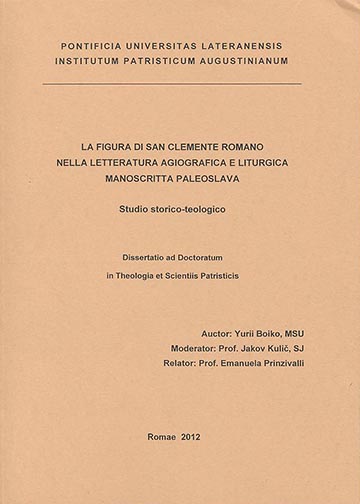
This week the Hilandar Research Library (HRL) and the Resource Center for Medieval Slavic Studies (RCMSS) received a copy of Hieromonk Justyn Boiko’s La Figura di San Clemente Romano nella letturatura agiografica e liturgica manoscritta paleoslava: Studio storico-teologico (Dissertatio ad Doctoratum in Theologia et Scientiis Patristicis, Pontificia Universitas Lateranensis Institutum Patristicum Augustinianum).

Photo of the front cover of Yurii Boiko's dissertation on St. Clement of Rome

Father Justyn had requested for his research copies of the text of the Passion of St. Clement and the Encomium of St. Kliment of Ohrid to St. Clement of Rome from one of the Hilandar Monastery Slavic manuscripts by the scribe Averkii, HM.SMS.441. This is one of a set of manuscripts containing panegyrical texts (Serb панагирик или тржаставник; Russ торжественник; Bulg панегирик) that was commissioned by Hilandar Monastery and dated to 1623-1624.

« Older posts Newer posts »