ScriptoriaSlavica

Medieval Slavic Manuscripts and Culture

Page 12 of 15

ASEEES Convention 2012


The 44th Annual Association for Slavic, East European and Eurasian Studies (ASEEES)* Convention is being held in New Orleans, November 15-18, 2012. This year’s conference theme is “Boundary, Barrier and Border Crossing.”

Among the panels listed in the convention program, one that promises to be of interest to medieval Slavic scholars is Slavia Orthodoxa & Slavia Romana: A Round Table in Memory of Professor Riccardo Picchio, chaired by Paul Alexander Bushkovitch (Yale), with participants Giovanna Brogi Bercoff, Harvey Goldblatt (Yale), Michael A. Pesenson (U of Texas at Austin), and Marina Swoboda (McGill, Canada). (See page 13 of Cyrillic Manuscript Heritage 30 for Predrag Matejic’s obituary of Riccardo Picchio.)

Image of the front cover of Raffensperger's book "Reimaginging Europe," a red ink picture from a chronicle manuscript on a cream-colored background.

Harvard University Press 2012

Also intriguing is Reimagining Europe: Kievan Rus′ in the Medieval World: Christian Raffensperger‘s Bold New Hypotheses – (Roundtable),  sponsored by the Early Slavic Studies Association, chaired by David Maurice Goldfrank (Georgetown University), with participants Brian James Boeck (DePaul University), Ines Garcia de la Puente (University of St. Gallen, Switzerland), Elena Boeck (DePaul), and Christian Raffensperger (Wittenberg University).


*formerly, the American Association for the Advancement of Slavic Studies (AAASS)


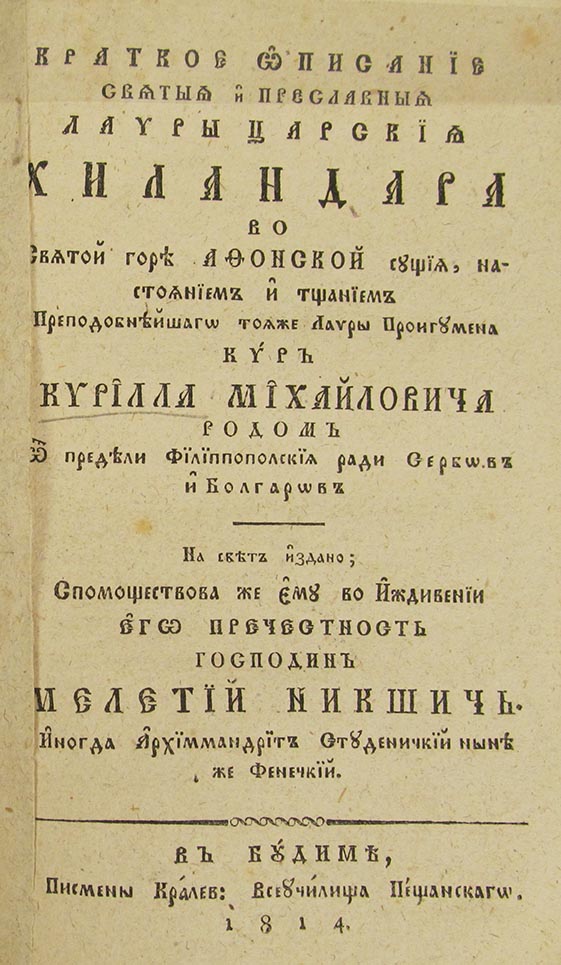
1814 Description of Hilandar Monastery


Among the unique items in the reference collection of the Hilandar Research Library is a copy of Kirill Mikhailovich’s brief description of Hilandar Monastery, published in Budim, 1814.

Photograph of the title page of the pamphlet

Bogdanović, Djurić, and Medaković (1997: 198), in a discussion of visitors to Hilandar Monastery in the 18th century, mention that in addition to “devout pilgrims,” there were also “travellers for scholarly purposes, particularly those curious about its collection of manuscripts. One such was the Russian Vasily Barsky, who stayed at Chilandar twice, in 1725 and 1744.” During his latter visit, Barsky “wrote a detailed description of Chilandar and its antiquities.”

The authors continue with the note that “Based on the results of Vasily Barsky’s works, a small book was published in Budapest in 1814 under the title Kratkoe opisanije svjatija i preslavnija Lavri carskija Hilandara (A Short Description of the Holy and Famous Imperial Monastery of Chilandar), which was virtually a copy of Barsky’s writings made by the monk Kirilo (Cyril) Mihailovich ‘for Serbs and Bulgars’. This was how Chilandar got its first monograph, similar to the already existing descriptions of Serbian monasteries intended for pilgrims and an educated public.”

Source: Bogdanović, Dimitrije, Vojislav J. Djurić, Dejan Medaković. Chilandar. 2nd edition. [Belgrade]: Jugoslav Revija, [Sveta Gora monastery of Chilandar], 1997.


Recent Acquisition: Hilandarski zbornik 12 and 13


Predrag Matejic recently returned from a trip to Bulgaria and Serbia with a number of books donated to the Hilandar Research Library by various individuals and institutions. The Serbian Academy of Science and Art presented Dr. Matejic with copies of volumes 12 and 13 of Hilandarski zbornik.

An invaluable work found in volume 13 is Mirko Kovačević’s article on the Hilandar monastic residence, the “white konak,” which was mostly written before the fire of 2004. The article includes detailed architectural drawings and photographs of the building’s interior, exterior, and various ornamental features, as well as devastating images of the ruined structure after the fire.

A photograph of volume 12 of the journal Hilandarski zbornik: the book has a red cloth cover with Serbian Cyrillic name of the journal in silver followed by the numeral 12 at the bottom of the front cover and a silver square seal of the two-headed eagle in the upper right corner of the book.Table of contents for volume 12 (2008):

Калић, Јованка. “Растко Немањић, истраживања”/Kalić, Jovanka. “Rastko Nemanjić – Research.”
Благојевић, Милош. “Хиландарски поседи на Косову и Метохији (XII-XV век)”/Blagojević, Miloš. “Chilandar estates in Kosovo and Metohija (12th-15th centuries).”
Bogdanović, Jelena.
“Some Additional Observations on the Original Tomb of St. Simeon at Hilandar and its Significance for the Architectural History of the Monastery”/Богдановић, Јелена. “Првобитни гроб св. Симеона и његов значај за историју архитектуре манастира Хиландар.”
Pavlikianov, Kyrill. “Unknown Slavic Charter of the Serbian Despot John Ugleša in the Archive of the Athonite Monastery of Vatopedi”/Павликијанов, Кирил. “Непознат словенски акт српског деспота Јована Угљеше из Архива атонског манастира Ватопеда.”
Бубало, Ђорђе. “Прилози српској дипломатици”/Bubalo, Djordje. “Four Studies on Serbian Diplomatics.”
Јовановић, Томислав.
“Карејски и Хиландарски типик у руском преводу из збирке Белокриницког манастира”/Jovanović, Tomislav. “Karayas’ and Chilandar typicons in the Russian translation from the Belokrinici monastery.”
Ракић, Зоран.
“Црква Светог Саве Српског у Хиландару”/Rakić, Zoran. “The Church of St. Sava in Chilandar.”
Бобров, Юрий, Боян Милькович.
“Карейская Богородица Млекопитательница. Краткая история и превоначальный вид”/Бобров, Јуриј, Бојан Миљковић. “Карејска Богородица Млекопитатељница. Кратка историја и првобитни изглед.”
Иванић, Бранка.
“Прилог тумачењу сликаног програма параклиса Светог Ђорђа на пиргу Светог Ђорђа у Хиландару”/Ivanić, Branka. “Additional Interpretation of the Iconographic Programme on the Parecclesion of St. George’s Tower at Chilandar.”
Fotić, Aleksandar.
“Xenophontos in the Ottoman Documents of Chilandar (16th-17th century)”/Фотић, Александар. “Ксенофонт у османским документима манастира Хиландар (16-17. век).”
Стошић, Љиљана.
“Једна непозната илустрована Библија из ризнице манастира Хиландара”/Stošić, Ljiljana. “An Unknown Illustrated Bible from the Chilandar Treasury.”
Peno, Vesna.
“Hilandar Church Chanting in 19th Century in the Frame of Mount Athos Music Tradition.”/Пено, Весна. “Светогорска музичка традиција и црквено појање у Хиландару у XIX веку.”

A photograph of volume 12 of the journal Hilandarski zbornik: the book has a red cloth cover with Serbian Cyrillic name of the journal in silver followed by the numeral 13 at the bottom of the front cover and a silver square seal of the two-headed eagle in the upper right corner of the book.

Table of contents for volume 13 (2011):

Томовић, Гордана.“Манастир Светог Ђорђа и село Уложишта на Дреници”/Tomović, Gordana. “The Saint George Monastery and the Village Uložišta on the Mount Drenica.”
Ковачевић, Мирко.“Конак обновљен 1598/1615. године – Бели конак (25)”/Kovačević, Mirko. “The Restoration of the Konak 1598/1615 – the White Konak (25).”
Петковић, Сретен. “Фреске XVII века у цркви Светог Геогрија у Хиландару”/Petković, Sreten. “17th Century Frescoes from the Church of St. George at Chilandar.”
Пено, Весна. “Мелод и писар Герман Неон Патрон у хиландарским музичким рукописима”/Peno, Vesna. “Melod and Scribe Germanos Neon Patron in Chilandar Music Manuscripts.”
Трипковић, Стевица М. “Обнова конака из 1814. године у манатиру Хиландару”/tripković, Stevica M. “The 1814 Restoration of the Monastic Quarters at Chilandar.”
Бубало, Ђорђе. “Хиландар и стонски доходак у XIX веку”/Bubalo, Djordje. “Chilandar and the Ston Tribute in the 19th Century.”


Fellowship in Eastern Christian Manuscript Studies


Dietrich Reinhart OSB Fellowship in Eastern Christian Manuscript Studies

Application Deadline: December 15, 2012

The Hill Museum & Manuscript Library (HMML) announces the establishment of the Dietrich Reinhart OSB Fellowship in Eastern Christian Manuscript Studies, to be awarded annually for three years beginning with the Academic Year 2013-2014. The fellowship has been established through the generosity of Rebecca Haile and Jean Manas of New York, New York, in memory of Br. Dietrich Reinhart OSB (1949-2008). Br. Dietrich, 11th President of Saint John’s University, was a visionary leader who saw HMML as integral to the mission of Saint John’s Abbey and University, and enthusiastically promoted HMML’s work in the Middle East, Ethiopia, and India.

Awardees must be undertaking research on some aspect of Eastern Christian studies requiring use of the digital or microfilm manuscript collections at HMML. They must have already been awarded a doctoral degree in a relevant field and have demonstrated expertise in the languages and cultures of Eastern Christianity relevant for their projects.

The Fellowship may be held for a full academic year (September 1-April 30) or for one semester (September 1-December 20; January 4-April 30). The Fellowship provides accommodation in an apartment at the Collegeville Institute on the Saint John’s University campus; working space at HMML; access to library, recreational and cultural activities at Saint John’s University; round-trip transportation; and a stipend of up to $25,000 for a full academic year. Stipends will be adjusted for less than a full year in residence.

Awardees will be expected to devote full attention to their research projects while in residence. They will also be expected to participate in a weekly seminar for Collegeville Institute resident scholars, to present their research in a public lecture sponsored by HMML, and to be a resource for HMML staff and other researchers during their stay.

Applicants are asked to provide: 1) a cover letter with current contact information and an indication of availability for a full-year or one-semester residency; 2) a description of the project to be pursued, including an explanation of how access to HMML’s resources will be important for its success (1000-1500 words); 3) an updated curriculum vitae; 4) two letters of reference.

The cover letter, project description, and CV should be sent by the applicant to hmmlfellowships@csbsju.edu; letters should be sent by the referees directly to the same email address or in hard copy to Julie Dietman, HMML, Box 7300, Collegeville, MN 56321.

Applications for the Academic Year 2013-14 are due December 15, 2012. The decision and acceptance process will be completed by the end of February 2013.

The Hill Museum & Manuscript Library is a sponsored program of Saint John’s University, with the world’s largest collection of research material for the study of manuscripts. HMML holds microfilm and digital images of more than 135,000 complete manuscripts. In addition to Latin manuscripts, HMML’s collections are particularly rich in Ethiopic, Syriac, Arabic, and Armenian manuscripts.

Source: Website of the Hill Museum & Manuscript Library, http://www.hmml.org/news10/fellowship.htm, via OSU Byzantinist, Professor Anthony Kaldellis.


39th St. Louis Conference on Manuscript Studies


The Manuscript Studies Conference at St. Louis University, which was held on October 12 and 13, 2012,  has been organized by the Vatican Film Library and its journal, Manuscripta, since 1974, and is the only conference in North America dedicated strictly to manuscript topics. The two-day program offers sessions on a variety of themes relating to paleography, codicology, illumination, book production, library history, manuscript cataloging, and much more. Suggestions for papers and sessions are always welcome, and specific submissions can be made through the annual call for papers.

This year’s “Lowrie J. Daly, S.J., Memorial Lecture on Manuscript Studies” by David Ganz was on “The Importance of Half Uncial Script.” Topics of the conference’s eight sessions included paleography, new discoveries in Armenian manuscripts, fragments and the fragmenting of manuscripts, “writing the scribe.” Two presentations in the session “Work in Progress” assessed “Manuscript Access in a Digital Age” and the “Digital Scriptorium Today and Tomorrow.”

Source: Website of the St. Louis Conference on Manuscript Studies


Workshop: Medieval Manuscript Fragments in Early-Modern Bindings


A workshop, “Hidden Treasure: The Use of Medieval Manuscript Fragments in Early-Modern Bindings,” was held on Wednesday, October 10, 2012, following a lecture by Erik Kwakkel (University of Leiden). The workshop was conducted by Kwakkel and Eric J. Johnson, OSU Libraries’ Curator of Early Books and Manuscripts.

WORKSHOP

Fragments of medieval manuscripts form an unusual and exciting research object for the historian of the book. They are the heavily damaged remains of objects – books – that themselves do not survive because they were cut up by book binders in the medieval and early-modern periods to be used as binding support. Hidden in book bindings, these snippets became travelers in time, stowaways with great and important stories to tell. Using specimens from the Rare Books and Manuscripts Library this hands-on workshop introduces the most common types of fragments and shows how the unpretentious objects add to our understanding of medieval written culture.

Kwakkel’s visit was co-sponsored by History of the Book, the Center for Medieval and Renaissance Studies, the Center for Epigraphical and Palaeographical Studies, and the Rare Books and Manuscripts Library.

Source: Website of the Working Group Literary Studies @ OSU, Institute of Humanities

Follow Erik Kwakkel on Twitter @erik_kwakkel

Like the OSU Rare Books and Manuscripts Library on Facebook


Lecture: Erik Kwakkel on Parchment Offcuts

History of the Book Lecture

Wednesday, October 10, 2012 – 1:00pm
Thompson Library 150

Erik Kwakkel is Associate Professor in medieval paleography at Leiden University, The Netherlands. He held appointments at the Universities of Amsterdam, Vancouver (UBC) and Victoria (UVic) before coming to Leiden as principal investigator of the research project ‘Turning Over a New Leaf: Manuscript Innovation in the Twelfth-Century Renaissance’. Among his publications are articles and book chapters on a variety of manuscript-related topics, as well as monographs and edited volumes on Carthusian book production (2002), medieval Bible culture (2007), change and development in the medieval book (2012), and medieval authorship (2012). Erik Kwakkel will be the holder of the 2014 E.A. Lowe Lectureship in Paleography at Corpus Christi College, Oxford. In 2012 he was appointed to The Young Academy of The Royal Netherlands Academy of Arts and Sciences (KNAW).

LECTURE

“From Scrap to Book: The Use of Parchment Offcuts in Manuscript Culture”
Technological changes in the later Middle Ages provided scribes and patrons with increased opportunities to reduce the cost of the manuscript they made or acquired. This lecture draws attention to a cheap kind of writing support, not discussed as such in present scholarship of the medieval book. It shows how small strips of discarded parchment from the edge of the skin became used as writing material, not only for short notes and letters, but also for full manuscripts. To make this case, the lecture will discuss references to such scraps in primary sources and introduce the tell-tale deficiencies on the medieval page that reveal that off-cuts were used. Ultimately it is shown that the tendency for books to become cheaper near the later Middle Ages predates the age of print.

Kwakkel’s visit is co-sponsored by History of the Book, the Center for Medieval and Renaissance Studies, the Center for Epigraphical and Palaeographical Studies, and the Rare Books and Manuscripts Library.

Source: Website of the Working Group Literary Studies @ OSU, Institute of Humanities

Follow Erik Kwakkel on Twitter @erik_kwakkel

Like the OSU Rare Books and Manuscripts Library on Facebook


Digitized Manuscript: The Gospels of Tsar Ivan Alexander, British Library


A scanned color version of the Gospels of Tsar Ivan Alexander with Added Menelogion, 1355-1356, is available in the “Digitised Manuscripts” section of the British Library’s website.

This codex is one of two manuscripts (see previous blog entry on the Curzon Gospel and the Nuttall Codex) that the hegumen of St. Paul’s Monastery presented to Robert Curzon, Lord Zouche, when he was visiting Mount Athos.


Predrag Matejic Receives Award from Sofia University


On September 19, 2012, Predrag Matejic was presented with the blue ribbon, the highest award that the University of Sofia “Kliment Ohridski” can bestow on one of its graduates, for his outstanding contribution to the study of Bulgarian culture.

The event was announced on the Sofia University website. The announcement is summarized below in English.

On 24 September 2012 at 11am in the Conference Hall of the Sofia University “St. Kliment Ohridski” Department of Cyrillo-Methodian Studies, Predrag Matejic, Curator of the Hilandar Research Library and Director of the Resource Center for Medieval Slavic Studies at The Ohio State University, Columbus, Ohio, USA, will lead a roundtable discussion. Professor Matejic will discuss the history of these two institutions and their future plans and projects, as well as the history of the longstanding relationship between Bulgarian scholars and this library and center. In the Hilandar Research Library are preserved a large number of microfilms of exceptionally valuable Slavic manuscripts, the originals of which are still kept in Hilandar Monastery [on Mount Athos] and in many other repositories around the world. The microfilms are used by many Bulgarian and foreign scholars and, as a result of such research, significant discoveries have been made in the field of Bulgarian and in Slavic and Balkan culture. The center aids scholars in their search for sources and literature.

Professor Matejic has a master’s degree from Yale University and a doctorate from Ohio State in the field of Slavic literatures and languages. His contribution to the study of the history of Bulgarian literature is invaluable. In 1978 he received his doctorate of philological sciences from Sofia University. In his dissertation he analyzed the literary works of a hitherto fore unknown medieval Bulgarian writer from the 14th century, which he discovered in a manuscript. The dissertation was published as a book in Bulgaria under the title “the Bulgarian hymnographer Efrem from the 14th cent.”


The Curzon Gospel and Codex Nuttall


Tuesday, September 11th, the OSU Fine Arts Library hosted a “facsimiles open house” so that patrons could familiarize themselves with the variety of manuscript reproductions available in the OSU Libraries. Facsimiles are invaluable resources for researchers, faculty, and students who are unable to access original unique items.

There were over 40 facsimiles in various languages from several different library collections on display. Among them was the Rare Books and Manuscripts’ Codex Nuttall: Facsimile of an ancient Mexican codex belonging  to Lord Zouche of Harynworth, England, with an introduction by Zelia Nuttall (Cambridge, Mass; Peabody Museum of American Archaeology and Ethnology, Harvard University, 1902).

Codex Zouche-Nuttall was presented at some point to Robert Curzon, 14th Baron Zouche.* This is the same Curzon who wrote an illuminating account of his travels and manuscript acquisitions entitled Visits to the Monasteries of the Levant (1848). Curzon describes receiving from the abbot of St. Paul’s Monastery on Mt. Athos a 14th-century Bulgarian manuscript . This manuscript is the focus of Cynthia Vakareliyska’s monumental two-volume annotation of and linguistic/textual introduction to the Curzon Gospel.


*Fewkes, J. Walter. Book Review: “Codex Nuttall. Facsimile of an Ancient Mexican Codex Belonging to Lord Zouche of Harynworth, England.” American Ethnography Quasimonthly. Upon Curzon’s death in 1873, the codex passed to his son, and then to the British Museum.

Addendum: According to the provenance record on the British Library’s webpage for the digital copy of The Gospels of Tsar Ivan Alexander, “Robert Curzon, 15th Baron Zouche (1851-1914): deposited his father’s collection of 218 manuscripts and 69 printed books on permanent loan to the British Museum in 1876. Bequeathed to the British Musuem in 1917 by the 14th Baron’s daughter, Darea, 16th Baroness Zouche (1860-1917)” (Digitised Manuscripts, Add MS 39627, http://www.bl.uk/manuscripts/FullDisplay.aspx?ref=Add_MS_39627, accessed Wed., June 9, 2021).


« Older posts Newer posts »