ScriptoriaSlavica

Medieval Slavic Manuscripts and Culture

Page 10 of 15

Preservation Field School in Italy: Buildings, Ceramics, Paper, Books and Art


The San Gemini Preservation Studies Program, now in its 14th year, is dedicated to the preservation of cultural heritage and offers students the opportunity to study and travel in Italy. The 2013 summer session is open for applications.

Deadline for application: March 15, 2013.

The 2013 courses offered are listed below. Check their website for more information about the application, housing, etc.

Building Restoration* (May 26th–June 22th)

Introduction to Art and Building Restoration in Italy
Surveying and Analyzing Historic Buildings

Ceramics Restoration (May 26–June 22)

Introduction to Conservation of Archaeological Ceramics
Workshop on Ceramics and Ceramics Conservation

(NEW) Book Bindings Restoration* (May 26–June 22)

Introduction to the Restoration of Book Bindings
Workshop on the Restoration of Book Bindings

Paper Restoration* (July 7–August 3)

Introduction to Restoration of Paper in Books and Archival Documents
Restoration Workshop – Paper in Books and Archival Documents

Traditional Painting Materials & Techniques (July 7–August 3)

Traditional Painting Methods and Techniques in Italy, including Issues of Weathering and Aging
Painting Workshop – Traditional Painting Methods and Techniques in Italy

Preservation Theory and Practice in Italy (July 7–August 3)
Restoration in Italy – Issues and Theory

*Field Projects:

Restoration of the Porta Burgi (12th-century city gate in San Gemini)
Surveying the 12th-century San Giovanni Battista Church complex
Archaeological survey of the public baths in Carsulae
San Gemini Historic Archives Project (restoration and digitalization of 16th- to 18th-century archival material)
The courses are open to students from various disciplines, both undergraduate and graduate. All lessons are taught in English.

Source: Email announcement from Max Cardillo, Director, San Gemini Preservation Studies Program
Online Resource: Apophthegmata patrum


Raffaele Caldarelli (Viterbo) has posted the full text of his 1996 edition of the Alphabetic part (CPG 5560) of the Alphabetico–Anonymous Collection of Apophthegmata patrum (based on the South Slavic witnesses available) at the site <http://hdl.handle.net/2067/2344>. It can be downloaded in .pdf format.

“The work presents the Old Church Slavonic text of the Alphabetic Paterìk (Lives of the Desert Fathers) according to Serbian and Bulgarian manuscripts, paralleled by the original Greek text.” The edition is based primarily on the manuscripts Gil’ferding 50* ( Serbian, from the mid 14th cent.) and Synodal (Patriarchal) Collection 345 (342)** (Greek, 11th cent.).

Caldarelli also examined several manuscripts from Hilandar Monastery’s Slavic collection, HM.SMS.421 and HM.SMS.428.

For additional information on the Apophtegmata patrum tradition, see the recent article, “The Scete Paterikon,” by W.R. Veder in Cyrillic Manuscript Heritage 32.

*National Library of Russia “Saltykov-Shchedrin,” St. Petersburg
**State Historical Museum (GIM), Moscow

Source: Announcement courtesy of William R. Veder.


Last Call for Papers: Sixth International Hilandar Conference


The Sixth International Hilandar Conference will be held at The Ohio State University in Columbus, Ohio, July 19-21, 2013. The conference theme is Medieval Slavic Text and Image in the Cultures of Orthodoxy. We invite abstracts (not to exceed 500 words in length) of proposed presentations to be sent as Word.doc attachments to hilandar@osu.edu prior to February 28, 2013.

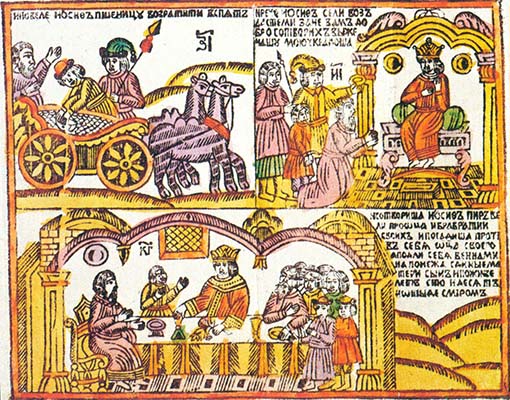
Image of a page from the manuscript entitled the Illumniated Life and Lament of Joseph the Beautiful (manuscript SPEC.OSU.HRL.SMS.15)

For the latest information, see the 6th International Hilandar Conference page.

The conference will follow immediately after the conclusion of the 2013 Medieval Slavic Summer Institute (MSSI), which is scheduled for June 24-July 19. We look forward to introducing participants and guests to the recently renovated Thompson Library, the Jack and Jan Creighton Special Collections Reading Room, and the enhanced research, teaching, and preservation opportunities now at the disposal of the HRL.


Recent Acquisition: Byzantium without Borders


A recent acquisition comes as a donation from Svetlana Kuiumdzhieva, renown musicologist and vice-president of the Bulgarian Academy of Sciences. It is the most recent issue of Българско музикознание /Bulgarian Musicology 36.3-4 (2012), which contains the proceedings of “Byzantium Without Borders: Hymnography and Music in the Byzantine World,” the 22nd International Congress of Byzantine Studies that was held in Sofia, Bulgaria, August 22-27, 2011.BulgarskoMuzikoznanie3-4

The papers are divided into three sections: New Sources, New Approaches, and Distinguished Personalities.

“New Sources” includes articles by Svetlana Kuiumdzhieva on the Tropologion, Yuliya Artamonova on Znamennaia Notation, Gregory Myers on the ritual and music for the Dedication of a Church; Olga Grinchenko discussing Byzantine and Slavic Kontakaria, and musical manuscripts from Sozopolis (by Stefan Harkov) and in Ohrid and Tirana (by Asen Atanasov).

Christian Troelsgärd addresses a “new approach” in “The Construction and Dissemination of the Middle Byzantine Musical Notation,” Nina Zakharina considers “On the Reforms (‘Ispravlenie’) of Russian Liturgical Chant Books from the 11th to the 19th Century,” Galina Alekseeva and Denis Gordeev write on “Mechanisms for the Adaptation of Byzantine Culture in Russia: Chant, Church Service,” and Elena Toncheva‘s abstract alludes to discussion “About the Modal Characteristics during the Post-Byzantine Period: Based on Sources in Slavonic Church Music.”

Prominent figures in Byzantine and Slavic musicology discussed are: Gregory of Nyssa – by Anna Arevshatyan, Photios – by Silvia Tessari, Apostol Nikolaev-Strumski – by Stefka Venkova, and Hieronymus Tragodistes – by Christiana Demetriou.


Research Stipends: Hill Museum and Manuscript Library


Although not specifically listed in the announcement below, there are Slavic manuscripts on microform among the holdings of the Hill Manuscript Library. For example, if you search its online catalog Oliver, select Vienna and Austria’s National Library for Library from the dropdown menus. For shelfmark, simply put in “Slav” and the search results will include the codices Vindobonensis.Palatinus.Slav, described in Gerhard Birkfellner’s Glagolitische und kyrillische Handschriften in Österreich (Wien, 1975).

City:  Wien
Library: Österreichische Nationalbibliothek
Shelfmark: Slav

HECKMAN RESEARCH STIPENDS

Hill Museum & Manuscript Library
Saint John’s University
Collegeville, Minnesota  56321
Phone: 320-363-2741
Fax: 320-363-3222

PURPOSE:  For research at the Library.
ELIGIBILITY:  Graduate students or scholars who are within three years of completing a terminal master’s or doctoral degree.
DURATION:  Two weeks to six months.
AMOUNTS:  Variable up to $2,000.

DEADLINES:  Twice a year.
April 15 for research conducted from July 1-December 31. November 15 for research conducted from January 1-June 30.

APPLICATION:  Submit a letter of application, c.v., a one-page description of the research project including proposed length of stay, an explanation of how the Library’s resources will enable you to advance your project, and a confidential letter of recommendation from your advisor, thesis director, mentor, or, in the case of postdoctoral candidates, a colleague who is a good judge of your work.

SEND:  All inquiries and materials to The Committee on Research, Hill Museum & Manuscript Library, 2835 Abbey Plaza, Box 7300, Saint John’s University, Collegeville, MN 56321-7300 or directed to hmml@csbsju.edu, or fax (320) 363-3222.

The Hill Museum & Manuscript Library houses extensive resources for the study of manuscripts and archives. Almost 130,000 manuscripts are available on microfilm and in digital format.  HMML has microfilmed extensively in Austria, Germany, Spain, Portugal, Malta, and Ethiopia, and is currently digitizing manuscripts in Lebanon, Turkey, Iraq, India, Malta and Italy. Consult the Library’s website for further information, including an electronic inventory of its collections (OLIVER) and a growing database of manuscript and book images (Vivarium).

www.hmml.org

www.facebook.com/visithmml

Source: Email announcement from the Hill Museum & Manuscript Library <hmml@csbsju.edu>


Recent Acquisition: Ruthenian Tetraevangelia


photo of the front cover - white with a color image from a fresco of SS. Onufrios and Makarios in Mileseva Monastery.

The Hilandar Research Library received a copy of Mirja Varpio’s In Search of a Predecessor to a Ruthenian Tetraevangel, Slavica Gothoburgensia 11 (Götgeborg, Sweden: University of Gothenburg, 2012) from the author this month. The book may also be downloaded from the University of Gothenburg’s digital repository http://hdl.handle.net/2077/31660.

Dr. Varpio used resources from the Hilandar Research Library in his publication, including an image from the Steven Enich Serbian Orthodox Slide Collection for the cover of his book. The cover is “St. Onufrios. Part of the fresco of Sts. Onufrios and Makarios in Mileseva monastery.”


Recent Acquisition: A History of Servia


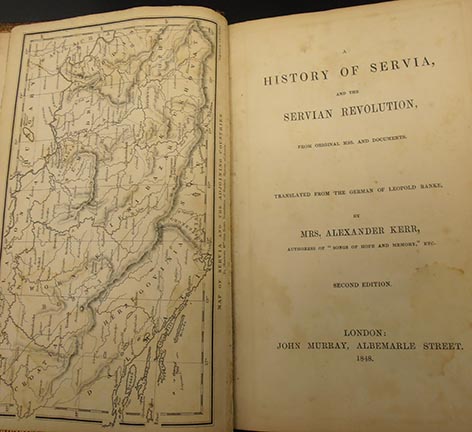
The Hilandar Research Library recently acquired a copy of A History of Servia, and the Servian Revolution, from Original Mss. and Documents. London: John Murray, 1848. 8vo. xxiv, 477, [3] pp. Translated from the German of Leopold Ranke by Mrs. Alexander Kerr. Second edition.

Photo of title page of the book and map


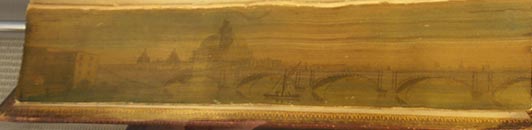
An exquisite painting of “St. Paul’s cathedral viewed from the Thames, with a sailboat manned by two men in the foreground drifting by Blackfriars Bridge” is preserved on the volume’s fore-edge.

Fore-edge painting

The book is bound in 19th-century gilt red morocco with a crowned double-headed eagle stamped on the front cover. There is an attempt to spell out in Cyrillic “Благоверны Кнезь Лазарь Србскый” followed by a date using Cyrillic letters and then “Бжѥю млтію.”


Ranke Front Cover


Purchase of this volume was made possible by a generous donation from Alex Machaskee.


Thanks to Eric J. Johnson, Curator of Early Books and Manuscripts, OSU Libraries, for bringing this volume to the attention of the Hilandar staff.


Call for Papers: Slavic Apocrypha, Oct. 3-5, 2013, Łódź, Poland

Deadline for submission of presentation topics is 31 January 2013.

The International conference Biblia Slavorum Apocryphorum III: Varia will be held October 3-5, 2013 at the University of Łódź Training and Conference Centre (Centrum Szkoleniowo-Konferencyjne Uniwersytetu Łódzkiego), Rogowska 26, 91-529 Łódź, Poland. This is the third in a series of conferences on Slavic apocrypha (see below for citations of published conference proceedings).

Proposed topic areas:

“The international conference Biblia Slavorum Apocryphorum. III. Varia will … be an opportunity to advance the discussion of the problems of pseudo-canonical Old, New and Inter-Testamental literature. At the same time, we hope to broaden the topic area of the two previous meetings to include the following issues:

  • pseudo-canonical Christian literature not directly connected with the Old and New Testament sacral history;
  • the relics of pagan cults in pseudo-canonical literature;
  • heretical literature (Manichaean, Paulician, Bogomil, Cathar etc.) and anti-heretical literature (treatises, council decisions etc.);
  • cultural communities, interreligious and interdenominational relations in the Mediterranean Area and South-East Europe.

In view of the breadth of the topics covered, the discussion is to be organized around the following points:

  • pseudo-canonical literature: current state of research, available text editions, catalogues, thesauri; textual criticism (the original vs. translations, revisions, variants); the language of pseudo-canonical texts, the relations between originals and translations; Biblical text vs. pseudo-canonical text; issues in poetics (narration, composition etc.); the theology of pseudo-canonical texts;
  • the relation between literary texts and folklore texts (legends, songs, rituals); mythology vs. literature vs. folklore; folk Christianity and pseudo-canonical literature;
  • the relation between Old and New Testament pseudo-canonical texts and commentaries on post-biblical events;
  • the relation between pseudo-canonical and heretical texts; anti-heretical literature as a source of information about alternative religious movements in the Middle Ages;
  • iconography depicting broadly understood pseudo-canonical works.”

Deadline for submission of presentation topics is 31 January 2013. Please send via email to ceraneum@uni.lodz.pl or skowronek.malgo@gmail.com, with a note ‘conference – apocrypha.’

  • Confirmation of participation and abstract (in Polish, English or Russian, up to 1000 characters) to be submitted by 30 April 2013.
  • The conference languages are: Polish, English, Russian.
  • Presentation time is limited to 20 minutes.
  • The 250 PLN / 70 EUR conference fee (100 PLN for graduate students and other pre-Ph.D. level participants) is to be paid upon arrival at the conference. The fee is meant to cover part of the costs of the conference materials, the publication of the proceedings as well as a cocktail party.

The papers presented at the conference will be published (upon favorable review) in the subsequent volume of the yearly Studia Ceranea.

For more information see “Invitation” link at the bottom of the page http://ceraneum.uni.lodz.pl/archives/1599

Bibliography
Fundamenta Europaea 6-7, special issue (Gniezno 2007)
Południowosłowiańskie Zeszyty Naukowe 4 (Łódź 2007)
Biblia Slavorum Apocryphorum. Novum Testamentum (Łódź 2009)

HRL/RCMSS Webpage on OSUL Website


Check out the HRL/RCMSS webpage on the University Libraries’ website for updates on MSSI 2013 and the Sixth International Hilandar Conference (July 19-21, 2013). The website also lists contact information for the faculty and staff of the HRL/RCMSS, publications of the RCMSS, manuscript collection descriptions, how to request copies of materials in the HRL, and provides information on how to donate to the Hilandar Research Library.

HRL/RCMSS Website


† Bishop Hrizostom (1939-2012), former Hilandar Monastery Librarian


We are saddened to learn of the death of Hrizostom, Bishop of Žiča, Serbia, on Monday, December 17, 2012.

At the time of the Hilandar Research Project photographic expeditions to Mount Athos in the early 1970s, Bishop Hrizostom was the librarian of Hilandar Monastery.

Photograph of Bishop Hrizostom with Mateja and Predrag Matejic

Reunited at the 5th International Hilandar Conference in 2002: Very Rev. Dr. Mateja Matejic, Bishop Hrizostom, Dr. Predrag Matejic (Photograph by Slobodan Mileusnić)

Bishop Hrizostom (Stolić) was born in Ruma, Yugoslavia, in 1939. From Visoki Dečani Monastery (Kosovo), where he had become a monk, he went to Jordanville, New York, where he graduated from St. Sergius Holy Trinity Orthodox Seminary. Afterwards he spent 19 years in Hilandar Monastery. He became Bishop for Western America in 1988, serving in that capacity until 1992, when he was elected Bishop of Banat. In 2003, he became Bishop of Žiča. He is the author of several interesting books on Orthodoxy, Svetačnik ili Pravoslavni mesecoslov, Služba Sv. Savi Trećem, and the editor of Liturgija Sv. Apostola Jakova, Liturgija Apostola Marka and Liturgija Apostolskih ustanova (Joković 2007: 47, n31).

Source: Joković, Miroljub. An Archival History of the Hilandar Research Project at The Ohio State University. Translation from the Serbian by Nataša Kaurin-Karača. Belgrade: Рашка школа, 2007.

Bishop Hrizostom’s death was reported in the online issue of Глас Јавности.

Screenshot of online obituary of Bishop Hrizostom from Глас јавности, Dec. 18, 2012.

Screenshot of online obituary of Bishop Hrizostom from Глас јавности, Dec. 18, 2012.


May his memory be eternal!


« Older posts Newer posts »