ScriptoriaSlavica

Medieval Slavic Manuscripts and Culture

Page 9 of 15

Romanov Coronation Albums on Exhibit at the Hillwood Museum, Washington, D.C.

Russian Liturgical Gallery, Hillwood Mansion, Washington, D.C.

Russian Liturgical Gallery, Hillwood Mansion, Washington, D.C.


“Pageant of the Tsars” is an exhibit of Coronation Albums of seven of the Romanov rulers on display in the “Dacha” at the Hillwood Estate, Museum and Gardens in Washington, DC, through June 8, 2013.

Download the free digital versions of the albums from the iTunes store.

The Albums were printed on the occasion of the coronations of Catherine I (1724), the second wife of Peter the Great; Anna Ioannovna (1730), daughter of Ivan V and niece of Peter I ; Elizabeth Petrovna (1742), daughter of Peter I and Catherine I; Nicholas I (1826), brother of Alexander I and son of Paul I; Alexander II (1856), son of Nicholas I; Alexander III (1883), son of Alexander II; and Nicholas II (1896), son of Alexander III.
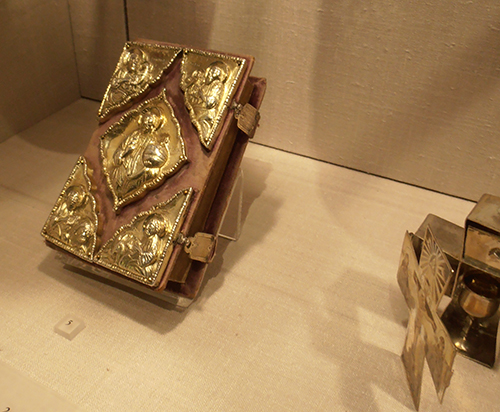
2): Silver, velvet, paper

Hillwood Russian Gospels (1702): Silver, velvet, paper

From the exhibit brochure:

“These coronation albums offer unique perspectives of the Romanov dynasty and also trace the development of printmaking in Russia through the eighteenth and nineteenth centuries. While progressing through the exhibition, one can observe how the black-and-white etchings of the eighteenth century give way to the vibrant color images of the late nineteenth century. For more information about these techniques, please visit www.hillwoodmuseum.org/pageant.”

Note that the cover of Nicholas II’s coronation album is in the style of Art Nouveau.
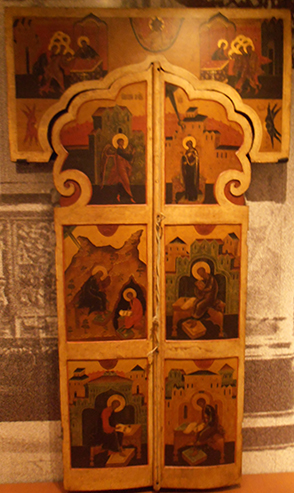
 

Royal Doors of an Iconostasis (16th cent.), Hillwood Mansion, Washington, D.C.

Royal Doors of an Iconostasis (16th cent.), Hillwood Mansion, Washington, D.C.


Sources: Exhibit brochure for Pageant of the Tsars, visit to the exhibit, and the Hillwood Estate, Museum and Gardens website.

Image Sources: Photographs taken in the Hillwood Estate Mansion, March 7, 2013.


Conference: “SS. Cyril and Methodius and the Bulgarian Golden Age,” Preslav and Shumen, Bulgaria, 1-3 November 2013

BishopKonstantinPreslavski

Bishop Konstantin Preslavski logo


The Research Center for the Preslav Literary School at the “Bishop Konstantin Preslav” Shumen University is organizing an international symposium “SS. Cyril and Methodius and the Bulgarian Golden Age,” which is dedicated to the 1150th anniversary of the creation of the Slavic alphabet and the 1120th anniversary of the establishment of Preslav as the capital of Bulgaria, on November 1-3, 2013, in Shumen, Bulgaria. The symposium is co-sponsored by the Institute of Literature of the Bulgarian Academy of Sciences, the Department of Old Bulgarian Literature, and under the patronage of the President of Bulgaria.

Preslavska Knizhovna Shkola11

Preslavska Knizhovna Shkola vol. 11


Scholars are asked to prepare a 15-minute presentation for the symposium. The paper submitted for publication, however, must be no more than 20 standard pages, submitted in Word 2007 by email or CD with an accompanying PDF document (to preserve the various fonts needed) no later than September 3, 2013. The proceedings will be published in volume 14 of the journal Преслав книжовна школа (‘Preslav Literary School’).


16th Annual Kenneth E. Naylor Memorial Lecture in South Slavic Linguistics


The sixteenth annual lecture in South Slavic Linguistics presented at The Ohio State University to commemorate Professor Kenneth E. Naylor (1935-1992) was given by Professor Olga Mladenova (University of Calgary) on “The Rise of Modern Bulgarian Literacy in the Seventeenth Century: New Facts and Interpretations,” Friday, March 22, 2013, in the Campus Reading Room on the 11th floor of Thompson Library.

photograph of Brian Joseph standing next to Olga Mladenova in front of the screen with the first powerpoint slide with the title of Dr. Mladenova's talk

Brian D. Joseph, Kenneth E. Naylor Professor of South Slavic Linguistics, and Olga Mladenova, 16th Annual Kenneth E. Naylor Memorial Lecturer on the 11th Floor, Thompson Library at The Ohio State University

Professor Brian D. Joseph (OSU Linguistics), who has held the “Kenneth E. Naylor Professorship of South Slavic Linguistics” since his investiture in 1997, opened the event with a brief account of Dr. Naylor and his contributions to OSU, to scholarship, and to the scholarly community, as well as a history of the professorship and the lecture series, and other initiatives funded by the professorship.

The lecture was well attended and Professor Mladenova’s account of her work with Bulgarian damanskini elicted a number of thought-provoking comments from the audience. Colleagues of Dr. Naylor present included professors emeriti David F. Robinson (OSU Slavic) and Carole Rogel (OSU History).

A reception of exceptional food from Milo’s Catering was organized by Karen Nielsen of the OSU Department of Slavic and East European Languages and Cultures. Ms. Nielsen also arranged a display of scrapbooks and a photo-montage documenting the past lectures. Shannon Niemeyer, events coordinator for the OSU Libraries, orchestrated a hospitable arrangement and atmosphere for what was judged a “superb” venue.

A wooden grid display case, provided thanks to the efforts of OSU Libraries’ Cheryl Mason-Middleton and Mark Moziejko, effectively exhibited publications of Drs. Joseph, Naylor, and Mladenova, as well as the first five Naylor Memorial lectures. Lauren Ressue, RCMSS GA, assisted. Immense gratitude to Michelle Drobik of the University Archives at OSU for photo images of Professor Naylor from 1975, 1976, and 1981.

Photo of Dr. Joseph standing next to open wooden shelves on wheels with books and publications propped up on book ends.

Professor Brian D. Joseph with the 16th Annual Kenneth E. Naylor Memorial Lecture publication display

Items on display (see photo) include photographs of Professor Naylor (1981 and 1975), Olga Mladenova’s Definiteness in Bulgarian: Modelling the Processes of Language Change (Trends in Linguistics: Studies and Monographs 182), Berlin: Mouton de Gruyter, 2007; Brian D. Joseph’s The Synchrony and Diachrony of the Balkan Infinitive: A study in areal, general, and historical linguistics (Cambridge Studies in Linguistics Supplemental Volume, 2009 reprint); Mladenova’s Russian Second-Language Textbooks and Identity in the Universe of Discourse: A Contribution to Macropragmatics (Slavistische Beiträge 432), München: Sagner, 2004; and a color printout of the cover of her Grapes and Wine In the Balkans: An Ethno-Linguistic Study (Balkanologische Veröffentlichungen 32), Wiesbaden: Harrassowitz Verlag, 1998, flanked by the first and second Naylor Memorial Lectures, Linguistic Emblems and Emblematic Languages: On Language as Flag in the Balkans by Victor A. Friedman (1998), and Ronelle Alexander’s In Honor of Diversity: the Linguistic Resources of the Balkans (1999), respectively.

Volumes 1-6 of Balkanistica: A Journal of Southeast European Studies (1974-1980), and Folia Slavica 1.1 (1977) edited by Kenneth E. Naylor, were framed by published versions of the third, fourth, and fifth Naylor Memorial Lectures: What Is a Standard Language Good For, and Who Gets to Have One? by Wayles Browne (2000), The Balkan Linguistic League, “Orientalism,” and Linguistic Typology by Howard I. Aronson (2007), and Minority Language Rights in Primary Education: A Century of Change in the Balkans by Christina E. Kramer (2010).


Ohio State Partners with Google Books Library


Read the article about Ohio State Partnering with Google Books Library in OnCampus: Ohio State’s Faculty and Staff News Source.

screen shot of the online publication of the OnCampus article with a photograph of OSU Depository stacks


News of ASEC 2013 Conference Participants


The Association for the Study of Eastern Christian History and Culture (ASEC) held its fifth biennial conference at Georgetown University, Washington, DC, on March 89, 2013.

Eve Levin (University of Kansas), chair of the panel “Orthodoxy Amidst the ‘Other,'” included in her introduction to Matthew Lee Miller’s presentation that his book, The American YMCA and Russian Culture: The Preservation and Expansion of Orthodox Christianity, 1900-1940, had just been released by Lexington Books.

Roland Clark (Eastern Connecticut University), who presented at ASEC on “Prophecy, Miracles, and Pilgrimage in Interwar Romania,” has just had a book review published in the latest issue of Balkanistica 26 (2013): 265-267, which is published for The South East European Studies Association. He reviews Antonio Momoc’s Capcanele politice ale sociologiei interbelice: Şcoala Gustiană între carlism şi legionarism ‘The Political Snares of Interwar Sociology The Gusti School Between Carlism and Legionarism.’

In the same issue of Balkanistica, Lucien J. Frary (Rider University) has a review article in which he critiques three recent titles related to “Health, Society and the Family in the 20th Century Balkans” (241-254).

The latest issue of Russian History has been released – and it contains selected papers from the ASEC’s second conference, “Centers and Peripheries: Interaction and Exchange in the Social, Cultural, Historical, and Regional Situations of Eastern Christianity, which was held at The Ohio State University in Columbus, Ohio, October 5–6, 2007.

Guest editors J. Eugene Clay and Barbara J. Skinner also presented at the 2013 ASEC conference.

Russian History 40.1 (2013): Centers and Peripheries in Eastern Christianity–Part 1.

Guest editors: J. Eugene Clay, Russell E. Martin, Barbara J. Skinner

Section 1. Text and Interpretation

Alice Whealey, “Muslim Motives for Conquering the Byzantine Empire 634-720: The Evidence from Eastern Christian Sources”

Enrique Santos Marinas, “Reassessment, Unification, and Enlargement of the Sources of Slavic Pre-Christian Religion”

Donald Ostrowski, “Dressing a Wolf in Sheep’s Clothing: Toward Understanding the Composition of the Life of
Alexander Nevskii”

Martha M. F. Kelly, “Cultural Transformation as Transdisfiguration in Pasternak’s Doctor Zhivago”

Section 2. Mission: Expanding the Periphery

Jesse D. Murray, “Together and Apart: The Russian Orthodox Church, the Russian Empire, and Orthodox Missionaries in Alaska, 1794-1917”

Mara Kozelsky, “A Borderland Mission: The Russian Orthodox Church in the Black Sea Region”

Lucien J. Frary, “Russian Missions to the Orthodox East: Antonin Kapustin (1817-1894) and his World”


Source of the Russian History 40.1 table of contents: Lawrence Langer (University of Connecticut) via the Early Slavic Studies listserv.


Conference: “The Fairest Meadows in the World” – Crusades and Crusaders in the Balkans


Papers are invited for the conference, “‘The Fairest Meadows in the World’: Crusades and Crusaders in the Balkans,” to be held at St. Cyril and St. Methodius University of Veliko Tŭrnovo, Bulgaria, November 7-9, 2013.

Papers dealing specifically with Crusader-Balkan relations after 1204 are especially encouraged. Interested graduate students and faculty should send an abstract of no more than 300 words, together with name, title, institutional affiliation, and CV to Thomas Lecaque (tlecaque@utk.edu) and Jake Ransohoff (jransohoff@uchicago.edu), by no later than April 15, 2013.

The presence of the Crusades and Crusaders in the Balkans, from the eleventh to the fifteenth centuries, introduced a vast and disparate array of foreign elements into the complex world of Medieval Southeastern Europe and served as a flashpoint for a number of substantial changes in the political, social, religious,and economic fabric of the region. Yet while some important military dimensions of the Crusades in the Balkans can be described in detail, our knowledge remains incomplete in many crucial areas. Let us ask the questions: How did the presence of Crusaders in the Balkans influence the ideas and concepts through which Latins, Byzantines, and Slavs alike described, or attempted to describe, themselves? Why did certain aspects of exchange among Latin and Orthodox polities prove more resilient than others? These are complex, causal questions which have rarely been addressed in Balkan-Crusader history.

This conference sets out to ask structural questions in order todevelop a richer context in which to place the phenomenon of Crusades and Crusaders in the Balkans. With this goal in mind, we hope to engage in discussion across a wide range of subjects and encourage scholars from different national backgrounds with different expertise, perspectives, and priorities, to reach across their respective fields and work towards a more nuanced and holistic understanding of this critical but understudied theatre of Crusader history. We welcome papers concerning any aspect of the social, economic, artistic, religious, cultural, political, and diplomatic interactions between Latins, Byzantines, Turks, and Slavs in the Balkan Peninsula between roughly 1096 and 1444. Any and all topics are welcome, but we are particularly receptive to papers concerning:

  • The reception of Latin political culture in the Balkans, and its impact on state structure, methods of government, and ideologies of legitimacy.
  • Commercial activity among Crusaders, Byzantines, and Balkan polities, and the role of trade in generating cultural exchange.
  • Changing definitions of Orthodoxy and Heterodoxy among both Latin and Orthodox populations in the Balkans.
  • Artistic expressions and material culture as a means of cultural, political, and religious transmission between Slavs, Latins, and Byzantines.
  • The role of language and literature in facilitating cultural exchange and ideological transfer between Balkan and Crusader polities.
  • The application of border theory to the Crusade-era Balkans and cultural/religious hybridization in the “borderlands” between Slavs, Latins, and Byzantines.

Source:  BSANA forward from Thomas Lecaque, University of Tennessee-Knoxville via Anthony Kaldellis, OSU.


Festschrift for Predrag Matejic, Part 2


The Bulgarian Academy of Sciences (BAS) and the Cyrillo-Methodian Research Centre (Sofia, Bulgaria) honored Predrag Matejic, Curator of the Hilandar Research Library and Director of the Resource Center for Medieval Slavic Studies, with а festschrift on the occasion of his 60th birthday (August 2, 2012) that spans issues 3 and 4 of volume 36 (2012) of the prestigious journal for medieval Slavic studies Palaeobulgarica/Старо-Българистика.

Contents of Palaeobulgarica/Старо-Българистика 36.4 (2012):

Image of photograph of Dr. Matejic and clear overlay with ornamental flourish from a manuscript in issue Palaeobulgarica 36.3 (2012)

Festschrift to Predrag Matejic

Predrag Matejic, “Хилендарската научна библиотека и България – 40 години сътрудничество”/’The Hilandar Research Library and Bulgaria: 40 Years of Cooperation,’ 3-17.

Adelina Angusheva-Tikhanova and Iskra Khristova-Shomova, “Образи и фигури в риторични и химнографски творби за св. Петър и Павел,  представени в славянската традиция”/’Tropes and Verbal Images in Hymnographical and Liturgical Rhetorical Texts Dedicated to SS. Peter and Paul in the Medieval Slavonic Tradition,’ 18-38.

Lora Taseva, “Антилатинската полемика на Григорий Палама и Варлаам Калабрийски в частите от в. на кодекс Дечани 88 и славянската ръкописна традиция”/’An Anti-Latin Polemic of Gregory Palamas and Varlaam from Calabria from the 16th-Century Codex Dečani 88 and the Slavonic Manuscript Tradition,’ 39-61.

Margaret Dimitrova, “Гръцките заемки гѷψи, ѵψи и епалѯис, или как Константин Костенечки използва тълкованията на Песен на песните в оригиналните си съченения”/’The Greek Loanwords gypsi, ypsi and epalxis, or How did Constantine of Kostenec Use Commentaries on the ‘Song of Songs’ in His Original Compositions?,’ 62-74.

Maria Spasova, “Неизвестен славянски превод на правило а· и в· от Посланието на Дионисий Александрийски”/’An Anonymous Translation into Slavonic of Precepts and in the Epistle by Dionysius of Alexandria,’ 75-97.

William R. Veder, “Плоская традиция текстов”/’Flat Tradition of Texts,’ 98-109.

Svetlina Nikolova, “Неизвестно изследване на Григорий Илински за Пространното Методиево житие”/’An Unknown Study by Gregory Ilinsky on the Extended Life of Methodius,’ 110-136.


Festschrift for Predrag Matejic, Part 1


The Bulgarian Academy of Sciences (BAS) and the Cyrillo-Methodian Research Centre (Sofia, Bulgaria) honored Predrag Matejic, Curator of the Hilandar Research Library and Director of the Resource Center for Medieval Slavic Studies, with а festschrift on the occasion of his 60th birthday (August 2, 2012) that spans issues 3 and 4 of volume 36 (2012) of the prestigious journal Palaeobulgarica/Старо-Българистика.

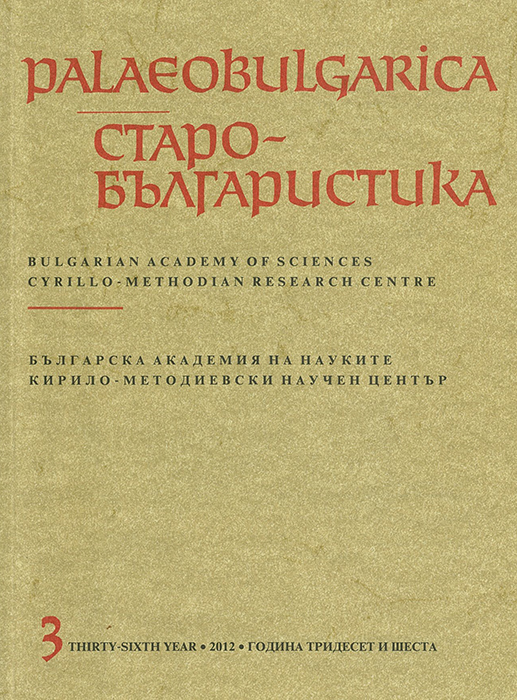
Image of the front cover of the volume of Palaeobulgarica

Festschrift to Predrag Matejic

Contents of Palaeobulgarica/Старо-Българистика 36.3 (2012):

Svetlana Kuiumdzhieva, “Приносът на д-р Предраг Матеич за развитието на славистиката и българистиката”/’The Contribution of Dr. Predrag Matejic to the Development of Slavistics and Bulgarian Studies,’ 3-10.

Klimentina Ivanova, “За календарните триодни сборници, писани в Хилендарския манастир”/’On the Panegyrical Triodia Written in Hilandar Monastery,’ 11-28.

Francis J. Thomson, “The July and August Volume of the Hilandar Menelogium,” 29-59.

Aksiniia Dzhurova, “За украсените в Blütenblattstil ръкописи от X век – евангелията Berat 4 и Vlorë 5 от Държавния архив в Тирана”/’About Two 10th-Century Manuscripts Illuminated in the ‘Blütenblatt’ Style: The Gospels Berat 4 and Vlorë 5 in the State Archives in Tirana, Albania,’ 60-82.

Svetlana Kuiumdzhieva, “По какъв осмогласник е пял св. Йоан Дамасин?”/’What Did the Book of the Octoechos that St. John Damascene Use Look Like?,’ 83-91.

Cynthia M. Vakareliyska, “Archaic Constantinople Typikon Commemorations in the Menelogion to Apostolus Dečani-Crkolez №2,” 92-103.

Mariyana Tsibranska-Kostova, “Ленгендарната история на Света гора в един печатен апокриф от Венеци (1571–1572)”/’The Legendary History of the Holy Mount in One Printed Apocrypha from Venice (1571-1572),’ 104-124.


ASEC Conference, Day 2: March 9, 2013


The Association for the Study of Eastern Christian History and Culture (ASEC) held its fifth biennial conference at Georgetown University, Washington, DC, on March 8-9, 2013.

Saturday, March 9, 2013

Session 5: Vladimir Solov’ev and Russian Orthodoxy (Philosophy and the Church)

Chair/Discussant: Patrick Michelson, Indiana University

Papers:

  1. “Humanity, Divinity, and All-Unity in Vladimir Solov’ev’s Critique of Abstract Principles” – Randall A. Poole, College of St. Scholastica
  2. “Does Philosophic Orthodoxy Have a Future?” – Paul Valliere, Butler University
  3. “The Russian Orthodox Church in Italy Today: A Kaleidoscope Clarifying Itself”  – Valeria Z. Nollan, Rhodes College

Session 6: Christianity in the World

Chair/Discussant: Christine Worobec, Northern Illinois University

Papers:

  1. The Contemplation of Nature in Eastern Christianity: Greek Patristic Foundations” – Joshua Lollar, University of Kansas
  2. “Slaves of the Sultan: Russian Reactions to Christian Captives during the Greek Revolution (1821–1830)” – Lucien J. Frary, Rider University
  3. “Lived Christianity in the Donbass: The Activities of Donetsk’s Transfiguration Brotherhood in the Late Nineteenth and Early Twentieth Century” – Dezeree Hodish, University of Kansas
  4. “Orthodox and Protestant Alcohol Rehabilitation Programs in the Former Soviet Union” – Mark R. Elliott, Asbury University

Session 7: Icons and the Visual at the Center of Religious Controversy

Chair/Discussant: Valeria Z. Nollan, Rhodes College

Papers:

  1. “Framing the Miraculous: The Physical and Temporal Reordering of Image Oriented Lay Religious Devotions in Early Modern Greek-rite Catholicism” – Wojciech Bełtkiewicz, Kenyon College
  2. “Old Believers and Icons” – Evgeny Grishin, University of Kansas
  3. “Digitized Resources on Religious Debate: Rare and Unique Items from the Hilandar Research Library″ – M.A. Johnson, The Ohio State University

Session 8: Orthodoxy Amidst the “Other”

Chair/Discussant: Eve Levin, University of Kansas

Papers:

  1. “‘The Russian Ecclesiastical Mission in Jerusalem: A Documentary History” – Paul du Quenoy, American University of Beirut
  2. The American YMCA and the St. Sergius Theological Academy in Paris” – Matt Miller, Northwestern College
  3. “‘In the Shadow of the Orient’: Orthodox Christianity and Orientalism” – Christopher D.L. Johnson, College of the Bahamas
  4. “Prophecy, Miracles, and Pilgrimage in Interwar Romania” – Roland Clark, Eastern Connecticut State University

The conference was sponsored by ASEC, Inc.; Georgetown University’s Medieval Studies Program, Center for Eurasian, Russia and East European Studies, and the Departments of History and Theology; The Ohio State University’s Resource Center for Medieval Slavic Studies (Columbus, OH); and the Department of History of Eastern Kentucky University (Richmond, KY).

ASEC Conference, Day 1: March 8, 2013


The Association for the Study of Eastern Christian History and Culture (ASEC) held its fifth biennial conference at Georgetown University, Washington, DC, on March 8-9, 2013. The theme of the conference was “Antecedents and Subsequents of Iosif Volotsky: Exploring Eastern Christian Concerns.”

Over 40 participants and attendees congregated on Georgetown University’s historic campus for two days of intense historical, philosophical, and theological discourse during eight panels of scholarly presentations as well as a keynote lecture and numerous social gatherings.

Congratulations to the conference host David Goldfrank (Department of History, Georgetown University), his Medieval Studies associate Sandra Strachan-Vieira, and conference staff and assistants Carol Dockham and Alyssa Gomes, for arranging the on-site logistics of a highly successful conference.

Image of the front cover of the program for the 2013 ASEC conference

ASEC Conference Program 2013


Friday, March 8, 2013

Session 1: Iosif Volotskii

Chair/Discussant: J. Eugene Clay, Arizona State University

Papers:

  1. “Iosif Volotsky’s sui generis Ars Disputandi” – David Goldfrank, Georgetown University
  2. “An Imagined Disputation: The Prenie s Iosifom Volotskim” – Donald Ostrowski, Harvard University
  3. “What Was New about Commemoration in the Iosif Volotskii Monastery? A Reassessment”  – Ludwig Steindorff, Christian-Albrechts-Universität zu Kiel

Session 2: Iosif Volotskii’s Legacy in the Russian Orthodox Church

Chair/Discussant: Scott Kenworthy, Miami University of Ohio

Papers:

  1. Metropolitan Macarius and Muscovite Politics during the Reign of Ivan IV” – Charles J. Halperin, Indiana University
  2. “Deacon Feodor Ivanov as a Follower of Iosif Volotsky or a Comparative Analysis of Feodor’s ‘Authentic Testimony’ about the Wolf and Predator and One-Marked-by-God Nikon who is Pastor in Sheep’s Skin and Forerunner of the Antichrist and Iosif’s Enlightener” – Kevin M. Kain, University of Wisconsin, Green Bay
  3. “Defining Orthodoxy in Imperial Russia: The Heresiological Heirs of Iosif of Volokolamsk” – J. Eugene Clay, Arizona State University

Session 3: Tradition and Change in Monasticism through the Centuries

Chair/Discussant: Jennifer Spock, Eastern Kentucky University

Papers:

  1. “What is Late Antique Monasticism?” – Rod Stearn, University of Kentucky
  2. “From Ascetic Hermit to Communal Monk: The Changing Image of Saint Nil Stolbenskii in the Early Seventeenth Century” – Isolde Thyret, Kent State University
  3. “The Last Basilians in Russia: Conversion and Cultural Change in Russia’s Western Borderlands, 1820–1840” – Barbara Skinner, Indiana State University

Session 4: Theological Controversy in the Early Church

Chair/Discussant: Joshua Lollar, University of Kansas

Papers:

  1. “‘No one can doubt that the Father is greater’: Constantius II and the Council of Sirmium” – Edward Mason, University of Kentucky
  2. Canonical Fathers and the Creation of Authority in the Disputatio cum Pyrrho (PG 91, 287-353)” – Ryan W. Strickler, University of Kentucky
  3. “Schism, Unity, and Social Networks in Sixth-Century Byzantine-Papal Relations” – Joshua Powell, University of Kentucky

The conference was sponsored by ASEC, Inc.; Georgetown University’s Medieval Studies Program, Center for Eurasian, Russia and East European Studies, and the Departments of History and Theology; The Ohio State University’s Resource Center for Medieval Slavic Studies (Columbus, OH); and the Department of History of Eastern Kentucky University (Richmond, KY).


« Older posts Newer posts »