Manga

...bibliographic notes about manga...

Category: News (page 1 of 8)

The Carefree Gameboard of Asō Yutaka’s Nonki na Tōsan 

Guest Post by Mitchell Clark  

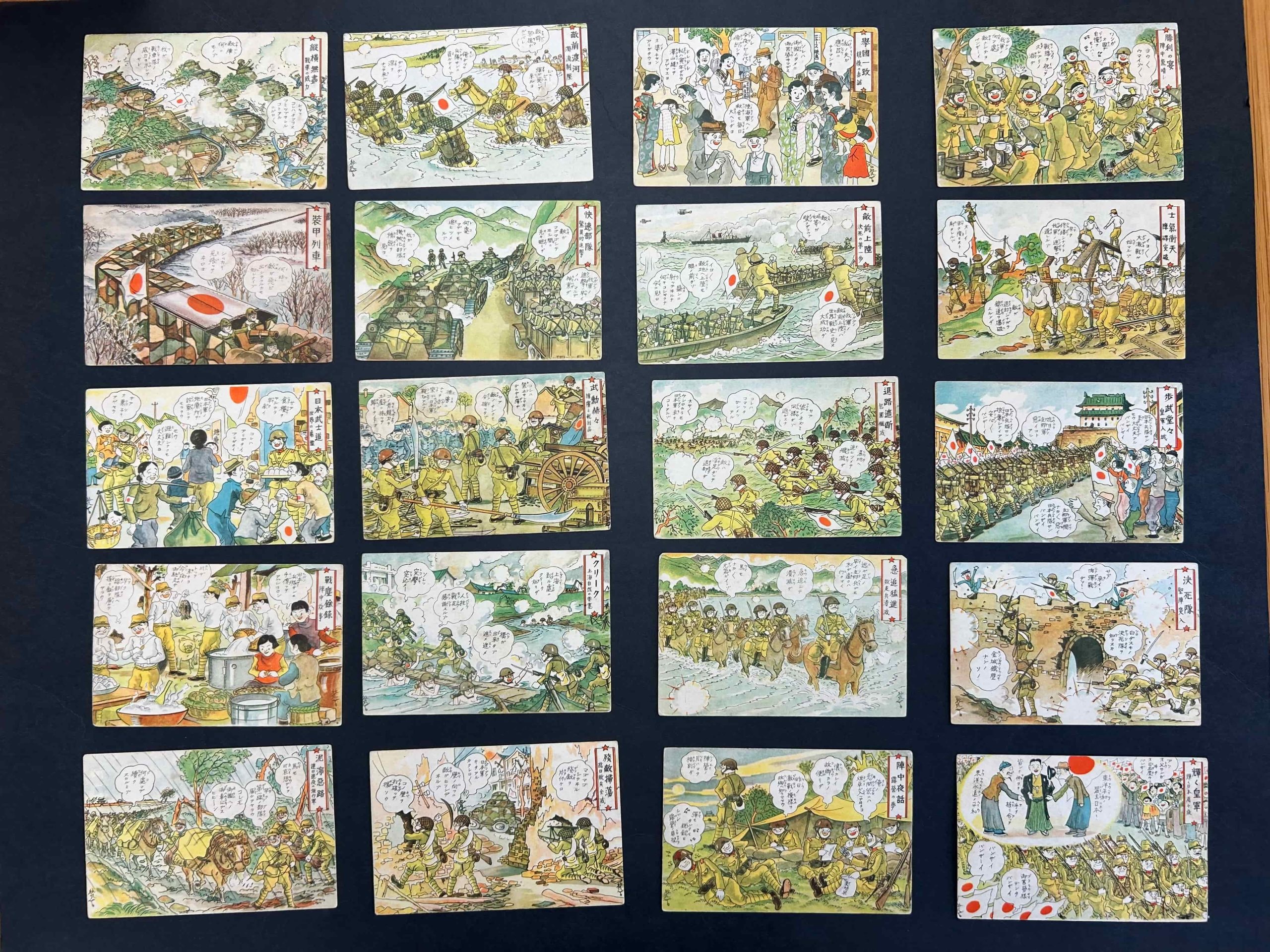
Japanese board game print featuring cartoon characters doing various actions across 37 film-roll-shaped spaces.

Nonki na Tōsan Shusse Sugoroku, or Carefree Dad Success Story Gameboard.

One of the many strengths of the manga collection at OSU is a subcollection of gameboard prints, or sugoroku. Our collection contains dozens of these, dating from as far back as the Edo period to as recently as the 1980s. One sugoroku, dating to 1925, features one of Japan’s earliest serialized comic strips, Nonki na Tōsan, or Carefree Dad (often translated as Easygoing Daddy).

Nonki na Tōsan was first published in the newspaper Hōchi Shimbun in 1923—interestingly, in the wake of the Great Kantō Earthquake. Its lighthearted nature was seen by publishers as a salve to lift spirits at a time when the capital region was still reeling from disaster. Inspired by the American comic Bringing Up Father by George McManus, Nonki na Tōsan became immensely popular for its slice-of-life comedy and portrayal of everyday Japanese virtues. Created by Asō Yutaka, the cartoon quickly inspired Nonki na Tōsan merchandise, toys, games, and even three silent films released in 1925.

Continue reading

Manga Artists at OSU: A Creative Exchange with Marco Kohinata & Keita Katsushika

3-picture photo collage

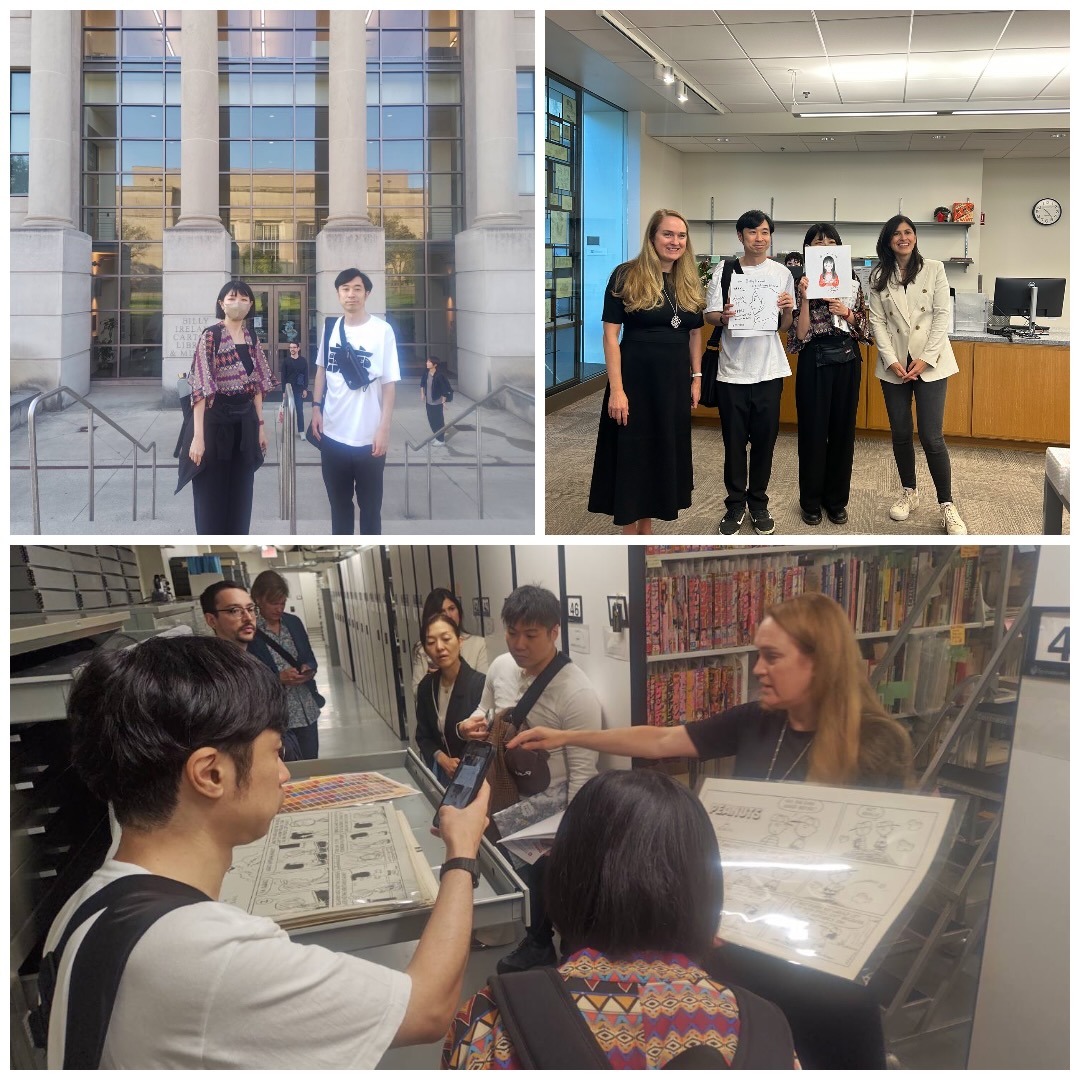
Pictures taken with manga artists Katsushika Keita and Kohinata Marco during their tour of the Billy Ireland Cartoon Library & Museum.

Last week, our library had the pleasure of welcoming two up-and-coming manga artists—Marco Kohinata and Keita Katsushika—from the MINT Project (Manga International Network Team). Their visit to The Ohio State University was part of a larger tour in Columbus in conjunction with Cartoon Crossroads Columbus (CXC), a popular four-day citywide festival celebrating cartoon and comic art.

As part of their visit, the artists toured the Billy Ireland Cartoon Library & Museum, home to the largest collection of cartoon art in the world, and the site where we keep our libraries’ rare and historical manga.  As a token of appreciation, the MINT team gifted us a selection of the artists’ works—as well as original drawings—an honor that will enrich our collection and inspire scholars.

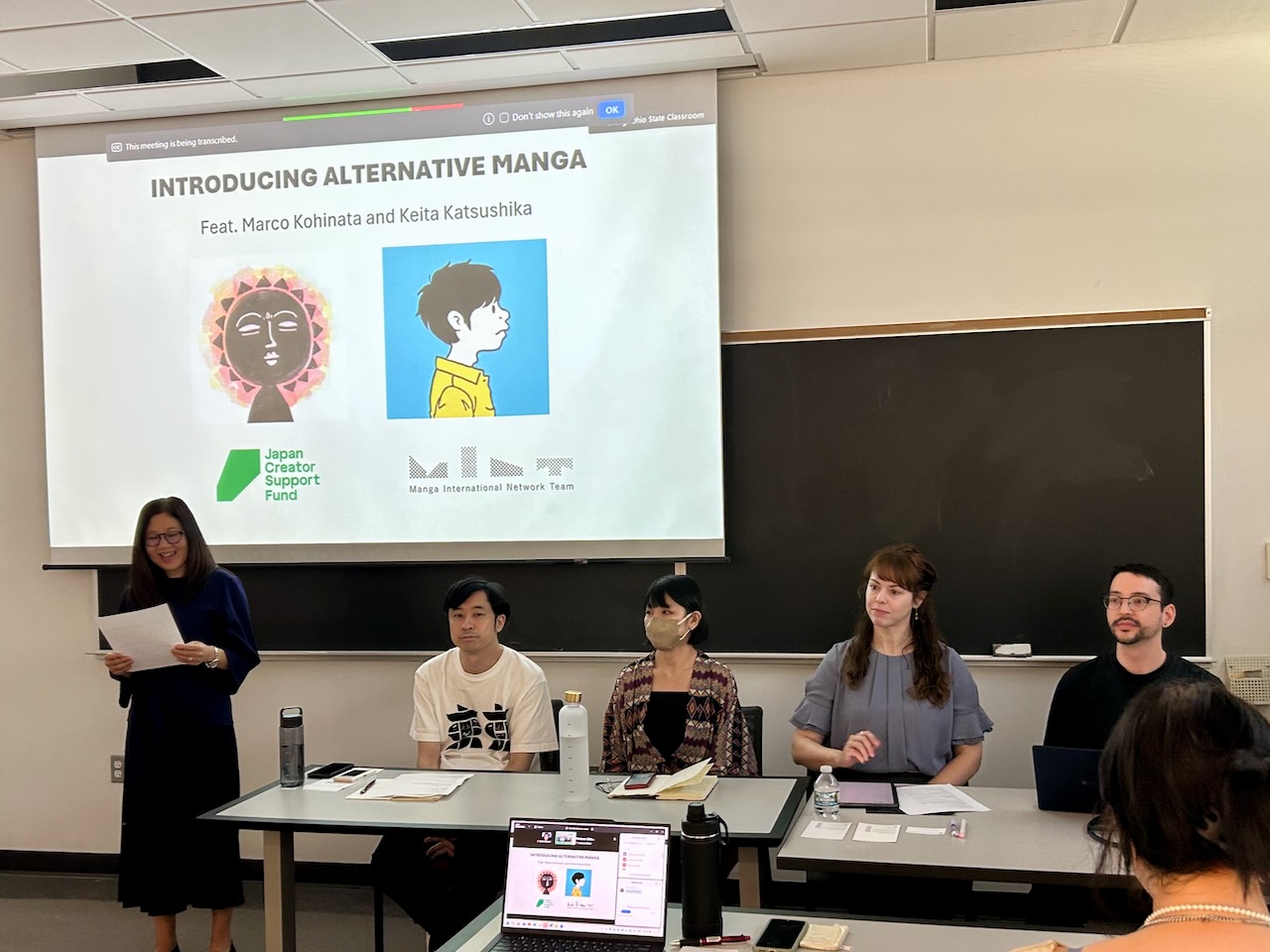
Following the tour, Marco and Keita visited an upper level Art History class, where they held a panel talk and responded to a series of thoughtful questions posed by Adam Jimenez (OSU Class of 2012) from the Japan Publishing  Industry Foundation for Culture (JPIC). Their answers offered unique and inspiring insights into their creative journeys, the challenges of getting published, and the realities of working in the manga industry today. What follows is a synopsis of their discussion:

Introducing the panel of manga artists

The panelists, manga artists Keita and Marco, as well as moderator Adam Jimenez and their interpreter are introduced by DEALL Professor Naomi Fukumori

Continue reading

Leveling Up the Jiji Manga Wiki: Fresh Updates + Video Walkthrough

Collage of Jiji Manga Covers

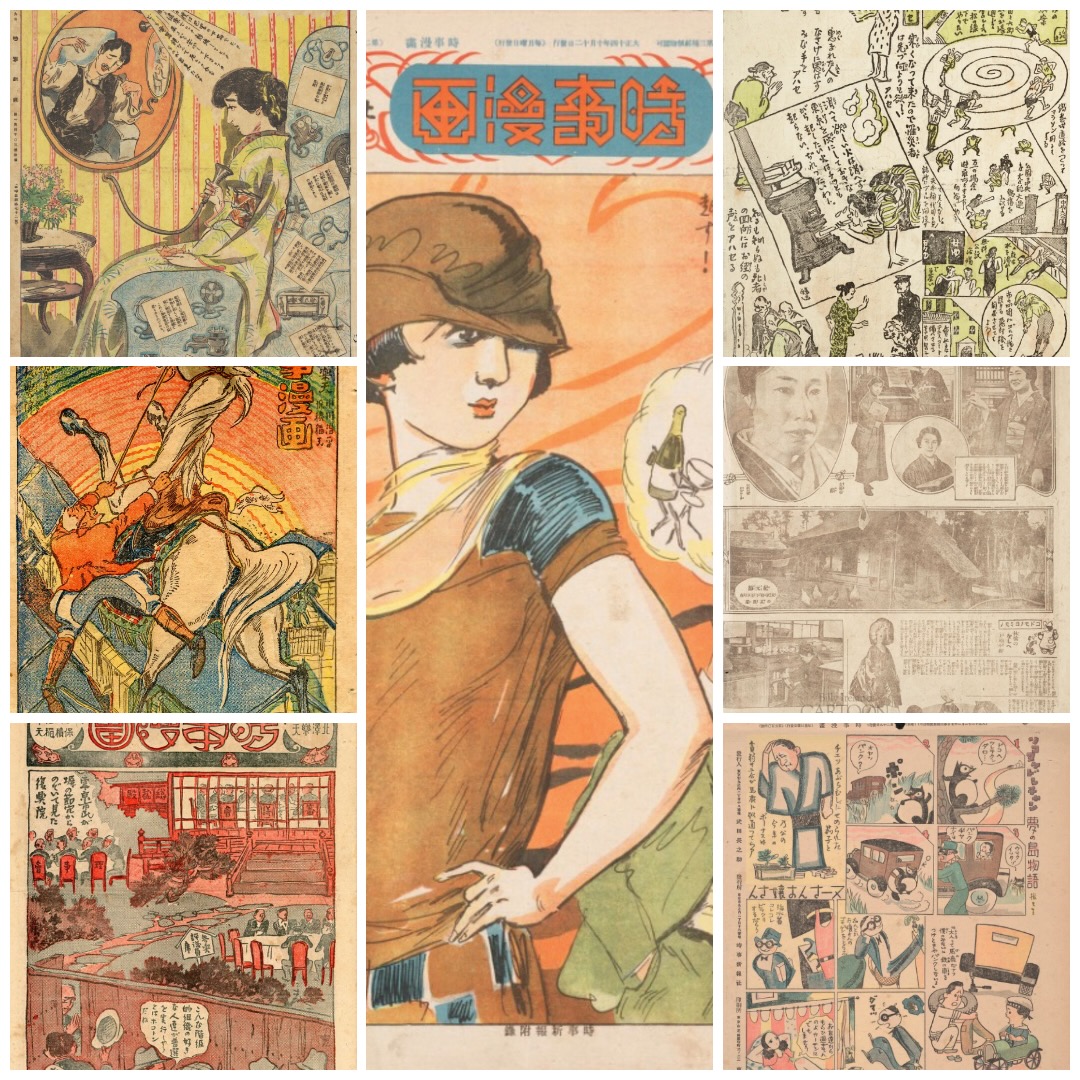
A collage of Jiji Manga covers retrieved from the University Libraries’ Digital Collections

Inspired by American-style newspaper comic supplements, Jiji Manga was one of Japan’s first modern comic strips. It featured cartoons by Kitazawa Rakuten (北澤楽天) and his contemporaries, translations of foreign comics, as well as puzzles, photographs, and editorial articles. The Billy Ireland Cartoon Library & Museum holds 476 of the 504 published volumes—making it one of the most complete runs in the world.

To help make this remarkable resource more discoverable, our library launched the Jiji Manga Wiki over fifteen years ago (a project still in progress). This past summer, thanks to the dedicated efforts of student workers Anqi Chen and Joseph Santiago, many gaps in the Wiki were finally filled. Their careful reading of prewar, non-standardized Japanese texts has allowed us to add complete contents transcriptions for almost every volume of the magazine—bringing us closer than ever to completion.

Jiji Manga Video Tutorial Transcription

Continue reading

Prized Sketch by Tezuka Osamu for Shonen Club series ‘Donguri March’

One of our prized holdings held at the Billy Ireland is an original sketch by the prolific artist TEZUKA Osamu, famously dubbed the ‘Godfather of Manga’ (マンガの神様).  Set during the post-World War II era (1945-52), this rare piece features ubiquitous markers of the American Occupation –such as the Coca Cola sign in the shop window (panel 4), and the “Off Limits” sign on the fence (panel 7). Notably, Japanese men are seen shining shoes for American GIs, one of whom has a presumed Japanese ‘girlfriend for hire,’ known as a panpan girl, on his arm.

Until recently, our library was not sure what manga series this draft sketch was intended for. However, a couple years ago, thanks to the power of social media and crowdsourcing, I discovered through a wonderful follower (@agujeta) that this piece originates from Donguri Kōshinkyoku (or Donguri March in English), a manga series that ran from January to June of 1959 in Shōnen Club Magazine (Shōnen Kurabu / 少年倶楽部, later known as 少年クラブ in 1946). Per the official Tezuka Osamu web site, this short-lived series follows the ambitions of the cartoon’s main protagonist, Kinoshita Toukichirō, a first-year junior high school student who works at a bookstore and aspires to become a publisher. This drawing was apparently unfinished. The character Tōkichirō’s clothes have not been drawn on the top row.

To learn more about this rare holding, please check out this wonderful Curator Talk, recorded in 2020 by my colleague Dr. Kay Clopton, a specialist in manga sound effects and currently the Social Sciences and Humanities Librarian at OSU.

Note: This item, made available for research and educational purposes, may be protected by copyright; the user is responsible for making a final determination of copyright status.

Teaching Postwar Counterculture with Japanese Gekiga

Sample set of 4 gekiga publications

Sample set of four gekiga titles used for “Group 9”
in a recent class on post-war Japanese counterculture

It’s been a while since the last blog post, but never fear, we are still working hard to build and activate our cool manga collection! Speaking of “cool” — we recently had a cool opportunity to explore our manga sub-collection of gekiga (劇画) during a class visit with Professor Keita Moore this semester. In his course “Elements of Japanese Culture” (DEALL 2231), Prof. Moore brought his students in to the BICLM to view some of our gekiga and to learn more about Japanese postwar protest and opposition.

Known for its more mature themes and cinematic flow, gekiga (often translated as “dramatic pictures” in English) is a type of avant-garde manga that departed in style from mainstream Japanese comics in the late 1950s. In contrast to the prevailing manga that were drawn for children (jidō manga or kodomo manga) by artist Tezuka Osamu, gekiga emerged with new content for adult readers, many of whom harbored doubts about the postwar status quo.  In many ways, the genre of gekiga gave shape to these doubts, and spoke to societal issues of the times, ranging from economic and social inequality, Japan’s Cold War military alliance with the United States, and the threat of nuclear warfare.

Continue reading

More “Boys’ Love” (or “BL”) Titles Donated to the Manga Collection!

Part of a wonderful anonymous donation added recently to the general collections.

The genre known as “boys’ love (BL)” or “yaoi” is deep and expansive, covering all manner of settings, scenarios, and characters. Collecting LGBT+ manga titles is a priority for us, and so we are thrilled to acquire these books through a recent gift in kind from several donors! Here are some highlights that are now available for check-out in our circulating collections:

Cover art for "Ten Count" vol. 1 [Aug. 9, 2016]

Cover art for “Ten Count” vol. 1 [Aug. 9, 2016]

First on the list is Ten Count, an award-winning series by Rihito Takarai. Ten Count follows Tadaomi Shirotani, a salaryman plagued with obsessive-compulsive disorder that manifests in his intense germophobia. In order to improve his condition, Shirotani is instructed by a therapist, Riku Kurose, to write a list of ten actions he is unable to do, and then he is to work toward completing each one as a form of exposure therapy. However, things get complicated when Kurose falls in love with Shirotani. What secrets will come out as their relationship intensifies?

Continue reading

Glimpses from the Vault: The Tokyo Puck (Tōkyō pakku) Originals and Reprints

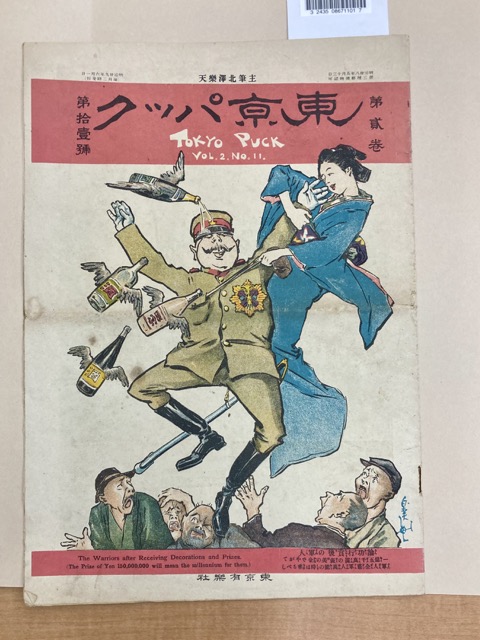
Among the many unique manga serials held at OSU’s Billy Ireland Cartoon Library & Museum (BICLM) are three original issues of Tokyo Puck (東京パック), an early Japanese satirical comic newspaper launched by Kitazawa Rakuten (北沢楽天, 1876-1955) and published from 1905 to 1923 (with a 5-year interruption circa the First World War). This Japanese manga newspaper was inspired by the American magazine Puck (published from 1877 to 1918), one of the earliest humor magazines in the US to solely feature cartoons, caricatures, and political satire.

Colorful newspaper cover page with a geisha, flying beer bottles and a drunken soldier

The cover page of an issue of Tokyo Puck (Volume 2, Number 11, published June 1, 1906), held at the BICLM. PN6790.J32 T65 v.2:no.11

Recently I had the opportunity to click some pictures of two of our Tokyo Puck issues during a class visit with students from “The Art of Colonial Taiwan,” (ArtHist 5002). In addition to our Tokyo Puck samples, the students in this class browsed a variety of materials depicting Taiwan and other Japanese colonies in historical cartoon maps, water colors, and artist scrolls created by famous manga artists of the early 20th century.

Continue reading

Manga Zasshi Hakubutsukan

Are you interested in the history of cartoons and comic art in Japan? If so, you will definitely want to check out the anthology  Manga Zasshi Hakubutsukan (漫画雑誌博物館/Manga Magazine Museum), held at the Billy Ireland Cartoon Library & Museum (BICLM), as well as in our Kinokuniya Digital Library (KinoDen) online. The chief editor of this  twelve-volume set is Isao SHIMIZU (清水勲), a well-known manga historian and scholar who published over 100 books and articles during his lifetime.

Figure `1. Cover image of one of Japan’s earliest manga magazines, Tokyo pakku. Courtesy of Wikipedia.org.

Covering the history of manga at the turn of the 20th century, Manga Zasshi Hakubutsukan (漫画雑誌博物館/Manga Magazine Museum) offers select issues of some of the earliest and most innovative satirical magazines printed in Japan. To get a taste of the various titles covered in this anthology, let’s look at some of the highlights!

Volume 1 and 2 of this series is a reprint of Marumaru Chinbun (團團珍聞), a satirical journal published weekly between 1877-1907. Founded by Nomura Fumio 野村文夫 (1836-91), a former official of the Meiji government, this early periodical followed the style of British satire and humor magazines. Satirizing the government in articles, comics, haiku, and caricatures, this serial also covered pivotal events such as the Movement for Civil Rights and Freedom (自由民権運動, Jiyū Minken Undō) of the late 1800s.

Continue reading

The Fumio Fujiki and Tokio Tobita Collection of Manga, Part II

The following is Part II of a two-part essay that was published on the Spotlights blog of the The North American Coordinating Council on Japanese Library Resources (NCC) in October 2022. The essay was co-written by Jeremy Joseph (OSU Class of 2024) and Japanese Studies Librarian, Dr. Ann Marie Davis. Part I of this essay is available here.


Capturing the Mundane to the Extraordinary: Tobita’s Valuable Sketches

A trove of details, from the mundane to the extraordinary, about life at Sugamo naturally surfaced as a result of this Project. For example, extensive interviews with Tobita revealed that he began gifting his art to fellow inmates at the behest of Prince Nashimoto Morimasa, an uncle-in-law of Emperor Shōwa and Tobita’s fellow inmate and confidant at Sugamo. When Prince Nashimoto was released in April 1946, he asked Tobita to offer him one of his drawings as a parting gift.

Figure 5. In “Inmates Sleeping in a Cell,” Tokio Tobita depicts convicts suffering haunting nightmares as well as a cacophony of late-night prison sounds. The emblem “American Red Cross” is visible on the backside of a presumably rationed and donated leaf of paper. Pencil on paper, 13.8 × 21.5 cm. Fumio Fujiki and Tokio Tobita collection, The Ohio State University, Billy Ireland Cartoon Library and Museum; SPEC.CGA.SUG.2012.

Tobita had drawn pictures for himself in private, but he had never shared his work before the prince’s request. After some thought, he drafted a cartoon-like watercolor, entitled Senpan haishoku no zu (roughly translated, “An Illustration of the Cafeteria Line for War Criminals”) in which about two dozen Class-A and Class-C suspects, including Hideki Tojo, Prince Nashimoto, and Tobita himself, stand in single file as they advance toward a meal distribution table. At the head of the line, a couple of men bow to fellow prisoners who are serving their food. An American serviceman stands by idly observing with a cigarette in his mouth.

After composing this watercolor, Tobita began drawing manically to alleviate his extreme anxiety and fear of execution as he awaited sentencing before the Tokyo Trials. Reflecting this mood, his earliest drawings took up haunting scenes, such as the routine cavity searches of naked convicts and the confiscation of shaving razors by guards at public baths. In one such troubled drawing (Figure 5), a prisoner struggles with insomnia while his cell mates sleep through an onslaught of threatening noises that breach the vent in their prison cell door. While most of the men snore, two are shown experiencing dark nightmares, as indicated by image-filled “speech” bubbles, one with a horn-headed monster and the other a knife-wielding assailant and bomber plane flying overhead.

Figure 6. The cover page of P-ko Sugamo Seikatsu, a scrapbook containing sixty-six sheets of hand-colored 4-coma (4 panels per page) “gag” manga strips by Fumio Fujiki. This serialized cartoon strip, named after the “everyman” prisoner, “Mr. P-ko” often appeared in the bi-weekly prison newspaper, “Sugamo Shimbun.” Hand painted on paper, 24.8 x 17.1 cm. Fumio Fujiki and Tokio Tobita collection, The Ohio State University, Billy Ireland Cartoon Library and Museum; SPEC.CGA.SUG.2012.

Continue reading

The Fumio Fujiki and Tokio Tobita Collection of Manga, Part I

The following is Part I of a two-part essay that was previously published on the Spotlights blog of the The North American Coordinating Council on Japanese Library Resources (NCC). It was co-written by Jeremy Joseph (OSU Class of 2024) and Japanese Studies Librarian, Dr. Ann Marie Davis. Note: To conform with library collection titles, all Japanese names in this article follow Western conventions with given names appearing first and family names last.

The cover page of Sugamo Life

Figure 1. The cover page of Sugamo Life, a sketch book containing 65 rough cartoons by convicted war criminal Fumio Fujiki. The original art cover verso has a brief handwritten description identifying the images as rough sketches from Sugamo Prison sent by request to the U.S. Department of State. Watercolor and ink, 20 × 28 cm. Fumio Fujiki and Tokio Tobita collection, The Ohio State University, Billy Ireland Cartoon Library and Museum; SPEC.CGA.SUG.2012

Emblematic of rare and distinctive manga collection at OSU is the Fumio Fujiki and Tokio Tobita Collection, held at the University Libraries’ Billy Ireland Cartoon & Library Museum (BICLM). Stored in a full-size document box (measuring 5 inches in width), the collection is relatively small, yet offers a seismic punch. Its many files of sketches and cartoons offer first hand testimony to the daily experiences of roughly 2,000 alleged and convicted war criminals incarcerated at Sugamo Prison (巣鴨拘置所 Sugamo Kōchiso) after World War II. The sketches also reveal everyday interactions between Japanese Prisoners of War and American guards during the post-war occupation era (1945-52). The act of producing such art was, in itself, a significant gesture that not only reduced the anxieties of prison life but also served as a vehicle for meaningful exchanges between the Japanese inmates and American GIs running the prison.

Continue reading

Older posts