

Two books that relate Scandinavia and the Vikings to Byzantium and the Balkans were acquired in March 2016. The first is:
Byzantium and the Viking World, edited by Fedir Androshchuk, Jonathan Shepard, Monica White (Uppsala, 2016).
Two books that relate Scandinavia and the Vikings to Byzantium and the Balkans were acquired in March 2016. The first is:
Byzantium and the Viking World, edited by Fedir Androshchuk, Jonathan Shepard, Monica White (Uppsala, 2016).
Guest Blogger: Nina Haviernikova, Graduate Associate, RCMSS / HRL
Recent acquisitions to the stacks of the Hilandar Research Library include two works devoted to Saints Cyril and Methodius, the Apostles to the Slavs.
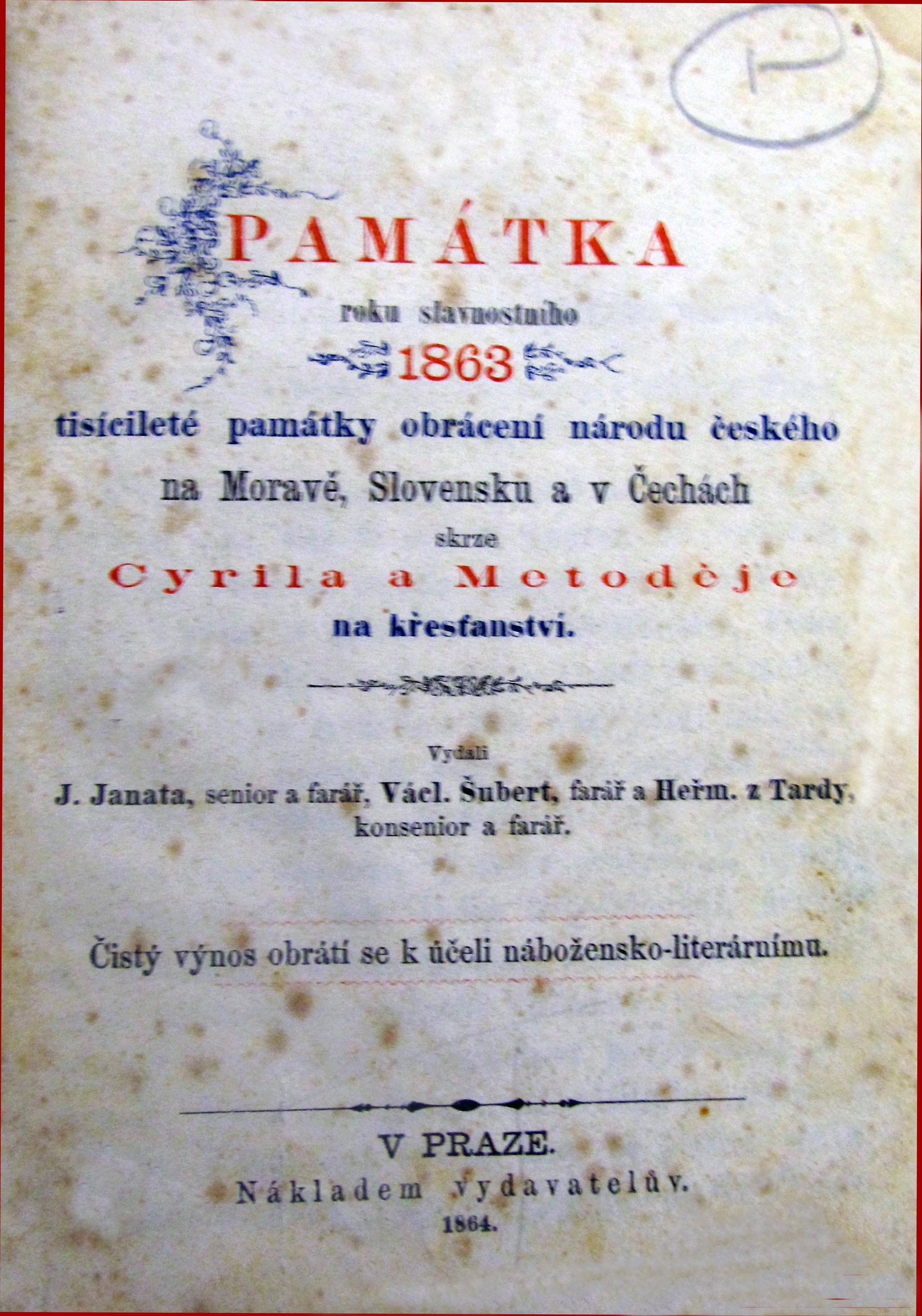
Title page
The first, formerly held by the Litchfield Public Library in Litchfield, Minnesota, and offered to academic libraries courtesy of Gordon B. Anderson* is Památka roku slavnostního 1863 tisícileté památky obrácení národu českého na Moravě, Slovensku a v Čechách na křesťanství / Commemoration of the Millennial year 1863 Anniversary of the Christianization of the Czech People in Moravia, Slovakia and in the Czech Republic by J. Janata, Václav Šubert, and Heřman z Tardy, published in 1864 in Prague. The book commemorates the one thousandth anniversary of SS. Cyril and Methodius’ mission to Great Moravia. Written by priests, the book contains poems, a history of the conversion of the Western Slavs to Christianity which began in 863, a section devoted to the lives of Saint Cyril and Saint Methodius, as well as notes on the history of Protestantism in Bohemia, and a description of the most important events of the Evangelical Church in Bohemia in the year 1863. The publication is interesting from theological, historical as well as linguistic and literary perspectives.

1864 spine and front cover
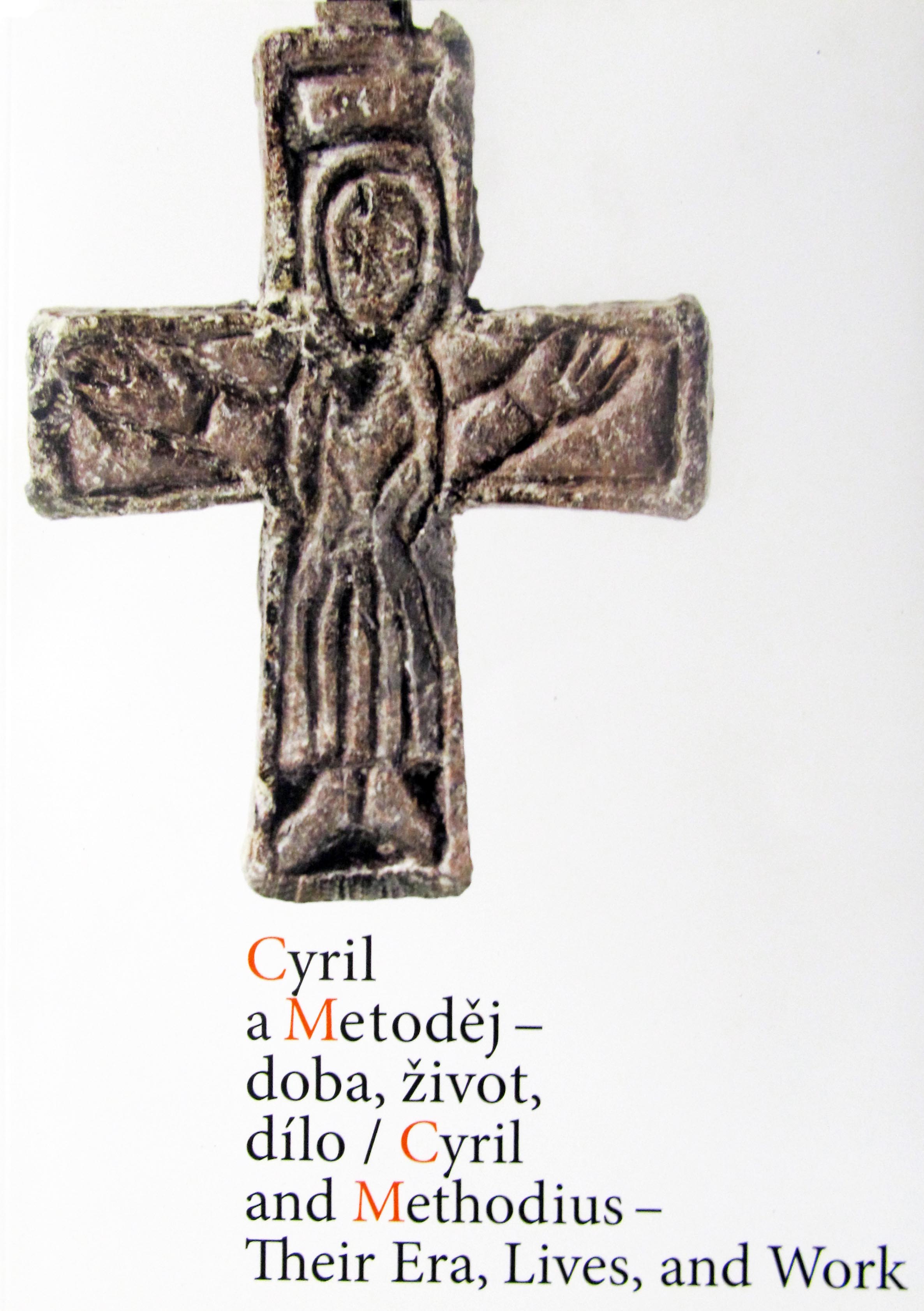
Gift of Václav Čermák
The second publication, a gift of Václav Čermák from the Institute of Slavonic Studies of the Academy of Sciences, Czech Republic, is the bilingual Czech-English Cyril a Metoděj – doba, život, dílo / Cyril and Methodius – Their Era, Lives, and Work, published by Moravské zemské muzeum in Brno in 2013. Besides addressing the importance of the Cyrillo-Methodian mission and its immediate legacy, this work also focuses on reflections of the Cyrillo-Methodian traditions in Czech literature, theater, music, and society. The publication specifically examines Cyrillo-Methodian themes in modern Czech literature and in Czech folk culture. It offers insight into the long-lasting influence of the “Enlighteners of the Slavs” on the culture and society of Czechs and Moravians.
*Gordon Anderson is both the Librarian for European Studies at the University of Minnesota and the Bibliographer for Scandinavian Studies for the University of Chicago Library.
Andrei A. Orlov, professor of theology at Marquette University (Milwaukee, Wisconsin), presented us with one of his recent publications, Воскрешение ветхого Адама: вознесение, преображение и обожение праведника в раннеи иудеискои мистике ‘Resurrection of the Fallen Adam: Ascension, Transfiguration, and Deification of the Righteous in Early Jewish Mysticism.’

The volume is a collection of previously published articles, some of which have been revised. The book is divided into four sections: the Book of 2 Enoch, Jacob’s Ladder, the Apocalypse of Abraham, and the Book of 3 Baruch.
New Perspectives on 2 Enoch: No Longer Slavonic Only (Leiden ; Boston: Brill, 2012), edited by Andrei A. Orlov,  , which is vol. 4 of the series Studia Judaeoslavica, contains the collected proceedings from the Fifth Conference of the Enoch Seminar in Naples, Italy (June 14-18, 2009). It includes articles by Grant Macaskill, Liudmila Navtanovich, Anissava Miltenova et al.
 Other works by Orlov include “Potaennye knigi”: iudeiskaia mistika v slavianskikh apokrifakh (2011), Dark Mirrors: Azazel and Satanael in Early Jewish Demonology (2011; Project MUSE 2014), Heavenly Priesthood in the Apocalypse of Abraham (2013), Selected Studies in the Slavonic Pseudepigrapha (2009), Divine Manifestations in the Slavonic Pseudepigrapha (2009), From Apocalypticism to Merkabah Mysticism: Studies in the Slavonic Pseudepigraph (2007), and The Enoch-Metatron Tradition (2005).
We received from Mirjana Živojinović, President of the Hilandar Committee in Beograd, the latest volume in a series dedicated to the Holy Mountain: Thoughts and Studies, Osma kazivanja o Svetoj Gori (Beograd : Zadužbina Svetog manastira Hilandara ; Društvo prijatelja Svete Gore Atonske, 2012, which contains a dozen articles related to Hilandar Monastery and Mount Athos.
A Word of Greeting from Archimandrite Metodije, abbot of Hilandar Monastery, 11
Introduction, 13-14
Emil Tahiaos, “Духовна порука Свете Горе савременој Европи,” 15-30, abstract in English “The Spiritual Message of Mount Athos to Contemporary Europe,” 341-342, abstract in Greek, 365-366.
Andrej, Bishop of Remesiana, “О православном монаштву на Светој Гори,” 31-49, abstract in English “About Orthodox Christian Monasticism on Mount Athos,” 343-344, abstract in Greek, 367-368.
Bojana Krsmanović, “Оснивање словенских манастира на Светој Гори атонској – сличности и разлике,” 51-75, abstract in English “The Founding of the Slavic Monasteries on Mount Athos – Similarities and Differences,” 345-346, abstract in Greek, 369-371.
Mirjana Živojinović, “Монаси Хиландара у улози дипломата између српског двора и Византије,” 77-96, abstract in English “The Hilandar Monks as Diplomats between the Serbian Court and Byzantium,” 347, abstract in Greek, 372-373.
Srđan Pirivatrić, “Хиладнар и лионска унија,” 97-108, abstract in English “Hilandar and the Union of Lyon,” 349-351, abstract in Greek, 374-377.
Ognjen Krešić, “Пајсије Хиландарски и његова Историја Славјанобугарска,” 109-125, abstract in English “Paisii of Hilandar and his Slavonic-Bulgarian History,” 352, abstract in Greek, 378-379.
Mirko Sajlović, “Сабрана уласка женама на Свету Гору Атонску,” 127-159, abstract in English “The Ban on Women Entering Mount Athos,” 353, abstract in Greek, 380.
Nenad Makuljević, “Унутрашњост католикона манастира Хиландара у новом веку,” 161-203, abstract in English “Interior of the Katholikon of the Monastery of Hilandar in the Modern Age,” 354, abstract in Greek, 381.
Ljiljana Ševo, “Зидно сликарство у параклису Светих апостола у Хиландару,” 205-253, abstract in English, “Wall Painting in the Parakklesion of the Holy Apostles in Hilandar,” 355-356, abstract in Greek, 382-383.
Igor Borozan, “Произвођење традиције: Хиландар и српски монарски крајем 19. века,” 255-303, abstract in English, “Producing Tradition: Hilandar and Serbian Monks at the End of the 19th Century,” 357, abstract in Greek, 384.
Irena Špadijer, “Хиландар и почеци српске књижевности,” 305-318, abstract in English “Hilandar and the Beginnings of Serbian Literature,” 358-359, abstract in Greek, 385-387.
Vesna Peno, “Светогорски појци и писари с почетка XIX века – сатрудници у обликовању музичке реформе,” 319-337, abstract in English “Athonite Chanters and Scribes from the Start of the 19th Century – Collaborators in the Shaping of the Music Reform,” 388-389.
The Hilandar Research Library has received the latest volume of Trudy Otdela Drevnerusskoi Literatury / ‘Works of the Department of Old Russian Literature,’ an invaluable publication of the Institute of Russian Literature “Pushkinskii Dom” of the Russian Academy of Sciences in St. Petersburg, Russia. The 774-page volume contains articles on the topics of biblical studies and the history of the Church; hagiography, hymnography, and tales of icons; historiography; didactic literature, polemical works, miscellanies; pilgrimage; scriptoria and scribes, archaeography; polemics; bibliography; and obituary notices of prominent scholars in the field.
V.A. Romodanovskaia, “K istorii Novogo Zaveta Gennadievskoi biblii i Evangelii XV v. Razvitie sistem otsylok. Part II,” 3-20.
O.A. Belobrova, “Illiustrirovannye Biblii XVI-XVII vekov v russkikh srednevekovykh bibliotekakh,” 21-28.
G.M. Prokhorov, “Isihasty na Spaso-Kamennom,” 29-33.
N.V. Ponyrko, “Dimitrii Rostovskii kak avtor ‘Rozyska o raskol’nicheskoi brynskoi vere,” 34-42.
T.I. Aleksandrova, “Stikhiry sluzhby Velikogo pokaiannogo kanona Andreia Kritskogo i stanovlenie slavianskoi Triodi,” 43-52.
A.G. Mel’nik, “Praktika pochitaniia sv. Alekseia, mitropolita vseia Rusi, v XVI veke,” 53-69.
T.L. Nikitina, “Prepodobnyi Avraamii Rostovskii. Pozdniaia agiograficheskaia traditsiia i gimnografiia,” 70-92.
I.A. Lobakova, “Istoricheskie sobytiia i litsa v Zhitii Irinarkha Rostovskogo. Smutnoe vremia v agiograficheskom proizvedenii,” 93-119.
M.A. Fedotova, “Skazanie, koeia radi viny izlozhisia Akafist sviatiteliu Khristovu Dimitriiu,” (Ob odnom chude sviatogo Dimitriia Rostovskogo), 120-142.
V.V. Lepakhin, “Skazanie ob ikone Nikoly Zarazskogo. Nekotorye problemy issledovaniia,” 143-166.
E.M. IUkhimenko, “Vygovskaia ikona ‘Obraz vsekh rossiiskikh chudotvortsev,'” 167-174.
E.G. Vodolazkin, “Kak sozdavalas’ Polnaia Khronograficheskaia Paleiia, Chast’ 2,” 175-200.
I.L. Zhukova, “Novyi spisok Sofiiskoi I letopisi (samostoiatel’naia gruppa),” 201-224.
A.V. Maiorov, “Grecheskii olovir Daniila Galitskogo. Iz kommentariia k Galitsko-Volynskoi letopisi,” 225-235.
E.S. Bystrova, “K probleme datirovki, Novgorodskoi Pogodinskoi letopisi,” 236-247.
A. S. Levochskaia, “O rabote IUriia Krizhanicha nad tekstom russkoi letopisi,” 248-259.
M.V. Semina, “Gramota velikogo kniazia Olega Riazanskogo XIV veka,” 260-268.
O.V. Tvorogov, “Opisanie sostava Prostrannoi redaktsii Prologa po spiskam XIV-XVI vekov, Chast’ 1: Prolog za sentiabr’-fevral’,” 269-342.
M.B. Pliukhanova, “‘Mnogoslozhnoe poslanie/svitok’ kak laboratoriia idei,” 375-419.
S.A. Semiachko, “‘Predanie starcheskoe novonachal’nomu inoku,’ v sostave Sledovannoi psaltiri,” 375-419.
I.V. Fedorova, “Varvara Pavlovna Adrianova-Peretts kak issledovatel’ drevnerusskokh ‘khozhdenii’ (K 40-letiiu so dnia smerti),” 420-449.
I.V. Fedorova, “‘Povest’ o sviatoi gore Sinaiskoi’ – maloizvestnyi pamiatnik vostochnoslavianskoi palomicheskoi literatury,” 450-479.
M.A. Shibaev, “‘Vetshanye’ minei i rekonstruktsiia sbornikov XV v. iz biblioteki Kirillo-Belozerskogo monastyria,” 480-496.
T.R. Rudi, “K biografii Ermolaia-Erazma (Ermolai-Erazm i Kirillo-Belozerskii monastyr’),” 497-527.
A.G. Bobrov, “Proiskhozhdenie i sud’ba Musin-Pushkinskogo sbornika so ‘Slovom o polku Igoreve,'” 528-553.
O.V. Panchenko, “Povesti o solovetskikh pustynozhiteliakh (K istorii sozdaniia tsikla),” 554-613.
V.A. Esipova, “Dve rukopisi kruga Dimitriia Rostovskogo (Po materialam Nauchnoi biblioteki Tomskogo gosudarstvennogo universitets), 614-627.
A. Dzhurova, “Rol’ Vizantii v ofromlenii slavianskogo kodeksa (glagolicheskogo i kirillicheskogo): Problemy retseptsii,” 628-643.
E.A. Liakhovitskii, “Issledovanie bumagi v izuchenii pis’mennykh pamiatnikov. Problemy klassifikatsii i interpretatsii vodianykh znakov,” 644-672.
L.V. Sokolova, “Pervonachal’na li Kratkaia redaktsiia ‘Zadonshchiny’? (V sviazi s noveishimi rabotami o vzaimootnoshenii ‘Slovo o polku Igoreve’ i ‘Zadoshchiny’),” 673-724.
Khronologicheskii spisok nauchnykh trudov Andreia Nikolaevicha Robinsona za 1946-2010 rr., 725-739.
Khronologicheskii spisok nauchnykh trudov Olega Viktorovicha Tvorogova za 2004-2014 rr., 740-744.
Khronologicheskii spisok nauchnykh trudov Natalii Sergeevny Demkovoi za 2002-2013 rr., 745-750.
Marina Alekseevna Salmina (1927-2013), 751-757
Elena Konstantinova Romodanovskaia (1937-2013), 758-763
Among the books that we have added to our collection in the past year are a half a dozen that came to us thanks to Zhanna Levshina of the Manuscripts Division of the Russian National Library, St. Petersburg. We are also grateful to Robert Romanchuk, professor of Russian, Slavic and medieval studies at Florida State University (Tallahassee), for bringing the books to us from Russia. This post highlights a book of research on the Ostromir Gospel.

A collection of scholarly articles on the Ostromir Gospel (St. Petersburg: RNB, 2010)
E.V. Krushel’nitskaia, otvet. red., A. A. Alekseev, M. IU. Liubimova, i dr.; sostav. Zh. L. Levshina, Ostromirovo Evanglie i sovremennye issledovaniia rukopisnoi traditsii novozavetnykh tekstov: Sbornik nauchnykh statei (St. Petersburg: Russian National Library, 2010).
This is a collection of articles on the Ostromir Gospel, the earliest extant dated East Slavic manuscript, published on the occasion of the 950th anniversary of the creation of codex (1056-1057).
От редколлегии/’From the editors,’ 7-11
Е. В. Крушельницкая, “Остромирово Евангелие и Российская национальная библиотека: хранение и изучение памятника”/’The Ostromir Gospel and the Russian National Library: the Housing/Preservation and Study of the Monument,’ 15-40.
A. A. Aлексеев, “Остромирово Евангелие и византийско-славянская традиция Священного Писания”/’The Ostromir Gospel and the Byzantino-Slavic Tradition of the Holy Scriptures,’ 41-59
О. С. Попова, “Остромирово Евангелие: Миниатюры и орнаменты”/’The Ostromir Gospel: Miniatures and Ornamentation,’ 60-84
А. В. Сиренов, “Мнение старообряцев о подложности Остромирово Евангелия”/’The Opinion of the Old Believers on the Spuriousness of the Ostromir Gospel,’ 85-94
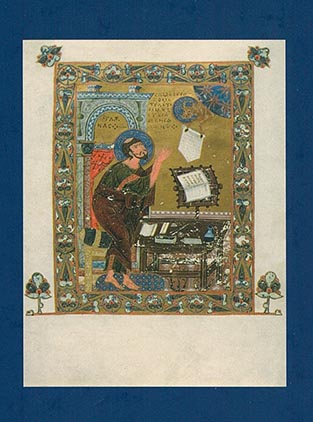
Miniature of St. Luke from the Ostromir Gospel
К. Попконстантинов, “Евангельские тексты в эпиграфических памятниках средневековой Болгарии”/’Gospel Texts in the Epigraphical Monuments of Medieval Bulgaria,’ 97-105
В. А. Есипова, “Новозаветные тексты в составе рукописей из сибирского собрания XIII‒XVIII веков”/’New Testament Texts in the Structure of a Siberian Collection of the 13th-18th Centuries,’ 106-116
А. А. Турилов, “Из какого евангельского кодекса происходит послесловие анагноста Радина?” 117-127
С. Г. Жемайтис, “Спиридоний—диакон, протодиакон, писец Киевской Псалтири и Евангелия 1393 года: опыт реконструкции биографии,” 128-147
В.А. Ромодановская, “Маргиналии в Евангелиях Геннадиевской Библии 1499 года (на примере Евангелия от Иоанна)”/’Marginalia in the Gospels of the Gennadii Bible of 1499 (for example, the Gospel According to John),’ 148-161
Е. К. Братчикова, “Сийское Евангелие XVII века—’редчайший образец иллюстрированного апракоса’ (особенности текстовой и изобразительной композиции),” 162-171
О. В. Чумичева, “Символы евангелистов в русской рукописной традиции,” 172-180
И. Д. Соловьева, “К истории живописного оклада русских напрестольных Евангелий,” 181-190
О. А. Белоброва, “Дневникове записи военного моряка Д. П. Белоброва на Евангелии, изданном на церковнославянском языке в Киево-Печеской лавре в 1900 году,” 191-197
Г. Импости, “Два знаменитых библиотекаря: Джузеппе Меццофанти и Александр Востоков,” 198-209
В. Н. Алексеев, Е. И. Дергачева-Скоп, А. Ю. Бородихин, А. В. Шабанов, “Цифровая версия Острожской Библии: к проблеме максимального функционального приближения электронного образа к живому к ‘живому’ памятнику,” 210-218
Н. В. Рамазанова, “Остромирово Евангелие и древнерусские нотированные рукописи,” 221-238
А. Н. Кручинина, “Евангельский текст в древнерусских песнопениях,” 239-249
А. Н. Гаевская, “Неделя о мытаре и фарисее: евангельское чтение, гимнография, роспев,” 250-263
Ю. В. Жилина, “Евангельские чтения в службе Сретения Господня,” 264-274
Е. В. Крушельницкая и В.А. Ромодановская, “Обзор,” 277-279
Остромирово Евангелие и рукописная традиция новозаветных текстов:
И. Н. Лебедева, “Греческие рукописи евангельских текстовVI–XIII веков,” 280-285
Ж. Л. Левшина, “Южнославянские рукописные Евангелия,”286-301
О. С. Сапожникова, Е. Э. Шевченко, “Рукописные Евангелия в Древней Руси и Новой России: XI–XIX веков,” 302-322
Н. В. Рамазанова, “Певческие рукописи XII–XVII веков,” 323-332
М. Г. Логутова, “Евангелие в западноевропеŭскоŭ рукописноŭ традиции: от слова к образу,” 333-339
О. В. Васильева, “Рукописи Нового Завета на восточных языках,” 340-349
Beautiful, full-color plates

Front cover of “Archpriest Vladimir Mošin” (St. Petersburg, 2012)
Протоиереŭ Владимир Мошин, Воспоминания/’Reminiscences’ (Санкт-Петербург Цветослов, 2012). Издание подготовили Ж. Л. Левшина и Е. А. Пережогина.
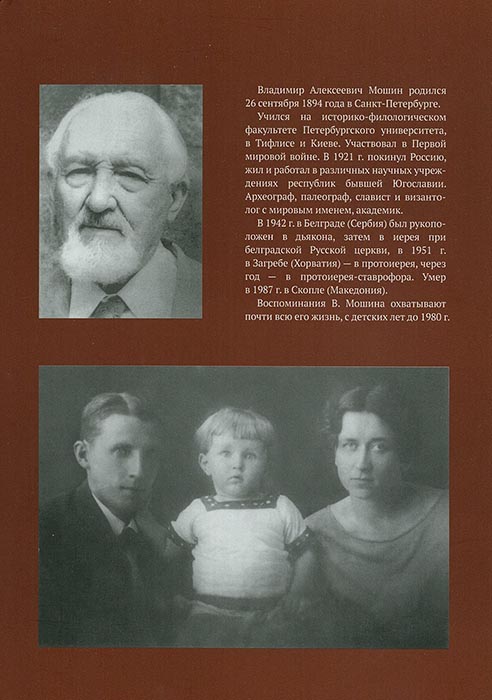
Back cover of “Archpriest Vladimir Mošin” (St. Petersburg, 2012)
Ж. Л. Левшина, ред. Жития, Святитель Николай Жичский: Служба—Житие—Житије (Санкт-Петербург Цветослов, 2013). The book includes a tribute to Hrizostom, Bishop of Žiča (1939-2012), and a former librarian of Hilandar Monastery

St. Nicholas, Bishop of Žiča (Serbia): Office – Life (St. Petersburg, 2013)
Aleksandra IUr’evna Nikiforova’s book, Iz istorii Minei v Vizantii: Gimnograficheskie pamiatniki VIII-XIi vv. iz sobraniia monastyria sviatoi Ekateriny na Sinae, focuses on the history of the Menaion liturgical book in Byzantium, specifically the hymnographical texts of the 8th-12th centuries from the manuscript collection of St. Catherine’s Monastery, Mount Sinai.

Moscow 2012
Nikiforova examines the Sinai Greek Tropologia and Menaia from the 8th-16th century, housed in both St. Catherine’s and in Moscow’s State Historical Museum and Russian State Library. Manuscripts from other Russian repositories, the Austrian National Library (Vienna) were also consulted, as were microfilms held in the Patristic Greek Institute (Vlatadon) in Thessaloniki of manuscripts from Philotheos Monastery on Mt. Athos.
Nikiforova’s book includes a preface, three chapters (“Menaia before Menaia: the Tropologia”; “The Birth of the Menaia: Sinaiticus gr. 607, 9th-10th cent.”;
“Menaia 9th-12th centuries”), and extensive appendices, such as a description of one of the early Greek Tropologia, the hymnographical texts found in a daily readings from a Menaion, and calendars of saints with information about the authors and hymnographers of Menaion texts.
Among the recently cataloged books for the Hilandar Research Library (HRL) is a title that was previously owned by a faculty member of The Ohio State University. From the collection of Charles E. Gribble, Professor Emeritus, Department of Slavic and East European Languages and Cultures, comes the book ‘Pages of the Chronicle of Saratov,’* which gives a brief history of the city of Saratov, its historical significance, its administrative, urban and cultural growth, and brief sketches of individuals who had an impact on the city’s development.

Страницы летописи Саратова (Moscow, 1987)
The HRL has among its microform holdings 294 manuscripts from the collection of Saratov State University’s Research Library,** which has been a very fertile source for manuscript research since the HRL acquired the microfilms as part of a Title II-C grant of the National Education Act that was submitted in 1993-1994. Страницы летописи Саратова describes the establishment of the university, and the names of several individuals are referenced, who appear to be connected to the provenance of some of the Saratov manuscripts.
Researchers in the HRL have reported on the significance of the Saratov manuscripts in issues of the RCMSS/HRL newsletter Cyrillic Manuscript Heritage for a number of years. Here is a sample of some of the research:
Victor Alexandrov, “Tracing the Slavic Syntagma of Blastares,” CMH 11 (May 2002): 5, 8.
Adelina Angusheva-Tihanov, “Tracing Byzantine Rhetorical Sources of the Sermons of Gregory Camblak,” CMH 21 (June 2007): 5.
Brian J. Boeck, on the Life of St. Philip, Metropolitan of Moscow, see CMH 14 (December 2003): 4.
Margaret Dimitrova, “Prayers for Newborns, Mothers and Midwives,” CMH 11 (May 2002): 8, 11.
Margaret Dimitrova, “Bulgarian Scholar Receives Fulbright to Examine HRL Collection,” CMH 25 (June 2009): 4-5, 8.
Eve Levin, “Researching Physical and Spiritual Approaches to Healing,” CMH 13 (May 2003): 4, 7.
William R. Veder, “Saratov Collection Provides Missing Key,” CMH 9 (May 2001): 6.
*Б. И. Казаков, Г. Д. Казакова, и Л.Н. Любомирова, Страницы летописи Саратова (Саратов: Привожское книжное издательство, 1987).
**Note that the contractual agreement between the HRL and SGU allows only for the viewing of the microfilms on site – no reproductions from the HRL films may be made without the permission of SGU.

Authority in Byzantium, edited by Pamela Armstrong (Ashgate, 2013)
Authority in Byzantium is volume 14 in the series of publications by the Centre for Hellenic Studies, King’s College, London. In addition to a preface (xxi) and introduction (1-6) by editor Pamela Armstrong, the book contains twenty-five articles that are divided among the nine sections. There is an index.
Part I The Authority of the State
Jonathan Shepard, “Aspects of Moral Leadership: The Imperial City and Lucre from Legality,” 9-30
Ruth Macrides, “Trial by Ordeal in Byzantium: on whose Authority?”, 31-46
Sergey Ivanov, “A Case Study: The Use of the Nominative on Imperial Portraits from Antiquity to Byzantium,” 47-58
Susan Reynolds, “Response,” 59-61
Part II Authority in the Marketplace
Cécile Morrisson, “Displaying the Emperor’s Authority and Kharaktèr on the Marketplace,” 65-82
Johannes Koder, “The Authority of the Eparchos in the Markets of Constantinople (according to the Book of the Eparch),” 83-108
Chris Wickham, “Response,” 109-110
Part III The Authority of the Church
Jane Baun, “Coming of Age in Byzantium: Agency and Authority in Rites of Passage from Infancy to Adulthood,” 113-135
Günter Prinzing, “The Authority of the Church in Uneasy Times: The Examples of Demetrios Chomatenos, Archbishop of Ohrid, in the State of Epiros, 1216-1236,” 137-150
Miri Rubin, “Response,” 151-152
Part IV Authority within the Family
Christine Angelidi, “Family Ties, Bonds of Kinship (9th-11th Centuries), 155-166
Anne P. Alwis, “The Limits of Marital Authority: Examining Continence in the Lives of Saints Julian and Basilissa, and Saints Chrysanthus and Daria,” 167-179
Janet Nelson, “Response,” 181-183
Part V The Authority of Knowledge
Paul Magdalino, “Knowledge in Authority and Authorised History: The Imperial Intellectual Programme of Leo VI and Constantine VII,” 187-209
Charalambos Bakirtzis, “The Authority of Knowledge in the Name of the Authority of Mimesis,” 211-226
Dionysios Stathakopoulos, “On Whose Authority? Regulating Medical Practice in the Twelfth and Early Thirteenth Centuries,” 227-238
Alexander Murray, “Response,” 239-243
Part VI The Authority of the Text
Albrecht Berger, “Believe It or Not: Authority in Religious Texts,” 247-258
Alicia Simpson, “From the Workshop of Niketas Choniates: The Authority of Tradition and Literary Mimesis,” 259-268
Marc D. Lauxtermann, “‘And many, many more’: A Sixteenth-Century Description of Private Libraries in Constantinople, and the Authority of Books,” 269-282
Part VII Exhibiting Authority in Provincial Societies
Leonora Neville, “Organic Local Government and Village Authority,” 285-295
Part VIII Exhibiting Authority in Museums
Maria Vassilaki, “Exhibiting Authority: Byzantium 330-1453,” 299-323
Part IX Authority in Byzantine Studies
Ljubomir Maksimović, “George Ostrogorsky St Petersburg, 19 January 1902–Belgrade, 24 October, 1972,” 327-335
Vera von Falkenhausen, “Hans-Georg Beck,” 337-343
Elizabeth Jeffreys, “Robert Browning,” 345-353
Slavia Islamica: Language, Religion and Identity edited by Robert D. Greenberg and Motoki Nomachi (Sapporo, Japan: Slavic Research Center, Hokkaido University, 2012). Slavic Eurasian Studies No. 25.
Motoki Nomachi, Foreword, I-II
Robert D. Greenberg, Introduction, 1-8
Articles

Slavia Islamica: Language, Religion and Identity (Sapporo, 2012)
Бранко Тошович [Branko Tošović], “Особенности боснийского/ бошняцкого языка по отношению к сербскому и хорватскому” [‘The features of the Bosnian/Bosniak language in relation to Serbian and Croatian’], 9-64
Hanka Vajzović, “Jezik i identitet slavenskih muslimana: Bošnjaci između lingvistike i politike” [‘Language and Identity of Slavic Muslims: Bosnians between Linguistics and Politics’], 65-114
Радивое Младенович [Radivoje Mladenović], “В поисках этнического определения славянские мусльманские группы на юго-западе Косово и Метохии” [‘Slavic Muslim Groups of Southwest Kosovo and Metohija in Search of Ethnic Definition’], 115-147
Vemund Aarbakke, “Pomak Language Usage and the Spell of Nationalism: The Case of the Pomaks in Greece,” 149-177
Йоанна Кульвицка-Каминьска [Joanna Kulwicka-Kamińska],” К проблематике перевода библейских, а также коранических названий ангелов и духовных существ (в письменных памятниках татар Великого княжества Литовского и польских переводах Библии и Корана)” [‘On problems of biblical translation, as well as Qur’anic names of angels and spiritual beings (in written monuments of the Tatars of the Grand Duchy of Lithuania and Polish translations of the Bible and the Qur’an’)], 179-205
Review Article
Чеслав Лапич [Czesław Łapicz], “Ivano Luckevičiaus Kitabas, Lietuvos totorių paminklas. Китаб Ивана Луцкевича. Памятник народной културы литовских татар” [‘Kitab of Ivan Lutskevich: a monument of the folk culture of the Lithuanian Tatars’], 207-216
Book Reviews
Victor Friedman, The Pomaks in Greece and Bulgaria: A Model Case for Borderland Minorities in the Balkans (Südosteuropa-Studien 73). Ed. by Klaus Steinke and Christian Voss. Munich: Verlag Otto Sagner/Südoosteuropa Gesellschaft. 278 pp., 217-225
Svein Mønnesland, Hanka Vajzović: Jezik i nacionalni identitet. Sociolinvističke teme [‘Language and National Identiy: Sociolinguistic Subjects’], Fakultet političkih nauka Sarajevo, Sarajevo 2008, 391 p. ISBN 978-9958-12-8, 227-234
Feel free to contact us with any comments or questions!
The Hilandar Research Library and the Resource Center for Medieval Slavic Studies
The Ohio State University
119 Thompson Library
1858 Neil Avenue Mall
Columbus, Ohio 43210-1286
phone: (614) 292-0634
email: hilandar@osu.edu
website: go.osu.edu/Hilandar

© 2026 The Ohio State University - University Libraries
1858 Neil Avenue Mall, Columbus, OH 43210
Phone: (614) 292-OSUL (6785)
Request an alternate format of this page | Accessibility | Privacy Policy | Contact Us |
