

OSUL recently acquired two sets of Karuta cards: Nonkidane Iroha Kokkei Karuta (ノンキダネイロハ滑稽カルタ) and Kyoka Karuta (狂歌かるた). These sets, along with many other rare manga items can be accessed by the public at The Billy Ireland Cartoon Library and Museum. Contact them to schedule your visit to the reading room today: cartoons@osu.edu
First introduced by Portuguese traders to Japan in the 16th century, Karuta are a form of Japanese playing cards and are still popular today.
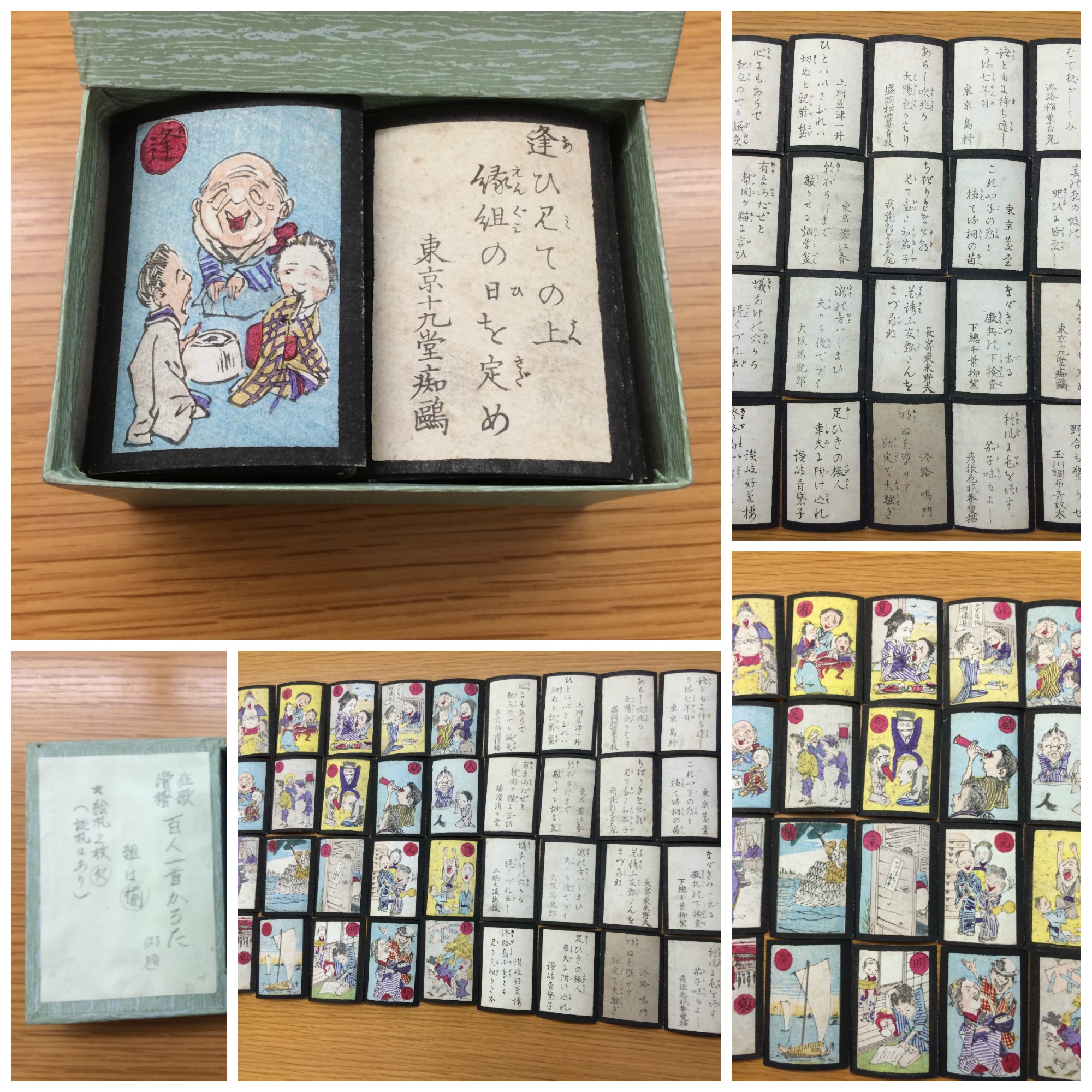
Photo of the Kyoka Karuta (狂歌かるた)
The first set, Kyoka Karuta or Mad Poem card game, is a form of Uta Karuta, known for using Hyakunin isshu (百人一首), a collection of traditional waka (和歌) poems composed by one hundred different poets. Published in 1890, the Kyoka Karuta set originally had 200 cards in total. Our set, which is missing two cards, has a total of 198 cards: 100 poems cards and 98 miniature color-mounted comic woodblock prints cards. The poems appear in an older, pre- standardized form of Japanese writing. Since some of the characters have changed and are pronounced differently today, the poems may be a challenge for the uninitiated. The cards present a unique opportunity to learn about this precious form of Japanese poetry.
To learn more about Karuta and hyakunin isshu:
- Hyakunin isshu : Teika to karuta no bungakushi (百人一首:定家とカルタの文学史) by Matshimura Yūji (1995 Heibonsha) – contains the history of Hyakunin isshu and explains how it spread to the general public.
- Etoki Hyakunin isshu : Edo karuta to fūkei shashin de ajiwau (絵解き百人一首: 江戸かるたと風景で味わう) by Ariyoshi Tamotsu (1991 Kodansha) – information and photographs of the locations and scenes described in the poems on the Karuta cards.

Photo of the Nonkidane Iroha Kokkei Karuta (ノンキダネイロハ滑稽カルタ)
The second set of cards, Nonkidane Iroha Kokkei Karuta, was created before WWII and based on a character from Nonki na Tōsan (ノンキナトウサン), a popular four-panel or yonkoma (4コマ漫画) comic, by artist Yutaka Asō (麻生豊). First published in 1922, the series Nonki na Tōsan (Lazy Daddy) appeared in the Yūkan Houchi newspaper (夕刊報知新聞) and inspired movie productions by the same name in 1925 and 1946. The drawings of this Karuta set are humorous in nature, so players can enjoy them even if they do not know Japanese.
Other works from Yutaka Asō at OSUL include:
- Seishun Jidai (青春時代) by Yutaka Asō (1935 Tōkyō : Atoriesha, Shōwa 10)
- Yome o sagashi ni (嫁を探しに) by Yutaka Asō (1929 Tōkyō : Gendai Yūmoa Zenshū Kankōkai, Shōwa 4)
- Jinsei benkyō (人生勉強) by Yutaka Asō (19–?)
For research on Nonki na Tōsan (Lazy Daddy), refer to:
- Erotic grotesque nonsense : the mass culture of Japanese modern times by Miriam Silverberg (Berkeley: University of California Press, 2006)
- Taishō kōki no manga (大正後期の漫画) by Maeda Ai and Shimizu Isao, eds. (Tokyo: Chikuma Shobō, 1986)
NOTE: See the “Chihayahuru (ちはやふる) and Karuta Card Games” post for more information on Karuta.
