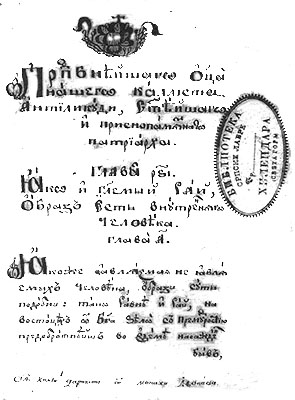
Paradeisos of Kallistos Antilikoudēs, 18th cent.
Someone working with Hilandar Monastery Slavic Manuscript 205, an 18th-century Russian manuscript of the works of Symeon the New Theologian, as well as HM.SMS.219, asks:
Kто-то встречал какие-то фрагменты житий св. Симеона Благоговейного, составленное преп. Симеоном Новым Богословом (11 век), а также Каллиста Ангеликуда – 14 век (Он же Каллист Катафигиот, он же Меленикеот)? Эти тексты несомненно существовали в средние века, об этом есть упоминания у самого преп. Симеона.
Translation: Has anyone encountered fragments of the life of St. Symeon the Pious, written by Symeon the New Theologian (11th cent.), or of Kallistos Angelikoudēs (14th cent., possibly the same as Callistos Cataphygiota or of Melnik)? These texts undoubtedly existed in the middle ages; there are references to this by the Venerable Symeon himself.
The Tusculum-Lexikon notes that Symeon Eulabes is also known as Symeon Studites, 917-986/7, a monk of the Studite Monastery in Constantinople and the spiritual elder of Symeon the New Theologian. A reference is provided to Migne PG 120: 668-686 (32 chapters).
Sources: Wolfgang Buchwald, Armin Holhweg, Otto Prinz, Tusculum-Lexikon griechischer und lateinischer Autoren des Altertums und des Mittelalters (München: Artemis Verlag, 1982), 753; Syméon le Studite, Discours Ascétique, Introduction, Texte critique et notes par Hilarion Alfeyev, traduction par L. Neyrand s.j., Sources Chrétiennes № 460 (Paris: Les Éditions du Cerf, 2001).
Image Source: HM.SMS.197, f. 1r, an 18th-century Russian text that is a translation of the Paradeisos of Kallistos Antilikoudēs, from microfilm in the HRL.