Student Project Spotlight: The 20th-Century Language of Nonkina Tōsan
Guest post by Mitchell Clark
As a former student assistant working with the library’s manga collection, I recently had the opportunity to translate Nonkina Tōsan Shusse Sugoroku, a gameboard featuring a popular cartoon character known as Carefree Daddy. My translation was part of a broader project supporting K–12 educator workshops centered on the library’s historical sugoroku collection. In addition to introducing teachers to the history of these games and their place within Japanese popular culture, the workshop aimed to provide classroom-ready materials that could allow students to directly engage with and even play the games themselves.
出世 – shusse: success in life; getting ahead; successful career; promotion; climbing the corporate ladder; eminence

Rules on how to play the Carefree Daddy’s Success Story Game appear in the margin on the left side of the gameboard.
This highlighted portion shows Rule 3, a very interesting rule that rewarded players who could read quickly and without stammering.
Translating the rules of this gameboard also posed an interesting challenge, as the written language of the early 20th century differs from written Japanese today. Enthusiasts of the Japanese language will find this 1925 sugoroku extremely interesting as a valuable codex showcasing archaic hiragana, katakana, kanji, and other early 20th century linguistic phenomena. One of my favorite examples seen throughout is the placement of extra consonants in front of single-vowel sounds and the outright swapping of other characters. Here, we see that:
- お (o) is sometimes realized as ほ (ho)
- え (e) is sometimes realized as へ (he)
- い (i) is sometimes realized as ゐ (wi)
- ず (zu) is sometimes realized as づ (dzu)
- わ (wa) is sometimes realized as は (ha)
Some other idiosyncrasies of this archaic written language I found were:
- 言う – iu “to say” is realized as 云ふ (ifu)
- 一回 – ikkai “once” is realized as 一囘
- 居る and ゐる are both used, meaning いる
- ゝ appears as a hiragana repetition mark (いゝ – ii “good”), similar to 々.
- When attached to an adjective, sono is written in hiragana. However, when compounded with kanji, sono is realized as 其(i.e., その云はない人 vs 其人)
- The small tsu (ッ and っ), also known as sokuon, is less common, and the full size tsu is sometimes used to denote double consonants instead.
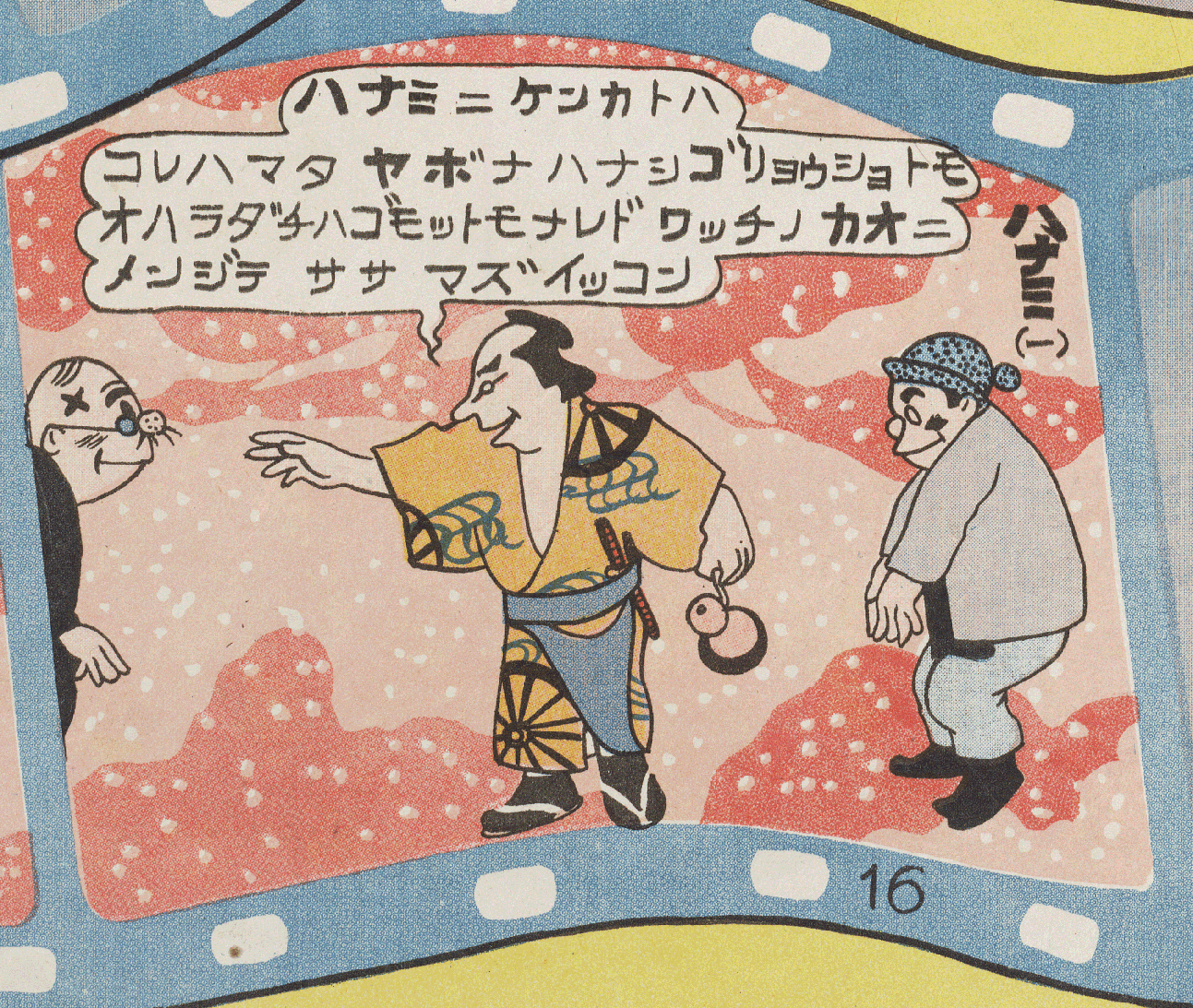
Spot 16. An example of the writing and lettering style of Aso Yutaka.
The playing board is written in katakana except for a few instructional notes written in hiragana, a distinction that made me wonder if this was a stylistic choice or a standard of the time. Writing in katakana might have provided more accessibility for those who were not fully literate in the Japanese written language, a complex system that had not been standardized since the late 19th century. The artist behind this cartoon, Asō Yutaka, was from Oita, a prefecture that even now is known for its distance from the capital of Tokyo. Perhaps his humble beginning in rural Japan is what inspired his signature use of katakana.
Asō was not only a talented illustrator but he also showed skill and creativity with lettering, including his use of font, and typography. He also opted to write some characters in bold letters and left spaces in between certain words (atypical in written Japanese), helping readers to “break up” longer sentences in the absence of kanji.
Interestingly, having good reading skills and being able to read these spaces properly would have likely given players an advantage in the game, as one of its finer rules required players to recite speech-bubble quotes within the game in order to advance. For example, as in the inset in the image above, Rule Three says “If you can repeat the words of “Cherry blossom viewing” several times without stuttering, making mistakes, or pausing, you can move forward one space per number of times repeated. But if you fail in the middle of the second attempt, or if you make a mistake on the third attempt, you’ll be forced to go back in the opposite direction.” (A close-up image of this rule is also available below).
As we can see with this rule, the ability to read these spaces was not just about accessing important background information; it was also about following the actual steps in the game!
I could go on and on about the written language used in this game, but I feel it would be best for fans of Japanese, manga, and history to see this work for themselves. Check out these blogs about sugoroku to learn more about the fascinating gameboards in the OSU manga collection. To view these games or other manga, please contact Japanese Studies Librarian Ann Marie Davis at davis.5257@osu.edu or our colleagues at the Billy Ireland Cartoon Library and Museum.

Click this image above to enlarge and view Rule 3 on the gameboard!