Page 25 of 34

Mount Carmel Medical Center

Mount Carmel Medical Center

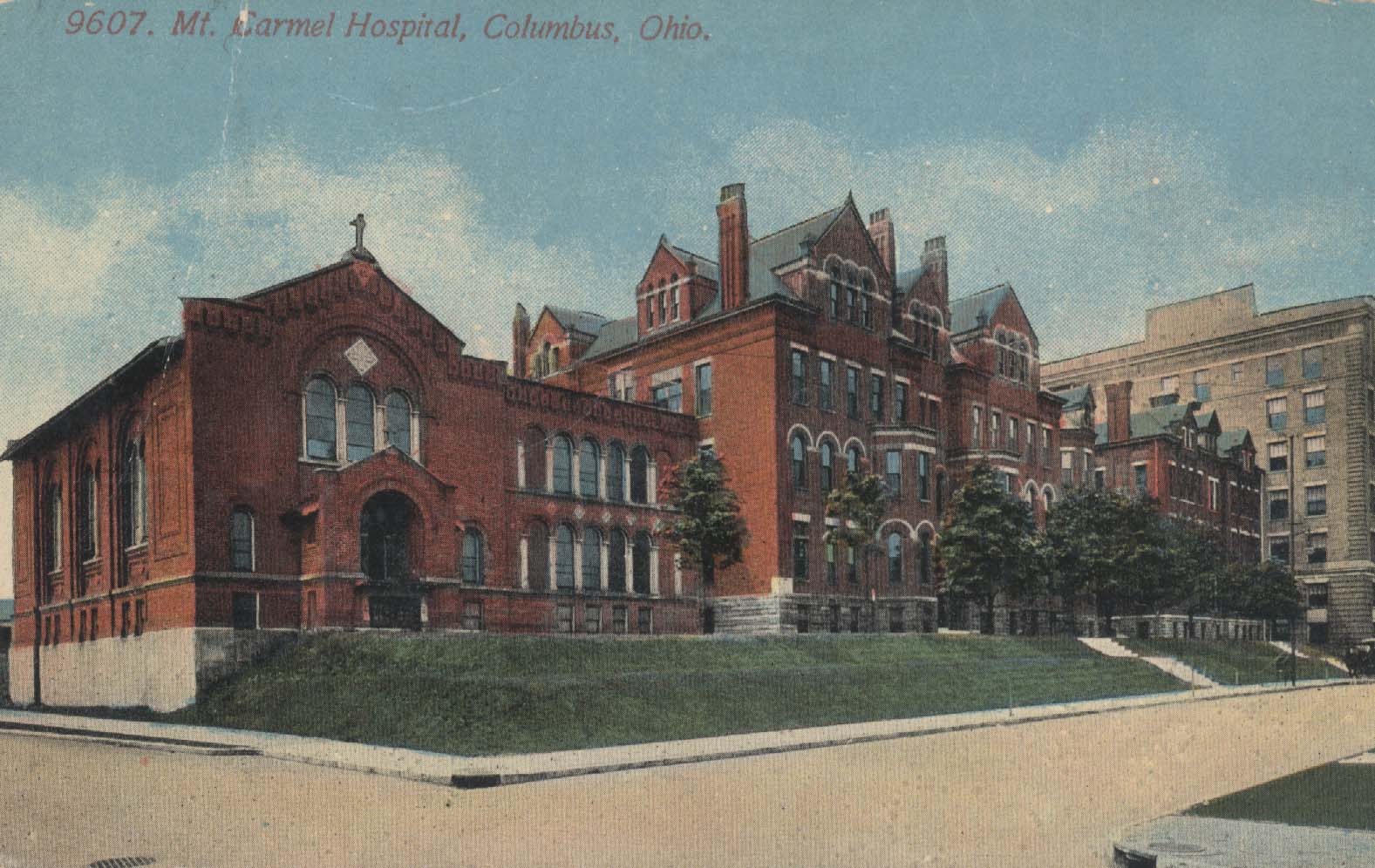
Hawkes Hospital of Mt. Carmel was founded by Dr. W. B. Hawkes (1812-1883). He donated land and gave $10,000 in United States Government bonds. Before the building was completed, Dr. Hawkes died and Dr. John W. Hamilton (1823-1898) completed the work. Dr. Hamilton secured the services of the Sisters of the Holy Cross, and formally opened the hospital in 1886. The hospital was located on West Street and Davis Avenue.

The first addition to the hospital was made in 1891. In 1906 a second building adjoining the old one was started. It contained a chapel and 120 additional private rooms for patients. Another building, consisting of 120 rooms with recreation halls, library, and three classrooms was erected and opened in 1921. This was the home for the student nurses. In 1934, on a lot to the west of the hospital, and connected with the hospital, a building for convenience of the Sisters was erected. It was a gift of Mrs. Neill Darrow.

From 1876 to1892, the hospital was operated in connection with the Columbus Medical College.

The Training School for Nurses was opened in 1903. The first graduates received their diplomas in 1906. Eight Sisters were included in the class. The school still exists today and is now the Mount Carmel College of Nursing.

Today this location is known as Mount Carmel West and is one of the four facilities that comprise the Mount Carmel Health System.

*Part five of a seven part series highlighting the history of Columbus medical centers.

Children’s Hospital

Children’s Hospital

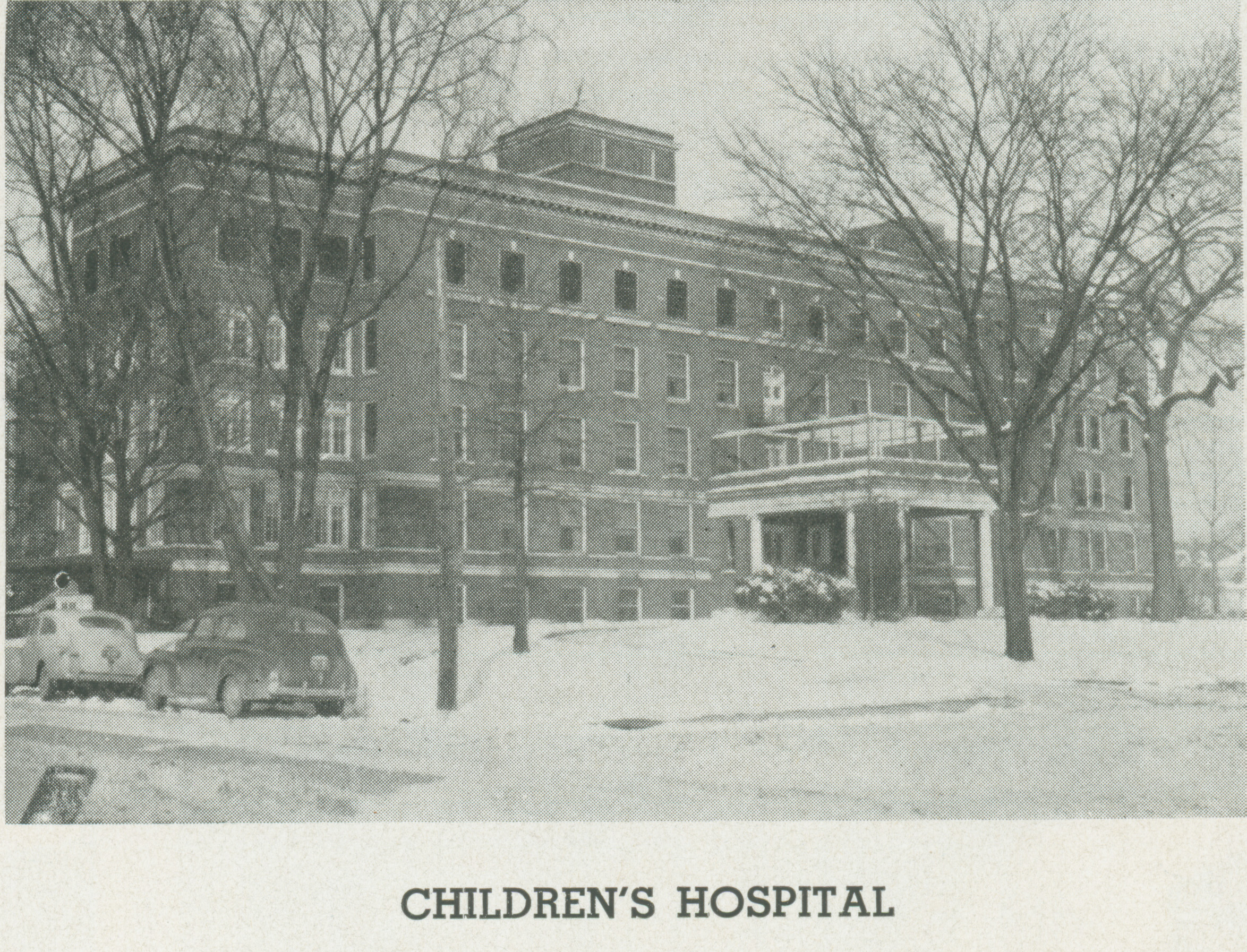
Hospitals for children began to appear in the United States in the late 1800s. Members of the King’s Daughters of St. Paul Episcopal Church initiated the movement to secure a children’s hospital in Columbus in 1891.

The first Children’s Hospital building opened in 1891. The prevailing color scheme was blue and white, carried out in staff uniforms, chinaware, linens and bedding. Originally Children’s Hospital had four beds. Six more were added almost immediately. The hospital was open to patients between the ages of one and sixteen; no patient could stay longer than three months; and, no cases of infectious disease were accepted.

Eventually, the hospital outgrew its original building and moved to new facilities in 1924 at 17th and Stone Streets, fronting Livingston Park. The hospital is now known as Nationwide Children’s Hospital. It is home to the Department of Pediatrics of The Ohio State University College of Medicine.

*Part four of a seven part series highlighting the history of Columbus medical centers.

10th Annual John C. Burnham Lecture in the History of Medicine

The Ohio State University Department of History
and The Medical Heritage Center
Present
10th Annual John C. Burnham Lecture in the History of Medicine
Featuring
Dr. George Weisz
Cotton-Hannah Chair in the History of Medicine, McGill University

“The Reinvention of Chronic Disease in the 20th Century”

The term “chronic” has existed for many centuries to describe illnesses that unfold slowly, in contrast to acute diseases that either kill or disappear quickly. But in the early 20th century, “chronic disease” took on an entirely new meaning; it was reframed as a social problem that demanded significant reform of health care institutions. It has been argued that this development was a natural response to what has been called the “demographic transition”—that the decline in infectious diseases, allowed diseases like cancer, diabetes and cardiovascular disease to assume new significance. While this view has some validity, it ignores the fact that the process occurred almost exclusively in the United States until around the 1950s, when chronic disease appeared on a limited scale in Britain as part of an effort to deal with the institutionalized elderly. The term did not assume policy significance in France until the 21st century. In the first part of this talk I shall try to explain why the term emerged as a useful category of thought and action in the American health arena between 1920 and 1960 and how “objective” data was produced that confirmed the existence of a “chronic disease plague”. The second section of the talk will focus on France, where institutional conditions made the notion of chronic disease virtually invisible for much of the 20th century.

George Weisz is Cotton-Hannah Chair for the History of Medicine at McGill University. His recent books include Divide and Conquer: A Comparative History of Medical Specialization, 1830-1950 (2006) and, as co-editor, Body Counts: Medical Quantification in Historical and Sociological Perspectives // La Quantification médicale, perspectives historiques et sociologiques (2005) and Healing the World’s Children: Interdisciplinary Perspectives on Child Health in the Twentieth Century (2008).  He is currently completing a book on Chronic Disease in the Twentieth Century for the Johns Hopkins University Press.

Thursday, October 25, 2012
Reception at 4:00 pm; Lecture at 4:30 pm
OSU Health Sciences Library Medical Heritage Center (5th Floor)

Prior Hall | 376 West 10th Avenue, Columbus, OH
Wexner Medical Center at The Ohio State University
FREE and open to the public
Parking: We suggest parking in the SAFEAUTO Hospitals Garage. Please visithttp://medicalcenter.osu.edu/pdfs/maps/finding_prkng_pad.pdf for maps and parking information. Visit go.osu.edu/mhc or call (614) 292-9966 for event information.

St. Anthony’s Hospital

St. Anthony’s Hospital

St. Anthony’s Hospital opened in 1890 under the direction of the Sisters of the Poor of St. Francis. The Hospital was located at Hawthorne Street and Taylor Avenue (site of present day University Hospital East). There were accommodations for over 200 long-term critically-ill patients, with no inside rooms. In 1904 an additional floor was added, and in 1939 a 3-story wing increased bed capacity to 270. The Sisters also operated St. Francis – St. Anthony Hospital School of Nursing from 1955 to 1970.

*Part three of a seven part series highlighting the history of Columbus medical centers.

Conestoga Club Lecture

The Medical Heritage Center and the Ohio Historical Society’s Conestoga Club present:

Dr. Steve Gabbe

A Story of Two Miracles, the Impact of Insulin on Pregnant Women with Diabetes Mellitus

October 11, 2012

Reception at 4:00pm; Lecture begins at 4:30pm

Room 550 of Prior Hall
376 W. 10th Ave.
Columbus, OH 43210

The event is free and open to the public.

Parking: We suggest parking in the SAFEAUTO Hospitals Garage. Please visit http://medicalcenter.osu.edu/pdfs/maps/finding_prkng_pad.pdf for maps and parking information.
Visit go.osu.edu/mhc or call (614) 292-9966 for event information.

Protestant/White Cross/Riverside Methodist Hospitals

Protestant/White Cross/Riverside Methodist Hospitals

After outgrowing its original location on Dennison Avenue, Protestant Hospital moved to a new facility at 700 North Park Street in 1898. The site consisted of a large five-story building and was incorporated March 18, 1891 by the Methodist Episcopal Church. Because the Ohio Medical University (1892-1907) financially supported the hospital after its relocation, the University was given a perpetual lease for clinical privileges.

Protestant Hospital was renamed White Cross Hospital in 1922. Eventually modernization caught up with the physical aspects of the hospital and this site was abandoned in 1961 as its successor, Riverside Methodist Hospital, opened on Olentangy River Road. The Protestant/White Cross Hospital building was demolished in 1970.

*Part two of a seven part series highlighting the history of Columbus medical centers.

2012 Annual Heritge Lecture

2012 Annual Heritage Lecture
in memory of Charles F. Wooley, MD

Featuring
Ed Lentz
Local Historian, Educator and WOSU Commentator
Places of Haven and Hope: The Hospitals of Columbus and How They Came to Be

The story of health care in Central Ohio is a long, interesting and diverse one. Central to that story are the great hospitals. All of these large and complex institutions sprang from rather simple and sometimes rather unexpected origins. There are many stories to tell here, and in an illustrated lecture, historian Ed Lentz will share some of the better ones.

Thursday, September 27, 2012
Reception at 4:00 pm; Lecture at 4:30 pm

OSU Health Sciences Library Medical Heritage Center (5th Floor, room 550)
Prior Hall | 376 West 10th Avenue, Columbus, OH
The Wexner Medical Center at The Ohio State University
FREE and open to the public

Parking: We suggest parking in the SAFEAUTO Hospitals Garage. Please visit http://medicalcenter.osu.edu/pdfs/maps/finding_prkng_pad.pdf for maps and parking information. Visit go.osu.edu/mhc or call (614) 292-9966 for event information.

Grant Hospital

Grant Hospital

Dr. James F. Baldwin began Grant Hospital in 1900 as a private hospital to serve the growing middle class in Columbus. Three additions were added to the original building from 1904 to 1914. By 1904, Grant Hospital was considered the largest private hospital in the world with a bed count of 303.

*Part one of a seven part series highlighting the history of Columbus medical centers.

William G. Myers, MD, PhD

In 1940, just one year after Ernest O. Lawrence won the Nobel Prize for his invention of the cyclotron, William Myers attended a lecture by Ernest’s brother John Lawrence on the potential uses of the cyclotron in medicine.  The cyclotron was one of the earliest sub-atomic particle accelerators.  When accelerated particles in the cyclotron struck ordinary nucleai radioisotopes were produced.  Lawrence pointed out that, at times, these radioisotopes had potential uses for medicine. Lawrence’s lecture ignited Myers’s interest in what was to become his life-long research pursuit: using the cyclotron to develop radioactive isotopes for medical use.

Myers (1908-1988) made many contributions to nuclear medicine and was instrumental in bringing the cyclotron to the Physics Department at Ohio State in 1941.  In 1948, he introduced cobalt-60 as a substitute for radium in cancer treatment, in 1952, he and Benjamin H. Colmery introduced gold-198 as a replacement for radon-222 in permanent seed implantation for cancer.  Myers was also instrumental in the development of radioisotopes for diagnostic and investigative medicine.  He introduced more radioisotopes into nuclear medicine than any other individual – eleven in all.

Born in Toledo, Ohio, Myers was a son of a farmer and a factory worker.  Myers’s parents divorced when he was very young, and as a result, he lived in an orphanage for a number of years.  After remarrying, his father reunited the family and moved into a homestead in Alberta, Canada.  As a boy, Myers helped build the family log cabin and support the family by hunting and fishing.  Myers rode ten miles by horse to attend the local school. However, he left home and school as a teenager to support himself as a photographer and waiter.  Myers eventually returned to his family, and to school.  A decent student whose grades were not always stellar, he excelled in the sciences, particularly in chemistry.  Myers graduated from Wauseaon High School and won a competitive tuition scholarship to The Ohio State University. The Myers Collection contains his master’s thesis, dissertation, and course work that document his years at The Ohio State University, where he supported himself as a barber and a teaching assistant in chemistry.  By attending thirty-nine consecutive quarters, Myers earned his PhD in physical chemistry in 1939 and his MD in 1941.

The Myers Collection also contains the papers of his wife Florence Lenahan Myers. Myers and Lenahan met in a neuroanatomy class in 1938 and were married in 1940 – the same year that Lenahan earned her MD.  Lenahan was one of only three female medical doctors to graduate that year.  His “favorite wife,” as Myers affectionately called her, was a physician in Columbus for thirty-five years.  Lenahan was one of the few doctors who remained in private practice in the Columbus, Ohio area during World War II.  She made house calls in a rural area and often accepted canned goods, and even live chickens, for payment.  In 1944, she and Myers were the first doctors to use penicillin in Columbus, and in 1945, they co-authored the article, “A Case of Osteomyelitis Treated with Penicillin with Unusual Bacteriological Findings.”

A radiation secretary officer and radiation monitor, Myers served during Operation Crossroads, the joint Army and Navy nuclear weapons test series that took place in the Bikini Atoll of the Marshall Islands and comprised the first post-World War II nuclear bombing tests was.  A highlight of the Myers Collection are the letters he wrote in 1946 to Lenahan describing his experience.  The series consisted of two tests, Able and Baker, each using the same type of MK 3A fision bomb that was dropped on Nagasaki.  Able was the first test designed to study the effects of the atomic bomb on naval vessels, planes, and animals. Utilizing an airburst-type detonation, Able produced radiation contamination that quickly dissipated.  Baker, on the other hand, employed a sub-surface burst and yielded very differenct results: an explosion that bathed the fleet in radioactive mist and debris and required close to a year of de-contamination efforts.  All personnel were exposed to unhealthy levels of radiation, but in his job as monitor, Myers had the greatest risk of harmful exposure.  This experience cemented his interest in what he called “atoms for peace.”

Myers cultivated professional and personal relationships with Nobel Prize winners and other important figures in the fields of chemistry, physics and nuclear medicine at hospitals and research centers throughout the world.  A member of the Society of Nuclear Medicine since its inaugural year, Myers remained active in the organization throughout his long career and served as the society’s historian for 13 years (1973-1986).  During this time, he published many articles documenting the history of nuclear medicine in the societies journal The Journal of Nuclear Medicine.  He also regularly corresponded with  various United States Government agencies, including the U.S. Atomic Energy Commission.

An active member of the faculty photography club and an avid photographer, Myers shot many of the 3, 840 photographic prints, 4,508 negatives, and 18,400 slides in the collection.  Myers’s photographic subjects include nuclear medicine pioneers, historical OSU Medical Center events, and nuclear medicine equipment.  Myers was among the first researchers employing radiation in medical studies and counted among his friends many of the early innovators who are mentioned in a previous paragraph as recipients of his letters.  Myers was particularly proud of the photograph he took of Madame Marie Curie’s daughter Irene Joliot-Curie, which he donated to the Institut du Radium at the University of Paris.

Myers pioneered safety standards for nuclear waste as well as the use of radioisotopes for medical use.  As a faculty member at The Ohio State University College of Medicine, Myers researched and taught for more than forty years.  He taught the university’s first radiation biology course (the first course in the world to be taught by a physician), held faculty positions in the departments of medicine, physiology, and radiology, and earned emeritus professor status in 1979.  Additionally, he served as visiting professor of biophysics at the University of California, Berkeley (1970s) and Cornell University (1980s).  Myers also spent considerable time researching with larger cyclotrons at the Lawrence Berkeley National Laboratory and the Memorial Sloan-Kettering Cancer Center.  Myers was a prolific author, publishing over 200 articles during his lifetime.

Throughout his career, Myers championed the cyclotron.  With Myers as its backer, OSU acquired one of the first cyclotrons in the world and was one of the first universities to make short-lived radionucledes for medical use.  However, the development of the nuclear reactor, which could produce larger quantities of radioisotopes than the cyclotron, began to put cyclotrons on the back burner.  As Myers’s career progressed, he studied radionuclides with progressively shorter half-lives.  Many of these shorter-lived radionuclides could not remain radioactive in transit from a large nuclear reactor and could be better produced in a cyclotron.  Myers argued that every hospital should have its own cyclotron.  Through continuing research with cyclotrons, Myers played a large rold in their resurgence in the 1990s.  For his continuing role as proponent of the cyclotron, Henry Wagner, present historian of the Society of Nuclear Medicine and co-author of Atoms for Life: a Personal History of Nuclear Medicine, called Myers the “godfather of the cyclotron.”  This is a title he greatly deserves.

OSU Harding Hospital

OSU Harding Hospital was built in 1991 and houses clinical inpatient, outpatient, partial, and research facilities. It is located at 1670 Upham Drive and has seven stories.

In 1916, George T. Harding II, MD, founded a hospital in Worthington, Ohio, and the Harding name has been synonymous with leadership in mental health care and education ever since. In 1999 Ohio State and Harding Hospital united their services and moved the hospital facility to the OSU campus.

Today, OSU Harding Hospital offers the only academic program in central Ohio providing child, adolescent, adult and geriatric inpatient services.

« Older posts Newer posts »