

Nelson Donnellan medical license certificate 1828 (click to link to the PDF)
Nelson Donnellan’s medical license granted by the State of Ohio on April 10, 1828 is the oldest in our collection.
Nelson Donnellan medical license certificate 1828 (click to link to the PDF)
Nelson Donnellan’s medical license granted by the State of Ohio on April 10, 1828 is the oldest in our collection.


Starting today, January 7th, the MHC is changing our open reading room hours to better accommodate our researchers. The new hours are Monday-Thursday 1-4pm and by appointment.
The Medical Heritage Center reading room hours are affected due to the upcoming holidays. Please see below:
December 24 – 25: closed for Holiday
December 26-31: please contact Carol Powell for assistance
January 1: closed for Holiday
January 2 – 4: by appointment
Join us for the Quick Information Session on Wednesday, December 12 from noon-1:00pm in the first floor collaborative space behind the Desk:
“Treasures from the Medical Heritage Center”
Curators will be showcasing hidden treasures from the MHC collections. If you are curious about the services and artifacts that the Medical Heritage Center houses on the fifth floor of Prior Hall, this is a great opportunity to learn more!
Featured treasures will include
– Swamp root cure
– Dental cabinet (shown through images, not in person)
– Jimmy Buffet eyewear
– Bound human skull
– Wax moulage and book
– Suppository pill press
– Newton’s Opticks (1704)
– Nightingale’s Notes on Nursing (1860)
– OSUWMC Service Board poster
– Dr. Pavey Collection booklet
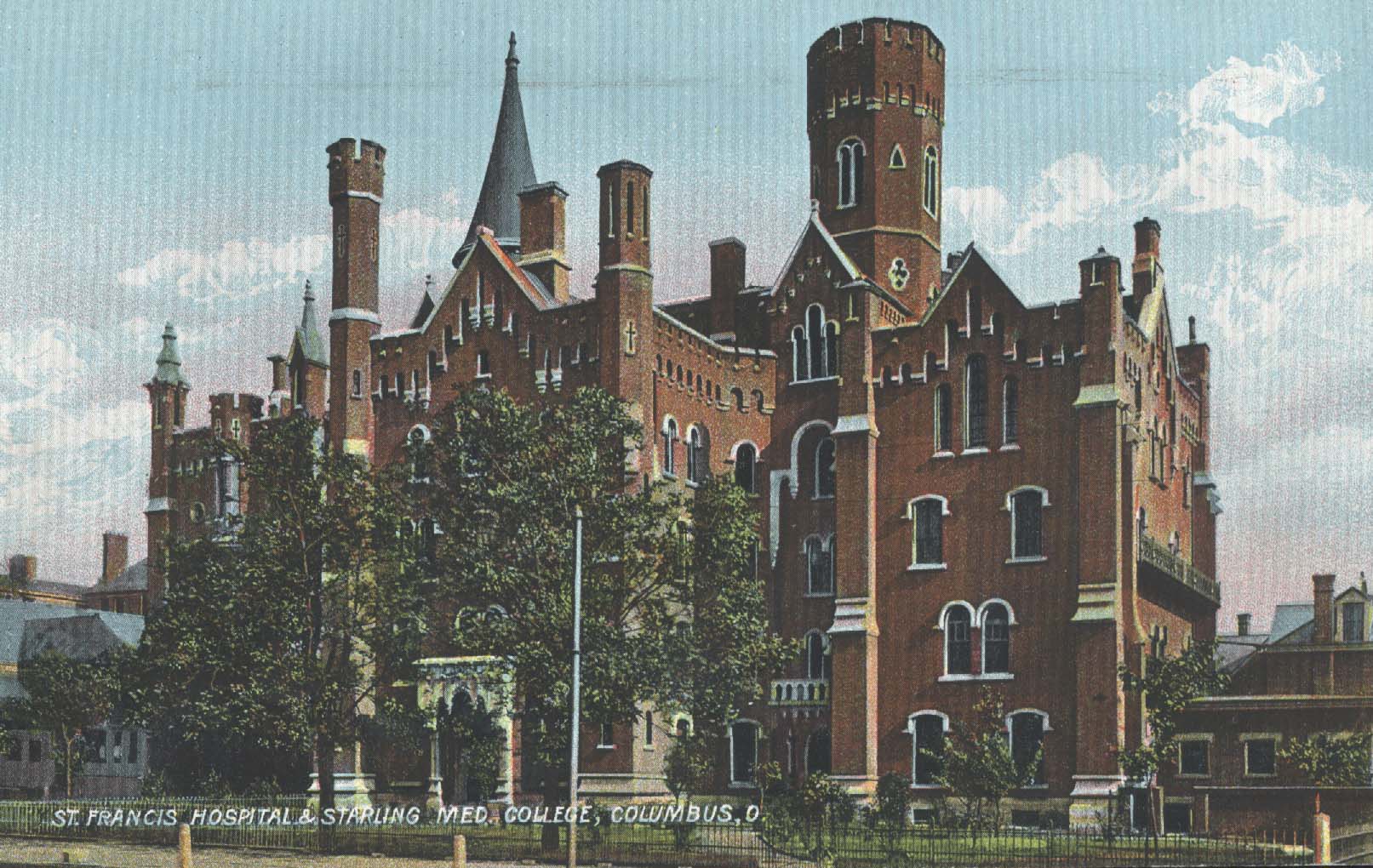
St. Francis Hospital and Starling Medical College
Built in 1847 at 311 East State Street (present site of Grant Medical Center), this Norman Gothic structure was the first to combine patient care and clinical teaching in the same facility in the United States. St. Francis Hospital comprised two-thirds of the building with Starling Medical College housed in the remainder.
Starling Medical College (one of six predecessor schools to the OSU College of Medicine) was in operation from 1847 to 1907 and named in honor of Mr. Lyne Starling, who donated the land and $35,000 for the new building. During its tenure, the College had 2,600 graduates.
Initially lacking funding to complete the hospital part of the building, Dr. Richard L. Howard, a Starling Medical College trustee, provided money to open the “Howard Infirmary.” Managing this facility proved to be overwhelming and the Infirmary closed in the 1850s. Because of the lack of medical facilities in Columbus at this time, local physicians organized a move to bring a group of nuns to the Columbus community to serve as health care workers in 1861. In 1865, a 99-year lease was granted to the Sisters of the Poor of St. Francis to operate the hospital. In 1929, the Sisters organized a School of Nursing which moved to St. Anthony’s Hospital in 1955 when St. Francis Hospital closed. St. Francis Hospital was razed in 1957.
*Part seven of a seven part series highlighting the history of Columbus medical centers.
In observance of the University holidays, the Medical Heritage Center is closed November 22 and 23.

Starling-Loving University Hospital
In 1917, The Ohio State University Board of Trustees announced that the abandoned homeopathy building would be incorporated into a new hospital for the medical school. A modified English Tudor addition to the homeopathic building made the hospital operational in 1924. The building was renamed Starling-Loving University Hospital in honor of Mr. Lyne Starling, a community leader and benefactor of Starling Medical College, and Dr. Starling Loving, dean of Starling Medical College (1880-1905).
By 1926, with the addition of three wings, the hospital housed 296 beds, an operating amphitheater, laboratories, a maternity department and an outpatient clinic. The main purpose was clinical teaching.
When The Ohio State University Hospital was built in the 1950′s, all hospital practices moved there. Starling-Loving University Hospital was renamed Starling-Loving Hall in 1961. It no longer serves as a hospital facility but houses offices and classrooms.
*Part six of a seven part series highlighting the history of Columbus medical centers.

© 2026 The Ohio State University - University Libraries
1858 Neil Avenue Mall, Columbus, OH 43210
Phone: (614) 292-OSUL (6785)
Request an alternate format of this page | Accessibility | Privacy Policy | Contact Us |

Recent Comments