Author: Maria Scheid (page 4 of 4)

Copyright Roundup, Part II

In Copyright Roundup Part I we discussed the fair use of an “aesthetically displeasing” photograph, copyright protection for cheerleading uniforms, and copyright ownership for non-human authors. In this post we will discuss the latest development in the Google Books litigation, fair use considerations in issuing DMCA takedown notices, and the public domain status of Happy Birthday to You.

Another fair use win for Google in most recent Google Books lawsuit.

Many of our readers are familiar with the Google Books litigation which began in 2005 when a number of publishers and the Authors Guild brought separate lawsuits against Google for Google’s Library Project.[1]  As part of the project, Google partners with research libraries to digitize works in the participating libraries’ collections. Digital scans of books are indexed and added to Google Books, providing the public with the ability to do full-text searches of terms within the books. Users can use the full-text search function in Google Books to determine how many times a particular term appears in any book within the Google Book collection. Absent an agreement with the copyright owner, Google does not provide the full scans to the public. Users can, however, see snippets of text containing the searched-for terms. Additionally, Google provides a digital copy of the scanned book back to the submitting library.

On October 16, 2015, the Second Circuit affirmed the lower court’s decision, holding Google’s digitization activities to be a transformative fair use. In analyzing the fair use factors, the court identified Google’s new purpose in providing otherwise unavailable information about the books, allowing users to identify works that include (and do not include) terms of interest. The court also found the snippet view to add important value to the search function, providing users with the context necessary to determine if the book fell within their scope of interest. While Google is a for-profit company, the Google Books project is provided as a free service without advertising. The court found Google’s ultimate profit motivation was not enough to deny a fair use finding in light of other factors, including its transformative purpose in using the works.

The court held that use of the entire work was reasonably appropriate to achieve the transformative purpose of enabling a full-text search function. For the snippet view feature, Google had a blacklisting process in place to permanently block about 22% of a book’s text from snippet view. In addition, researchers for Authors Guild were only able to access an aggregate of 16% of a text. The fragmented and scattered nature of the snippets results in an insubstantial amount of the work being displayed.

The court held the search and snippet view functions did not serve as a competing substitute for the original works. While snippet view may cause some loss of sales it did not rise to the level of meaningful or significant effect upon the potential market or value of the copyrighted work required to tilt the fourth factor in favor of the Authors Guild.

Finally, the court held that providing library partners with the digital copies of the works in their own collections was not infringing. Whether the libraries would then use the copies for infringing purposes was mere speculation and insufficient to place Google as a contributory infringer.

Why does it matter?

Despite ongoing litigation, Google continued their partnerships with libraries to digitize works in library collections, meaning they faced huge potential costs in damages. Consequently, this decision was a big fair use for Google, partnering libraries, and the public who use Google Books.

In his opinion, Judge Leval emphasized the goal of copyright to expand public knowledge and understanding, making the public, rather than the individual author or creator of a work, the primary beneficiary of copyright. Google’s activities served this goal. Public knowledge was augmented by making available information about the scanned books without serving as a substantial substitute for the copyrighted works.

The Authors Guild has indicated their intention to appeal the ruling but it will be up to the U.S. Supreme Court to decide whether they will hear the case.

Continue reading

Copyright Roundup, Part I

The past few months have seen a number of interesting trials and developments in copyright law. We are providing a two-part Copyright Roundup to summarize those cases you may have missed and to let you know why they are important. In part I, we discuss embarrassing photos, cheerleading uniforms, and monkey selfies.

Blogger’s use of “aesthetically displeasing” photograph of Miami Heat investor still a fair use.

We first covered the facts in the Katz v. Chevaldina case in our blog post, “Copyright as an Instrument for Censorship?”, noting that Mr. Katz had filed an appeal of the district court’s finding that defendant Irina Chevaldina was entitled to summary judgement based on a fair use defense. On September 17, 2015, the 11th Circuit released their opinion, affirming the lower court’s decision. Analyzing the purpose and character of use, the court found every use of the Mr. Katz photo to be primarily educational, rather than commercial (educating others about the nefariousness of Mr. Katz) and use of the photo to be transformative (Chevaldina used the photo to ridicule and satirize Mr. Katz’s character). When considering the nature of the copyrighted work, the court found the previously published photo to be primarily a factual work (the photo was a candid shot and the court found no evidence to establish that the photographer attempted to “convey ideas, emotions, or influence Katz’s expression or pose”.[1] Finally, the use of the photo would not materially impair Katz’s incentive to publish the work—because Katz obtained ownership to prevent publication, there was no market for the original work.

Why does it matter? Katz’s conduct in initiating this lawsuit raised some big questions about the role of copyright law in censoring speech. In this case, Katz’s attempt to use copyright law as a shield against unwanted criticism ended up helping to strengthen Chevaldina’s fair use defense. The court’s central question under the fourth fair use factor was whether Chevaldina’s use of the photo would cause substantial economic harm that would impair Katz’s incentive to publish the photo. By obtaining the copyright in the photo and initiating a lawsuit to prevent publication of the photo, however, Katz demonstrated his desire to stop any use of and access to the photograph. The court held that Chevaldina’s use of the photo did not impair Katz’s incentive to publish the photo because Katz had no incentive to publish the photo and the likelihood of Katz changing his mind was “incredibly remote.”

The court also had an interesting analysis of the factual nature of the photograph. For a thoughtful discussion of this point, read Kevin Smith’s post, “Photography, Fair Use and Free Speech.”

Copyright protection for cheerleading uniforms: Varsity Brands v. Star Athletica

Varsity Spirit Corporation and Varsity Spirit Fashions and Supplies, Inc. (Varsity) designs and manufactures cheerleading apparel and accessories, having received copyright registrations for many of their design sketches. These designs included different combinations and arrangements of stripes, zigzags, chevron, and color blocks. The question on appeal was whether these elements were needed to make a cheerleading uniform or whether the design elements could exist separately from the uniform.

On August 19, 2015, the Sixth Circuit reversed the district court’s decision that Varsity’s designs were not physically or conceptually separable from the utilitarian function of the cheerleading uniform, holding that the graphic designs on Varsity’s cheerleading uniforms were separate and therefore copyrightable. The Court distinguished Varsity’s design from dress designs, which typically do not receive copyright protection.

Why does it matter? U.S. copyright does not protect useful articles. Useful articles are articles that have a utilitarian function beyond portraying the appearance of the article or conveying information. To the extent that a work includes a useful function, copyright will only protect those original elements of the work that can be independently separated from the useful function of the work.

Prior to this case, the Sixth Circuit (binding authority for Ohio’s federal district courts) had not adopted an approach for determining separability. After reviewing the approaches taken by other circuits, the Sixth Circuit decided to adopt a hybrid approach to determine if a particular design is a copyrightable pictorial, graphic, or sculptural work. To make this determination, the following questions must be asked:

  1. Is the design a pictorial, graphic, or sculptural work?
  2. If yes, is it a design of a useful article?
  3. If the design is of a useful article, what are the utilitarian aspects of the useful article?
  4. Can the viewer of the design identify pictorial, graphic, or sculptural features separately from the utilitarian aspects of the useful article?
  5. Finally, can the pictorial, graphic, or sculptural features of the design of the useful article exist independently of the utilitarian aspects of the useful article?

In answering these questions, the court identified a utilitarian function of a cheerleading uniform to “cover the body, wick away moisture, and withstand the rigors of athletic movements.”[2] The court found that the top and skirt of the uniform could still be identified as a cheerleading uniform even without stripes, chevrons, color blocks, or zigzags. Finally, the interchangeability of the designs indicates the graphic features can exist separately and independently from the utilitarian features of the uniform.

Can a monkey own a copyright?

The “Monkey Selfie” case has taken an additional twist with a new lawsuit brought on behalf of Naruto, the crested macaque. The monkey selfie case began in 2011 when photographer David Slater took a trip to Indonesia and left his camera unattended. A monkey (Naruto) used the camera to take a number of photos of himself grinning into the camera. One self-portrait was reproduced in publications around the world, eventually being added to Wikimedia Commons under the presumption that the work was in the public domain.[3] This prompted Mr. Slater to issue several DMCA takedown notices.

In 2014, Mr. Slater published a book containing copies of the Monkey Selfies, continuing to assert himself as copyright owner of the photographs. Later that year, the Copyright Office revised the Compendium of U.S. Copyright Office Practices, to clarify that the U.S. Copyright Office would not register works produced by animals, including, for example, “a photograph taken by a monkey.”[4]

On September 21, 2015, PETA filed a copyright lawsuit on behalf of Naruto against Mr. Slater, alleging that Mr. Slater falsely claimed to be the author of the photographs and made unauthorized copies of the works for commercial purposes. The lawsuit seeks an order to permit PETA to administer and protect Naruto’s rights in the photographs, declaring Naruto the author and copyright owner of the works.

Why does it matter? U.S. copyright law does not specify human authorship, though the U.S. Copyright Office has provided guidance on the issue through the Compendium of U.S. Copyright Office Practices. This case raises a number of interesting questions around how we define, or should define, “author.” If non-human authors are recognized as eligible copyright owners, should lines be drawn? Should the law, for example, provide exclusive rights to machines? And if the author can’t communicate their preferences, should we allow someone to speak on their behalf?

***

We will continue our Copyright Roundup in part two, where we will look at some important fair use developments in the Google Books lawsuit and Stephanie Lenz’s “dancing baby” case against Universal Music and answer the question, “is Happy Birthday to You finally in the public domain?”

_____________________________________________________________________________________

By Maria Scheid, Rights Management Specialist at the Copyright Resources Center, The Ohio State University Libraries


 

[1] Katz v. Chevaldina, No. 14-14525 (11th Cir. 2015).

[2] Varsity Brands, Inc. v. Star Athletica, LLC, No. 14-5237 (6th Cir. 2015).

[3] Wikimedia Commons refused to remove the photograph on the basis that Mr. Slater was not the author of the work. Without a human author, Wikimedia Commons argued, the work may not be protected by copyright.

[4] U.S. Copyright Office, Compendium of the U.S. Copyright Office Practices (3d ed. 2014) § 313.2.

Copyright in Campaigns

Note: This blog post was updated on 9/14/2020 to include more information on the option for exclusion found in the ASCAP and BMI public performance licenses for political campaigns.

Election Day may still be over a year away but the 2016 Presidential campaign is already underway. As a battleground state, Ohio will experience a lot of political activity over the next 14 months.  Among the anticipated barrage of political ads, full calendar of rallies, and around-the-clock media coverage of campaign activity, we will see our friend: copyright. Copyright protects a wide variety of works—speeches, websites, marketing materials, etc.—so long as the work is original and fixed in a tangible format. This blog will highlight some of the many areas you will see copyright pop up during the campaign season.

Political Speeches:

Original political speeches written by candidates (or speechwriters) receive copyright protection, meaning the author of the speech may exercise control over the reproduction, adaptation, distribution, and performance or display of the speech. Two categories of works are not covered by copyright, however: works that fail to meet the fixation requirement and works created by federal employees within the scope of their employment. This means that speeches made at town hall meetings or political rallies may not be protected by copyright, unless those speeches were recorded or transcribed. It also means that works created by incumbent presidents or U.S. Senators or Representatives, if made within the scope of their employment, lack copyright protection and are free to use. For example, a speech made and recorded by Bernie Sanders within his role as Senator or a report written by Hillary Clinton as U.S. Secretary of State may be used without permission. A work created by a non-federal employee (e.g., Martin Luther King Jr.’s famous “I Had a Dream” speech), however, may still be protected by copyright.

When speeches are televised, the broadcasting entity televising the speech (e.g., CBS, Fox News, C-SPAN, or CNN) may hold a separate copyright in the broadcast recording. This is true even if the speech itself is made by a federal employee within the scope of their employment or is otherwise in the public domain.

Continue reading

Copyright and Accessibility

Many educational institutions, including Ohio State, share the mission of advancing and encouraging the spread of knowledge. At times, however, the exclusive rights of copyright owners can impede this mission by conflicting with the important objective of making works accessible to all, particularly to individuals with disabilities. Even with the emergence of new technologies that facilitate instantaneous copying and dissemination of materials, owner control over reproduction and distribution of works has continued to create an obstacle to the growth of works in formats accessible to individuals with print, hearing, or other disabilities. Statistics from the World Blind Union reveal, for example, that of the approximately 1 million books published per year, less than 5% are made in formats accessible to the print-disabled.[1] Given the significant societal benefit that is achieved by promoting equal access, it is important to understand the provisions of copyright law that currently support the growth of works in accessible formats and identify opportunities for further change.

Current U.S. copyright law lacks a blanket exception for accessibility, relying instead on a patchwork of statutory exceptions and the doctrine of fair use. This blog will cover some of these current key exceptions, as well as potential developments under national and international law.

The Chafee Amendment and Performance of Literary Works under §110

One important provision in copyright law that promotes accessibility to copyrighted works is the Chafee Amendment. The Chafee Amendment (17 U.S.C. § 121) permits an authorized entity to reproduce or distribute copies of previously published nondramatic literary works if the copies are reproduced or distributed in specialized formats exclusively for use by blind or other persons with disabilities.

Authorized entities include nonprofit organizations or governmental agencies “whose primary mission is to provide specialized services relating to training, education, or adaptive reading or information access needs of blind or other persons with disabilities.” The vagueness surrounding the definition of “authorized entity” has contributed to confusion and reluctance to rely on the protections set forth in the Chafee Amendment. Do educational institutions like The Ohio State University, who are bound to comply with the provisions of Section 504 of the Rehabilitation Act and the Americans with Disabilities Act (ADA),[2] qualify as authorized entities? Publishers assert that only institutions who specialize in promoting accessibility (e.g., the National Library Service for the Blind), not educational institutions in general, qualify as authorized entities. Educational institutions, on the other hand, argue that their work and legal obligations under federal law establish them as authorized entities under the Chafee Amendment.

The Copyright Act also provides narrow exceptions for the performance of literary works. Section 110(8) permits certain eligible entities to perform nondramatic literary works by or in the course of a transmission specifically for the print or hearing disabled when the transmission is noncommercial. Section 110(9) permits an authorized radio subcarrier to make a single transmission of a dramatic literary work for the print disabled if the performance is noncommercial and the work was published at least 10 years before the performance.

Current & Proposed Exemptions under the Digital Millennium Copyright Act (DMCA)

Section 1201 of the Digital Millennium Copyright Act (DMCA) prohibits any individual from circumventing technological protections measures placed on a work. For example, you cannot decrypt DVDs protected by Content Scrambling System (CSS). The law, however, provides exemptions to this anti-circumvention rule. One current exemption, in effect from 2012-2015, allows for the circumvention of electronically distributed literary works that are protected by technological measures when those technological protection measures prevent the enabling of read aloud functionality or interfere with screen readers or other assistive technologies. Literary works must be lawfully obtained by a blind or other person with a disability (for nondramatic literary works the work must be lawfully obtained and used by an authorized entity under the Chafee Amendment) and the rights owner must be appropriately remunerated for the price of the mainstream copy of the work. A renewal of this exemption has been requested in the 2015 triennial review.[3]

Another current exemption permits the circumvention of motion pictures and other audiovisual works that are on DVDs protected by the Content Scrambling System (CSS) or distributed by an online service that is protected by technological measures, in order to facilitate research and development of players that are capable of providing captioning or descriptive audio.

The Important Role of Fair Use

The statutory exceptions listed above are relatively narrow in their applications, including limitations on who may reproduce or transmit a work, the type of work that may be reproduced or transmitted, and who may benefit from such activities. One exception in copyright law that has been instrumental in filling in the gaps left by these narrow exceptions and promoting accessibility for copyrighted works has been fair use.[4] A recent decision by the Court of Appeals for the Second Circuit has reinforced the significant role of fair use in increasing the accessibility of copyrighted works.

In Authors Guild, Inc. v. HathiTrust,[5] HathiTrust created a shared digital repository of collection materials from academic and research member institutions, allowing full access to patrons with qualifying disabilities. The district court held this activity was permissible under the Chafee Amendment, stating that educational institutions “have a primary mission to reproduce and distribute their collections to print‐disabled individuals…[making] each library a potential ‘authorized entity’ under the Chafee Amendment.” The court held, however, that HathiTrust was not precluded from relying on the defense of fair use in the event that they were not authorized entities or did not otherwise fall within the permissible categories of the Chafee Amendment. On appeal, the Second Circuit held that providing full digital access to print-disabled patrons was protected under fair use. [6]

International Considerations: Adoption of the Marrakesh VIP Treaty

U.S. copyright law may also be influenced by international agreements. One international treaty directed to making works more accessible is the Marrakesh Treaty to Facilitate Access to Published Works by Visually Impaired Persons and Persons with Print Disabilities (“Marrakesh VIP Treaty”). The Marrakesh VIP is an international treaty administered by the World Intellectual Property Organization (WIPO) which would obligate signatory countries to create mandatory limitations and exception to their copyright laws pertaining to “the right of reproduction, the right of distribution, and the right of making available to the public…to facilitate the availability of works in accessible format copies” for the benefit of people with print disabilities.[7] The treaty would also permit exchange of accessible works across borders by authorized entities serving the blind, visually impaired and otherwise print disabled. Finally, the Treaty provides that contracting parties take appropriate measures to ensure that any anti-circumvention restrictions do not prevent the blind, visually impaired, or print disabled from enjoying any of the exceptions provided for in the Treaty.

The Treaty, adopted on June 27, 2013, will go into force three months after 20 eligible entities have acceded to or ratified the Treaty. There is currently accession or ratification from ten nations. The United States signed the Treaty on October 2, 2013 but has not yet ratified the Treaty.

In Conclusion

Making copyrighted works available in accessible formats can present a challenge to the exclusive rights of copyright owners. Absent a blanket exception that would allow for the creation of accessible formats for all persons with disabilities, individuals and educational institutions must navigate the existing narrow statutory exceptions or rely on a fair use defense in order to make works accessible. While society recognizes the importance of incentivizing creators to create new works, we must also recognize the importance of establishing equal access to those works in order to advance public knowledge and encourage further creation of works.

Accessibility Resources

_____________________________________________________________________________________

By Maria Scheid, Rights Management Specialist at the Copyright Resources Center, The Ohio State University Libraries

[1] Limitations and Exceptions: Access to Books for the Visually Impaired – Background Brief, World Intellectual Property Organization, http://www.wipo.int/pressroom/en/briefs/limitations.html (last updated January 2014).

[2] Section 504 of the Rehabilitation Act of 1973 provides that no qualified individual with a disability, solely by reason of his or her disability, be excluded from participating in, or be subjected to discrimination under any program or activity receiving federal funding. 29 U.S.C. § 794(a). The Americans with Disabilities Act of 1990 requires public entities to make reasonable modifications when necessary to avoid discrimination on the basis of disability. 28 C.F.R. Sec. 35.130(b)(7).

[3] 79 FR 73863 (December 12, 2014).

[4] The House Report on the Copyright Act of 1976 also identifies making accessible copies of works for the blind as an illustrative application of the fair use doctrine (“…the making of a single copy or phonorecord by an individual as a free service for a blind persons would properly be considered a fair use under section 107.” H.R. Rep. No. 94-1476, 94th Cong., 2d Sess. (1976).

[5] 902 F. 22 Supp. 2d 445, 460‐64 (S.D.N.Y. 2012).

[6] 755 F.3d 87 (2d Cir. 2014).

[7] Marrakesh Treaty to Facilitate Access to Published Works for Persons Who Are Blind, Visually Impaired, or Otherwise Print Disabled art. 4, June 27, 2013, TRT/MARRAKESH/001.

Copyright as an Instrument for Censorship?

Copyright protects the intellectual property of creators—more specifically it protects original works of authorship that are fixed in a tangible medium of expression. Copyright owners have a bundle of exclusive rights in their protected works and they may exercise these rights to control who and under what conditions their work may be used or reused. In copyright law, the rights of copyright owners have often intersected with the rights of others regarding copyright as well as other legally protected rights, including trademark, right of publicity, and right of privacy. Recently, some issues have arisen over the intersection of copyright enforcement and censorship, in which subjects and/or rights holders of publicly available copyrighted works have sought to remove access to the works.

These issues have become seemingly more common with the emergence of the takedown procedure set forth in the Digital Millennium Copyright Act (DMCA). The DMCA provides a takedown process that allows rights holders to request the removal of their copyrighted materials that have been uploaded by users and hosted by online service providers such as YouTube, WordPress, or Tumblr. In the past month alone, Google has received DMCA takedown notices from 5,596 copyright owners requesting the removal of 39,829,891 URLS.[1]

The DMCA takedown process makes removal of copyrighted material expeditious, and in many cases automatic (e.g., YouTube’s Content ID system), but when does the removal of infringing content align with the purpose of copyright law to “promote the Progress of Science and useful Arts,”[2] and when does it cross the line into the realm of censorship?[3] Here are some recent examples to consider:

  1. “Ugly” photograph. In Katz v. Chevaldina,[4] a photograph was taken of businessman Raanan Katz, in which Mr. Katz can be seen with his tongue sticking out of his mouth. The photograph was described as “ugly” and “candid and embarrassing” by Mr. Katz. The photo was first published in an Israeli newspaper accompanying a favorable article discussing Mr. Katz’s potential ownership interest in an Israeli basketball team, before being republished several times by Irina Chevaldina on her blogs. The republished photos were sometimes accompanied by critical remarks or included in mocking cartoons. Following a request from Mr. Katz, the Israeli photographer who took the photo assigned his copyright to Mr. Katz free of any charge (Mr. Katz testified he had obtained the assignment “[b]ecause I wanted to stop this atrocity”). Following the assignment, Mr. Katz asked Ms. Chevaldina to remove the photos from her blogs. When Ms. Chevaldina refused, Mr. Katz filed a suit for copyright infringement. On balance, the district court found Ms. Chevaldina’s use of the photo to constitute a fair use, protecting her from liability. An appeal has been made to the Eleventh Circuit.
  1. Propaganda film. In 2011, Cindy Lee Garcia agreed to perform a minor role for Desert Warrior, an action thriller set in Arabia. Without her knowledge or consent, Ms. Garcia’s performance was then used in the creation of Innocence of Muslims, an anti-Islam propaganda video. Following the upload of the video to YouTube, Ms. Garcia received death threats for her involvement in the film. Ms. Garcia filed numerous DMCA takedown notices with Google, all of which were resisted, before seeking legal action to remove the video based on the claim that the posting of the video infringed her copyright in her individual performance. In May 2015, the Ninth Circuit affirmed an earlier decision by the district court and held that Ms. Garcia lacked a copyright interest in her 5-second performance, stating that “a weak copyright claim cannot justify censorship in the guise of authorship.”[5]
  1. “Unauthorized” blog post. In 2013, student journalist Oliver Hotham reached out to Straight Pride UK, asking if he could send some questions for more information on the organization. The questions and corresponding answers were posted to Mr. Hotham’s WordPress blog and included comments from Nick Steiner, Straight Pride UK’s press officer, urging individuals to come out as straight and speaking of the need to raise awareness of heterosexuality and traditional lifestyles and relationships. On the same day the post was made, Mr. Hotham received a DMCA takedown notice. Mr. Hotham refused to remove the material from his blog and filed a counter-claim. Following legal action, Automattic, the company responsible for operating WordPress.com, was granted a motion for default judgement on their claim against Mr. Steiner for misrepresentation in filing a DMCA notice (17 USC 512(f)). [6] Automattic was awarded $25,084 in damages.
  1. Revenge porn. The emergence of revenge porn has also raised some questions around the role of copyright in removing online content. Typical revenge porn cases involve the nonconsensual public distribution of sexually explicit photos or videos, often released by a victim’s ex-partner. A majority of these videos and images are taken by the victims themselves.[7] While some states have passed revenge law legislation or currently have laws in place broad enough to encompass revenge porn, many states leave victims with fewer legal options. Victims of revenge porn have pursued tort claims, including harassment, stalking, and invasion of privacy, but because most uploaded photos are taken by the victim themselves, a claim of copyright infringement has been suggested as an attractive option to facilitate the takedown of the material.

In situations where copyright is asserted to censor in order to achieve a positive societal result, is it enough that the ends justify the means? Or should these issues be viewed solely through the lens of the purpose of copyright law; to promote the progress of science and the useful arts? These types of issues will continue to arise as courts are asked to define the line between allowing copyright owners to exercise their legal rights and allowing copyright owners to use their legal interests to censor otherwise lawful conduct.

_____________________________________________________________________________________

By Maria Scheid, Rights Management Specialist at the Copyright Resources Center, The Ohio State University Libraries

[1] Google Transparency Report. Requests to remove content: Due to copyright. Available at: https://www.google.com/transparencyreport/removals/copyright/ (last updated July 8, 2015).

[2] U.S. Constitution, Art. 1, Sec. 8, cl. 8.

[3] Compare the emphasis the European Union places on privacy versus the United States’ emphasis on the public’s right to know. In 2014, the Court of Justice for the European Union ruled that under the 1995 Data Protection Directive, individuals have a right to be forgotten under certain circumstances. Individuals may exercise this right by asking search engines (including U.S. search engines with a branch or subsidiary in an EU Member State) to remove inaccurate, inadequate, irrelevant, or excessive personal information. The court ruled, however, that the right to be forgotten would be balanced against the freedom of the media and the freedom of expression. Individuals have since exercised this right to be forgotten, requesting Google to remove links to revenge porn. See The Economist (Oct. 4, 2014). The right to be forgotten: Drawing the line. Retrieved from http://www.economist.com/news/international/21621804-google-grapples-consequences-controversial-ruling-boundary-between.

[4] Katz v. Chevaldina, 12-22211-CIV-KING/MCALILEY, 2014 U.S. Dist. LEXIS 88085 (S.D. Fla. 2014).

[5] Cindy Lee Garcia v. Google, Inc., D.C. No. 2:12-cv-08315-MWF-VBK (9th Cir. 2015) (en banc).

[6] Automattic, Inc., et. Al., v. Nick Steiner, 2014 U.S. Dist. LEXIS 182295 (N.D. Cal., Oct. 6, 2014).

[7] Cyber Civil Rights Initiative (Sept. 10, 2013). Proposed CA Bill Would Fail to Protect up to 80% of Revenge Porn Victims [Press release]. Retrieved from http://www.cybercivilrights.org/press_releases.


Creative Commons Licenses: What You Need to Know as a Creator and User

As one of the major open licensing options for copyright owners, Creative Commons (CC) is likely a familiar name to many of our readers. For those that are unfamiliar, CC is a nonprofit organization that offers a number of different copyright license options to copyright owners. A CC license allows a copyright owner to choose how they would like others to be able to use their work, and anybody may use the work for free, so long as they follow the terms of the license. Before using a CC licensed work or deciding to apply a CC license to your own work, you should have an understanding of the scope of the license you are working with. This blog will provide more information on some important points to keep in mind about CC licenses and provide an overview of the license options.

What Do You Need to Know About Creative Commons Licenses?

Whether you are applying a CC license to your own work or using a work covered by a CC license, here are some important things to keep in mind:

9 million websites use Creative Commons licenses

  1. Creative Commons licenses are not an alternative to copyright—a work must be copyrighted in order to be licensed under a CC license. Copyright owners have a bundle of rights that allow them exclusive control over how their work may be reproduced, adapted, distributed and publicly performed or displayed. A copyright owner may decide to transfer some or all of these rights to another or permit others to use the work through a licensing agreement. If a copyright owner chooses to license their work under a CC license, they are not giving up ownership of their work—they are permitting others to exercise one of the copyright owner’s exclusive rights under the terms and conditions listed in the language of the license.
  1. Creative Commons licenses do not limit or restrict any rights granted through statutory exceptions, including fair use. If your use of a copyright protected work would otherwise be allowed through a statutory exception (such as the face-to-face teaching exception, the TEACH Act, or fair use), you may still rely on those statutory exceptions.
  1. Only the copyright owner can place a CC license on the work or authorize another to do so. If third party material  is being used in a new work under a statutory exception or limitation or through permission of the copyright owner, the author of the new work can only license the part of the work to which they claim ownership. In this type of situation, it is important for the author to mark third party content to let others know that the entire new work may not be available under the selected CC license. An author of a new work may avoid this situation by seeking permission from the copyright owner to make the third party material available under a CC license, allowing others to then use the entire work according to the license terms.
  1. Creative Commons licenses are non-exclusive and non-revocable. Anyone is free to use a CC licensed work so long as they abide by the terms of the license. A copyright owner is also free to continue to exercise their exclusive rights, meaning they may simultaneously enter into separate agreements for the use of their works. A copyright owner may decide to no longer distribute their work under a CC license, but because CC licenses are non-revocable, anybody who already has access to the work may continue to use the work under the original license terms.

What Are the License Options?

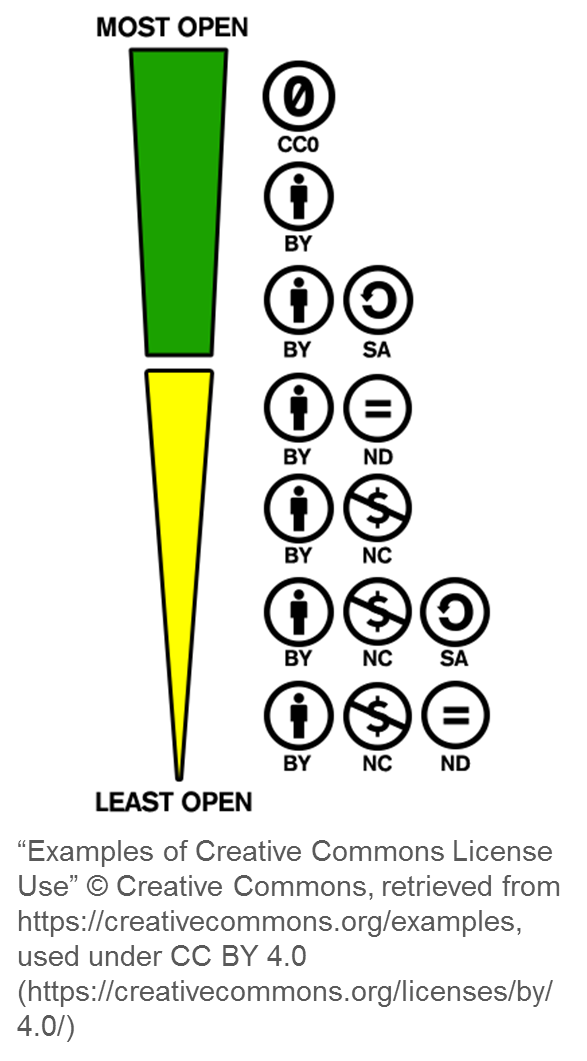
Icon badges for all six Creative Commons license options and the Public Domain tool.

Creative Commons licenses provide copyright owners with a great degree of flexibility in how open they would like to make their work. The various license terms define the ways in which users may freely and legally share, modify, or build upon a copyrighted work.

All CC licenses require attribution. Beyond attribution, copyright owners may choose among a combination of licensing terms. Copyright owners may specify that their work not be used for the primary purpose of monetary compensation (NonCommercial) or that their work not be modified or adapted in any way (NoDerivs). Alternatively, a copyright owner may permit a user to modify, adapt, or build upon their work but specify that any new work created be made available under similar open licensing terms (ShareAlike). Creative Commons also provides a Public Domain Dedication (CC0) tool. This tool allows a copyright owner to dedicate their work to the public domain by waiving all of their copyright and related rights in a work, to the extent allowed under the law. While attribution is not required for CC0 works, it is recommended as a best practice in order to acknowledge the intellectual work of others and to avoid accusations of plagiarism.

Spectrum of openness for Creative Commons licensesFinally, if you are looking for CC works to use, a good place to start your search is with the search function on the Creative Commons website. You may also look through the Creative Commons content directories to view organizations and projects using CC licenses. Many services, including Flickr, SoundCloud, Google, Bing, and Vimeo, provide their own advanced search feature, making the search for CC licensed works quick and easy.

In conclusion, CC licenses are a great resource for copyright owners and users of copyrighted content. As with any license agreement, however, be sure you are clear about the scope and limitations of the license before using a protected work or making your own works available for use by others.

Interested in learning more about Creative Commons? Contact the Copyright Resources Center for answers to your questions or to schedule a Creative Commons workshop.

___________________________________________________________________________________________________________________________________

By Maria Scheid, Rights Management Specialist at the Copyright Resources Center, The Ohio State University Libraries
Navigating the TEACH Act in Distance Education

Distance education is a thriving field, supported by the swift evolution and progress of technologies that promote access to and interaction with educational materials. The Technology, Education, and Copyright Harmonization Act of 2002 (“TEACH Act”), an amendment to Section 110 of U.S. Copyright Act, seeks to encourage these educational experiences by providing a specific carve out for distance education. The TEACH Act, codified in § 110(2), was signed into law and became effective on November 2, 2002 and amended existing copyright law to permit certain performances and displays of copyrighted materials in distance education settings.

A Brief History

In 1976, the time that the original language was enacted, § 110(2) provided an exemption for certain performances or displays of copyrighted works in the course of a transmission. At the time, a transmission referred to an instructional television or radio broadcast. With the expansion of digital technologies and development of distance learning, however, concerns arose over the adequacy of the existing copyright law in promoting digital distance education and protecting the rights of copyright owners. To address this concern, Section 403 of the Digital Millennium Copyright Act of 1998 (DMCA) required the Register of Copyrights to submit recommendations to Congress on “how to promote distance education through digital technologies, while maintaining an appropriate balance between the rights of copyright owners and the needs of users.”[1] In their 1999 report “Report on Copyright and Digital Distance Education” the U.S. Copyright Office provided a number of recommendations after consultation with representatives of copyright owners, nonprofit educational institutions, and nonprofit libraries and archives. The original TEACH Act bill implemented a number of the recommendations set forth in the Copyright Office’s report.[2]

Requirements of the TEACH Act

You must comply with a rather lengthy list of requirements in order to receive the protection the TEACH Act provides. To guide you through these various requirements, we have created a new handout: Using Materials in Distance Learning: A Guide to § 110(2) (TEACH Act).

In many ways the TEACH Act broadened the scope of § 110(2). Transmissions of works were no longer confined to physical classrooms, all type of works could now be performed or displayed (subject to certain limitations), and transmitting organizations were now permitted to reproduce copies of the works in order to perform or display them (again, subject to certain limitations). At the same time, the TEACH Act introduced additional institutional, teaching, and technology requirements to address concerns over how a work may be accessed and shared in a digital environment. All of the following requirements must be met:

□ General Scope: 

The TEACH Act only applies to the performance and display of copyrighted works. It does not cover the remaining exclusive rights held by a copyright owner, including the rights of distribution or creation of a derivative work. Under § 112(f)(1), however, a work may be reproduced in order to be performed or displayed within the requirements of the TEACH Act. See our handout, Using Materials in Distance Learning: A Guide to § 110(2) (TEACH Act), to see under which conditions reproduction would be permissible.

The TEACH Act amended § 110(2) to expand the scope of works that may be performed or displayed. You are permitted to perform a full nondramatic literary or musical work or reasonable and limited portions of all other types of works. You are permitted to display any type of work so long as you do so in an amount comparable to what would be displayed in a traditional classroom setting.

Finally, all copies of works that are being performed or displayed must be lawfully made and acquired—illegally obtained copies are not permitted—and the copy performed or displayed cannot be a work that is produced or marketed primarily as eLearning or distance learning materials.

□ Institutional Requirements: 

Eligible transmitting entities include government bodies and nonprofit educational institutions. Nonprofit educational institutions must be accredited. The institution must also provide a number of safeguards to counteract the risk of widespread dissemination of works. These safeguards include instituting policies regarding copyright, providing notice to students or recipients of the materials that the works may be subject to copyright protection, and providing copyright information to faculty, staff, and students to promote compliance with copyright law.

□ Teaching Requirements:

Performance or display of a work must be made by, at the direction of, or under the actual supervision of an instructor. The performance or display of the work must be made as an integral part of a classroom session offered as a regular part of systematic mediated instructional activity. In other words, an instructor must either initiate or actually supervise the performance or display, though real-time supervision is not required. Additionally, the performance or display must be an actual part of the class itself, not ancillary to the class, and it must be analogous to the type of performance or display that would take place in a live classroom setting. The performance must also be directly related and of material assistance to the teaching content. Works cannot be performed or displayed as unrelated background materials or simply for entertainment—they must be tied to the curriculum.

□ Technology Requirements:

At the time the law was being amended and distance education was gaining popularity, copyright owners were expressing their concerns over the ease of reproduction and dissemination of the works in a digital environment. Such activities, they argued, would have a large impact on their ability to license or otherwise exploit their rights as copyright owners. To address this concern, the TEACH Act imposes a number of technology requirements and limits the receipt of transmissions, to the extent technologically feasible, to students officially enrolled in the course or governmental employees as part of their official duties or employment.

In the case of digital transmissions, the transmitting body must apply technological measures to reasonably prevent retention of the copyrighted work beyond the duration of a particular class session and to reasonably prevent unauthorized further dissemination of the work. This may include performance or display via streaming services or limiting access though adoption of a closed content management system.

Finally, the TEACH Act supports the anti-circumvention language of the Digital Millennium Copyright Act and prevents a transmitting body from engaging in conduct that could reasonably be expected to interfere with technological protection measures that are already in place for copyrighted works.

What to Do if You Don’t Satisfy All Requirements

It may be the case that your intended use doesn’t satisfy all requirements of the TEACH Act. Maybe you would like to share materials to students beyond those officially enrolled in your class, or maybe you are performing or displaying materials through a service that does not allow for any sort of downstream control. In such situations, you may consider whether your intended use is likely to be considered a fair use. Fair use is a defense against a claim of copyright infringement and would allow you to perform or display the work without permission from the copyright owner. A fair use analysis is fact specific and should be considered for each individual piece of work you intend to perform or display.

You may also explore options for using alternative works that are in the public domain or available through more flexible open license terms. Works that are in the public domain are free to use without restriction. To use works available under an open license, you must comply with the license terms.

Finally, if you would like to use a particular work and you cannot rely on fair use, you may seek the permission from the copyright owner to use the work.

▪▪▪

In summary, the TEACH Act was a result of years of discussion and debate between copyright owners and individual and institutional users of copyrighted content. The final product was a compromise designed to promote distance education through digital technologies, addressing the holes created through rapid growth of technology and proliferation of distance learning. Because of its many limitations and restrictions, the TEACH Act has been accused of being too narrow in applicability, prompting many instructors to rely instead on fair use or pursue licensing options. But for those transmitting bodies that meet all of its requirements, the TEACH Act serves as an important statutory exemption.

[1] Digital Millennium Copyright Act, Pub. L. 105-304, 112 Stat. 2860 (1998).

[2] Technology, Education and Copyright Harmonization Act of 2001, S. 487, 107th Cong. (2001).

________________________________________________________________________________________

By Maria Scheid, Rights Management Specialist at the Copyright Resources Center, The Ohio State University Libraries
World IP Day 2015 Celebrates Music

On April 26, 1970, the Convention Establishing World Intellectual Property Organization (WIPO Convention) entered into force. The event is celebrated annually through the World Intellectual Property Day. The theme for this year’s World IP Day is “Get up, stand up. For music.”

Music plays a critical role in our lives—it is an essential defining element of our culture and society.  And through the changing of technology, consumer preferences, and industry standards, the demand for music has remained.  This past year has seen a lot of activity surrounding music creators and their rights under copyright law. Parties on all sides have questioned our current systems and laws, seeking changes designed to fairly support the value that musicians contribute to our lives and adequately encourage society’s access to and use of music.

Keeping with the theme of this year’s World IP Day 2015, we are highlighting a few out of many interesting and important recent developments and the resulting impact on copyright owners of musical compositions and sound recordings.


The Fair Play, Fair Pay Act of 2015

While musical compositions have long been protected under federal copyright, the inclusion of sound recordings under federal copyright law has been a relatively recent development (sound recordings fixed before February 15, 1972 are still governed by state law). In 1995, through the Digital Performance Right in Sound Recordings Act (DPRSRA), Congress provided copyright owners an exclusive public performance right in their sound recordings, but limited the exclusive right to public performances of sound recordings via digital audio transmission. This limitation means satellite and music subscription services need to pay a licensing fee to perform a sound recording, but terrestrial (AM/FM) radio stations do not. Why the exception for traditional over-the-air broadcasts? In short, Congress didn’t believe radio and television broadcasters posed a threat to copyright owners. Terrestrial radio stations, it has been argued, enjoy a symbiotic relationship with copyright owners. Terrestrial stations play music to increase their listenership and increase advertising revenue and in return create exposure for artists, promoting record and other sales for the sound recording owner.

Introduced in Congress earlier this month, the Fair Play, Fair Pay Act of 2015, H.R. 1733, 114th Cong. (2015) would require terrestrial broadcasters to pay royalties for the public performance of sound recordings, a requirement that is currently only applicable to services that perform a song via digital audio transmission. This public performance right would also extend to sound recordings fixed before February 15, 1972.  Special protections exist for small broadcasters, public broadcasters, college radio, noncommercial radio, and religious services. The bill also includes pieces from the Allocation for Music Producers (AMP) Act, discussed below.

Why it matters: Under the current law, owners of a musical composition (songwriters or music publishers) are compensated if their song is played on terrestrial radio but owners of the sound recording (performing artist or record label) are not. If that same song is transmitted through a service like Pandora, both copyright owners will be compensated. If enacted, the Fair Play, Fair Pay Act of 2015 would result in terrestrial broadcasters operating under the same system that newer digital broadcasters are required to operate under. Overall, this would create more harmonization in copyright law by bringing platform parity to radio and would establish an additional revenue stream for both current artists and older artists.


Local Radio Freedom Act

The Local Radio Freedom Act, a resolution reintroduced into the House and Senate earlier this year, declares that “Congress should not impose any new performance fee, tax, royalty, or other charge” to terrestrial broadcasters for the public performance of sound recordings. The National Association of Broadcasters has backed the resolution, which does not carry the force of law. The resolution highlights the “mutually beneficial relationship between local radio and the recording industry,” in which radio stations have provided publicity and promotion to artists, which has benefitted the careers of many performers. The resolution also cautions the economic hardship local radio stations and small businesses will face at the imposition of any new performance fee.

Why it matters: While artists have thrown a lot of support behind the Fair Play, Fair Pay Act (discussed above), broadcasters believe the Local Radio Freedom Act provides a better solution. The Local Radio Freedom Act, is non-binding, but functions to express the sentiment of Congress. This resolution would preserve the status quo for public performance of sound recordings. There are currently 165 co-sponsors in the House and 12 co-sponsors in the Senate.


Allocation for Music Producers (AMP) Act

Traditionally, record producers have received compensation for their work through the negotiation of a flat fee for their services and/or points (typically 3-4% of the wholesale price of an album). The Allocation for Music Producers (AMP) Act, H.R. 1457, 114th Cong. (2015), introduced in March of this year, would amend copyright law to provide a statutory right for producers, sound engineers, or mixers involved in the creative process of creating the sound recording to receive royalties for the digital transmission of the work.

Current law requires that royalties paid for the public performance of a sound recording by digital audio transmission be split between featured artists (45%), non-featured artists (5%), and sound recording copyright owners (50%). A featured artist may provide a Letter of Direction to SoundExchange, the entity responsible for collecting and distributing such royalties, requesting that a portion of their royalties be paid to the producer. Under the AMP Act, this informal process would be recognized through a statutory amendment.

In addition, the bill creates a new process for setting aside royalties for sound recordings fixed before November 1, 1995. In the absence of a Letter of Direction, SoundExchange may set aside 2% of featured artist royalties to be paid to the producer, mixer, or sound engineer of the relevant sound recording, so long as the artist does not object within a given period of time.

Why it matters: Producers, sound engineers, and mixers play an important role in the creative development of sound recordings. The AMP Acts acknowledges the importance of these individuals in the overall creative process and seeks to establish a permanent procedure by which these professionals can fairly be compensated for their contributions.


Songwriter Equity Act

Re-introduced into both houses on March 4, 2015, the Songwriter Equity Act of 2015 (SEA) would amend Sections 114 and 115 of the Copyright Act to allow the calculation of statutory royalty rates for musical compositions based on fair market value.

The SEA would change the way royalties are calculated for the reproduction of musical compositions. There is currently a compulsory mechanical license for the reproduction of musical compositions. The initial rate set by Congress in 1909 was 2¢ per song. In 2015, it is 9.1¢ per song. The SEA would now allow Copyright Royalty Judges to establish rates that “most clearly represent the rates and terms that would have been negotiated in the marketplace between a willing buyer and a willing seller.” In addition, Judges may now consider the royalty rates set for the public performance of sound recordings in their determination of rates for the public performance of musical compositions.

Why it matters: The intent of this bill, as with the other bills we have discussed, is to even the playing field. By adopting rates that reflect free market conditions, songwriters may receive fair compensation for their works.


Calculation of digital royalties for pre-digital artists

It is difficult to predict how technology will change in the future, as a result, older recording agreements are silent on how to handle payments for digital downloads. The major record labels have historically treated downloads as equivalent to physical sales (meaning artists get 12-20% of net receipt of sales) but artists have argued that digital downloads are more appropriately treated as licenses (meaning the artist would receive 50% of net receipts).

The approach taken by major labels has resulted in major class action lawsuits against Sony, Warner, and Universal. On April 14, 2015, Universal submitted a preliminary settlement of $11.5 million, to be paid to artists signed with UMG or Capitol Records between 1965 and 2004. Universal does not, however, admit wrongdoing in the payment of royalties. Going forward, an increase of 10% has been applied to the royalty rate for digital downloads. Settlements have already been reached in the Sony and Warner Music Group lawsuits.

Why it matters: Compensation. There is a substantial difference in royalty rates between traditional physical sales and licenses. In cases where digital downloads have not been anticipated, it has been up to the court to determine what is just based on the technology of today.

As you can see from just these examples, this past year has been full of activity surrounding music and copyright issues. Following calls for comprehensive copyright reform and talks of a “music omnibus bill” to overhaul the music licensing system, we can expect this important dialogue to continue. Only time will tell how some of these issues will ultimately be resolved and the impact any changes will have on artists, consumers, and facilitators of music.

Interested in learning more about music copyright? Be sure to check out our 4-part series on music copyright: What is music copyright?, Copyright duration for musical compositions and sound recordings, Termination of transfer for music copyright, and Licensing opportunities for music copyright.

________________________________________________________________________________________

By Maria Scheid, Rights Management Specialist at the Copyright Resources Center, The Ohio State University Libraries

How the public domain promotes scholarship: Engaging Columbus uses 1922 OSU thesis to map Columbus neighborhoods

Engaging Columbus, a collaboration between Ohio Wesleyan University, the Ohio Five Libraries, the City of Columbus Department of Technology / Geographic Information Systems, and other partners in central Ohio, has generated an interactive map of historic panoramic images from the City of Columbus using digitized photographs from a 1922 Ohio State University master’s thesis. The thesis, “An introduction to the economic and social geography of Columbus, Ohio” was written by Forest Ira Blanchard, OSU Department of Geography’s first graduate-level alumnus. The use of Mr. Blanchard’s photographs is a great example of the way digitization of works can spur new scholarship. Mr. Blanchard’s thesis photographs, published ninety-three years ago, provide important historical information on urban neighborhoods and development in Columbus, Ohio. As Engaging Columbus notes, “Blanchard’s photographs are remarkable for their depiction of typical streets, railroad corridors, and neighborhoods (rather than the more typical images of important buildings or events).” Engaging Columbus was able to freely use the valuable resource contributed by Mr. Blanchard to inform and shape its own work in geocoding historical photographs. The information they have generated is fully available for the benefit of the public and will in turn be used in a variety of ways.

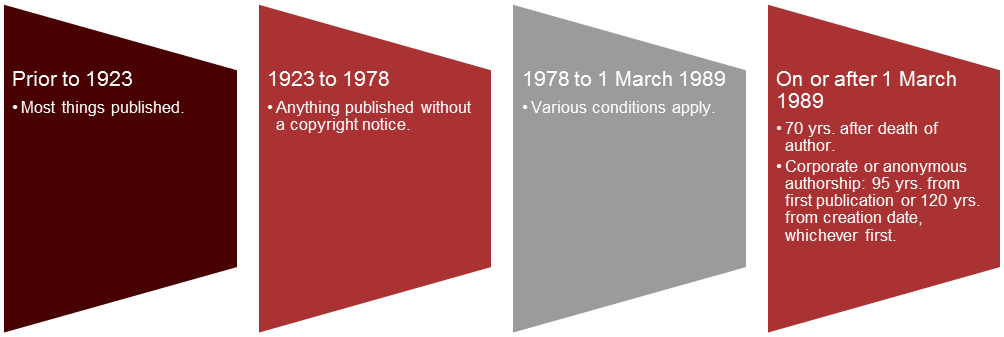
Engaging Columbus was able to use Mr. Blanchard’s photographs without having to ask permission or pay fees to Mr. Blanchard’s estate. Original photographs such as the ones taken by Mr. Blanchard are subject to copyright protection, so how did Engaging Columbus use the photographs without permission? The answer comes from the law surrounding copyright duration and expiration. Mr. Blanchard’s photos were published prior to 1923; the photographs are in the public domain and therefore no longer protected by copyright.

What is the public domain?

In the United States, copyright law seeks “to promote the Progress of Science and useful Arts” by providing copyright owners with a number of exclusive rights over their works, for a limited time. By limiting the time in which a work may fall under copyright protection, the law seeks to find the right balance between incentivizing creators to create works and opening works up for the use and benefit of the public. In addition to establishing duration for copyright protection, the law also provides that certain works never receive copyright protection to begin with. The public domain includes works that fall into both of these categories: those in which the copyright has expired and those which never had copyright protection. Works in the public domain can be used by anyone in any way, without any permission required.

Copyright duration has been extended a number of times over the years, and calculating when exactly a work falls into the public domain due to expiration of its copyright can be tricky. The graphic can provide some general guidance. For more information on the public domain, visit our resources page.

When does a work fall within the public domain?

Four trapeziods, positioned sideways and all of a different color, depicting general guidelines for determining when a work falls into the public domain.Trapeziod 1 reads: Prior to 1923, most things published. Trapezoid 2 reads: 1923 to 1978, anything published without a copyright notice. Trapezoid 3 reads: 1978 to 1 March 1989, various conditions apply. Trapezoid 4 reads: On or after 1 March 1989, 70 yrs. after death of author, corporate or anonymous authorship: 95 yrs. from first publication or 120 yrs. from creation date, whichever first.


Digitization as a tool for new scholarship

Scholars around the world are creating tools, digital platforms, websites and documents to help society learn about ourselves. Many like Engaging Columbus are linking the arts, geography, history and sociology, among others, in new and innovative ways. By digitizing works in the public domain, we can provide access to previously unavailable historical, cultural and educational resources, which can have a positive impact on academia. Works such as Mr. Blanchard’s photographs may now reach new audiences and serve as the catalyst for creation and dissemination of new information and perspectives. Building upon and promoting of scholarship is at the heart of the mission of universities and libraries across the country, including The Ohio State University, to advance discovery and learning.

An introduction to the economic and social geography of Columbus, Ohio” is available for viewing in the Architecture Library at the Austin E. Knowlton School of Architecture and will soon be available online through the OhioLINK ETD Center.

________________________________________________________________________________________

By Maria Scheid, Rights Management Specialist at the Copyright Resources Center, The Ohio State University Libraries

Newer posts