
Category Archives: Gender and Sexuality

Collective Imaginaries

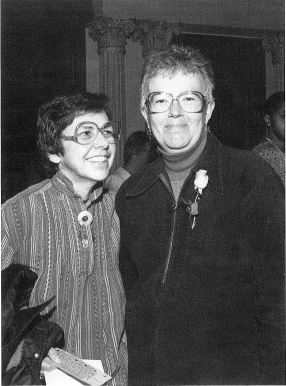
Photo of two women side by side, June L. Mazer and Bunny MacCulloch

June L. Mazer (right) and Bunny MacCulloch. All rights reserved UCLA Center for the Study of Women

by Lizette Guerra

Yolanda Retter-Vargas, my mentor and predecessor at the UCLA Chicano Studies Research Center, taught me that even within my own perceived community there were many communities: Latinas, Chicanas, Lesbianas, feminists, and others. She drilled into my work ethic the notion that I could not truly be at the service of my community, or any community for that matter, if I did not make a true concerted effort to represent everyone, women, men, lesbian, gay, rich and poor, of all cultural backgrounds and beliefs. Yet, historically, this belief has not been central to our profession. Archivists have been privileged with the power to decide what is deemed historical and what is not. What do we preserve for future generations and what do we leave out of our collective imaginaries?

Despite the reality that Los Angeles is one of the most diverse cities in the world, people of color and the LGBT community in particular continue to be underrepresented and in effect invisible within archival collections, the public record, and historical research. The partnership between the UCLA Library, CSW, and the Mazer Archives reflects an increasing awareness amongst archivists and librarians about the importance of collecting more ethnic studies and LGBT materials. In recent years, our profession has been moving away from exclusionary collecting practices and progressing toward more community-oriented approaches that include donors and patrons in the archival process. The collections in the Mazer Archives project not only reflect this nation’s rich history, but also, more importantly, provide communities who have long been under-served and under-documented within the historical record with a resource that respectfully reflects their experiences and contributions to U.S. history. Each step of the way, we have made it our priority to include the Mazer Archives’ staff and affiliates in the archival process. We have chosen to do so because each of the stories contained within the collections represents a community’s memories. The presence of such materials within an institution such as UCLA contributes to a community’s visibility, legitimation, and continuity.
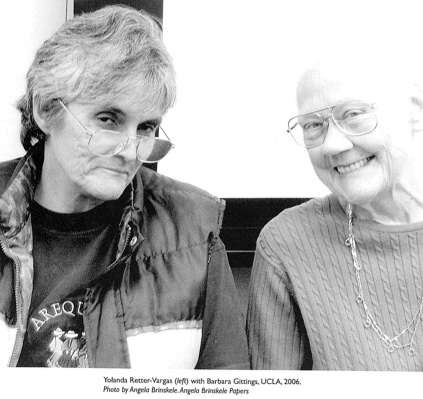
Yolanda Retter-Vargas and Barbara Gittings standing side by side.

Yolanda Retter-Vargas (left) with Barbara Gittings, UCLA, 2006. Photo by Angel Brinkele. Angela Brinkele Papers. All Rights Reserved UCLA Center for the Study of Women.

“If we don’t collect these things,” Yolanda always said, “no one else will.” The partnership between UCLA and the Mazer Archives is a perfect example of the type of innovative project that Yolanda would have supported. This partnership has allowed us to document and provide wide access to documentation of early lesbian activist and literary history in Los Angeles since the 1930s—stories that might otherwise have been lost or forgotten. As Yolanda wrote in her dissertation, On the Side of Angels: Lesbian Activism in Los Angeles, 1970-1990 (University of New Mexico, 1999), “Amid the criticisms, let it be remembered that once there was a vibrant movement that put women first. In a world that was (is still) bent on undermining women, that kind of prioritizing and commitment deserves respect and study. Regardless of what terms are used to describe (or disparage) the lesbian activist movement, its spirit persists within the generational cohort that created it during a ‘social moment’ in U.S. history. It persists as a vision, an ideology, a submerged network and as a significant contribution to the tradition of resistant consciousness and pro-woman advocacy. Blessed Be.”

This essay is reprinted with permission from June L. Mazer Lesbian Archives: Making Invisible Histories Visible: A Resource Guide to the Collections. Edited by Kathleen A. McHugh, Brenda Johnson-Grau, and Ben Raphael Sher. Los Angeles: UCLA Center for the Study of Women, 2014. ISBN: 978-0-615-99084-2.

Appendices

Herstory Archives

http://www.lesbianherstoryarchives.org/

June Mazer Lesbian Archive

http://www.mazerlesbianarchives.org/

In the June Mazer Archive, the following are Latina collections:

Terri de la Pena Papers

http://www.oac.cdlib.org/findaid/ark:/13030/c8sx6f0m/

Terri de la Peña is a novelist, short story writer, and children’s book author whose writings deal with complex issues of identity, homophobia, assimilation and resistance focusing on the lives of Chicana lesbians. This collection contains materials related to the creation, dissemination, publication and revision of both fictional and nonfictional works by Terri de la Peña. The bulk of the collection is made up of drafts of her first novel, Margins, also considered to be the first lesbian Chicana novel. The collection includes correspondence, contractual information, promotional materials, drafts and notes.

Connexxus /Centro de Mujeres Collection

http://www.oac.cdlib.org/findaid/ark:/13030/kt1779r55b/

The Connexxus/Centro de Mujeres Collection contains the administrative records of Connexxus / Centro de Mujeres, one of the first Los Angeles non-profit organizations that catered and provided services to lesbians.

Lizette Guerra is the archivist and librarian at the UCLA Chicano Studies Research Center Library and Archive. She received an MA in Latin American Studies and an M.L.I.S. in Information Studies from UCLA in 2007. She has research experience working in museums both in Mexico and Guatemala. She has done archival, curatorial, and cataloging work for the Autry National Center’s Southwest Museum of the American Indian and the Museum of the American West in Los Angeles, CA.

“Adam’s Rib: Island Taboo Unveiled”


by Iris Lafé

I had long forgiven my father. For the sake of my battered mother’s dignity safely folded the skeletons in the family closet as good little Puerto Rican girls and boys so often do. Five decades later and our homecoming to their native Puerto Rico (1999), the dreadful specter of domestic violence returns to haunt me again—this time, in high definition. In this essay, I explore a silent tragedy ravaging La Familia Puertorriqueña of the 21st Century: Femicide.

My story begins with a visit from The Muse. While languishing in the remote, rural quiet solitude of my aging parents’ Barrio down south, my heart cries out for the battered mujeres of Puerto Rico. I was expecting her.

“There’s a reason you came back to the troubled homeland when you did,” she prompts. “Family violence, child abuse and benign neglect, the traumatic ripple effects on victims and to society is a subject you know all too well. Remember your experience. Don’t be afraid. You lived it and carry your mother’s memories deep inside the well of your anguished soul. You both survived, as a single mother you broke that cycle of abuse and your only daughter remains virtually unscathed. But look at the future, getting bleaker by the day for the next generation of women and girls, if they survive at all. Be the light, tell your story and break the silence.” The Muse emboldened me and possessed my disenchanted body right on the spot.

Day after day I was riveted to the Spanish local TV news. During breaks from my 24/7 caregiver duties, I began to chronicle my life on the island, to document what I was witnessing—it became a feverish compulsion—a reflex and residue from my California days in broadcasting and the media: Where’s the story? Get the story and get the scoop. Switching channels, clearly, from the missing coverage on mainstream networks beaming down by satellite, I had the scoop.

On the U.S. Caribbean colony—population 3.7 million “Forgotten Americans”—violence against women had reached unbridled, unconscionable proportions. From January to June 2011, in only six months, an unprecedented nineteen (19) mujeressuffered brutal, gruesome deaths, mortal mutilations and slayings reminiscent of a Stephen King novel—an abomination to our noble society.[i]

Despite La Ley 54 (domestic violence protection and prevention act of 1989) Puerto Rico had the highest per capita rate in the world of women over 14 murdered at the hands of a spouse or partner and the numbers kept climbing, ending 2011 with 30 femicides, scrutinized in an ACLU report.2 These are terrorizedwomenthe police failed to protect (whether by omission or commission) among the total of 1136 men, women, and children violently murdered that year.[ii]

The vivid scenarios of families trapped in violence, condemned to unmitigated poverty, beamed me back to my childhood household in 1960s New York.

The sweltering Lower East Side tenement, exuding the aroma of festering refuse from the back alleys, made me gag each time I scurried past the dingy hallways into our fire escape window apartment #1. The humble hearth Mami, the dutiful domestic—Boricua clean freak—whitewashed using her penetrating Pine Sol cleaner and irresistible sautéing sofrito vapors rising from the stove. Her story I’d begun to write:

Everything I am, ever was or ever shall be I owe to mi santa madre. Mami was a saint— “Saint Tolerance.” She put up with my father´s “casca rabia” irascible, grumpy temperament, early years of matrimonial hell, always on her knees, praying without cease at her overworked altar of Catholic Christian faith. Holding high hopes for a miracle, that one day, Papi would stop getting drunk, using her as his punching bag; while she still loved “el macho de la casa” (her sole provider) unconditionally. To the day he passed away, she justified, “tu Papá es bueno.” Your father is a good man, her misty eyes imploring me to forgive him, her final dying wish.  

It hadn’t looked that way to me. I’d seen “The Hulk” crush her face into one bloody pulp. From the age of five in Loisaida, I witnessed the “War of the Lópezes” time and time again. The silent and sullen type, under the influence Papi was “a bad drunk,” your standard Dr. Jekyl and Mr. Hyde. Generous shots of rum fueled a strange combustion unleashing the beast, a cruel monster of a two-legged kind. No civility whatsoever, he fumed and roared, the foul-mannered brute he became, ¿Pendeja, cómo dejastes que’se nene se queme? Idiot, how could you let the child get burned? he charged. No questions asked of Mami, as if she were chattel, less than human to boot, and beat!—reared on erroneous illusions of greater male entitlement.  

Earlier, my curious brother reached up to the hot stove toppling the simmering pot of yummy habichuelas (beans) onto his 3-year-old frame. An ossified Papi arrived from his midtown-Manhattan garment district job pushing clothes racks (earning a paltry $35 a week) to find little Junior badly burned.    

A sewing machine operator (he forbade to keep her factory job) Mami was busy too; in the living room sewing piecemeal to earn some cash to feed her hungry brood. The roach-overrun cupboards were bare again. Accidents were common with my hyperactive brother. Impatient for dinner on the table, he wiled into the kitchen to silence the grumbling in his belly. Mami feared Papi squandered his meager earnings again—drinking.

“Yo no tengo la culpa.” It´s not my fault, Mami pleads Papi to hear her out. “You don’t help me raise these children. You’re their father.” It never failed, on pay day, Papi took a detour to the liquor store for his panacea and was plastered by the time he got home, swearing ¡hijo eh putas!, those sons of bitches, without a care our little hearts were pumping fear. An in-your-face Mami dares to “sass” her Lord and master! “¿Pa´ qué fué eso?” She went there? Not again!

Papi clenches his teeth, huffs and puffs arrogance. His sledgehammer fist craters the walls, crashing into Mami’s lovely cinnamon-colored face, rapid fire licks meant to show her who´s boss. The heavyweight punches dislodging her front teeth vanished her cheerful alabaster smile. “Why don’t you leave that man, he will kill you the next time,” I begged my inconsolable mother, afraid I could be next, to suffer the wrath of a drunken, domineering father. A future feminist was burning inside the “Mini-me.”  

“I can’t. I will not raise my children without a father,” she despaired; Adam’s Rib beaten but not broken. Down her swelling face cascaded red rivulets of tears.

Loving, as it were, Papi was a tormented man from the time he learned he was a “castaway”—a love-child kicked to the curb. “Yo no tengo familia,” I have no family, he bemoaned to me on his death bed. “Ello sí.” Of course you do. “You have us, Daddy,” I retorted consolingly, switching from Spanish to English, like we always did since the time I was a little girl, feeling the sting of his rejection all over again. And yet, I empathized with his frail human condition.

Hijo de crianza (adopted by next of kin) Papi never knew his biological parents. Emotional baggage he was not up to the task of handling in marriage; Mami captured his heart at the tender age of 17—she was 27. He piled his arrested development issues on her, inflicted bodily and emotional injuries no child should grow up seeing as my three siblings and I did during the formative years. Early childhood traumas leave an enduring emotional scab that can harden one’s heart.  

On July 14 2011, reported our daily Primera Hora, outraged women advocates, representing the organization Coordinadora Paz Para La Mujer, a women’s collective of emergency shelter and service providers; and the civil rights coalition Movimiento Amplio de Mujeres, MAMPR, (General Mobilization of Women of Puerto Rico) denounced the government for not doing more to confront this issue and declared Un Estado de Emergencia Nacional (National State of Emergency) to stop the killings, demanding government action.[iii] Decrying the failures of La Ley 54 for lacking the muscle (and greater goodwill) of a male-dominated police and judiciary on the island; for not observing the tactical plans and protocols implemented, since 2005, by La Oficina de la Procuradora de Las Mujeres (Women’s Legal Advocate Office); for sanctioning the consequential violation of victim’s rights: bottom line, for being part of the problem, not the solution.

Puerto Rico suffragettes earned the right to vote in 1935. Eighty years later, women victims of gender violence fall victim to another crime, the cavalier machismo attitude judging that “the woman asked for it” including my own Papi until the thrashings stopped.

I pondered Mami’s fate, had not the NYC police handcuffed him and placed him behind bars, shielding her from her abuser. Not so in the case of la colonia:

  • 20,000 domestic violence incidents, on average, are officially reported each year
  • 130,000 women and girls subjected to family violence each year eschew the unresponsive system.[iv]

According to the ACLU, 107 femicides over the five years 2007–2011highlight the new normal today.[v]

My Mami’s action in defending herself scared my Papi straight. The thrashings stopped. To my parents’ credit, true love killed the beast.

[i] González, Leysa Caro. “Emergencia nacional por muertes de mujeres víctimas de violencia doméstica.” Primera Hora. 14 de julio de 2011.

[ii] Alvarez, Lizette. “Economy and Crime Spur New Puerto Rican Exodus.” New York Times. Feb. 9, 2014. [iii] González, Leysa Caro. “Emergencia nacional por muertes de mujeres víctimas de violencia doméstica.” Primera Hora. 14 de julio de 2011.

[iv] Mollmann, Marianne. A Step Backward for Puerto Rican Women.Women’s Rights Advocacy Director for Human Rights Watch. Puerto Rico Daily Sun. August 4, 2011.

[v] ACLU. “Failure to Police Crimes of Domestic Violence and Sexual Assault in Puerto Rico.” June 19, 2012.

Iris Lafé is the pen name for an emerging Afro-Latina writer who reports on 21st Century “Colonial” Puerto Rico from her perspective as a Diasporican returnee to the homeland in stylized personal vignettes. A Writer’s Well Literary Competition winner (2012), contributor to herkind.org Global Woman, and former writer KCBS News Radio (SF), Lafé is a Bronx Science alumna, holds a BA in Black and Puerto Rican Studies from Hunter College, and works and lives in the San Juan Metropolitan Zone with her daughter. Currently editing her back-to-roots memoir, Lafé can be reached at: boricua.freedom.writer@gmail.com

Finding My Home in Psychic Restlessness

by Lizeth Gutierrez

“Because I, a mestiza

continually walk out of one culture

and into another

because I am in all cultures at the same time,

alma entre dos mundos, tres, cuatro,

me zumba la cabeza con lo contradictorio.

Estoy norteada por todas las voces que me hablan

Simultáneamente.”

Gloria Anzaldúa

Gloria Anzaldúa is my academic godmother. She has provided me the tools to create a sense of home. A space of survival. A space to call my own in the academy. This piece is inspired by Anzaldúa’s work, specifically her writing in Borderlands/La Frontera. Anzaldúa provided me the tools to name my restlessness. “Finding My Home in Psychic Restlessness” is about my journey to self-discovery. In this poem I recite ‘culture’ and ‘race’ as homogenous markers of identity only to strategically address the multiple identities I wear on my body. I do not seek to homogenize identity or discipline racial categories of identification. Culture and identity, as Anzaldúa’s writing reveals, are complex, multifaceted and fluid.

I wrote this piece when I was an undergraduate student at Grinnell College. As a current PhD student at Washington State University this poem continues to speak to me in painful ways. I am a first generation Chicana college student from Los Angeles, California who decided to pursue her Bachelor’s degree in small town Grinnell, Iowa. I oftentimes felt dislocated there and swore to myself that I would never go back to rural towns. I did not belong in those spaces. Ironically, my distaste for small towns brought me back to a similar rural town: Pullman, Washington. Maybe I am a masochist. Perhaps it is in that masochism that lies my sense of home. Who knows, but it is with this knowledge that I offer you a piece of who I am.


!Ya no!

No quiero sentirme marginalizada por tu hipocresía

Me exotizas por ser Latina.

Me llamas “lazy” por ser Mexicana.

Y te burlas de mi acento porque no es como el tuyo.

Tú dices “pizza” cuando yo digo “piksa.”


You tell me I can achieve the American dream, and yet set boundaries that aim to intimidate me and make me question my own abilities.

Si, vivo en un lugar de contradicciones.

I am in a college where I am the “exotic Latina,” pero soy la “outsider” en mi familia.

La “pocha.”

La “ya te crees muy miss thing porque vas a coh-ledge”

No me encuentro ni aquí, ni allá.


Why do you make me feel like I have to choose only one culture?

Soy mestiza, una hybrid, una mixture.

Anzaldúa me lo grita al oído in my dreams.


I, like Anzaldúa, believe in the new Latina consciousness.

Una conciencia que reconoce y tolera las contradicciones de mis dos culturas.

I love frijoles y las tortillas hechas a mano, and let’s not forget the smell of el cilantro en la salsa roja.

Y adoro el crispy chicken sandwich with large fries de McDonalds.


Soy Mexicana como mi abuela, like my mother who must constantly fight against the machismo of our patriarchal culture.

Y soy Americana: conquering my dreams and goals a como de lugar is the mentality of my gobierno capitalista.


Tú  te sigues sintiendo perdida, abandoned, ahogada en un mar that restricts your identity

because it tells you constantly that you are not enough Mexican, ni suficientemente Americana.

Date cuenta that you are more than one culture, no te de vergüenza, no te escondas.


Do not let the waves of assimilation trap you.

No te dejes.

Nada. Nada más rápido. Defiendete, you can do it.


Our history has shown us that Chicanas are guerrilleras.

Tú como yo somos la negotiation of two distinct worlds.

Anzaldúa dice que vivas sin fronteras.


No dejes que la corriente del mar te lleve.

Do not let it make you choose one culture over the other.

¡Lucha!

Lucha por tu crossroads.


This internal fight no acaba hasta que hagas tu propia negociación de identidad.

Revolutionize your sense of self.

No eres prisionera.


You are not less than one culture or more than the other.

You are all cultures.

La güera. La negra. La india. La mestiza.

Eres la voz de la nueva Chicana and you have the inner-strength to create your third space of survival.


A space Anzaldúa so proudly calls “una conciencia de mujer.”


Lizeth Gutierrez is a graduate student in Critical Culture, Gender, and Race Studies at Washington State University. She researches representations in popular culture of gendered and raced Latinidades and is particularly interested in the commercialization of mainstream Latinidad in relation to U.S. discourses on second-class citizenship.

Bang Bang

by Carmen R. Lugo-Lugo

[O]ne can never assume that anything one does, and especially the moral and political position one takes, is innocent and does not need to be interrogated for complicity.   —Barbara Applebaum

          I think love is an imperative. It obligates you. —Marisa de los Santos

Once, confessing to a colleague that I was going to attend a J.Lo. concert, she looked at me and without missing a beat simply said: “We all have our weaknesses. And that’s fine.” I can’t even begin to explain how grateful to her I was for saying that. Although I understand that it is practically impossible to lead a purely and unadulterated politically-sound existence, sometimes I struggle with the simple things. Like popular culture. I wish I were that person who could never be enticed by cool performers with a connection to Puerto Rico, or by overly processed and packaged images of gorgeous Latinas in the media, or by the incessant spectacle of reality television. Or scripted TV. Or B movies. Definitely B movies. I also wish I were too together to be seduced by songs with problematic lyrics and weird videos. But alas, those are only wishes, and I am not that person. The truth is that more frequently than I would care to admit, I find myself immersed in all of it, even as I dutifully try to resist its lure. I have had certain levels of success in my attempts at resistance, but at the end of the day, and to reiterate, I am not the person that I wish I were. I tend to get enthralled by all sorts of images, lyrics, and performers that taunt my politics and academic training, which is to say, I become enthralled by all sorts of things that shouldn’t appeal to me. And as a professor of ethnic studies and gender, this can lead to a distressing struggle, because I do know better. Of course, given what I do for a living, I have been able to work through some of my “weaknesses” by studying and analyzing them and by writing academic pieces about them: the ultimate means of intellectual penance we academics have at our disposal. But the fact remains, I still fall for problematic performers, shows, marketing campaigns, and songs.

Case in Point:

In 2005, Mexican American actor Michael Peña formed a rock band that he named Nico Vega (after his mom, Nicolasa). Last year, the band did a cover of the song “Bang Bang,” originally sung by Nancy Sinatra. The song should trouble anyone with a basic understanding of gender relations and violence against women. It should also alarm anyone with a pulse, as its literal meaning walks a very fine line between being politically objectionable and being downright wrong. Just to give you an idea, here are the first 8 lines of the song: “I was five and he was six/We rode on horses made of sticks/He wore black and I wore white/He would always win the fight/ Bang bang, he shot me down/Bang bang, I hit the ground/Bang bang, that awful sound/Bang bang, my baby shot me down.” The last four lines, the ones with the bangs become the chorus for the song, so before you begin to wonder whether the song gets any better after those lines, I will earnestly and promptly answer, no it does not. Not only that, but here I am about to tell you why I find the song metaphorically compelling. See, weakness through and through.

First Bang:

I have been haunted by this song since I first heard Nico Vega’s lead singer Aja Volkman sing it a few months back. It was as if I could actually hear the sound of each bang as she sang it.  Almost as if I could feel each bang against my skin and my heart even though I have never been shot in my life. The song affected me, there is no other way to explain it. So in trying to answer Applebaum’s call to interrogate complicity, I asked myself why. After pondering that for a while, this is my answer.

I am a Latina lesbian. Hardly much of an answer, right?  But as I thought about it, being shot down (metaphorically, of course) by men who should have loved me and had my back is a fairly familiar feeling. Friends and family members alike. Of course, women have done their part too, especially women protecting those men, and I suppose I will eventually find a song for them as well. But for now, there is this: each bang in the song feels real because it symbolizes rejection, abandonment, and contempt. That is to say, each bang represents the violence of neglect (bang bang, he shot me down), of the spoken word (bang bang, I hit the ground), and of silence (bang bang, that awful sound). Each bang is a reminder of a person who has chosen not to acknowledge me and my life, leaving me on the ground to pick up the pieces (bang bang, my baby shot me down).

Final Bang:

I am not trying to justify being affected by the song. I am, however, trying to exact my penance and work through why I am affected by it. I know I am taking a risk by writing this piece, for I may be seen as romanticizing a decidedly violent narrative. But I am only trying to explain (perhaps to myself) why I have developed a soft spot for a song so distastefully against my politics. I am writing this because as Isabel Allende tells us, writing is a “journey into memory and the soul.” And also, because as Audre Lorde warned, “only one thing is more frightening than speaking your truth, and that is not speaking.”  I am writing this because I loved those men, friends and family, who have, for all intents and purposes, disowned me. I still love them, and to paraphrase Marisa de los Santos, as an imperative, love obligates me. It obligates me to think and to write. But it also obligates me to maintain my integrity and remain true to my compass, even if as Applebaum suggests, my compass may be complicit in my weakness for popular culture. I will finish this short writing by sharing the song’s last two verses, the least violent ones, yet, the ones that hurt the most: “He didn’t even say goodbye. He didn’t take the time to lie.” And suddenly, my weakness for popular culture doesn’t seem so daunting, because as problematic as it may be, it can also help me articulate my pain.

Carmen R. Lugo-Lugo is an Associate Professor in the Department of Critical Culture, Gender, and Race Studies at Washington State University. She engages in research involving Latinos in the US, “the War on Terror,” US/Puerto Rico relations, and popular culture. She is a co-editor of A New Kind of Containment: “The War on Terror,” Race, and Sexuality, and a co-author of Containing (Un)American Bodies: Race, Sexuality and Post 9/11 Constructions of Citizenship, both published by Rodopi Press in 2009 and 2010 respectively. With C. Richard King and Mary K. Bloodsworth-Lugo, she  is co-author of Animating Difference: Race, Gender, and Sexuality in Contemporary Films for Children, published in 2010 by Rowman and Littlefield.