Category Archives: Gender and Sexuality

The Story of Justice For My Sister: Combatting Gender-Based Violence Across Borders

By Kimberly Bautista
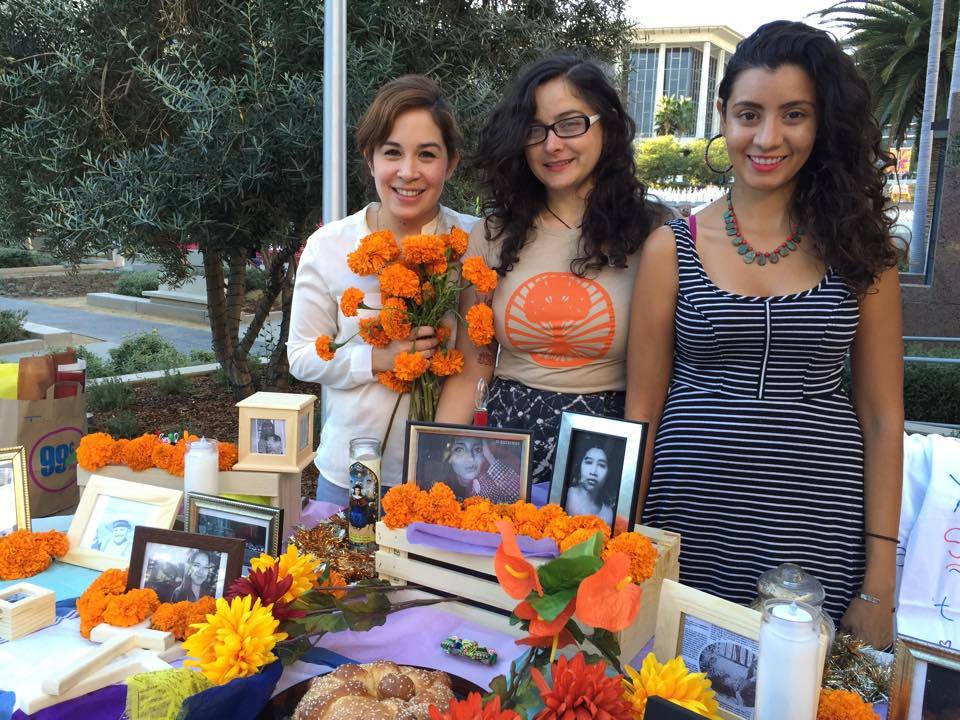
People standing behind altar for Day fo the Dead

Justice for My Sister Collective members adorn Altar for Día de los Muertos at Grand Park in LosAngeles, curated by Self Help Graphics & Art www.selfhelpgraphics.com
Photoed (L to R) Paulina Castro Murillo, Kimberly Bautista, Daniella Padilla-Ortiz. CC BY-NC-ND 2.0

My Testimonio of Coming Full Circle

Coming full circle is when your activism leads to your scholarly work, and that leads to your community work and career. And you continue cycling through this rotation in different ways during your journey. For me, at the center for each of these intersecting worlds and coming full circle is healing through community–recognizing myself and my own struggles in the testimonios of my sisters, brothers, and all my relations who connect and build together to produce critical work and uplift our struggles to heal our mundo. The connections among us are numerous. Recently, I’ve considered a few examples of this “full circle” in my experience. One is when my friend from UC Santa Cruz Edith Gurrola invited me to speak about my documentary Justice for My Sister and its violence prevention campaign at Comisión Femenil in the San Fernando Valley.  After the talk, I spoke with Rosemary Muñiz, College Admissions Adviser at CSUN, and realized that we had met at the Comisión back in 2007 when they hosted my student group Speak Out For Them (SOFT) at their event to denounce the unsolved cases of las muertas de Juárez. Another was hearing

Lourdes Portillo, the filmmaker who created Señorita Extraviada, in an academic context and getting inspired to co-found the club Speak Out For Them (SOFT) with my friend Joanna Kibler. Yet another example of “full circle” in my life was running into my mentor Maria Soldatenko at a march in Guatemala. Many years before that Soldatenko had introduced me to Lucia Muñoz from MIA, Mujeres Iniciando en Las Americas, who holds trainings for Men Against Feminicide in Guatemala. One final example is when MIA advocate Marina Woods introduced me to JFMS Collective members in Guatemala in 2011 and later joined our retreat in Los Angeles to train us on Gender 101 in 2012. Full circle. Every time.
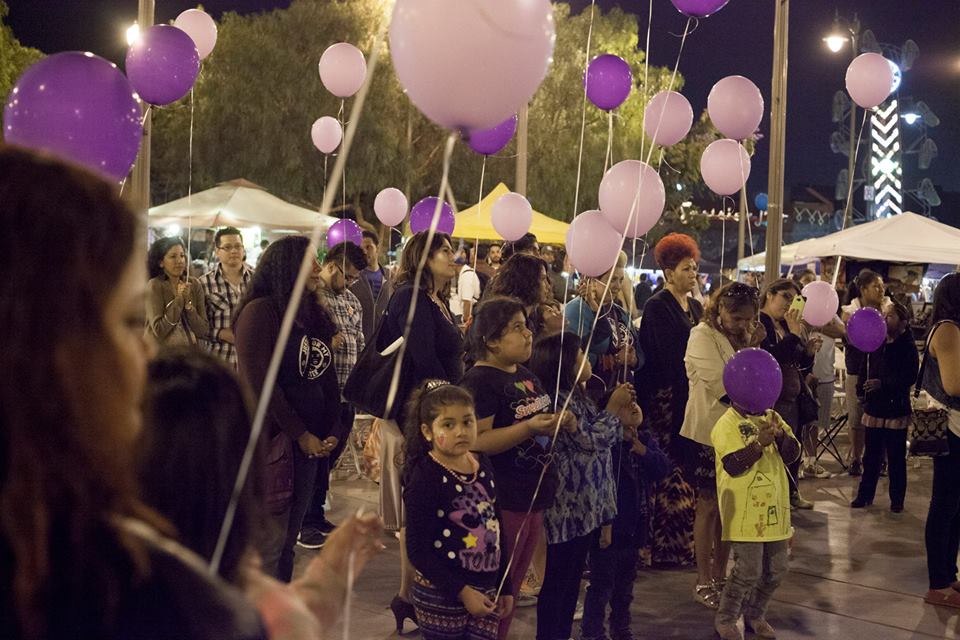
Children and Adults holding purple balloons

Comunidad en Boyle Heights (Los Angeles) commemorate those affected by violence and symbolically release trauma through a balloon release at Retomemos la Noche. Photo by Sonia Hernandez IG: @_bag_lady_ CC BY-NC-ND 2.0

These “full circle” moments are about the importance of creating community. With my film, I commit to continuing that work by screening the film annually with our SiStars from Mujeres de Maiz at the Boyle Heights Farmers Market and hosting a series of Healthy Relationships Panels with the Justice for My Sister Collective and our partners in Los Angeles. These events gave us advocates and activists a chance to have meaningful conversations about our own relationship histories. These talks led to other conversations about community accountability. Community accountability, through transformative justice can lead to healing, and more creative and love-centered approaches to breaking cycles of violence. It provides an alternative to the prison industrial complex, which has historically criminalized men, women, and gender non-conforming individuals of color and torn our communities apart.

Personal Stakes Led to a Bigger Movement

Let me take a step back to explain why healing through community is so important to my journey.  Justice for My Sister is my award-winning documentary about violence against women in Guatemala. It follows the story of Rebeca during her journey to hold her sister’s killer accountable in spite of victim-blaming and impunity.

When I was in the field during production, I was targeted in a home invasion where my equipment was stolen and I was raped at gunpoint. The ringleader of the operation threatened to kill me. I realized then that the film had to be much more than an advocacy piece. It needed to be part of a larger solution to actively prevent gender-based violence through leadership development where participants (both women and men) are trained to become resources to their peers. It’s for this reason that our educational materials are tailored to a variety of audiences: mothers of young children, youth (young women and men), police, judges, lawyers, religious communities, Indigenous communities, survivors of violence, and men who work in male-dominated industries.

At the core, this documentary and the curriculum created inspires entire communities to empower themselves by understanding how to identify the different forms of violence, as well as how to offer solutions. As part of the film screening, we develop local resource guides (many audiences otherwise don’t know where to go for help) and we emphasize the importance of healthy relationships. We emphasize that “healthy relationships” within community extends past intimate partner situations: it encompasses relationships in family, friendships, work, and lucha. It means we listen attentively, ask questions, speak from the heart, give space to others, and stand our ground (read: set and maintain boundaries). Self-care is also fundamental to achieve healthy relationships in community. We must sometimes retreat, sleep, replenish, and reflect in order to be fully present for others and continue in our (beautiful) struggle for equitable exchanges in our everyday interactions and in our overarching narrative in our fight for a more equitable society, free of victim-blaming, where we can individually and collectively reach our full potential.

Accountable Representation and Filmmaking

In the making of the documentary, I was concerned with creating an ethical representation of Rebeca and her family, whose story we follow. It was very important for me to develop a good relationship with them in a humble way, keeping in mind that I was entering a very sensitive moment in their lives where they were recently exposed to live-changing trauma.  The unity that we developed with each other surface in the film, and this is why the story resonates with audiences. Rebeca became a support for me when I was subject to abuse, and she helped me frame the narrative in my mind so that I could see myself as an empowered individual. She helped me keep my vision in mind during my healing process, which continues to this day. That has been an enormous source of strength.

Also, Rebeca is very relatable: many people understand the nature of fighting for someone you love and the struggle for justice in the face of all the odds. Rebeca’s heroic determination is very empowering and the truth is, many people are hungry for these stories to be on screen, because sadly Rebeca’s fight is one of many–we just simply don’t see it often on the screen because the mainstream media places more value on the lives of the affluent.

Three women standing together.

Shero Rebeca Eunice Perez (donning a shirt from our Collective in Los Angeles) meets
representatives from UN Women in Guatemala after an inspiring talk at a university
in Guatemala City. CC BY-NC-ND 2.0

It was important for me to follow Rebeca in particular because she’s a single mother of five from Escuintla, a community rarely represented in popular media. She’s a woman who descends from Indigenous folks, who identifies as costeña, who obtained a sixth grade education. She makes tortillas for a living, and essentially became an advocate and investigator for her sister’s case. She was determined to hold her sister’s killer accountable, an almost unimaginable task in a country where 99% of men who kill women are never punished, and often times, not even investigated. Rebeca’s determination and courage in the face of threats and intimidation on behalf of the suspect, and discrimination and objectification on behalf of the state, is inspiring. Audiences who have had the privilege to meet Rebeca at a screening approach her as a role model, and can’t help but hug her.

Breaking Silences and Building Justice

The feature-length documentary has been on tour in Guatemala with advocates from the Justice for My Sister Collective since we had a rough cut in late 2011. Every time we screen it, audiences come forward to break the silence and share their own stories. In 2013, I decided I wanted to document some of the other stories to highlight the far-reaching impact of gender-based violence and bring more visibility to other cases as well. Many of the stories in our web series are of survivors that had seen Rebeca’s story in the feature documentary and decided they also wanted to share their stories. Again, coming full circle. We want to offer survivors a platform to share their stories, casting aside blame and shame (as the historically typical narrative would have it), and in turn break the silence and disrupting the hegemonic, heteronormative, white supremacist, imperialist, victim-blaming narrative.

We should all feel passionately about eradicating gender-based violence, because gender-based violence affects many communities in distinct ways. And if you’re doing nothing, here’s your gentle cue to get centered so you can work on empathy a bit more. I know mainstream occidental culture has worked hard to program empathy out of us, but we just have to focus on our humanity a few moments a day to reclaim it.

In Ecuador there’s a chant: “Si tocan a una, nos tocan a todas.” “If they touch one woman, they touch us all.” This is true anywhere that men get away with these crimes; impunity gives aggressors a sense of entitlement or a license to abuse or even kill in some cases. Sometimes it feels daunting because there’s a lot of work to be done. That’s when seeing the human impact of the campaign is most heartening. Through the production of Justice for My Sister, the film’s campaign materials, and the support of Community Partners, we have provided a platform for women to lift up their voices and be heard, which is very healing when you’ve been silenced and your story has been challenged or questioned. The feedback we’ve received from survivors of abuse, their children and their families assures us that we’re on the right path.

Kimberly Bautista is a Colombian-Irish-American feminist, filmmaker, and community organizer based in Southern California. Her feature-length documentary film, Justice for My Sister, has screened in over 20 countries as part of a transnational campaign to prevent gender-based violence. The film has won several accolades, including the HBO-NALIP 2012 Documentary Filmmaker Award, and Best Documentary at film festivals in Holland, Bolivia, Guatemala, France, and Los Angeles. She has spoken as an expert on the topics of gender-based violence and representation of women and girls in the media at the United Nations Office at Geneva, and at the INternational PUblic Television Screening Conference (INPUT) in El Salvador. She acted as jury member for the Connect the Docs Transmedia Pitch Competition at the 2013 Hot Docs Conference & Forum in Toronto, Canada. She is the Project Lead for the Justice for My Sister Collective, a project of Community Partners that uses an arts-based approach to create safe spaces within marginalized communities to initiate collective healing and develop local leaders to combat gender-based violence.

To bring the film Justice for My Sister to your campus, organization, or film festival, email justiceformysister@gmail.com. To purchase a copy of the film and study/discussion guide, please see: http://newdayfilms.com/film/justice-my-sister Continue reading
Reports from NWSA “Feminist Transgressions” Conference

Photo by Susy Zepeda. CC BY-NC-ND.

Photo by Susy Zepeda. CC BY-NC-ND.

Feminisms in the World

by Susy Zepeda

In November 2014, I attended the National Women’s Studies Association conference, “Feminist Transgressions” in San Juan, Puerto Rico along with scholar-activists in the fields of women and gender studies, feminist studies, queer studies, and critical race studies. Critical discussions of transnational feminist methodology, a stellar plenary panel on “Imperial Politics,” and the reformulated practices of solidarity emerging through out the conference space made this gathering a particularly memorable one in terms of critical feminist history.

Perhaps the most vivid and relevant discussion to the current moment was an inspiring, yet extremely complicated and eye-opening discussion on the possibility of passing a Boycott, Divestment, and Sanctions resolution by NWSA members. There were several panels that offered space for critical discussion on the politics surrounding the underpinnings of this solidarity work, a key one being, “Solidarity Delegations to Palestine & Indigenous/Women of Color Feminists: Reflections, Impact and Assessment” featuring Rabab Ibrahim Abdulhadi, Angela Davis, Gina Dent, Beverly Guy-Sheftall, and Barbara Ransby as former participants in solidarity delegations to Palestine. Briefly mentioned, yet illuminating, was the need for collaboration among social movements based in different geopolitical locations to be more connected due to implicating imperial logics—particularly highlighted were the cases of Puerto Rican political prisoner Oscar López Rivera, and the targeted arrest and imprisonment of Rasmea Odeh[1], associate director of Arab American Action Network (AAAN), who has since been released due to mass protest and organizing.[2]

The plenary session titled, “The Imperial Politics of Nation-States: U.S., Israel, and Palestine,” featuring Chandra Talpade Mohanty as moderator, and Islah Jad, Rebecca Vilkomerson, and Angela Davis as panelists continued this critical discussion by involving over 2,000 NWSA members in the rethinking of critical feminist solidarity politics.  It was perhaps Rebecca Vilkomerson, from the organization Jewish Voice for Peace[3], whose disruption of whiteness through her own life testimony and activism that gave new life to a much-needed discussion on revised racial and solidarity politics in this organization. She questioned accusations of anti-Semitism while asking: who can speak for Palestine? Angela Davis echoed these critiques by suggesting we methodologically pay attention to the “intersectionality of resistances” as we contemplate how police in Oakland are trained by Israeli military.

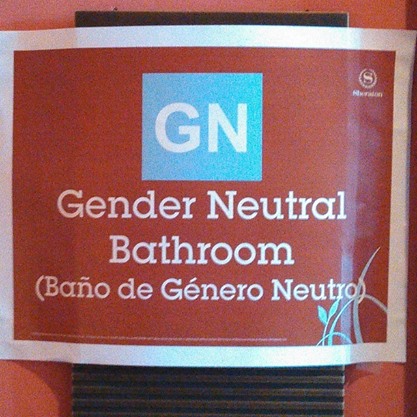
For a conference that has been widely critiqued for upholding white heteronormativity, and western-centered practices, among other injustices[4] it was great to walk into a space with gender neutral restrooms that read: “Baños de Género Neutro.”  This conference experience seems to be a reflection of changing energy and politics due to the leadership of radical women of color in the last decade or so in this feminist organizing space.[5]  The photo booths near the registration table were an ingenious part of this gathering to document the critical feminist gathering moments in San Juan, Puerto Rico.[6]

Theory and Activism

by Theresa Delgadillo

The NWSA Conference in San Juan, Puerto Rico drew over 2,000 participants and presented a special opportunity to learn more about feminist movements in Puerto Rico, but it was also a conference schedule filled with panels, workshops, roundtables, and discussions on feminist research around the globe. As outgoing NWSA President Yi-Chun Tricia Lin wrote in her welcome letter to the event: “the conference endeavors to take up the histories, geographies, affective dimensions, and political stakes of various feminist insubordinations in the spaces they occupy: intellectual and institutional, local and global, public and intimate, by choice and under duress.” The focus on “transgressions,” therefore, was an invitation to participate in analyzing actions and interventions of multiple kinds and in varied sites. The number of panels focused on Chicana and Latina Studies research seemed higher this year than in previous years, and so the conference presented an opportunity for networking both within and across fields. I took full advantage and attended, among others, a panel retrospectively examining the significance of the work of Barbara Smith (a co-author of the Combahee River Collective’s statement), a panel of women from the Puerto Rican island of Vieques (for many years, used by the U.S. for bombing practice) who have shifted into activism around economic opportunity in light of development trends on the island, Latina scholars presenting research on queer arts activism in Puerto Rico and Latina media pioneers in the U.S., and Asian American scholars examining affective labor and human rights discourses within Asian diasporas. NWSA was a place to engage with rich and interrelated work. At the 2014 American Studies Association conference it was reported at the evening keynote address that one session on the “keywords” trend in critical studies had proposed the elimination of “intersectionality” from the keywords vocabulary. However, at the NWSA conference the influence of the contributions of women color to critical theory were recognized and rigorously engaged across disciplines, geographies, and fields.

________________________________________________________________________

[1] For the words “Rasmea Odeh” please link: http://www.thenation.com/article/188033/will-rasmeah-odeh-go-prison-because-confession-obtained-through-torture#
[2] for the words “mass protest and organizing” please link: http://electronicintifada.net/blogs/nora-barrows-friedman/15-powerful-ways-student-activists-stood-palestine-2014
[3] for the words, “Jewish Voice for Peace” please link: http://jewishvoiceforpeace.org/
[4] Sandoval, Chela. (1990). “Feminism and Racism: A Report on the 1981 National Women’s Studies Association Conference.” Making Face, Making Soul: Haciendo Caras: Creative and Critical Perspectives by Women of Color. G. Anzaldúa. San Francisco, Aunt Lute.
[5] The 30th Annual NWSA Conference, “Difficult Dialogues,” with keynote speaker Angela Davis resonates this shift.
[6] Photos can be found the National Women’s Studies Association Facebook timeline.  Also, available is the bell hooks keynote at: http://www.nwsa.org/

Aztlán and Anzaldúa

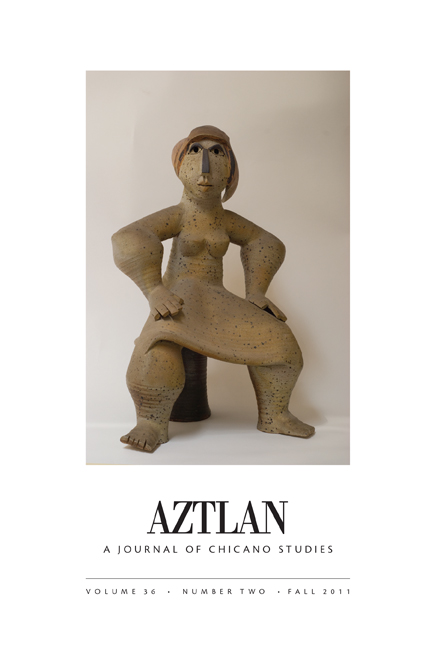
Stone sculpture of woman seated facing forward with hands on thighs.

Copyright 2011 by The Regents of the University of California. Cover art by Dora De Larios, Sierra Madre, 1960. Glazed stoneware, 26 x 15 x 12 inches. Copyright 1960 by Dora de Larios, photograph by Sabrina Judge.

By Karrmen Crey

I’m somewhat new to Aztlán: A Journal of Chicano Studies, having joined the journal as assistant editor in June 2013, so I’ve played a very small part in Aztlán’s history, which is now approaching its forty-fifth anniversary. As a part of my position I process submissions and coordinate our double-blind peer review process. Although I’m far from an expert in Chicana/o studies (I’m a doctoral candidate in film studies studying Canadian Indigenous media), the sheer volume of submissions that comes across my desk has given me a sense of the contours of Chicana/o studies—that is, a familiarity with certain themes, topics, and scholars in the field. Of these scholars, perhaps none is more frequently cited than the groundbreaking feminist, queer, Chicana scholar Gloria Anzaldúa. In fact, since 2007, every issue of Aztlán— fourteen issues total—has contained at least one essay or dossier that takes up Anzaldúa’s ideas. Given a longer timeline it would be interesting to comb through earlier issues, although I fully expect that I would see her name appear over and over. The submissions that Aztlán receives engage with the full scope of thinkers and theorists that constitute the rich intellectual terrain of Chicano studies. Still, authors return to Anzaldúa so frequently, and across so many disciplines, that tracing the use of her work offers a window onto the evolution of her ideas in Chicana/o studies, and a sense of the contemporary contours of the field.

In theorizing the “borderlands,” particularly in her groundbreaking The Borderlands/La Frontera: The New Mestiza (1987), Anzaldúa developed a language and set of conceptual tools that scholars continue to employ and debate, building on and complicating her ideas as they are applied to new and different areas. Anzaldúa’s theorizations, which sprang from her lived experience as a Chicana lesbian, produced a methodological framework for making visible subjectivities that are often invisible within unifying constructs such as “community” and “nation.”  In articles published in Aztlán over the past several years, we see Anzaldúa’s ideas driving, for instance, research methods in ethnographic projects that concentrate on social groups—women, the LGBTQ community, and people from mixed racial backgrounds—whose experiences, following Anzaldúa’s “theory of the flesh,” form the terra firma of cultural theory. Studies have, for instance, have employed intersectionality to examine Chicana/o political organizations in order to recuperate into the historical record the complex social dimensions (gender, race, transborder life experiences) that shaped these organizations.

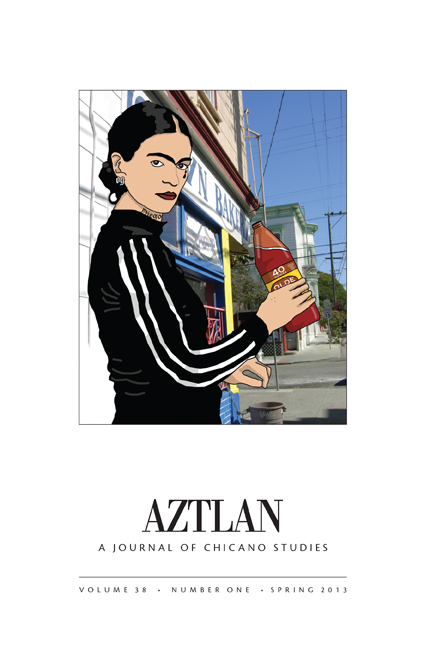
Graphic illustration of frida kahlo like girl on contemporary street in athletic wear.

Copyright 2014 by The Regents of the University of California. Cover art by Rio Yañez, Ghetto Frida, 2006. Digital illustration, 16 x 20 inches. Copyright 2006 by Rio Yañez.

Anzaldúa’s ideas have flourished in jotería and queer studies, where the intersectionality of race, gender, and sexuality is fundamental to the field, as we saw in the dossier on jotería studies in the Spring 2014 issue. In this collection Anzaldúan thought forms a backdrop for nuanced discussions of the history of jotería studies and the growing diversity within this area over the past several decades. Naturally, border studies is indebted to her work, as we see in submissions that explore many types of borderland—national and transnational, physical and psychological, concrete and metaphoric.  More recently, it has been fascinating to see scholars in political science and sociology taking up Anzaldúa’s thoughts to better frame and understand principles of political organizing and inter- and intragroup dynamics—a testament to the value and relevance of her ideas across disciplines.

Anzaldúa’s legacy is seen perhaps most frequently in submissions that examine Chicana/o cultural production. We receive our share of literary analysis, of course—it would be fair to say that among the submissions that Aztlán receives, Anzaldúan thought is applied most frequently to Chicana/o and Latina/o literature. Yet scholars have explored her ideas in other areas too, including the visual arts, performance, and film and media, and even comic books. Authors apply Anzaldúa’s critical concepts of mestiza consciousness, the borderlands, and nepantla, extending them through analyses of the text and its production, and at times challenging these concepts; for instance, where the celebration of “hybridity” is seen as masking the tensions inherent in identities that are shaped by intersecting and sometimes irreconcilable social markers and experiences.

The breadth of scholarship that engages Anzaldúa’s work is a testament to the richness of her ideas and their ongoing relevance to Chicana/o studies as the field continues to expand, embracing more academic disciplines and specializations. As it does, so too does Aztlán, as these shifts and others are reflected in the submissions we receive and encourage. We welcome and invite your essays, dossiers, artwork, and book reviews. Please see our website for more information on submissions and subscriptions. Institutions and individuals with subscriptions to Aztlán can access our entire catalog of issues through Metapress.

Karrmen Crey is a PhD candidate in the Cinema and Media Studies Program at the University of California, where she is researching the infrastructure for Aboriginal media in Canada. Prior to beginning her doctoral work, she received her Master of Arts in Cinema Studies at the University of Toronto. She has been the Assistant Editor of Aztlan: A Journal of Chicano Studies at the University of California, Los Angeles since June 2013.

“Presumed Incompetent” and Fight the Tower

presumed incompetentDr. Ramona Fernandez

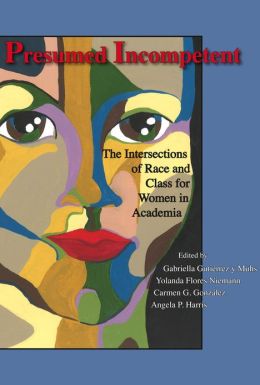
Since the publication of  Presumed Incompetent: The Intersections of Race and Class for Women (PI) edited by Gabriella Gutiérrez y Muhs, Yolanda Flores Niemann, Carmen G. González, and Angela P. Harris in late 2012, a quiet storm is gathering on the edges of academia. The book and subsequent Berkeley conference gave isolated women of color in academia impetus to step forward. Reading Presumed Incompetent is painful, so painful and so familiar many of us have to take it in small doses.

The truth is, academia is not a way station where rationality overcomes prejudice, but a site for the enactment of oppression essentially no different from any location. Under the rubric of what we assume is an honorable profession dedicated to making the world a better place, all the irrational competition and hatred that is race, gender, class (and the host of –isms which help prop up these central three) remains at the center of the intellectual project. Presumed Incompetent gathers together more than 500 pages of documentation of discrimination against women of color in academia. As stereotypical oppression after oppression is revealed in this collection, the reader is overwhelmed by the inevitable conclusion that not much has changed in this supposedly post-racial world. Many of us have been suffering in relative silence, believing that the treatment we have been receiving was unique and somehow pinpointed real faults of our own. Now, it is both liberating and frightening to realize that our sisters have been enduring similar treatment and worse.

As the stories poured out in response to the volume, it became clear that there was a need both to continue documenting them and to create a movement. The book has caused so many of us to come out of the woodwork, expounding our similar stories, that two law journals have made a coordinated effort to gather subsequent stories together.  Both the Berkeley Journal of Gender, Law & Justice and the Seattle Journal of Social Justice are publishing issues devoted to follow-up on Presumed Incompetent. fight the towerThe revelations in PI have inspired a movement which is coalescing around a site created by Kieu-Linh Caroline Valverde, herself one of the most courageous survivors. Her battle for tenure damaged her health to the point she lost her unborn child and was clinically dead for ninety minutes before being resuscitated. The details of her story can be found in the Fall/Winter 2013 issue of the Seattle Journal for Social Justice along with the details of my own journey. Her site, Fight the Tower, will continue documenting stories and pressing for the kind of change we need in order to remake academia into a place where we do not have to be ten times as competent just to survive.

My own story includes the ridiculous fight for tenure I had to endure because of the veto of one Dean. Despite passing muster through all the relevant committees, this Dean refused to support my tenure bid twice, reluctantly not standing in my way the third time. By the time I was finally tenured, I had endured damage to my health and professional confidence. And before I had regained my footing, I found myself the sole caregiver for my handicapped and elderly mother while also undergoing a transplant operation. Every time I was poised to regain my former health and momentum, either the continuing abuse of my institution or my health problems surfaced in such a way that I found it literally impossible to walk or talk the path I knew was my destiny. Instead of perceiving me as the treasure I am, complicated institutional politics continued to bludgeon me with ridiculous assumptions about my work and health. Collapsing in the department office and being transported by ambulance to the hospital only increased the abuse. Ironically, one of my most vivid nightmares came true: I would almost expire right in front of the eyes of my “colleagues” who didn’t care enough to check whether I was dead or alive. “My” institution has lost all moral authority over me as a result of this litany of absurdities, and I consider myself a free agent living inside the mouth of the monster.

Women of color all over the nation are waking up to the struggles we have in front of us for the foreseeable future, realizing that academia is another battleground where we must continue to fight for recognition and respect. Academia is not for the feint of heart because it has long propped up all the elements of oppression in a complicated alliance with the powers that be. Our inclusion has tested its foundations and its foundations have been found wanting. We should never assume we are living in an ivory tower from which we can leverage social change: the ivory tower is allied with an abusive social structure, props it up in formal and informal practices and itself needs to be resisted. The stories emerging in the aftermath of Presumed Incompetent are stories of multiply valenced oppressions which enter our bodies, causing permanent disabilities which further weaken our efforts to fight the tower.

Research has demonstrated that oppression causes a host of chronic illnesses which are then used as excuses for further oppression and, for some, result in the end of their careers. The increased demands for work product created by neoliberalism since the middle of the twentieth century have increased productivity in every job sector without subsequent compensation. Academia has not been immune to this global trend, but the toll it has taken on those of us who are not enfranchised is huge. Those in the majority may produce adequately but for those of us not accepted inside academia as legitimate, no amount of production or excellence will suffice. The pressures create impossible demands, demands we seek to fulfill at the risk of permanent damage to our physical and psychological well-being. Wed to these demands are constant criticism born out of prejudice and hatred, born out of the simple fact that few in the majority have truly internalized their own pronouncements about equality and justice.

PI points out that “Betrayal of women faculty of color is also the betrayal of explicitly stated institutional values and goals within higher education in the United States” (Collin 302). We know that silence in an indication of abuse; the publication of this volume and its subsequent collections represent an end to the silence and a cry for action. Part of that action recognizes that those who should stand beside us, our fellow women of color, are sometimes among those actively complicit in our oppression. For this reason and many others, it is critical that all of us speak truth to power as often and as loudly as possible. Latinas are the most underrepresented cohort in academia. That will not change without tremendous effort. We must learn to ally ourselves, and we must do so in an organized fashion with a cohort of other women of color who are willing to be part of an effective resistance movement, a movement which is organized, courageous and committed to changing academia as just one of the many steps we need to take to change our world.

Works Cited

Collin, Robin Morris. “Book Review of Presumed Incompetent: The Intersection of Race and    Class for Women in Academia.” Seattle Journal for Social Justice 12.2 (2013): 301–317. Print.

Gutiérrez y Muhs, Gabriella et al., eds. Presumed Incompetent: The Intersections of Race and Class for Women in Academia. Boulder, Colo: University Press of Colorado, 2012. Print.

Dr. Ramona Fernandez is an Associate Professor who has taught at the college level for forty four years and is a graduate of The History of Consciousness Program at the University of California, Santa Cruz. Her book, Imagining Literacy: Rhizomes of Knowledge in American Culture and Literature was a finalist for the Frederick W. Ness award from the Association of Colleges and Universities and is now available in a Kindle version. She is gratified beyond measure to be part of the Presumed Incompetent movement.