February 18, 2013
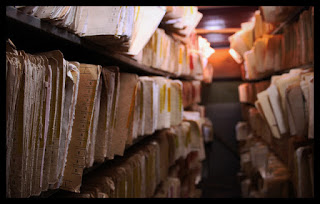
‘Archives’ by Marino Gonzalez. Flickr/Creative Commons License.
By Linda Garcia Merchant
(Crossposted from Humanities, Arts, Science, and Technology Advanced Collaboratory with permission of author)
These Digital History projects define how existing collecting methods have been tested, challenged and reconstructed to achieve their successful outcomes. Each project takes the basic idea of creating an online resource on knowledge that historically hasn’t been available to interested audiences.
The community collaborative projects are based on these general ideas.
• A model based on acquisition, preservation and distribution of an existing cultural history parallel to, but not included in the American narrative.
• An anecdotal history through interviews and a history based on material acquisitions in danger of being lost without this effort to acquire and preserve it.
• A history presented in visualizations that organize large amounts of data into a manageable visitor experience. Content that has a goal of informing a range of visitors, engaging a community eager for this history and encouraging future scholarship.
Featured Practitioners:
1. Thuy Vo Dang, Vietnamese American Oral History Project
(Email: thuy.vodang@uci.edu)
2. Janet Weaver, Iowa Women’s Archives, Mujeres Latinas Project
(Email: janet-weaver@uiowa.edu
)
3. Samip Malick, South Asian American Digital Archive (
Email: samip@saadigitalarchive.org
)
1. Origins: How did you come up with the original idea for the project? Did the idea come as a response to a community request? Did you approach the community as a result of your research? Did personal experience play a role in your project choice?
Thuy Vo Dang (Vietnamese American Oral History Project)
The Vietnamese American Oral History Project assembles, preserves, and disseminates the life stories of Vietnamese Americans in Southern California. The idea for the Vietnamese American Oral History Project (VAOHP) came after many years of conversation between academics and community leaders who wanted to see some efforts made to assemble and preserve the stories of Vietnamese Americans. Since the Vietnam-American War ended in 1975, the population of Vietnamese Americans has dramatically increased and the majority of Vietnamese Americans are concentrated in Southern California. With a population of about half a million here, we’ve seen scattered efforts to conduct oral histories, but without institutional backing. I wasn’t until UC Irvine’s School of Humanities received a generous grant from a donor (who wishes to remain anonymous) that we were able to begin this project in the Fall of 2011. I was hired to be the project director and in my first few months on the job that looked at existing models of oral history projects from the Jewish, Japanese, and Chinese American communities (to name a few). Besides connecting with other projects, we also outreached to the Vietnamese language media. In the first year of the project, VAOHP was covered by all 3 Vietnamese-language daily newspapers in Orange County and a handful of radio and television outlets.
I have experience with interview methodology, from my ethnographic field work in San Diego. I am also fully fluent in speaking, reading, and writing Vietnamese, which was a preferred qualification for this position.
Janet Weaver (The Iowa Women’s Archive Mujeres Latinas Project)
The original idea of the Mujeres Latinas Project grew out of the priority of the Louise Noun – Mary Louise Smith Iowa Women’s Archives (IWA), an archival repository located in the Main Library of the University of Iowa Libraries. The Archives was created to preserve the papers of Iowa women from all walks of life.
IWA staff started the Mujeres Latinas Project in 2005. Its impetus lay in our realization that at that time no archival repositories within Iowa were actively seeking to preserve the history of Iowa Latinas, whose contributions remained hidden in Iowa history. We originally conceived the project simply as an oral history collection. Between 2005 and 2007 three part-time oral history interviewers Georgina Buendía-Cruz, Teresa García, and Iskar Nuñez were hired to conduct interviews in different parts of the state. During the same period, additional interviews recorded by IWA staff members Janet Weaver, Kären Mason, and UI reference librarian Rachel Garza Carreón. During this period over 100 interviews were recorded, the majority of them in four areas of the state along the Mississippi River, and in Mason City in northern Iowa. Since the start, participants in the project have donated a variety of documents to the Archives and the collection has expanded beyond individuals’ papers to include records from organizations important to Latina/o history. The individual and family papers are preserved under the individual or family name in about twenty collections. Among the organizational records now preserved in IWA are the records of the Davenport League of United Latin American Citizens, LULAC Council 10, the records of the Muscatine Migrant Committee and the records of Iowa state LULAC.
Samip Malick (South Asian American Digital Archive)
We started SAADA because of a critical need not being addressed by other existing archival repositories. Very few materials relating to South Asian Americans are currently included in any other physical repositories. For the vast majority of archives, materials relating to this community fall outside the scope of their collection development policies. The archival materials that do exist are spread widely across collections around the country, making it difficult even for individual researchers to access the materials they need for their work and especially difficult for members of the community to consult them.
SAADA’s digital-only approach to archives presents a major re-conceptualization of traditional archival functions. This innovative, dispersed approach to archives reinterprets the post-custodial model for the digital era. Original archival documents remain with the communities, institutions or individuals from which they originate, while digital access copies are made available for use online.
Like many first and second generation South Asian Americans, I grew up completely unaware of the long and diverse history of South Asians in the United States. I was surprised to learn that Dalip Singh Saund, the first person of South Asian American heritage (and also Asian American heritage), was elected to serve in Congress in 1956. Or that in 1923 the Supreme Court ruled that South Asians should not be allowed to become American citizens, a policy that lasted for the next twenty-five years. Or how in 1913 South Asian immigrants on the Pacific Coast founded the Ghadar Party to fight for India’s independence from the British. These are the very kinds of stories that SAADA helps to preserve and make better known.
Since 2010, we have collected and provided access to over 1,000 discrete archival objects, each of which helps to uncover overlooked narratives from South Asian American history. Through outreach, public events, community forums, presentations in classrooms, reference interactions, and the use of blogs, traditional and social media, SAADA also works to create greater awareness about these histories. Materials from the archive have been included in documentary films, books and journal articles. In 2012, the SAADA website received over 73,000 visits.
2. Structure: Describe the support structure for this project. How was the support developed? Support from your institution (financial, staffing, network space), did this have challenges, if so, what kind, if not, why not? (If you would rather not speak to the challenges, that’s fine, but please do speak to the process).
Thuy Vo Dang (Vietnamese American Oral History Project)
The VAOHP is housed in the Department of Asian American Studies at UC Irvine, thus the department has provided support in terms of an advisory committee, a faculty mentor, and administrative staff that help with tracking the donor budget, equipment, and hiring work study interns to help with transcribing and other related work. I teach a course for the department called “Vietnamese American Experience” once per academic year where I teach students historical-social context and train them in oral history methodology. From this class, we generate one fully-processed oral history per student. I recruit from this class for an independent study/research program for VAOHP where students can continue to conduct oral history interviews or work on community outreach, social media, and website maintenance. Additionally, Professor Linda Vo, gives her Research Methods class the option to work with me on an oral history project and receive course credit through her course. These are all ways we generate interviews and train students in the process. I conduct interviews as well–between 5 to 10 oral histories per month.
We also partner with the Southeast Asian Archive at UC Irvine, which provides us with network/server space through the libraries’ UCI-Space. The libraries staff worked on the design and general maintenance of the digital repository. We will house the entire VAOHP Collection (hard copy and digital records) in the Southeast Asian Archive.
Finally, I have reached out to community organizations that have conducted oral histories, such as the Vietnamese American Heritage Foundation’s 500 Oral Histories Project to acquire their Southern California interviews so we can process these–transcribe, translate, and digitize them for online dissemination. The VAHF owns the copyright to their interviews and out of their 500, they have given us approximately 100 interviews.
Some challenges that have arisen are mainly budget-related. We are working with a very small budget and thus have to utilize volunteers and students to get the interviews processed. The UCI Libraries has kicked in tremendous support in terms of network space, but we anticipate needing to provide them with some support to sustain the website and make the interviews available to the public. The restrictions have affected us in our choice of media, as we only audio-recorded at this point. The cost of video is prohibitive for the libraries.
Janet Weaver (The Iowa Women’s Archive Mujeres Latinas Project)
We were able to begin the project with small grants from the State Historical Society of Iowa’s Resource Enhancement and Protection-Historical Resource Development Program and the State Historical Society, Inc. As the project grew we secured additional funding from the University of Iowa Libraries and from the University of Iowa’s Year of Public Engagement and Year of the Arts and Humanities.
The IWA’s Mujeres Latinas Project is able to call on resources from the UI Libraries, including access to technology support, state-of-the-art conservation and preservation facilities, and the Iowa Digital Library. The permanent two-person, full-time staff of the Iowa Women’s Archives continues to maintain the Mujeres Latinas Project as part of its ongoing commitment to preserve the papers of Iowa women and their families. The IWA website is an essential component of making its collections visible and the UI Libraries supports the maintenance of our website and provides server space for digitized materials.
Samip Malick (South Asian American Digital Archive)
SAADA is an independent non-profit organization. In 2008, the founding board members each chipped in a couple hundred dollars to purchase server space for our first website and submit the necessary paperwork to register the organization. From its inception until mid-2012, SAADA existed as an entirely volunteer run effort. However, in an effort to ensure that the organization is well situated to care for and curate the archive, we have begun to work towards building the organization and ensuring its financial sustainability.
In 2011, we applied for and received our organization’s first grant funding and also conducted our first annual fundraising campaign. In 2012, we expanded our fundraising efforts and began working towards hiring our first staff member. In July 2012, I left my position as the Director of the Ranganathan Center for Digital Information at the University of Chicago Library to begin volunteering with SAADA full time. Our fundraising efforts in 2012 went well and I am now SAADA’s first full time paid staff member.
SAADA is a start-up non-profit organization, and we face the same challenges as many other non-profit organizations. One of the primary challenges, of course, is that of fundraising. However, we are fortunate to have a Board of Directors that fully supports the organization’s growth and a volunteer Development Director with expertise in fund development who has helped us approach our fundraising efforts more strategically. I believe that we have the right elements in place to build a financially sustainable organization.
3. Sustainability: How long has the project been online? What has the feedback been from the community on usability? From the institution? Has any of the feedback been incorporated into adjustments or additions to the site, the collection or the process of acquisition? How has the collection/acquisition/curation process changed from the beginning to now? When did the development of site infrastructure enter into the process? If you would like to share, what are plans for the future? How have you addressed issues like ‘scope creep’?
Thuy Vo Dang (Vietnamese American Oral History Project)
We had a “soft launch” of the website in April 2012, just 5 months after getting UCI’s IRB approval for research. Then in October 2012 we had a formal website launch when we hosted a community reception in Little Saigon (Orange County, California) to demo the website. The event attracted over 250 people, from the community mainly. We had a great amount of media coverage, including an Associate Press story in the days after the reception.
The feedback has been overwhelmingly positive from the community so far. We have yet to receive any constructive criticism about the actual website, only requests for expand the project beyond Southern California and to incorporate video interviews.
Janet Weaver (The Iowa Women’s Archive Mujeres Latinas Project)
The Mujeres Latinas collections in the IWA have been included in its website since the project’s inception in 2005. Collection guides for papers of Iowa Latinas, their families and organizations are added to our website as they become available. A search for Latinas and their Families currently yields a list of collections with links to their finding aids. Additional collections of varying sizes wait in the wings to be processed and added to the website.
All IWA collection guides are described through the UI Libraries Archon database that allows for detailed description of collections and enhanced searching. In addition to collection guides, a sampling of documents and photographs are scanned with consent of donors and made available to the public through the Iowa Digital Library.
We are in the process of updating the Mujeres Latinas page of the IWA site to enhance visibility of the Latina collections and provide detailed information about the interviews and related documents.
Our plans for the future include creating a digital version of the 2012 Pathways to Iowa: Migration Stories from the Iowa Women’s Archives and an expansion of the project to offer offsite digitization in the homes of donors and to expand the scope of the project to encompass central Iowa. Through the UI Libraries digital department we are able to guarantee that the digital materials preserved in our repository will continue to be accessible in a future that brings new technologies that cannot be anticipated by today’s archivists and technology specialists. In this way IWA can promise those who entrust their family papers to us that no matter what the digital world of tomorrow holds, their papers will continue to be accessible.
Samip Malick (South Asian American Digital Archive)
We put a website online in 2008 with some basic information about the organization. But it was not until 2010, when we began collecting materials in earnest, that we built the website with its current structure and using our current content management system (Drupal 6). The website has undergone some aesthetic changes and added new features over time (such as the visual browsing, map browsing), but the interface and structure of the site have remained relatively consistent. We are just now beginning a process of refreshing our visual identity, branding and updating our website to Drupal 7.
The feedback from the community about our website has been overwhelmingly positive. We have not done any systematic usability testing or user surveys, though this is something that we hope to do in the coming months. However, based on anecdotal feedback, users have found the website easy to use and navigate. We have added some features to the website based on user feedback, such as the visual browsing and map browsing. Other feature requests are on the back burner, but will be implemented at a later date, such as a request to be able to download PDF versions of public domain materials.
SAADA is guided by a collection policy that was approved by the Board of Directors at the organization’s inception. However, given the breadth of the materials included in the collection policy, this year the Board of Directors has outlined three collecting priorities for 2013, which fall within the scope of the collection policy, but specify areas that we would like the archive to grow in the coming year. These priorities will be assessed again in 2014.
Feedback from the community through both informal and formal channels has been important in helping determining the priorities for collecting. For example, many community members have indicated the importance of documenting the South Asian American community post-9/11 and consequently, that is one of the collection priorities for 2013.
4. Building community: Projects like this can create generational and transformational experiences with students, staff and community that create related points of cultural, social, and historical awareness. These types of projects build new communities both virtual and real. What has been the multi-generational experience for your research group? For the community? What has the larger global community’s response been?
Thuy Vo Dang (Vietnamese American Oral History Project)
This project has been a tremendously successful vehicle for forging stronger relationships between the university (mainly the Southeast Asian Archive) and the community and between the different generations in the community. One vehicle that was truly effective was a weekly radio show on Vietnam California Radio (FM 106.3) that I co-hosted bilingually. The show was called “Oral History: Stories between the generations” and the goal was to make the stories we collected even more accessible to the community. The show also served as a recruitment tool to get a wider sampling of narrators to share their life stories with the project. I had students come on air to talk about what they learned in interviewing their parents or those of the first generation. I had narrator clips air thematically to showcase different types of experiences such as family life, migration, and education. This show has reached a really diverse audience in the Vietnamese American community and it proved to be a great media tool, since we were able to publicize our community reception through that show.
Aside from the radio show, the website where all the oral histories are presented has been used by a high school class as part of its curriculum. I invited that high school class to come for a tour of the Southeast Asian Archive and when they were able to get funding for a bus, they came to UCI for the tour. In addition to the Archive tour, I worked with an organization on campus called Southeast Asian Student Association to put together a college panel for the high school class. All these “extramural” activities are really crucial in helping to strengthen the relationships between the VAOHP, Southeast Asian Archive, and the local communities we serve which is multi-generational and quite diverse.
Another example of an inter-generational collaborative initiative through the VAOHP is a student-lead summer research project at a senior apartment in Orange County. My students came into the senior apartments and presented on the VAOHP at an opening social mixer and then recruited narrators to interview from that facility. After 2 quarters, they collected 8 interviews and shared their “findings” at a closing social mixer. The product of this initiative will be a bounded copy of life stories for the senior apartments’ library, individual CDs for the narrators, and a presentation on campus in Spring 2013. This initiative pushed students outside the university and allowed for an engagement between seniors and students.
Janet Weaver (The Iowa Women’s Archive Mujeres Latinas Project)
The digital world represents a critical point of access for younger generations through which ties with older generations and community can be strengthened. By providing ready access to information in undergraduate and graduate classes, students develop an understanding of the contributions of Latino families to Iowa history and recognize familiar sites and stories from their own family histories. They encounter primary source materials in their own time and through technologies with which they are familiar. We encourage them to visit the Archives and look at the physical collections in our reading room. IWA is also able to take reference questions by phone and email through our online reference account. Visitors to the IWA – whether in its physical or virtual space – develop an appreciation for the interconnectedness of family and community networks and the place of Iowa Latinas within a larger context of regional, national, and transnational history.
The connectedness of our IWA staff to communities with which they engage is strengthened by the process of reaching out, conducting interviews, collecting documents and building trust. In the community of Davenport, Iowa, the League of United Latin American Citizens – LULAC Council 10 – after reconnecting with its significant history of civil rights activism, now boasts the largest membership of any council in LULAC’s Midwest region. And the Council continues to work for educational opportunity, preserving traditions such as fiestas, its scholarship program, and reunions of residents of the community’s early-day Mexican barrios. These events provide an opportunity to connect younger members with a Latino past that stretches back over a hundred years. This year the Council has asked the IWA to charter a bus to bring community members, families, and individuals who have donated materials to the Mujeres Latinas Project for a day-trip to visit their papers, see how they have been preserved, and remember Iowa’s Latina/o past. Iowa LULAC’s recent leadership in the struggle for voter rights in Iowa has garnered Iowa state LULAC this year’s Louise Noun Award from the ACLU of Iowa. A former president of the ACLU of Iowa, Louise Noun was also the co-founder of the Iowa Women’s Archives.
Samip Malick (South Asian American Digital Archive)
We have used social media and other online forums extensively to create an online community around SAADA’s archive. We have more than 1,300 followers on Facebook, 250 on Twitter, and nearly 600 subscribers to our email list. We post items from the archive, news about the organization, relevant articles and links to other archives that will interest our online community. In response, the SAADA’s social media community has remained active and engaged with our posts. Our most popular post on Facebook last year (a photo of students at the Women’s Medical College, Philadelphia PA from the 1920s) received 58 likes and 42 shares.
Additionally, we have tried to find ways to make the materials from the archive relevant to our users by connecting historical items with current news and events. For example, after the tragic shooting at the Sikh Gurdwara in Wisconsin, we posted materials from SAADA with more information about Sikhism and that demonstrate the long history of Sikhism in the United States. We also put out a call requesting submissions of photographs and other materials documenting the community’s response to the shooting. We received photographs of vigils, official proclamations of mourning and flyers for community events. These materials were added to the archive.
As another example, before the 2012 presidential election, we posted an article from 1923 describing the U.S. Supreme Court decision to ban South Asians from becoming American citizens. This article was shared by many of our subscribers with added comments encouraging others in the community to vote. This item was liked 340 times on Facebook and shared 21 on Twitter.
In addition to our online presence, we have organized ‘community forums’ as a venue for community members to learn more about archives, see materials from SAADA’s archive and offer feedback and suggestions for our organization. We organized 2 forums in 2012 that were open to the general public (one in Chicago, one in Cleveland) and 1 forum specifically targeted to contemporary South Asian American artists in Chicago. We plan to have more such events this year. We have also presented in classrooms and at workshops and conferences. Altogether, we did over 20 public presentations in 2012 all over the country.
5. All things analog: Each of your projects engages in related creative products (art installations, performance events, print culture). How has this ancillary production influenced the project? What has been the most interesting or inspiring moment, material discovery, or interview experience in the work so far?
Thuy Vo Dang (Vietnamese American Oral History Project)
For the website launch/community reception in October 2012, we partnered with a local artist who was also a narrator for the VAOHP. Her artwork layers family and community history into visual pieces, so we wanted to have her art exhibited on one wall. On another wall we presented the Vietnamese American Heritage Foundation’s 500 Oral Histories Project and on the third wall we had the UC Irvine libraries laptop stations with volunteers to help community members navigate the website. This multi-pronged approach to presenting oral history shows the aesthetic/creative possibilities that life stories can initiate, features the collaboration between grassroots efforts to preserve community history, and brings technology directly to the community.
This community reception really cemented the notion that oral history can be exhibited, discussed, and used in a variety of ways that make it accessible to all.
Janet Weaver (The Iowa Women’s Archive Mujeres Latinas Project)
One of the best moments of discovery occurred when our staff along with staff from the conservation department of the UI Library visited the LULAC center in Davenport to assist with refurbishing an exhibit in the LULAC center. One of the elders from the council suggested exploring the attic space above the old portion of the building where he believed a box of records of the council’s activities during the 1960s had been stored. When the younger members of the council brought down the box – it did indeed contain precious documents that told of the council’s leadership in the grape boycott campaign, flyers supporting the passage of Iowa’s first migrant child labor legislation, and handwritten meeting minutes of the Quad City Grape Boycott Campaign. This was a signal and exciting moment and highlighted the active role that historical archives can play in enriching community life for people too often overlooked in the historical narrative.
The Mujeres Latinas collections in the IWA provide primary source material for scholars and researchers from all backgrounds – junior high school students participating in National History Day competitions, undergraduate students from across the state conducting course research assignments, independent scholars and interested members of the public and institutions. We conceptualized our recent exhibition Pathways to Iowa: Migration Stories from the Iowa Women’s Archives to showcase our Mujeres collections and celebrate IWA’s twentieth anniversary. We are currently reconceiving this exhibition as an interactive digital exhibit for the IWA website.
IWA’s Mujeres Latinas collections helped provide an impetus to the decision of three UI faculty members to organize and host a symposium in 2012 on The Latino Midwest, which was held at the University of Iowa. The symposium in turn provided inspiration for a February 2013 Iowa Alumni Magazine article, “The Invisible Iowans,” which drew on many of the collections featured in the Pathways to Iowa exhibition. Among the photographs it included was an especially moving and significant one of Florence Terronez with her daughter and granddaughter visiting the IWA exhibit, which featured her mother’s migration story.
Samip Malick (South Asian American Digital Archive)
For me, the most rewarding moments have been in working with community members who have materials saved in their basements or attics and who, for the first time, are given an opportunity to share these materials with the world.
One such example is our work with S.P. Singh, whose grandfather, Bhagwan Singh Gyanee, arrived in the United States in 1914. Gyanee was born in India in 1884 and from an early age became involved in the anti-colonial freedom struggle. In 1909, as the British began strongly suppressing the freedom movement, Gyanee began to feel that his and his family’s lives were in danger. He decided to flee India, leaving his wife and three young children behind and for nearly the next 50 years he lived in exile, traveling to Singapore, Japan, Malaysia, Burma, Panama, Canada and finally arriving in the United States in 1914. Here, he became a leader of the Ghadar Party, an organization based in San Francisco agitating for India’s independence from Britain. In 1917, Gyanee and his compatriots were arrested and imprisoned for amassing weapons, which they hoped to use to fight the British in armed combat. After his release from prison, Gyanee became a philosophical and spiritual leader and delivered lectures across the United States. Finally, in 1958, after nearly 50 years away from India, he was allowed to return. He spent his last years living in a small town near where he was born.
After his passing, his grandson, S.P. Singh inherited all of his grandfather’s materials. When Mr. Singh moved to the United States in the early 1970s and settled in Atlanta, he brought these materials along with him. His grandfather’s materials were important to him, and he thought they would be important to others as well.
I came across this story in a short article Mr. Singh had written about his grandfather that was published online. At the end of the article, Mr. Singh had included his email address. I emailed him to ask if he might consider working with SAADA and allowing us to digitize any materials he had in his possession. Mr. Singh was visiting India when he received my email, but he called me right away. He was so thrilled that an opportunity had finally presented itself to have his grandfather’s story heard by the world.
In April 2012 I flew to Atlanta, and along with a volunteer, sat in Mr. Singh’s house for three straight days as we digitized all of his grandfather’s materials. Mr. Singh would regale us with stories he had been told by his grandfather as we looked through page after page of correspondence, community publications, photographs and diaries. This incredible collection is now digital preserved and available online through the SAADA website. It has been featured in the New York Times and I have shared this incredible story at many of our community events.
For me, this experience embodies the possibilities of SAADA’s approach to building a community-based digital archive.
Linda Garcia Merchant is an independent documentary filmmaker and the Technical Director of the Chicana Por Mi Raza Digital Humanities Project. linda@vocesprimeras.com
Comment(s):
Anonymous March 23, 2013 at 5:51 PM
I applaud you for your efforts!
I believe it is very important to preserve a community’s history so that future generations can study the changes that communities undergo. The interviews that were conducted are and will be extremely rewarding. They will provide researchers with a better understanding of the personal circumstances that members of that community faced. I am glad to see that you have received support from different organizations and your communities. I agree that projects like this create cultural, social, and historical awareness and I hope in the future to have the opportunity to perform research in my community. Thank you.
Alejandra Cervantes
Latina/o Studies 2322; The Ohio State University
 Photo by Flickr User Steve Rhodes, CC BY-NC-ND 2.0