Tag Archives: poetry

Finding My Home in Psychic Restlessness

by Lizeth Gutierrez

“Because I, a mestiza

continually walk out of one culture

and into another

because I am in all cultures at the same time,

alma entre dos mundos, tres, cuatro,

me zumba la cabeza con lo contradictorio.

Estoy norteada por todas las voces que me hablan

Simultáneamente.”

Gloria Anzaldúa

Gloria Anzaldúa is my academic godmother. She has provided me the tools to create a sense of home. A space of survival. A space to call my own in the academy. This piece is inspired by Anzaldúa’s work, specifically her writing in Borderlands/La Frontera. Anzaldúa provided me the tools to name my restlessness. “Finding My Home in Psychic Restlessness” is about my journey to self-discovery. In this poem I recite ‘culture’ and ‘race’ as homogenous markers of identity only to strategically address the multiple identities I wear on my body. I do not seek to homogenize identity or discipline racial categories of identification. Culture and identity, as Anzaldúa’s writing reveals, are complex, multifaceted and fluid.

I wrote this piece when I was an undergraduate student at Grinnell College. As a current PhD student at Washington State University this poem continues to speak to me in painful ways. I am a first generation Chicana college student from Los Angeles, California who decided to pursue her Bachelor’s degree in small town Grinnell, Iowa. I oftentimes felt dislocated there and swore to myself that I would never go back to rural towns. I did not belong in those spaces. Ironically, my distaste for small towns brought me back to a similar rural town: Pullman, Washington. Maybe I am a masochist. Perhaps it is in that masochism that lies my sense of home. Who knows, but it is with this knowledge that I offer you a piece of who I am.


!Ya no!

No quiero sentirme marginalizada por tu hipocresía

Me exotizas por ser Latina.

Me llamas “lazy” por ser Mexicana.

Y te burlas de mi acento porque no es como el tuyo.

Tú dices “pizza” cuando yo digo “piksa.”


You tell me I can achieve the American dream, and yet set boundaries that aim to intimidate me and make me question my own abilities.

Si, vivo en un lugar de contradicciones.

I am in a college where I am the “exotic Latina,” pero soy la “outsider” en mi familia.

La “pocha.”

La “ya te crees muy miss thing porque vas a coh-ledge”

No me encuentro ni aquí, ni allá.


Why do you make me feel like I have to choose only one culture?

Soy mestiza, una hybrid, una mixture.

Anzaldúa me lo grita al oído in my dreams.


I, like Anzaldúa, believe in the new Latina consciousness.

Una conciencia que reconoce y tolera las contradicciones de mis dos culturas.

I love frijoles y las tortillas hechas a mano, and let’s not forget the smell of el cilantro en la salsa roja.

Y adoro el crispy chicken sandwich with large fries de McDonalds.


Soy Mexicana como mi abuela, like my mother who must constantly fight against the machismo of our patriarchal culture.

Y soy Americana: conquering my dreams and goals a como de lugar is the mentality of my gobierno capitalista.


Tú  te sigues sintiendo perdida, abandoned, ahogada en un mar that restricts your identity

because it tells you constantly that you are not enough Mexican, ni suficientemente Americana.

Date cuenta that you are more than one culture, no te de vergüenza, no te escondas.


Do not let the waves of assimilation trap you.

No te dejes.

Nada. Nada más rápido. Defiendete, you can do it.


Our history has shown us that Chicanas are guerrilleras.

Tú como yo somos la negotiation of two distinct worlds.

Anzaldúa dice que vivas sin fronteras.


No dejes que la corriente del mar te lleve.

Do not let it make you choose one culture over the other.

¡Lucha!

Lucha por tu crossroads.


This internal fight no acaba hasta que hagas tu propia negociación de identidad.

Revolutionize your sense of self.

No eres prisionera.


You are not less than one culture or more than the other.

You are all cultures.

La güera. La negra. La india. La mestiza.

Eres la voz de la nueva Chicana and you have the inner-strength to create your third space of survival.


A space Anzaldúa so proudly calls “una conciencia de mujer.”


Lizeth Gutierrez is a graduate student in Critical Culture, Gender, and Race Studies at Washington State University. She researches representations in popular culture of gendered and raced Latinidades and is particularly interested in the commercialization of mainstream Latinidad in relation to U.S. discourses on second-class citizenship.

Holders of the Light

People holding placards with lighted letters spelling out words.

Overpass Light Brigade at American Indian Sovereignty and Resource Management Conference, UW-Milwaukee, April 2014. Courtesy of Overpass Light Brigade.

by Kimberly Blaeser

In 1986, when I should have been writing my PhD dissertation, I was reading boxes (no exaggeration) of Department of Energy materials regarding the planned siting of high level nuclear waste repositories. One of the sites proposed was on my home reservation at White Earth, amid Minnesota’s basalt and granite hardrock deposits—very near the headwaters of the Mississippi River.  I don’t now remember details of the science I learned during that time about crystalline rock, fractures, and ground water, but I do remember the urgency with which I investigated, the weeks and months during which I wrote, went to meetings, knocked on doors, and testified.

I had reason to recall that urgent dedication recently when Edith Leoso, Tribal Historic Preservation Officer for the Bad River Ojibwe of Wisconsin, spoke of the way her life had shifted unexpectedly with the proposal of mining in the Penokee Hills of Wisconsin. Likewise, Bad River Tribal Chairman, Michael Wiggins, Jr. was forced to quickly educate himself in the pertinent science and legal intricacies in order to lead the ongoing anti-mining efforts, to protect the land and the people, to guard the future.

Of the many ways to say please stand, I have chosen a few.

∂, Partial Differential Equation

All things being equal, things are never equal. Think of scope. Like the reach of the imperial.  Or consider variables. Value. Or commodity. Ways of seeing. Angles and perspectives. Or how to solve for survival. 

The consideration of seven generations. This wisdom rule has become common knowledge. Leaders teach that tribal decisions should be made taking into consideration seven generations in the past and seven generations in the future.

The national sacrifice.  Lesser known, and frequently unacknowledged, this convenience policy has marked many generations. Uranium mining. The fallout from atomic bomb detonation at White Sands.

What we erase from polite conversation. Bodies on fire. The historic cleansing of the landscape, the sweep of humanity west, west, west. Environmental r  ism. 

Zongide’en, Be Brave.

Another partial differential equation. Let’s say a corporation proposes a mine. Variables include Tyler Forks. Bad. Potato. Rivers. A 22-mile, 22,000-acre strip of land. Jobs. Maanomin. Open pit. Exceptional or Outstanding Resource waters. Legislation. Iron oxide.  Fish. Blasting and pulverizing. New legislation. The functions depend upon the continuous variables. Fluid flow, for example. And changing laws. Somewhere along the granite line, someone enters. Let’s say they have put down one life and taken up another: the solution of the PDE. They face arbitrary functions. Changing laws. Guards. Guns. If the life is stretched over two points.  It vibrates. We cannot measure that vibration in this generation. We can sing it, or make it into light. (See above for a partial illustration.)

Minobimaadizi, Live Well.

This past week an environmental warrior from the Pacific Northwest passed away. Billy Frank, Jr.  Frank was quoted as saying about himself, “I was not a policy guy. I was a getting-arrested guy.” But in the end he changed policy. A Nisqually tribal member, his battle for tribal sovereignty in resource management protected the salmon and left its mark on contemporary understanding of treaty law. To accomplish that he was jailed, beaten, tear-gassed, and chose to sacrifice much of his time and liberty. A life stretched over two points.

The Anishinaabe word minobimaadizi translated gives us the English live well. But it means something more. To live this good life in ways both obvious and less so. Though we may feel dwarfed by the largeness of passion and action of people like Billy Frank, Jr., we remain variables in the equation and can tip the balance one way or the other.

When we held an American Indian Sovereignty and Resource Management Conference at the University of Wisconsin-Milwaukee campus recently, we invited my colleague Lane Hall and his Overpass Light Brigade to participate one evening. Lane’s idea to create lighted letters and spell out protest messages above freeways has caught on around the country. At our event, we spelled words in Anishinaabemowin. (For these Lane needed more vowels!)  I am not an OLB regular holder of the light, but I volunteered to be one of those to carry and display the large placards. You will find me at the “I,” the third “O,” and the “G.”  One lighted letter in a 14-letter word? Only a pair of legs beneath a billboard? Ahem. Can you spell m  taphor without me?

Gego Googiibike, Don’t Dive Into the Metal.

I’d like to ask you to fold up your deck chair and head to the Penokee Hills protests. But the truth is, you probably have an environmental threat within biking distance. Or canoeing distance. Mining companies are pushing to conduct a toxic new form of extraction for sulfide, right next to the Boundary Waters Canoe Area Wilderness in northeastern Minnesota, near the 1,090,000-acre (4,400 km2) wilderness area that is located in the Superior National Forest.  Where insistence is a function of insanity. If x then why.  A mine parallel to 1,000 miles of canoe routes, in the habitat of moose, beaver, wolves, bear, lynx, deer, bobcats, bald eagles, peregrine falcons and loons, within easy polluting distance of our once remote family cabin. We’ve hardly hands enough to hold all the signs or mics needed in this indifferent world of resource capitalism.

And yet.

Poetry is one letter when we spell resistance.

Debwetaan, Believe.

Eloquence of Earth

Nominal signs, these words we use—future, ecology, seven generations

have yellowed into clichés, editorials that line the cages

of captured birds, or burn in unransomed stone fireplaces

of America’s aspiring, royal mining families.

These green futures cast as fairy story,

sealed beneath the calloused ideals of legislators—

sleek smiling handshakes who seal bargains like Jabez Stone;

Our I-do-solemnly-swear paper-promise leaders

enticed by industry frenzy, slight of lips,

the short-sighted tally (seven hundred jobs)

coveted like Stone’s seven years of prosperity.

Though publicly professed (against all enemies, foreign and domestic),

and leather-oath sworn (will bear true faith and allegiance),

still quid pro quos reign, sell the soul of this land—

our waters our manoomin our children, abiinoojiihnyag.

Each season gavels strike new bargains with our oldest enemies

maji-manidoog, handsome fast-talking strangers disguised as prosperity.


Daily we watch patient warnings swim the Wolf River,

migrate to absent wetlands, trumpet old calls.

How do we translate the flashing fins of poisoned fish?

What other alphabet do you know to spell contaminated waters?

Like banned books words still burn on my tongue—reciprocity,

sacred, preservation, earth, tradition, knowledge, protect.

Even the vellum of justice has crumbled in fiendish fire.

Meanwhile we gather here, descendants of ajijaak and maang

lift our ancient clan voices in longing, for a chant of restoration

in a Faustian world.

Before a jury of the tricked and trapped and bamboozled,

before the very devil, Daniel Webster sang

the healing brush of common memory

a child’s wonder at each day’s waking

the freshness of a fine morning—waaseyaaban.


If I say Gichigami—Lake Superior—a turquoise plain, stretches

infinite, gete-gaming. If I say Wiikonigoyaang, she invites us to her feast,

how many will remember the eloquence of earth itself?

At dawn when jiibay mist backstrokes across the copper of northern prairies

eerie white hovering, damp and alive,

will you stretch out your hands in hope

cup the sacred like cedar smoke,

draw it toward you—a gesture

fervent and older than language?

Now I say wiigwaasikaa, everywhere we look

there are many white birch,

bark marked with sign, scrolls a history.

I say ritual, continuum, cycle of belonging,

I say daga, please; ninandotaan,

you must listen for it—aki.

Yes, our very earth speaks.

Who among us will translate?

Kimberly Blaeser is a 2014 Contributing Blogger for Mujeres Talk and a poet, critic and essayist. She teaches Creative Writing, Native American Literature and American Nature Writing at the University of Wisconsin-Milwaukee, where she is a Professor. Her publications include three books of poetry: Trailing You; Absentee Indians and Other Poems; and Apprenticed to Justice. Her scholarly study, Gerald Vizenor: Writing in the Oral Tradition, was the first native-authored book-length study of an Indigenous author. Of Anishinaabe ancestry and an enrolled member of the Minnesota Chippewa Tribe, Blaeser grew up on the White Earth Reservation in northwestern Minnesota and worked as a journalist before earning her MA and PhD from the University of Notre Dame. Her poetry has also been translated into several languages including Spanish, Norwegian, Indonesian and French.

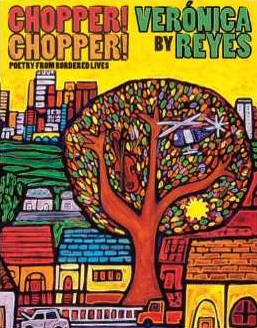
Review of Chopper! Chopper! Poetry from Bordered Lives

by Paloma Martinez-Cruz

Verónica Reyes. Chopper! Chopper! Poetry from Bordered Lives. Pasadena, CA: Arktoi Books, 2013. 111 pages. ISBN 978-0-9890361-0-8. $18.95

chopperchopper coverI left my hometown of Los Angeles to attend college in the Bay Area, and then I left California altogether to attend graduate school in New York City. Many denizens of the San Francisco Bay and the five boroughs of New York City have no love for my birth town, so when people asked me where I was from, I felt shy about admitting I was from the place known as “72 suburbs in search of a city.”  One day a fellow student shared with me what he loved about it: “You can feel how it’s red and brown.” After he said this, I realized that he was right, and that so many of the quips about L.A. being anti-intellectual and superficial were, in truth, about the other L.A., the tinsel L.A. that eclipses our red and brown realities, until violence erupts in the streets, or Chicana feminist jota poets like Verónica Reyes sound the thunder of our lives in verse.

The poems in Chopper! Chopper!, Reyes’ first published collection, envision East L.A. as the continuity of Mexican experience, participating fully in an Americas-based spirituality that venerates the natural world.  As with physical sacred gatherings, the volume begins with a blessing.  The poem “Desert Rain: blessing the land” [sic] surveys the desert cityscape with devotion.

The agua took her back to her childhood in México

rain that blessed her alma como copal shrouding her skin

She inhaled the desert aroma over concrete, nopales,

and limones beneath splintered street telephone wires

Socorro breathed in once and inhaled México in East L.A.

While I am exhilarated by the red and brown affirmation of Mesoamerica in Los Angeles, some of the portraits of Chicana ethnicity in this volume echo others. From my perspective as a Latin American/Latina Studies scholar, I question what seems like a nostalgia that conflates spirit, nature, and nation. Although some of the poetic turns tended toward predictability, there is also much to recommend in this volume.  Reyes is at her best when she navigates the difficulty of voicing bicultural, transnational experience by moving in for the hyper close-up, telling us what she alone is capable of observing.  In “Theoretical Discourse over ‘Sopa’ (what does it really mean?),” she playfully employs academic jargon to try to make sense of a word that has multiple meanings.

All our lives we called it “sopa”

Differentiated “sopa” from fideo

            to estrellas or melones

labels for different pastas

titles to establish subjectivity

within the hegemonic world of pasta.

The poem concludes with the narrator and her sister agreeing to use the word sopa the same way that their mother had used it – to refer to Mexican rice – thereby legitimizing local, intimate knowledge over official language usage.

As in the postmodern approach to “sopa,” Reyes’ poetry consistently repositions authority so that cholos, jotas and bus patrons are key culture makers.  In “Super Queer,” the queer Chicana becomes a supernatural champion, managing to survive homophobia, bashing and “what you thought no human being can withstand.”  Where others are tempted to perceive marginalization or victimization, Reyes tells of pride and strength, urging the listener to “take off those silly straight lenses that skew your vision.”  In “El Bus,” the narrator is proud to announce, “I speak in bus routes,” which, as Angelenos and visitors to the city are aware, is a dialect spoken almost exclusively by the poorest of the poor.  In Reyes’ poem, the speaker claims “You got it, esa or ese, I know the system/It’s in my blood to travel the calles via el bus” as if to boast of royal lineage.  Reyes’ poems invert the parameters of social inclusion, so that queer and street folk decide who belongs, and misguided wearers of “silly straight lenses” and novice bus riders become the outlanders in need of charitable assistance.

Vehicles of surveillance and pesticide application populate Reyes’ poetic universe, producing a bellicose environment in which East L.A. residents are surrounded by drone-like aerial hostility.  “Green Helicopters” describes the apple-orchard helicopter that sprays toxins on the migrant workers, and “Chopper! Chopper!” depicts the play of young neighborhood children who turn the menacing sounds and lights of police helicopters into fantastic games.

The cops announced to the convict, “We know where you are.  We know…”

And Xochitl ran out of breath chasing the big white light piercing the darkness

She stopped and stared up at the helicopter slicing the chapopote sky for a moment

It was almost as if it were stuck like the mammoths, the saber-toothed tiger, the Chumash

woman whose bones remained deep underground until the archaeologist came

The people screamed and wailed to be set free from the tar that pulled them down

that swallowed them little by little as they struggled to get out from the bottom

Still the thick goo engulfed them hole suffocating their skin, filling their mouths

Xochitl’s brown eyes stared at the chopper swirling in East L.A.’s summer sky

But the helicopter broke free, pulled back its white light and flew away to the hill

Here, the child Xochitl plays under a tar firmament where the craft hovers like a relic from California’s Pleistocene epoch, witnessing centuries of ancestors struggle against asphyxiation across the sky: just another summer night in East L.A.

While most of Chopper! Chopper! must remain unexamined here, there can be no doubt that Reyes achieves what she sets out to do. In her poem “A Xicana Theorist,” her queer protagonist moves through a lesbian, Latina social space, and yet she poses the question, “Are we really safe?” The final verse reveals the highest potential that theoretical work can aspire to achieve.

She dances with the woman from the bar

She holds her gently around the waist

She leans her body closely into hers

She wants to cry and tell her she is hurt

…tell her she is tired of fighting

…tell her she feels alone and scared

She wants to heal her wounds

These last lines of “A Xicana Theorist” leave room for interpreting whether the wounds she wishes to heal belong to her or to her dance partner, and this blurring of bodily boundaries and subjects allows the reader to interpret a more expansive notion of selfhood that includes all the Latinas who are wearied by building their lives in spaces that are racially negative and sexually oppressive. The desire that is repeated in these last lines does not hone in on sexual appetite, which would make sense given the erotically charged environment of the bar, but rather emphasizes the act of telling. The telling is the medicine the poetic voice craves in order to heal wounds.

In the tar and asphalt prism of East L.A., Reyes’ poems unearth and celebrate centuries of red and brown truths. While some of the writing resorts to idealizing Mexico as a font of political and spiritual alignment, the collection convinces readers to rethink urban spaces and witness the cunning and courage that develop under a dome of both hyper vigilance and civil neglect.  In the midst of roaring engines, slicing blades and hostile surveillance lights, her courageous act of telling manages to cultivate a space of safety and healing: a place for pride to grow.

Paloma Martinez-Cruz, PhD, works in the areas of contemporary hemispheric cultural production, women of color feminism, performance and alternative epistemologies. She is the author of Women and Knowledge in Mesoamerica: From East L.A. to Anahuac (University of Arizona Press, 2011) and the translator of Ponciá Vicencio, the debut novel by Afro-Brazilian author Conceição Evaristo, about a young Afro-Brazilian woman’s journey from the land of her enslaved ancestors to the multiple dislocations produced by urban life. Martinez-Cruz is also the editor of Rebeldes: A Proyecto Latina Anthology, a collection of stories and art from 26 Latina women from the Midwest and beyond. Currently Martinez-Cruz is at work on a book publication examining the resistance fronts found in Chicano/a popular culture. [5/1/14 post updated to correct an editorial error]

Remembering Nelson Mandela

11206285456_6b5da7bb8f_z(1)
Photo by Flickr User HelenSTB
CC BY-SA 2.O

by Inés Hernandez-Avila

I wrote this poem for Nelson Mandela in 1988 because he truly moved me, all along the path of his life as I began to know about him, and his spirit will continue to move me, always.  The poem speaks for me of what I think of him.  He was a great Spirit who came to this earth to be Nelson Mandela, and he kept the radiance he brought with him from the spirit lands of the ancestors.  With the example of his life, he “lifted us up,” as my own Nez Perce elder, Albert Andrews would say.  I have read the poem at literary events, but it has never been published.  On the occasion of Mandela’s death, my dear colleague, Jualynne Dodson asked, on the Ford Foundation Fellows listserv, what the impact of Mandela had been on the Chicana/o community.  I sent her my poem, from my own Native (Nez Perce) and Tejana perspective.  As I re-read what I had written in 1988, I saw that everything that I wrote for him all these years ago, still holds true.  And I did write the poem while listening to Abdullah Ibrahim’s piano composition, “Mandela.”  Ibrahim, moved by Mandela, composed his piece, and I was moved by the beautiful music for this great human being, this Maestro, who brought his light to the world.  It is a poem from my heart.

For Nelson–Leader, Tribal Person, Elder*

Summer 1988, on the occasion of Mandela’s 70th birthday, when the South African government offered him a six hour visit with his family

Oh Mandela, Mandela

I sing your name

in the name of all peoples locked in and up

in their very cells

weighed down by all the forces

that do not want their hearts light

and spirits lifted

Nelson, Nelson

Triumph is a sweet song

the one you know

saxaphones jubilant for your spirit

concentrating

in your space

to will your conscious waking

sleeping dreams

for all of us to see

And it is hard, Mandela, Mandela

Six hours offered you with family

with Winnie and your daughters

six hours to hold each other

gulp in every detailed facet

talk with hands eyes ears mouth

nose smiles tears

as if the heart of the very mother earth

would burst with joy at such a moment

but this joy cannot be

it is, as you say, not possible

for you are not alone

but one of oh so many whose pain like yours

meted out minutely daily

seeks to engulf you in despair

This visit offered is not to them

but to you

And what is six hours in the face of terror centuries old

horror with the face of most intentional genocide?

Six hours more or less of time

when in those same six hours

Children, little children

sit, like you, in other prison cells for their “subversion”

When heads are cracked and bodies wracked

across the landscape of a continent that is yours theirs

A motherland keeps count of each heart battered to a bloody pulp

to stop its count of life

And you know, too, that count

So you stop the maddened offer of a visit

What would you have said, Mandela, Mandela?

“Shall we have tea, Winnie?

Daughters, rub my back, I am so sore.

What shall we talk about?”

And in the next cells casually inflicting itself

in studied vehemence on seemingly countless others

the obscenity of racial/cultural boundless hatred

Nelson, Nelson

A visit?

We are visiting for you all over the world

for you and with you in our homes your face shines

from  the walls of our hearts

Poets gather to sing for you

Peoples gather to struggle with you

Workers pass the light of your name from mouth to mouth

Races, classes and sexes unite for you and for the people

Children learn of you and of the brave children

through whose eyes and spirits we find courage

Agelessness is where principled commitment is born and lives

Even in the splattered, broken bones of death

that wants so badly to detain the march of liberation

in all its splendor

Mandela, Mandela

you are real

The people you stand firm for are real and true

The visionary will outlast the cynic, the impotent and depraved

It is a matter of time

Only a small matter of time

The freedom spirit is soaring from heart to heart

around the world

To stop for six hours for convenience?

No, Nelson, Nelson

How you knew how time is precious

How you knew to keep on soaring

Oh, Mandela, Mandela

Keep on soaring

*With thanks to Abdullah Ibrahim, because this poem was written to his composition “Mandela.”

©Inés Hernández-Avila 1988

Inés Hernández-Avila is a Professor of Native American Studies at UC-Davis, where she is also Co-Director of the UC-Davis Social Justice Initiative. She has been involved in creating both the MA and PhD program in Native American Studies at UC-Davis. Her research and teaching focuses on indigenous literatures of the Americas and Chicana literature and feminism.