
Voices in Humanism

Work From Home Seminar: Peer 2 Peer Support with Honorary Dr. Sophie
Jessica Rutsky, MD
Pediatric Gastroenterology Fellow
Cincinnati Children’s Hospital Medical Center
Voices in Humanism Board
Photographer
Voices in Humanism
Work From Home Seminar: Peer 2 Peer Support with Honorary Dr. Sophie
Jessica Rutsky, MD
Pediatric Gastroenterology Fellow
Cincinnati Children’s Hospital Medical Center
Voices in Humanism Board
Photographer
Voices in Humanism

Last Lecture Flower
Created in 2020 in honor of the OSU College of Medicine’s Last Lecture Series presented each summer by the Medical Heritage Center and Courage to Teach. Defining the concept of the Last Lecture, Randy Pausch simply asked, “What wisdom would we impart to the world if we knew it was our last chance? If we had to vanish tomorrow, what would we want as our legacy?”
Jody Glasser Sobol
Photographer
Medical Student Mom
Voices in Humanism Advisor
Voices in Humanism
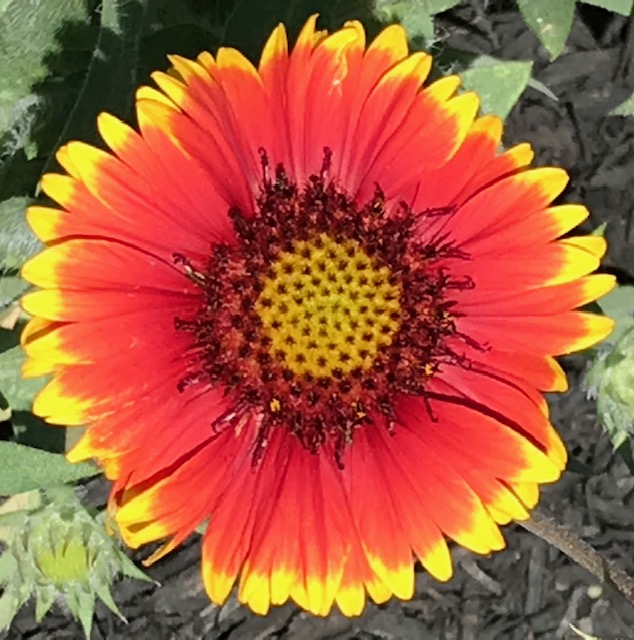
“Every flower blooms in its own time.”
-Ken Petti
Jody Glasser Sobol
Photographer
Medical Student Mom
Voices in Humanism Advisor
Voices in Humanism
BE LIKE BONNIE
Bonnie Bowen, artist, ‘spreading joy with her whimsical watercolors’ during the pandemic. OSU class of 1951
“I never dreamed it would take off like it did. All I do is draw the pictures.”
— Bonnie Bowen, artist

Bonnie Bowen, center, surrounded by fans wearing the O-H-I-O T-shirt of her design.
Bonnie Bowen’s art has indeed taken off with sometimes 14,000 to 25,000 views a day on her Facebook page titled: “Bonnie Bowen #belikebonnie.” Her aspiration with the paintings, she said, is to “spread happiness, comfort, and hope” during the pandemic.
The painting posts began March 24, 2020 at the suggestion of her daughter Betsy Bowen Hampton. What began as an idea to help her mother get through whatever was coming next with COVID restrictions, has become a massive sensation with fans such as Dr. Amy Acton and Governor DeWine. There have been television appearances and newspaper stories. Bonnie has been contacted by a national talk show for a possible appearance. The most popular paintings have been of Dr. Amy Acton and her daughter demonstrating safe distance, and the O-H-I-O med staff painting.


Themes in the beginning of the series were tributes to the medical staff and frontline workers and along came happy-making beach bunnies enjoying a glass of wine, cavorting families, movies like the BLUES BROTHERS, and even one of Dr. Rustin Moore, dean of the Ohio State University’s College of Veterinary Medicine.


The paintings have continued everyday and the comments from the posts reassure Bonnie that her work is potent medicine for the heart and soul.
One painting is of her dear friend Donna Clawson who has needed to isolate during the pandemic. She is looking out her window. Many people commented that the image reflected the feeling of their own isolation.
Comments on the Facebook page confirm that Bonnie’s art is a real shot in the arm, an assist to the vaccine. Comments such as: “Bonnie, just what I need on a gloomy day!” “Anything by the beach and water always perks me up.” “I do look forward to your delightful drawings. Thank you for your gifts of joy.” “Started my day off with a big smile.” “You are such an inspiration to me and so many more.”
One woman expressed her gratitude for the walking on the sun picture. She said her brother had died the day before and she was comforted thinking of him also walking on the sun.
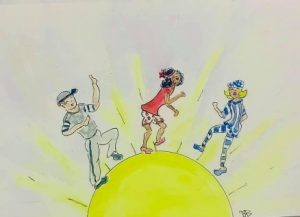
When Bonnie posted the OSU cheerleaders in a pyramid formation, the comments ranged from, “Team Work” to “Were you a cheerleader, Bonnie?”


Bonnie was not an OSU cheerleader but she knows how to raise spirits and rally the team. She took to heart the April 2020 statewide message that we should “end this together and be safe, stay home.” She puts these COVID guidelines into her art.
Bonnie is an attractive, vivacious, talented, funny, and intelligent woman, who happens to be 91. The “#belikeBonnie” on her Facebook page derives from daughter Betsy’s childhood friends, (who remain her friends to this day), who love Betsy’s mom and want to emulate her joie de vivre. Betsy helps Bonnie with social media and increasing requests for interviews and products. Betsy comes from a marketing background.
Betsy said, “Mom has a great attitude toward life. She feels there is a reason for whatever happens, and she takes everything in her stride, no matter what. She is happy 99.8% of the time, even in the worst of times. She clearly has sipped from the fountain of youth.”
Bonnie’s doctor agrees that Bonnie is a walking-talking age defier. He once asked her what the secret of her enduring youthful spirit is. Bonnie explained she enjoys wine with dinner. The doctor asked, “What kind of wine do you drink?” Bonnie answered, “Chardonnay.” The doctor told her he was going to buy some Chardonnay.
Charities like the Red Cross and Huckleberry house have benefitted from t-shirt and greeting card sales. More plans are in the works for prints, a calendar, and a book.
None of this might have happened had it not been for Mrs. Buck, Bonnie’s 3rd grade teacher whom Bonnie idolized. Mrs. Buck asked Bonnie to draw pilgrims on a mural in the school for Thanksgiving. Bonnie’s love and practice of art started there and continued at Ohio State where she majored in education with a minor in art.
Her ideas spring from her family life, her friends, the heroics of frontline workers, and from her Facebook fan comments. She was preparing her painting for another post before this interview and because rain was in the forecast and the song lyrics, “Raindrops keep falling on my head” emerged from her mind, she conjured a lovely lady in a flowery raincoat with matching umbrella prepared for come what may.
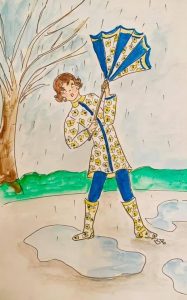
Into every life a little rain will fall. Nine years ago Bonnie was widowed. She and her husband, Grant, had known each other from the ages of 2 and 3 years old. They were married after college. A second great grandchild is on the way.
In September 2020, COVID struck Bonnie. It was a stretch of a few weeks before Bonnie got her energy back and Betsy knew her mom was better when she started painting again. “I like to bring sunshine into lives,” Bonnie said. Her fans brought sunshine to Bonnie with 100,000 Facebook well-wishes. The community of #belikeBonnie are all helping each other through, much like the people in Italy singing off their balconies in the evening, also captured by artist Bowen.
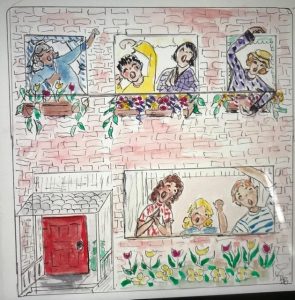
Bonnie is grateful for her education at Ohio State. She is in complete awe and admiration for the heroics of the essential workers. She has a special message for all of the staff at the hospital: “Thank you for the help you give people and all the time you spend saving so many lives. It is truly remarkable.” She would also like everyone to know, there is light at the end of the tunnel.
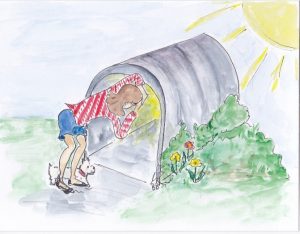
Better Days Ahead
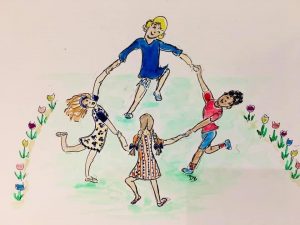
Patricia Wynn Brown
Writer and Performer
Medicine and the Arts Board
Author of: ESSENTIAL STORIES: Medicine During COVID-19 and the Lives of Practitioners at OSU Wexner Medical Center
Voices in Humanism
Nancy Smith, R.N.
Quality Improvement Coordinator, Ohio Reformatory for Women Physicians for Human Rights, OSU House Call Forum
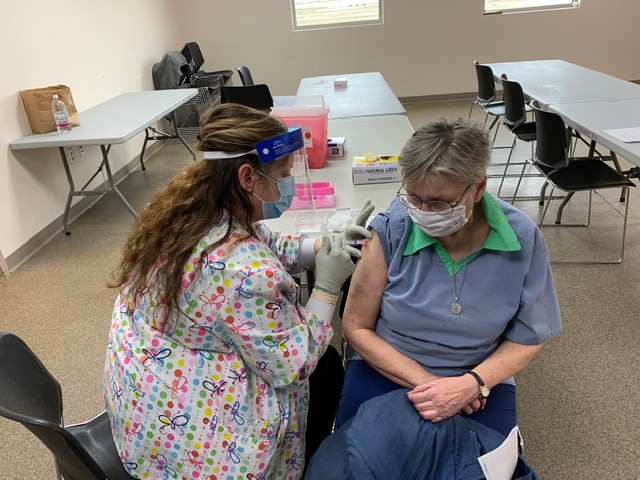
“The Salt of the Earth”
“The salt of the earth” phrase has biblical origins that refer to the value of salt in those times as analogous to virtuous people. The message to the fishermen, shepherds, and laborers was that basic fundamental goodness is to be valued and that we are all of worth, not only the elevated classes.
The women receiving the COVID vaccine shots had tears in their eyes. They felt fortunate. “It gave me chills,” said Nurse Nancy Smith.
“They are so tired of being in quarantine having not seen their families in person for 10 months,” Nancy said. “I explained to them that the best and brightest in the world have given you this gift of the vaccine and that you are so brave to take it and help save millions of lives.”
The women Nancy is speaking of are the elderly inmates at the Ohio Reformatory for Women (ORW) in Marysville, Ohio, the first there to receive the vaccine. Their hospital treatment center is at Ohio State.
Nancy is also part of the ORW medical team, along with Warden Teri Baldauf, Warden’s Assistant Clara Golding-Kent, advisors, five inmates, and five released women who meet on a regular basis with the OSU medical students of the Physicians for Human Rights sub committee to discuss the health needs of incarcerated women. The group is called HOUSE CALL.
Nancy became a nurse in 1994 and has held a position at ORW for 24 years. She has moved up through the ranks at ORW to now being in charge of a mind boggling number of health related things, COVID being one of them, such as policies, standards, and resources, with the title, Quality Improvement Coordinator. “The staff calls me Google,” she said with a giggle. Nancy ‘knows the ropes.’
“When asked to join the OSU HOUSE CALL forums I thought that I did not need one more meeting to attend,” Nancy recalled. “But the forums have helped me to step outside my role and meet and listen to the medical students. It has such great value and it injects a sense of purpose into my work. It managed to invigorate my career.”
She is personally and professionally aware of what a toll the pandemic has taken. “We have a lot of resources for self-care but I can see it in the nurse’s eyes working those 12-16 hour shifts and dealing with PPE all day. Prison is not easy on a good day and with the pandemic it is a struggle. I know what is happening when a nurse goes to the bathroom and comes out with her eyes all red from crying.
Nancy credits the Ohio Department of Rehabilitation and Corrections Director Annette Chambers-Smith with her explicit instructions for immediate and expeditious inmate care when the pandemic struck, who ordered maximum clinical resources for the sickest people. Nancy said, “We restructured, eliminated what was not absolutely necessary, and made every appointment count.”
ORW, as of this writing, has had no fatalities in a prison population of about 2000. Across the other 26 Ohio prisons, there have been 132 deaths.
Nancy greatly appreciates OSU for their extraordinary expertise in saving a critically ill ORW COVID patient inmate.
“This inmate went to OSU, with multi organ failure and was in the ICU months. With the machines and skills of the technicians and nurses and physicians at OSU, she was saved. I was so afraid for her. We all worry over our patients when they are at the hospital from Warden Baldauf to the nurses on the floor. Covid took that worry to a much higher level” Nancy said. She also noted that before an ORW woman goes to the hospital a prison nurse must practice exemplary fine-tuned clinical skill and critical thinking skills.
“Being a nurse in a prison is almost like being a country doctor. You need to know about everything. Also, I’ve known some of these women for 20 years or so, and they trust me,” she said. Trust in sharing personal history by women inmates is a significant element, and can be a stumbling block, in their health care assessments and diagnoses. Without trust, many of the women develop feelings of being marginalized or have those already existing feelings magnified.
In addition, “Our nurses need to know all of the clinical fundamentals. We do EKG’s and draw blood. We cannot call another department for help. It is hands-on nursing at its finest. You have to be at the top of your game to be a nurse here,” Nancy said.
You also must possess compassion and perhaps, according to Nancy, the drive to serve in your DNA. Nancy grew up with both parents working in housekeeping at a hospital. Nancy was a “Candy Striper” and loved everything about the hospital environment, “with those white coated docs zooming by.”
For many of the inmates, prison has been their saving grace and as ORW Warden Baldauf often says, “We want the women to come out much healthier than when they came in.” As many women inmates report, “prison saved my life.”
Nancy recognizes the medicinal value of analyzing what the women have endured as part of their assessment. Reading some of their histories is sometimes so traumatic that Nancy needs to take a bit of time, drink a cup of tea, to recover from the horrors they endured and survived.
Some of the inmates have never had medical care. Nancy recalls one young woman in her mid 20s who will remain etched in her mind. “She came in with the complaint of vaginal bleeding. She appeared to be the picture of health in every way. This was a time when gang violence brought most of the women in, and now it is addiction. She was in tears, sobbing, and certain she had cancer and was dying. I asked about her menstrual history. Turns out she was the victim of human trafficking. Because of the stress, malnutrition, and the birth control pills she had been on from a young age, she had never had a period in her life. After six months in prison, her body had settled down and unbeknownst to her, her period began.”
When Nancy was considering taking a position at ORW, Ms. Mary Neal Miller, then the health care administrator, used that biblical reference regarding the “salt of the earth” to convince Nancy that we are called to add value to the world and to be a light to those who need it most. Nancy accepted the challenge.
“The first day on the job I was hooked,” said Nancy. “I am working at the best prison in the state. There is nothing like experiencing women’s health as we do here. God put me where I need to be. This is my place. This is my purpose.”
Patricia Wynn Brown
Writer and Performer
Medicine and the Arts Board
Author: ESSENTIAL STORIES: Medicine During COVID-19 and the Lives of Practitioners at The OSU Wexner Center
Voices in Humanism
Overwhelming
A friend
of a friend
going into hospice
A particularly
poignant
paragraph in a novel
about loss
An email with
notification of
transplant de-listing
Senseless killing
unrecognized
by those who swore
to protect us
Sometimes this world
takes
too much.
Jessica Rutsky, MD
Pediatric Gastroenterology Fellow
Cincinnati Children’s Hospital Medical Center
Voices in Humanism Board
Voices in Humanism

Jodie Makara (pronouns: ze/zir/zirs)
OSU College of Medicine Class of 2023
Ze strives to bring more knowledge and awareness of LGBTQ+ identities and gender inclusive language to the medical field.
Jodie has brought both poetry and drawing into the Voices Collection.
Voices in Humanism

Bethany Lockwood, MD
Palliative Medicine Faculty
OSUCOM Class of 2013
Poet
Graphic Design: Kate Sivard, @lifeloveandlettering
Voices in Humanism

Mask
This piece was donated to the American Academy of Family Physicians Foundation in 2020.
Funds from the AAFP Foundation are used “To advance the values of Family Medicine by promoting humanitarian, educational and scientific initiatives that improve the health of all people”.
Brian Bachelder, MD
Past President, Ohio Academy of Family Physicians
Hometown: Mount Gilead, Ohio
Artistic Media: Foiled Stained Glass

© 2026 The Ohio State University - University Libraries
1858 Neil Avenue Mall, Columbus, OH 43210
Phone: (614) 292-OSUL (6785)
Request an alternate format of this page | Accessibility | Privacy Policy | Contact Us |


Recent Comments