Category: Education (page 4 of 6)

Seeking Scholar in Residence Applicants

The Medical Heritage Center at the Health Sciences Library, The Ohio State University is seeking applicants for its scholar-in-residence program for a flexible time period between July 1, 2012 and June 30, 2013.

Founded in 1997 as a partnership effort between the Columbus Medical Association Foundation and The Ohio State University, the Medical Heritage Center collects, preserves, and promotes the rich health sciences history of central Ohio. Part of the institution’s mission is to “provide an environment for the academic and clinical communities to study and research meaningful historical records for the education and understanding of the entire health community.” The scholar-in-residence program is a key part of this mission.

The Medical Heritage Center maintains a rare book, archival, and artifact collection that speaks to the development of central Ohio’s health sciences history.  The collection is particularly rich in documenting innovation in the areas of medical education, dentistry, nursing, nuclear medicine, homeopathy, and surgery. The Nathaniel Coleman Rare Book collection contains over 12,000 volumes representing limited edition and one-of-a-kind references and prints dating back to 1555. The scholar will also have access to the rich holdings of The Ohio State University and regional libraries. The Medical Heritage Center’s archives currently include papers and memorabilia from regional and nationally recognized institutions, organizations, and luminaries such as William G. Myers, PhD, MD; Arthur G. James, MD; Charles Doan, MD; and Robert Zollinger, MD. The artifacts collection represents medical equipment used as early as the 1800’s, and range from those now perceived as quackery to those that were truly innovations at their time.

Suitable potential scholars can come from a variety of backgrounds (i.e. students, clinician historians, PhD historians) and each application will be reviewed based upon the quality of the application and proposed use of historical collections. Preference will be given to scholars whose research is directed toward local or regional medical historic issues. Use of the in-house archival and rare book collections is suggested but not limited to the collections of the Medical Heritage Center. The intent to publish in nationally-known presses and peer-reviewed journals is highly essential. Scholars will be expected to provide a mid-point and final report discussing the progress and result of the residency project. At least one presentation and publication is expected from a successful scholar residency.

The scholar-in-residence program provides a stipend up to $5,000 to support the activities of the scholar. This funding is provided by the Columbus Medical Association Foundation endowment for the Medical Heritage Center and can cover but is not limited to equipment, travel, support staff, publication costs. Scholars also receive office space, basic office equipment, and extensive access to the collections of the Medical Heritage Center.

An application package should be submitted for consideration by March 30, 2012, and a successful applicant will be decided upon by the Medical Heritage Center advisory committee by April 30, 2012. For more program details, including an application package, please contact Medical Heritage Center Head Curator Judith Wiener at 614-292-9273 or wiener.3@osu.edu.
NLM History of Medicine Finding Aids Consortium

The Medical Heritage Center has joined the History of Medicine Finding Aids Consortium! The Consortium is a pilot project of the National Library of Medicine to explore the feasibility of crawling, indexing, and delivering web accessible content from external institutions in a union catalog format.

This is an amazing tool for medical and allied health researchers that simplifies the time it takes to search multiple repositories holdings as all participating repositories are searched at one website. The website for the Consortium is: http://www.nlm.nih.gov/hmd/consortium/index.html

Starling-Loving University Hospital

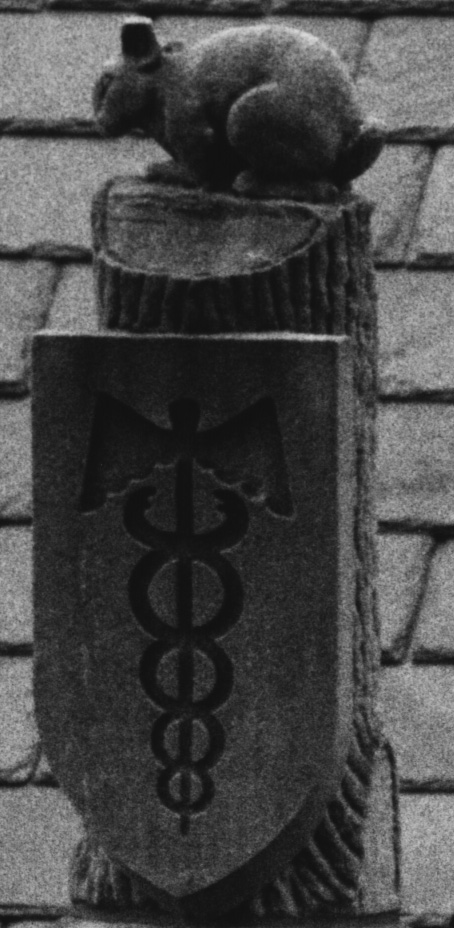
Bunny Gargoyle

In 1917, the Ohio State University Board of Trustees announced that the abandoned homeopathy building would be incorporated into a new hospital for the medical school. A modified English Tudor addition to the homeopathic building made the hospital operational in 1924. The building was renamed Starling-Loving University Hospital in honor of Mr. Starling, a community leader and benefactor of Starling Medical College and Dr. Loving, dean of the OSU Medical School (1880-1905).

By 1926, with the addition of three wings, the hospital housed 296 beds, an operating amphitheater, laboratories, a maternity department and an outpatient clinic. The main purpose was clinical teaching.

When The Ohio State University Hospital was built in the 1950’s, all hospital practices moved into it. Starling-Loving University Hospital was renamed Starling Loving Hall on July 14, 1961. It no longer serves as a hospital facility but rather houses offices and classrooms. The original building has had 5 additions over the years.

The building also features six gargoyles: bunny, cow, monkey, pelican, cat and horse.

St. Francis Hospital

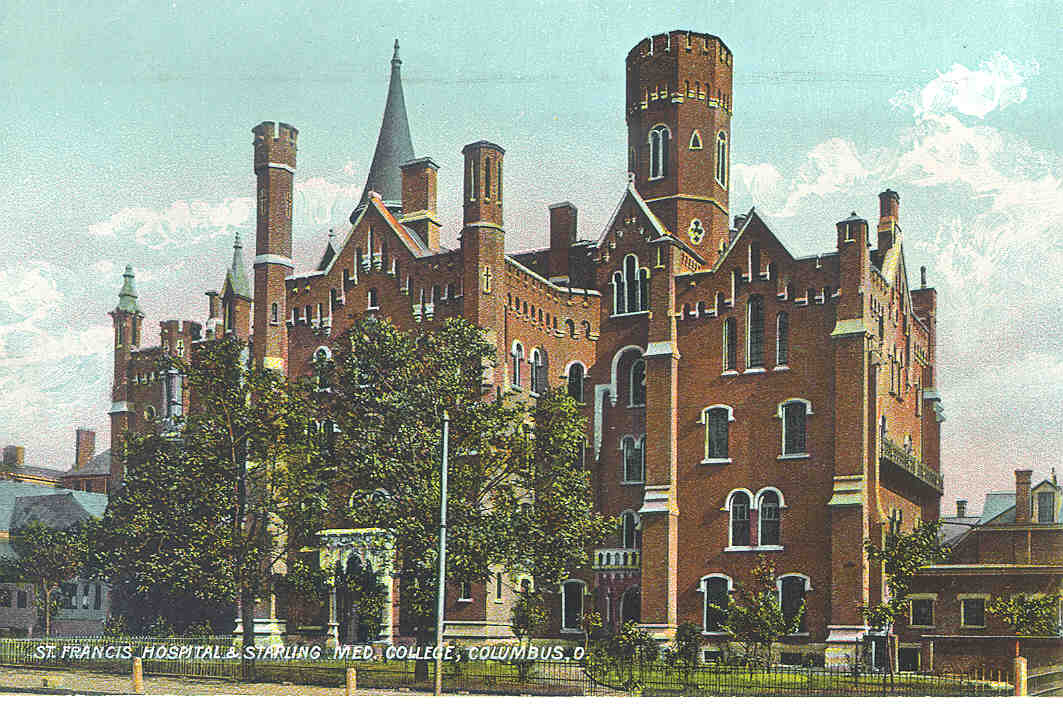
St. Francis Hospital and Starling Medical College, c. 1865

Built in 1847 at 311 East State Street, this Norman Gothic structure was the first combined medical school and hospital in the United States (St. Francis Hospital/Starling Medical College). Initially lacking funding to complete the hospital part of the building, Dr. Richard L. Howard, a Starling Medical College trustee, provided money to open the “Howard Infirmary.” Unfortunately, managing this facility proved to be overwhelming. The infirmary closed in the 1850s.

Because of the lack of medical facilities in Columbus, local physicians organized a move to bring a group of nuns to the Columbus community to serve as health care workers in 1861. In February 1865, a 99-year lease was granted to the Sisters of the Poor of St. Francis to operate St. Francis Hospital.

Homeopathy Hospital


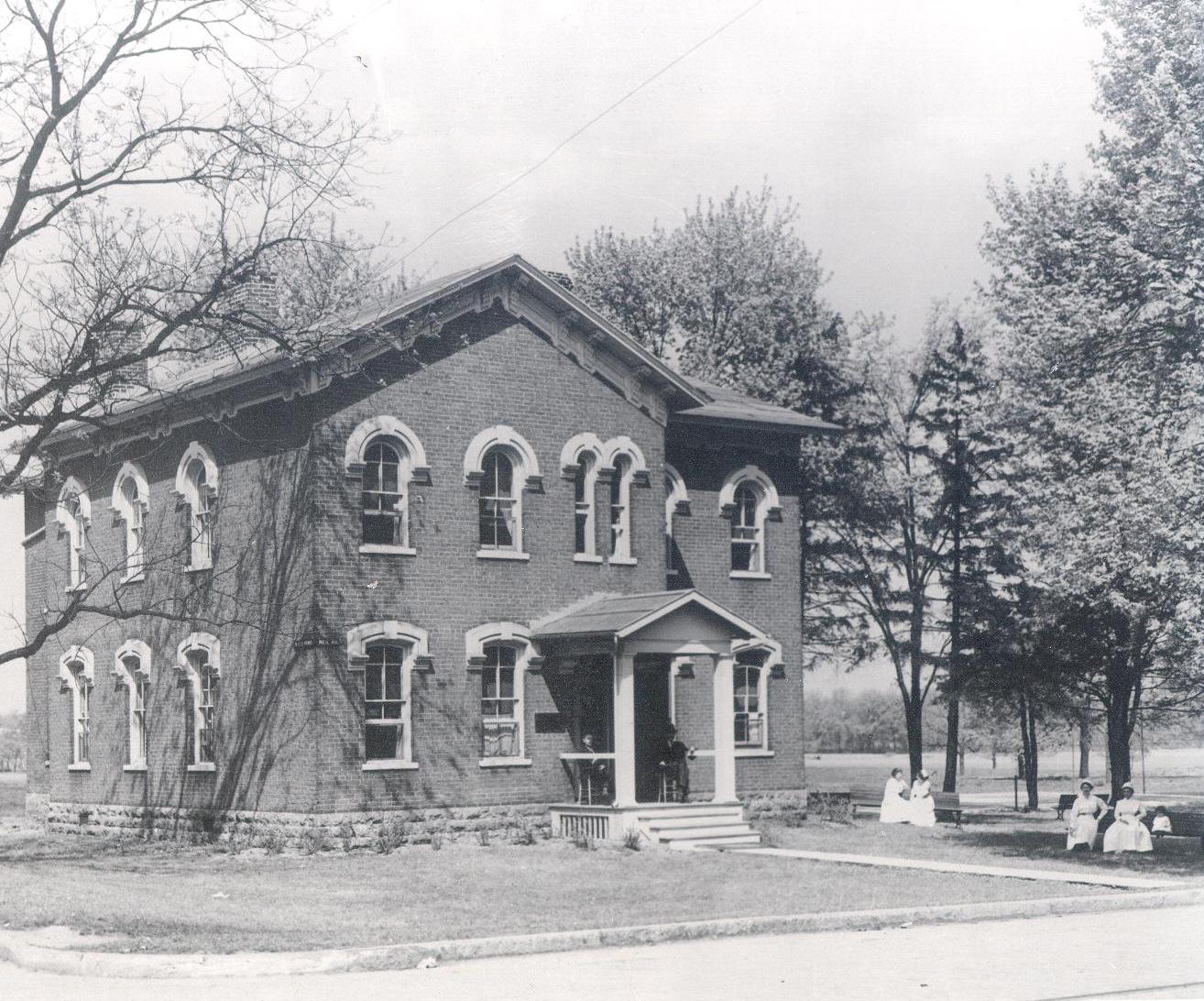
Homeopathic Hospital, circa 1914

Homeopathy is a form of what is now called alternative medicine that attempts to treat patients with heavily diluted preparations. The first homeopathic schools in the United States opened in 1830. By 1900, there were 22 homeopathic colleges and 15,000 practitioners in the United States. From its inception, however, homeopathy was criticized by mainstream science and the last school in the U.S. exclusively teaching homeopathy closed in 1920.

The Ohio State University had a College of Homeopathic Medicine. It was in operation from 1914 to 1922. The Homeopathic Hospital, stood on the corner of 10th and Neil Avenues (the present location of Newton Hall), originally served as a dormitory and was converted to clinical use as the Hospital in 1914. This was the first hospital on campus and, by 1921, there had been a total of 20,000 bed days and over 3,800 outpatients and 1,800 inpatients served by this facility. The Hospital was staffed by nurses with Jessie Harrod as chief nurse and a staff consisting of an assistant at night, a teacher of surgical nursing, a house physician, and eight student nurses. Starling-Loving University Hospital (now known as Starling Loving Hall) was built in 1917 to replace the Homeopathic Hospital on 10th and Neil. In 1922, after the University Board of Trustees voted to stop operating two colleges of medicine and the college of homeopathic medicine was discontinued, Starling-Loving University Hospital served as the main hospital on campus. The Homeopathic Hospital on the corner of 10th and Neil served as Children’s Hospital.


Protestant Hospital

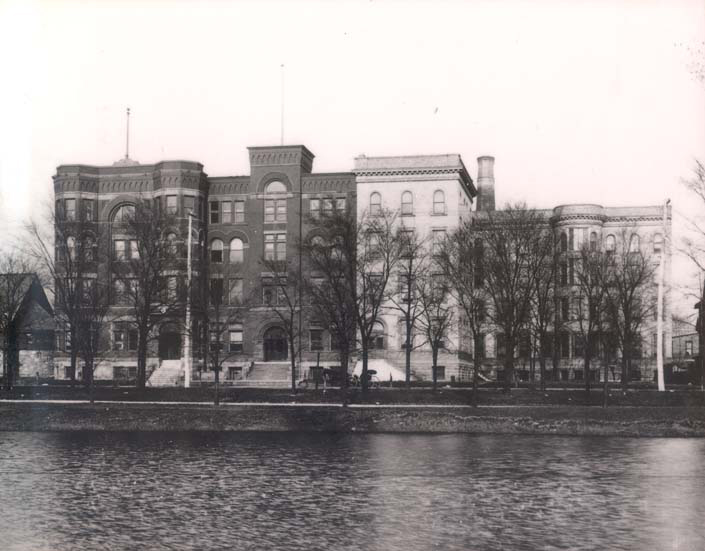
Protestant Hospital in 1898

After outgrowing its original location on Dennison Avenue, Protestant Hospital moved to a new facility at 700 North Park Street in 1898. The site consisted of a large five-story building and was incorporated March 18, 1891 by the Methodist Episcopal Church. Because the Ohio Medical University (1892-1907) financially supported the hospital after its relocation, the University was given a perpetual lease for clinical privileges.

Protestant Hospital was renamed White Cross Hospital in 1922. Eventually modernization caught up with the physical aspects of the hospital and this site was abandoned in 1961 as its successor Riverside Methodist Hospital opened on Olentangy River Road. The Protestant/White Cross Hospital building was demolished in 1970. This location on Park Street is now a residential complex, Victorian Gate Condominiums.

*Please note that the water in the foreground of the image is the lake at Goodale Park, on the corner of Buttles Avenue and Park Street.

St. Anthony’s Hospital

St. Anthony's Hospital, c.1910s

St. Anthony’s opened in 1890 under the direction of the Sisters of the Poor of St. Francis. The hospital was located at Hawthorne Street and Taylor Avenue (site of present day Ohio State University Hospital East). There were accommodations for over 200 long-term critically-ill patients, with no inside rooms. In 1904 an additional floor was added. In 1939 a 3-story wing increased bed capacity to 270.

Children’s Hospital

Children's Hospital, 1924

Hospitals for children began to appear in the United States in the late 1800s. Members of the King’s Daughters of St. Paul Episcopal Church initiated the movement to secure a children’s hospital in Columbus in 1891.

The first Children’s Hospital building opened February 1, 1891. The prevailing color scheme was blue and white, carried out in staff uniforms, chinaware, linens, bedding, etc. Originally Children’s Hospital included four beds. Six more were added almost immediately. The hospital was open to patients between the ages of one and sixteen; no patient could stay longer than three months; and no cases of infectious disease were accepted.

Eventually, the hospital outgrew its original building and moved to new facilities in 1924 at 17th and Stone Streets, fronting Livingston Park. The hospital still exists although as a much larger facility and is now Nationwide Children’s Hospital. It is home to the Department of Pediatrics of The Ohio State University College of Medicine.

Frank H. Netter, MD

Frank H. Netter, MD is recognized as the foremost medical illustrator of the human body and how it works. Netter was born in New York on April 25, 1906. In high school he obtained a scholarship to study at the National Academy of Design. After further studying at the Art Students League of New York and with private teachers, he began a commercial art career. He quickly achieved success and was doing work for the Saturday Evening Post and The New York Times. At the urging of his family, Netter gave up art and studied to be a surgeon at New York University.

Netter found that it was easier for him to take notes in pictures; and, soon faculty members recognized his artistic talents, and Netter began to pay for part of his medical education by illustrating lectures and textbooks. Netter graduated in 1931 opening a private surgical practice. He continued to accept art commissions to make money until his practice got off the ground. Through his art career he was making more money than through his surgical practice, so he gave up the practice.

In 1938 Netter was hired by the CIBA Pharmaceutical Company to work on a promotional flyer for a heart medication. He designed a folder cut in the shape of and elaborately depicting a heart, which was sent to physicians. Many doctors wrote back asking for more heart flyers without the advertising copy. Netter went on to design similar product advertisements depicting other organs. When that project ended, Netter was commissioned to prepare small folders of pathology plates later collected into the first CIBA Collection of Medical Illustrations. Netter went on to illustrate a series of atlases that became his life’s work. They are a group of volumes individually devoted to each organ system, which cover human anatomy, embryology, physiology, pathology, and pertinent clinical features of the diseases arising in each system. Into his eighth decade, Netter continued to create medical illustrations, it is said that his portfolio includes over 4,000 works. Netter died September 17, 1991 but his work lives on in books and electronic forms that continue to educate healthcare professionals worldwide.

The Medical Heritage Center rare book collection contains three of Netter’s works: The Ciba Collection of Medical Illustrations (1948); A Compilation of Paintings on the Normal and Pathologic Anatomy of the Nervous System (1958); and, The Vital Organs in Hypertension (1968).

Hawkes Hospital of Mt. Carmel

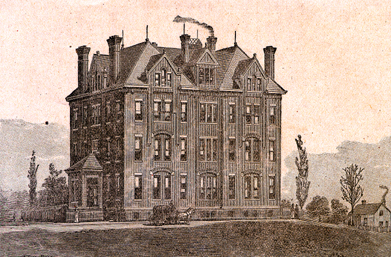
Hawkes Hospital, 1886-1889

Hawkes Hospital of Mt. Carmel was founded by Dr. W. B. Hawkes in 1885. He donated the lot, 150 feet square, and gave $10,000 in United States Government bonds. Before the building was completed Dr. Hawkes died, and Dr. John W. Hamilton (1823-1898) completed the work. The hospital was located on West Street and Davis Avenue.

Dr. Hamilton secured the services of the Sisters of the Holy Cross and Mother Angela, and formally opened the Hospital on July 5, 1856.

The first addition to the hospital was made in 1891. At that time the building was enlarged to make room for more patients.

The corner-stone for this building was blessed by Bishop Watterson on May 31, 1891.

In 1906 a second building adjoining the old one was started. It contained a chapel and 120 additional private rooms for patients. It was on the 20th anniversary of the founding of the hospital that Bishop Hartley broke ground for this wing.

Another building, consisting of 120 rooms, with recreation halls, library and three classrooms, was erected, and opened on February 2, 1921. This was the home for the student nurses. In 1934, on a lot to the west of the hospital, and connected with the hospital, a building for convenience of the Sisters was erected. It was a gift of Mrs. Neill Darrow.

The Training School for Nurses was opened on September 15, 1903. The first graduates received their diplomas in 1906. Eight Sisters were included in the class. The Training School was affiliated with the New York Board of Regents in 1922, and with Western Reserve in Cleveland in 1928. In 1934, there were 114 nurses and 26 Sisters on the service roll of the hospital.

The hospital was one of the first to meet the requirements of the American College of Surgeons in 1919 and was recognized as a Class A hospital. In 1934, it was equipped to take care of 239 patients, including 25 bassinets. The hospital was operated in connection with the Columbus Medical College (1876-1892).

Older posts Newer posts