
McKinley Hospital opened in March 1921 in the former Neil-Dennison home, located along North Park Street. The typical room had brown mahogany furniture, which replaced the traditional white hospital furniture. The hospital had 50 single patient rooms. The six-story building was designed after the “ward-less” concept, which was intended to make patients and visitors feel like they had entered a well-conducted home.
Year: 2011 (page 4 of 6)
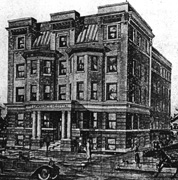
Lawrence Hospital, c.1915
In 1899 Lawrence Hospital opened its doors for the treatment of diseases peculiar to women especially cases requiring recourse to surgery. Three years after opening, the hospital began treating men and children as well to offset costs. The hospital was located on East Town Street, in close proximity to St. Francis Hospital, in an old home purchased by Dr. Lawrence. Supported by several businessmen, the hospital provided charity service to about 50 percent of their clients. The original Lawrence Hospital closed its doors in 1921 and moved its services to McKinley Hospital located on East Broad Street between Grant and Cleveland Avenues. Over 7,000 patients were seen and 5,000 major operations were performed during its 21 years of service with only 41 mortalities.
Frank H. Netter, MD is recognized as the foremost medical illustrator of the human body and how it works. Netter was born in New York on April 25, 1906. In high school he obtained a scholarship to study at the National Academy of Design. After further studying at the Art Students League of New York and with private teachers, he began a commercial art career. He quickly achieved success and was doing work for the Saturday Evening Post and The New York Times. At the urging of his family, Netter gave up art and studied to be a surgeon at New York University.
Netter found that it was easier for him to take notes in pictures; and, soon faculty members recognized his artistic talents, and Netter began to pay for part of his medical education by illustrating lectures and textbooks. Netter graduated in 1931 opening a private surgical practice. He continued to accept art commissions to make money until his practice got off the ground. Through his art career he was making more money than through his surgical practice, so he gave up the practice.
In 1938 Netter was hired by the CIBA Pharmaceutical Company to work on a promotional flyer for a heart medication. He designed a folder cut in the shape of and elaborately depicting a heart, which was sent to physicians. Many doctors wrote back asking for more heart flyers without the advertising copy. Netter went on to design similar product advertisements depicting other organs. When that project ended, Netter was commissioned to prepare small folders of pathology plates later collected into the first CIBA Collection of Medical Illustrations. Netter went on to illustrate a series of atlases that became his life’s work. They are a group of volumes individually devoted to each organ system, which cover human anatomy, embryology, physiology, pathology, and pertinent clinical features of the diseases arising in each system. Into his eighth decade, Netter continued to create medical illustrations, it is said that his portfolio includes over 4,000 works. Netter died September 17, 1991 but his work lives on in books and electronic forms that continue to educate healthcare professionals worldwide.
The Medical Heritage Center rare book collection contains three of Netter’s works: The Ciba Collection of Medical Illustrations (1948); A Compilation of Paintings on the Normal and Pathologic Anatomy of the Nervous System (1958); and, The Vital Organs in Hypertension (1968).
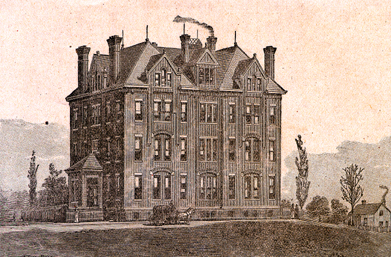
Hawkes Hospital, 1886-1889
Hawkes Hospital of Mt. Carmel was founded by Dr. W. B. Hawkes in 1885. He donated the lot, 150 feet square, and gave $10,000 in United States Government bonds. Before the building was completed Dr. Hawkes died, and Dr. John W. Hamilton (1823-1898) completed the work. The hospital was located on West Street and Davis Avenue.
Dr. Hamilton secured the services of the Sisters of the Holy Cross and Mother Angela, and formally opened the Hospital on July 5, 1856.
The first addition to the hospital was made in 1891. At that time the building was enlarged to make room for more patients.
The corner-stone for this building was blessed by Bishop Watterson on May 31, 1891.
In 1906 a second building adjoining the old one was started. It contained a chapel and 120 additional private rooms for patients. It was on the 20th anniversary of the founding of the hospital that Bishop Hartley broke ground for this wing.
Another building, consisting of 120 rooms, with recreation halls, library and three classrooms, was erected, and opened on February 2, 1921. This was the home for the student nurses. In 1934, on a lot to the west of the hospital, and connected with the hospital, a building for convenience of the Sisters was erected. It was a gift of Mrs. Neill Darrow.
The Training School for Nurses was opened on September 15, 1903. The first graduates received their diplomas in 1906. Eight Sisters were included in the class. The Training School was affiliated with the New York Board of Regents in 1922, and with Western Reserve in Cleveland in 1928. In 1934, there were 114 nurses and 26 Sisters on the service roll of the hospital.
The hospital was one of the first to meet the requirements of the American College of Surgeons in 1919 and was recognized as a Class A hospital. In 1934, it was equipped to take care of 239 patients, including 25 bassinets. The hospital was operated in connection with the Columbus Medical College (1876-1892).
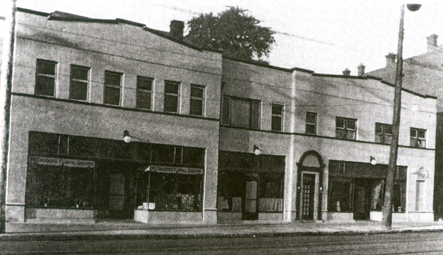
Alpha Hospital and Professional Building, c. 1920s
Alpha Hospital and Professional Building was built in 1920. Located on the corner of 17th and Long Street, this hospital was established by Dr. William Method and Dr. R. M. Tribbitt for the African-American community. It cost $23,000 to erect and functioned as a private institution.

Mabel Roe Codding Clovis, First Female OSU College of Medicine Graduate
There is no known record about The Ohio State University and its predecessor schools (Willoughby Medical College, Columbus Medical College, Ohio Medical University, Starling Medical College, and Starling-Ohio Medical College) stand on admitting women as students, but they must have been open to it as these schools did have female graduates. The exception to this is Willoughby Medical College, in operation from 1834-1847, that did not have any female students.
Starling Medical College (SMC), in operation from 1846-1907, graduated two women. These female graduates were Sarah R. Hall in 1880 and Elizabeth M. Bull in 1907. SMC had no female professors.
Columbus Medical College (CMC), in operation from 1876 to 1892, graduated three women. These female graduates were Miss M. S. Gilmore in 1883, Harriet L. Henderson in 1884, and Miss Aggie M. Eigholz in 1886. CMC had no female professors.
Ohio Medical University (OMU), in operation from 1892 to 1907, graduated 30 women. The first was Marinda Emolyn Blackburn in 1893. OMU had one female faculty member: Leona Ferguson Barnes, M.D., who served as Demonstrator of Anatomy from 1898-1899 and graduated from the University in 1895.
Starling-Ohio Medical College (SOMC), in operation from 1907-1914, graduated six women. The first two were Mabel S. Richards and Bessie Lucretia Sweet in 1908. SOMC had no female faculty members.
The Ohio State University College of Medicine founded in 1914 had in its first 20 years 55 female graduates. The first was Mabel Roe Codding Clovis in 1915. The first female faculty member was Vera McCoy Masters, B.Sc., M.A., who was an Instructor of Bacteriology from 1917-1921, then an Assistant Professor from 1921-1924.
Speaker Joan Pryor-McCann, PhD, will present “Florence Nightingale: Her Life, Her Legacy” at the annual Friends of Nursing History lecture on Thursday (April 28). The talk will discuss Florence Nightingale’s personal motivation to become a nursing leader and the changes in nursing and health care that have occurred as a result of Nightingale’s work.
A reception will be held at 4 p.m. with the lecture at 4:30 p.m. in the Ross Heart Hospital Auditorium. This event is co-provided by the Medical Heritage Center Friends of Nursing History Steering Committee and Ohio Nurses Foundation. One continuing education credit will be awarded to nurses. This event is free and open to the public. Call 292-9966 for additional event information.
Below is the transcription from a letter in the Richard L. Meiling, MD Collection.
Mr. John W. Galbreath
October 13, 1971
Dear John:
Again, my deep appreciation for the kind invitation to attend the World Series game on Tuesday in Pittsburgh. It was indeed a most enjoyable day and I was happy that I could be present when Pittsburgh won.
This was my first World Series game, and both Liz and I spoke about the events some 11 years ago when you were so kind as to invite me to accompany Liz as her obstetrician to the game. I’m still most pleased that we didn’t make the trip 11 years ago–that all came out well–and that I finally, in 1971, saw Pittsburgh again in the World Series. We will be pulling for them to take the Series this weekend.
Sincerely,
Richard L. Meiling, M.D.

Robert Zollinger
Robert Milton Zollinger, M.D., 1903 – 1992
Robert Milton Zollinger, M.D. was one of the giants of American Surgery. With a career that spanned much of the 20th century, Dr. Zollinger was respected by his peers, feared by his students and loved by his patients. Zollinger had a knack for being successful at whatever he did. He was the president of almost every society he belonged to, including the American Board of Surgery, the American Surgical Association, the American College of Surgeons and even the American Rose Society.
Born September 4, 1903, Zollinger was raised on his family’s farm in Millersport, Ohio. He attended grade school in a one room schoolhouse a mile from his home. For high school, he had to travel three miles into town, so he rode his pony, Bob, and stabled him at the barbers during classes. Zollinger was industrious, even at an early age. Utilizing his pony and a cart, he developed a thriving business delivering milk and vegetables from the farm to his neighbors. This was considered his job and he had to tally his receipts each night after supper with his parents. Besides running his business, he also found time to letter in basketball while in high school. Zollinger learned all of the plays during lunch, since his delivery route and farm chores kept him from staying after school to practice.
As a young man, Zollinger wanted to attend West Point. That dream faded when he decided to become a surgeon, even though he hated the sight of blood. When he told his parents his plans, his father gave him one piece of advice, “If you’re going to be a doctor, be a good one.” His parents always expressed an absolute confidence that he and his brother Richard would be successful at anything they attempted and they instilled this belief in their sons. This was a trait that Zollinger carried into his adult life, always expecting the best from everyone and keenly disappointed when he did not get it.
Showing early on that he was not afraid to do things differently, Zollinger was the first person from his high school to attend college. He graduated from the Ohio State University in 1925 with his B.A. and earned his M.D. two years later. After graduation, he was offered an internship at the Peter Bent Brigham Hospital (PBBH) in Boston, under the tutelage of another surgical master, Harvey Cushing. Cushing sent Zollinger to Western Reserve in Cleveland for six months before he began his internship to work with one of Cushing’s favorite pupils, Elliott C. Cutler. Their association would span the next twenty years and Cutler would become one of the great influences in Zollinger’s life. At Western Reserve, Zollinger worked in the dog labs as a voluntary assistant. His main job was to classifying Cutler’s collection of brain tumors. This work led to his first publication, an article in the April 1929 issue of The Ohio State Medical Journal.
Zollinger returned to PBBH in 1928 to begin his internship. There he was regarded as a country boy from that “cow town” Columbus. He was determined to know the answer to every question in order to prove that his education was every bit as good as his Ivy League peers. This endeavor proved time consuming, but provided Zollinger with a strong core knowledge of his subject matter. When his internship was over Zollinger renewed his association with Cutler by returning to Western Reserve in 1929 for his residency. That same year he finally married Louise Kiewet; while he had been at PBBH interns were forbidden to marry. Louise supported the couple in their early days of marriage by teaching, since Zollinger was only making $50.00 dollars a week as a resident.
Dr. Cutler returned to PBBH to take over for Cushing as the Moseley Professor of Surgery in 1932. Zollinger went with him as his chief resident and by 1939 he was an Assistant Professor of Surgery. During their time together at Harvard and PBBH, Zollinger and Cutler would publish the first of nine editions of the now famous Atlas of Surgical Operations (the Medical Heritgage Center has 27 volumes in 7 languages of various editions of the Atlas). Zollinger did much of the work on the text; yet, Cutler’s name appeared first on the cover. When Zollinger asked him whose name should be first Cutler had responded that they should be listed alphabetically.
Zollinger joined the army in 1941, when war seemed imminent for the United States. In so doing, he gave up a thriving practice and four years with his family. He felt that if he joined the Harvard Unit so would many of his younger colleagues. Zollinger hoped to be commissioned as a colonel and the commanding officer of the unit. Instead, he was made a major and the Assistant Chief of the Surgical Service. Immediately upon reaching camp in Ireland he called upon his early farm experience and began planting a garden. He had gathered money from everyone in the unit and purchased seeds before they had left the U.S. Because of this foresight he was soon appointed the Post Beautification Officer, a job which allowed him to nurture another of his passions, roses. Over the next four years, Zollinger would rise to the rank of colonel and the command of the 5th General Hospital. He would also earn the Legion of Merit Award, for the development of mobile surgical teams, and Battle Stars for Normandy, Northern France and Rhineland.
Zollinger returned to Harvard in 1946 and was soon offered a position as a professor of surgery at The Ohio State University. Within a year he became the chairman of the Department of Surgery at his alma mater, beginning a nearly thirty year reign. In 1955, working with Edwin Ellison, he discovered the Zollinger-Ellison Syndrome, which dealt with the relationship between non-beta islet cell tumors of the pancreas and diseases of the gastrointestinal tract. He also started the medical illustration division as a part of the Department of Surgery. This was surely influenced by the need for new illustrations for each subsequent edition of the Atlas of Surgical Operations.
Despite his busy schedule Zollinger was the editor-in-chief of the American Journal of Surgery from 1958 to 1986. He traveled the country lecturing on Zollinger-Ellison Syndrome and received numerous awards for his efforts. He was the recipient of honorary degrees from the University of Lyon, France (1965) and held honorary fellowships in the Royal College of Surgeons of England (1965) and the Royal College of Surgeons of Edinburgh (1966). The American Medical Association bestowed their highest honor, the Sheen Award, upon him, recognizing him as the Outstanding Doctor of Medical Science in the United States for 1977. Zollinger was even offered the presidency of The Ohio State University, but turned it down. He felt that he would not have any time left for surgery. Besides, he reasoned, “There are a lot more out of work college presidents than surgeons.”
Zollinger was a difficult taskmaster who expected nothing less than perfection from himself and his colleagues. On rounds he was known to fire a resident on the elevator for some misdemeanor, only to rehire them by the time they had reached the 7th floor. As hard as he was on his students, he was equally kind to his patients. He believed that they should always be the top priority of a surgeon. When he felt that his staff was moving away from that principle, he often felt the need to remind them. He once had a large chart made showing the golf handicaps of each surgery department member, clearly showing where he felt that their priorities lie.
Outside of surgery, Zollinger was a man of many interests. He raised prize-winning gourds. He loved roses and was an accredited rose judge. He constantly grumbled that his frequent lecturing and travel kept his roses from winning first prize. He also developed a passion for photography, which he indulged every winter on Sanibel Island.
Despite his numerous honors and international recognition, Dr. Zollinger never rested on his laurels. Even after his retirement in 1974, Zollinger continued to lecture around the world. He remained involved in the Department of Surgery as Professor and Chairman Emeritus. His quest for excellence continued up until his death in 1992 from pancreatic cancer. Perhaps he is best described in his own words. Once, when asked how he would like to be remembered he replied, “They should write on my tombstone: ‘teacher, surgeon, soldier and farmer.’ And my wife may remember that she says I’m an amusing fellow to live with.”
Women were not initially accepted by society as fit to be physicians; medical schools refused to admit them. In 1847 the faculty at Geneva Medical College (now State University of New York Upstate Medical University) did not want to admit women, but desiring the student body’s support put the issue to a vote. The students jokingly voted unanimously to accept Elizabeth Blackwell as a student, thus making her the first women in the United States to earn an M.D. in 1849. However, it was not until about the 1870s that medical schools slowly began to come around to the idea of accepting women.
Stymied in her attempts to obtain hospital privileges, Blackwell practiced out of her own home and later founded in 1857 along with her sister Emily and Maria Zakrzewska, the New York Infirmary for Women and Children, the first hospital in the United States staffed by women, and offering more women the opportunity for advanced training.
Increasing numbers of women were admitted to medical schools during the mid-1800s. Financial forces aided their entry as supporters of feminism made major contributions to schools accepting women. By the late 1800s, several previously all-male schools were admitting and graduating women and legislators allowed charters of medical schools specifically for women. Social acceptance also grew as women physicians increased their visibility by giving lectures on topics of hygiene. A few women, such as Mary Putnam Jacobi, who consulted at major New York hospitals and was the first woman inducted into the New York Academy of Medicine, came to be regarded by male physicians as peers in professional accomplishment. At the end of the 19th century, more than 7000 women were practicing medicine and another 1200 were in medical school.

© 2026 The Ohio State University - University Libraries
1858 Neil Avenue Mall, Columbus, OH 43210
Phone: (614) 292-OSUL (6785)
Request an alternate format of this page | Accessibility | Privacy Policy | Contact Us |

Recent Comments