Tag: copyright education (page 2 of 2)

Articles of Interest: July-December 2015

This post highlights articles published in the second half of 2015 with a focus on copyright, especially as it pertains to libraries, higher education, and scholarly communication. Links to the full-text articles are provided when available; [OSU full-text] links will connect authenticated users through The Ohio State University Libraries, while [OA full-text] links point to an open access version of the article that should be available to all users.

Did we miss an interesting article? Please share the citation in the comments!

Copyright

Datig, I., & Russell, B. (2015). “The fruits of intellectual labor”: International student views of intellectual property. College & Research Libraries76(6), 811-830 [OA full text] [OSU full text]

Franklin, T. (2015). Copyright and fair use in the digital age. EContent38(7), 8-10. [OSU full-text]

Gordon-Murnane, L. (2015). Copyright tools for a digitized, collaborative culture. Online Searcher39(6), 28-52. [OSU full-text]

Muriel-Torrado, E., & Fernández-Molina, J. (2015). Creation and use of intellectual works in the academic environment: Students’ knowledge about copyright and copyleft. Journal of Academic Librarianship41(4), 441-448. [OSU full-text] ­­­­

Owen, L. (2015). Fair dealing: A concept in UK copyright law. Learned Publishing28(3), 229-231. doi:10.1087/20150309 [OSU full-text]

Shan, L. (2015). Conditional access to music: Reducing copyright infringement without restricting cloud sharing. International Journal of Law & Information Technology23(3), 235-260. doi:10.1093/ijlit/eav008 [OA full-text]

Smith, D. (2015). Finding parents for orphan works: Using genealogical methods to locate heirs for obtaining copyright permissions. Journal of Academic Librarianship41(3), 280-284. [OSU full-text]

Libraries

Christou, C. (2015). Mass digitization and copyright. Information Today32(10), Cover-29. (Periodical) [OSU full-text]

Kawooya, D. k., Veverka, A. a., & Lipinski, T. t. (2015). The copyright librarian: A study of advertising trends for the period 2006–2013. Journal of Academic Librarianship41(3), 341-349. [OSU full-text]

Riley-Reid, T. D. (2015). The hidden cost of digitization – things to consider. Collection Building, 34(3), 89-93. doi:10.1108/CB-01-2015-0001 [OSU full-text]

Schmidt, L., & English, M. (2015). Copyright instruction in LIS programs: Report of a survey of standards in the U.S.A. Journal of Academic Librarianship41(6), 736-743. doi:10.1016/j.acalib.2015.08.004 [OSU full-text]

Wang, Y., & Yang, X. (2015). Libraries’ positions on copyright: A comparative analysis between Japan and China. Journal of Librarianship & Information Science47(3), 216-225. [OSU full-text]/[OA full-text]

Publishing & Scholarly Communication

Quinn, M. M. (2015). Open access in scholarly publishing: Embracing principles and avoiding pitfalls. Serials Librarian69(1), 58-69. [OSU full-text]

Sims, N. (2015). It’s all the same to me! Copyright, contracts, and publisher self-archiving policies. College & Research Libraries News76(11), 578-581. [OA full-text] / [OSU full-text]

Wassom, B. (2015). Navigating the rights and risks in social reading. Publishing Research Quarterly31(3), 215-219. doi:10.1007/s12109-015-9415-6 [OSU full-text]

Wilson, V. v. (2015). The open access conundrum. Evidence Based Library & Information Practice10(3), 116-118. [OSU full text] (From recurring Research in Practice column)

Legislation & Policy Developments

Christou, C. (2015). Copyright independence. Information Today32(7), 1-25. [OSU full-text]

Epperson, B. (2015). Copyright & fair use. ARSC Journal46(2), 293-300. [OSU full-text] (Recurring column in non-traditional academic journal)

Stannard, E. (2015). A copyright snapshot: The impact of new copyright legislation on information professionals. Legal Information Management15(4), 233-239. [OSU full text]

_____________________________________________________________________________________

By Maria Scheid, Rights Management Specialist at the Copyright Resources Center, The Ohio State University Libraries

New iTunes U Course on Copyright

Copyright can be a difficult area of the law to navigate for instructors and can at times serve as a barrier for instructors who are reluctant to include content in their courses or teaching materials for fear of infringement.  To help provide guidance in this area, we have created Copyright in the Classroom, a self-paced iTunes U course that introduces basic copyright concepts all instructors should know. Topics include fundamental principles of U.S. copyright law, rights reserved for instructors as content creators, and permissible use of copyrighted content in different teaching contexts.

At the completion of the course, participants should be able to utilize the resources and information provided to:

  • Recall the requirements for copyright protection;
  • Recognize the exclusive rights provided to a copyright owner;
  • Identify the copyright owner of a work;
  • Assess which statutory exceptions may permit an intended use of a copyrighted work;
  • Locate public domain and openly licensed works and summarize the conditions for the use of such works;
  • Evaluate whether an intended use may constitute fair use and explain the ways in which a fair use argument could be strengthened; and
  • Outline the process for seeking permission to use a copyrighted work.

To view a course description and subscribe (you’ll need to download iTunes), visit https://itunes.apple.com/us/course/copyright-in-the-classroom/id1071533208.

_____________________________________________________________________________________

By Maria Scheid, Rights Management Specialist at the Copyright Resources Center, The Ohio State University Libraries

Copyright in Campaigns

Note: This blog post was updated on 9/14/2020 to include more information on the option for exclusion found in the ASCAP and BMI public performance licenses for political campaigns.

Election Day may still be over a year away but the 2016 Presidential campaign is already underway. As a battleground state, Ohio will experience a lot of political activity over the next 14 months.  Among the anticipated barrage of political ads, full calendar of rallies, and around-the-clock media coverage of campaign activity, we will see our friend: copyright. Copyright protects a wide variety of works—speeches, websites, marketing materials, etc.—so long as the work is original and fixed in a tangible format. This blog will highlight some of the many areas you will see copyright pop up during the campaign season.

Political Speeches:

Original political speeches written by candidates (or speechwriters) receive copyright protection, meaning the author of the speech may exercise control over the reproduction, adaptation, distribution, and performance or display of the speech. Two categories of works are not covered by copyright, however: works that fail to meet the fixation requirement and works created by federal employees within the scope of their employment. This means that speeches made at town hall meetings or political rallies may not be protected by copyright, unless those speeches were recorded or transcribed. It also means that works created by incumbent presidents or U.S. Senators or Representatives, if made within the scope of their employment, lack copyright protection and are free to use. For example, a speech made and recorded by Bernie Sanders within his role as Senator or a report written by Hillary Clinton as U.S. Secretary of State may be used without permission. A work created by a non-federal employee (e.g., Martin Luther King Jr.’s famous “I Had a Dream” speech), however, may still be protected by copyright.

When speeches are televised, the broadcasting entity televising the speech (e.g., CBS, Fox News, C-SPAN, or CNN) may hold a separate copyright in the broadcast recording. This is true even if the speech itself is made by a federal employee within the scope of their employment or is otherwise in the public domain.

Continue reading

Copyright and Accessibility

Many educational institutions, including Ohio State, share the mission of advancing and encouraging the spread of knowledge. At times, however, the exclusive rights of copyright owners can impede this mission by conflicting with the important objective of making works accessible to all, particularly to individuals with disabilities. Even with the emergence of new technologies that facilitate instantaneous copying and dissemination of materials, owner control over reproduction and distribution of works has continued to create an obstacle to the growth of works in formats accessible to individuals with print, hearing, or other disabilities. Statistics from the World Blind Union reveal, for example, that of the approximately 1 million books published per year, less than 5% are made in formats accessible to the print-disabled.[1] Given the significant societal benefit that is achieved by promoting equal access, it is important to understand the provisions of copyright law that currently support the growth of works in accessible formats and identify opportunities for further change.

Current U.S. copyright law lacks a blanket exception for accessibility, relying instead on a patchwork of statutory exceptions and the doctrine of fair use. This blog will cover some of these current key exceptions, as well as potential developments under national and international law.

The Chafee Amendment and Performance of Literary Works under §110

One important provision in copyright law that promotes accessibility to copyrighted works is the Chafee Amendment. The Chafee Amendment (17 U.S.C. § 121) permits an authorized entity to reproduce or distribute copies of previously published nondramatic literary works if the copies are reproduced or distributed in specialized formats exclusively for use by blind or other persons with disabilities.

Authorized entities include nonprofit organizations or governmental agencies “whose primary mission is to provide specialized services relating to training, education, or adaptive reading or information access needs of blind or other persons with disabilities.” The vagueness surrounding the definition of “authorized entity” has contributed to confusion and reluctance to rely on the protections set forth in the Chafee Amendment. Do educational institutions like The Ohio State University, who are bound to comply with the provisions of Section 504 of the Rehabilitation Act and the Americans with Disabilities Act (ADA),[2] qualify as authorized entities? Publishers assert that only institutions who specialize in promoting accessibility (e.g., the National Library Service for the Blind), not educational institutions in general, qualify as authorized entities. Educational institutions, on the other hand, argue that their work and legal obligations under federal law establish them as authorized entities under the Chafee Amendment.

The Copyright Act also provides narrow exceptions for the performance of literary works. Section 110(8) permits certain eligible entities to perform nondramatic literary works by or in the course of a transmission specifically for the print or hearing disabled when the transmission is noncommercial. Section 110(9) permits an authorized radio subcarrier to make a single transmission of a dramatic literary work for the print disabled if the performance is noncommercial and the work was published at least 10 years before the performance.

Current & Proposed Exemptions under the Digital Millennium Copyright Act (DMCA)

Section 1201 of the Digital Millennium Copyright Act (DMCA) prohibits any individual from circumventing technological protections measures placed on a work. For example, you cannot decrypt DVDs protected by Content Scrambling System (CSS). The law, however, provides exemptions to this anti-circumvention rule. One current exemption, in effect from 2012-2015, allows for the circumvention of electronically distributed literary works that are protected by technological measures when those technological protection measures prevent the enabling of read aloud functionality or interfere with screen readers or other assistive technologies. Literary works must be lawfully obtained by a blind or other person with a disability (for nondramatic literary works the work must be lawfully obtained and used by an authorized entity under the Chafee Amendment) and the rights owner must be appropriately remunerated for the price of the mainstream copy of the work. A renewal of this exemption has been requested in the 2015 triennial review.[3]

Another current exemption permits the circumvention of motion pictures and other audiovisual works that are on DVDs protected by the Content Scrambling System (CSS) or distributed by an online service that is protected by technological measures, in order to facilitate research and development of players that are capable of providing captioning or descriptive audio.

The Important Role of Fair Use

The statutory exceptions listed above are relatively narrow in their applications, including limitations on who may reproduce or transmit a work, the type of work that may be reproduced or transmitted, and who may benefit from such activities. One exception in copyright law that has been instrumental in filling in the gaps left by these narrow exceptions and promoting accessibility for copyrighted works has been fair use.[4] A recent decision by the Court of Appeals for the Second Circuit has reinforced the significant role of fair use in increasing the accessibility of copyrighted works.

In Authors Guild, Inc. v. HathiTrust,[5] HathiTrust created a shared digital repository of collection materials from academic and research member institutions, allowing full access to patrons with qualifying disabilities. The district court held this activity was permissible under the Chafee Amendment, stating that educational institutions “have a primary mission to reproduce and distribute their collections to print‐disabled individuals…[making] each library a potential ‘authorized entity’ under the Chafee Amendment.” The court held, however, that HathiTrust was not precluded from relying on the defense of fair use in the event that they were not authorized entities or did not otherwise fall within the permissible categories of the Chafee Amendment. On appeal, the Second Circuit held that providing full digital access to print-disabled patrons was protected under fair use. [6]

International Considerations: Adoption of the Marrakesh VIP Treaty

U.S. copyright law may also be influenced by international agreements. One international treaty directed to making works more accessible is the Marrakesh Treaty to Facilitate Access to Published Works by Visually Impaired Persons and Persons with Print Disabilities (“Marrakesh VIP Treaty”). The Marrakesh VIP is an international treaty administered by the World Intellectual Property Organization (WIPO) which would obligate signatory countries to create mandatory limitations and exception to their copyright laws pertaining to “the right of reproduction, the right of distribution, and the right of making available to the public…to facilitate the availability of works in accessible format copies” for the benefit of people with print disabilities.[7] The treaty would also permit exchange of accessible works across borders by authorized entities serving the blind, visually impaired and otherwise print disabled. Finally, the Treaty provides that contracting parties take appropriate measures to ensure that any anti-circumvention restrictions do not prevent the blind, visually impaired, or print disabled from enjoying any of the exceptions provided for in the Treaty.

The Treaty, adopted on June 27, 2013, will go into force three months after 20 eligible entities have acceded to or ratified the Treaty. There is currently accession or ratification from ten nations. The United States signed the Treaty on October 2, 2013 but has not yet ratified the Treaty.

In Conclusion

Making copyrighted works available in accessible formats can present a challenge to the exclusive rights of copyright owners. Absent a blanket exception that would allow for the creation of accessible formats for all persons with disabilities, individuals and educational institutions must navigate the existing narrow statutory exceptions or rely on a fair use defense in order to make works accessible. While society recognizes the importance of incentivizing creators to create new works, we must also recognize the importance of establishing equal access to those works in order to advance public knowledge and encourage further creation of works.

Accessibility Resources

_____________________________________________________________________________________

By Maria Scheid, Rights Management Specialist at the Copyright Resources Center, The Ohio State University Libraries

[1] Limitations and Exceptions: Access to Books for the Visually Impaired – Background Brief, World Intellectual Property Organization, http://www.wipo.int/pressroom/en/briefs/limitations.html (last updated January 2014).

[2] Section 504 of the Rehabilitation Act of 1973 provides that no qualified individual with a disability, solely by reason of his or her disability, be excluded from participating in, or be subjected to discrimination under any program or activity receiving federal funding. 29 U.S.C. § 794(a). The Americans with Disabilities Act of 1990 requires public entities to make reasonable modifications when necessary to avoid discrimination on the basis of disability. 28 C.F.R. Sec. 35.130(b)(7).

[3] 79 FR 73863 (December 12, 2014).

[4] The House Report on the Copyright Act of 1976 also identifies making accessible copies of works for the blind as an illustrative application of the fair use doctrine (“…the making of a single copy or phonorecord by an individual as a free service for a blind persons would properly be considered a fair use under section 107.” H.R. Rep. No. 94-1476, 94th Cong., 2d Sess. (1976).

[5] 902 F. 22 Supp. 2d 445, 460‐64 (S.D.N.Y. 2012).

[6] 755 F.3d 87 (2d Cir. 2014).

[7] Marrakesh Treaty to Facilitate Access to Published Works for Persons Who Are Blind, Visually Impaired, or Otherwise Print Disabled art. 4, June 27, 2013, TRT/MARRAKESH/001.


Articles of Interest: January-June 2015

This post highlights articles published in the first half of 2015 with a focus on copyright, especially as it pertains to libraries, higher education, and scholarly communication. Links to the full-text articles are provided when available; [OSU full-text] links will connect authenticated users through The Ohio State University Libraries, while [OA full-text] links point to an open access version of the article that should be available to all users.

Did we miss an interesting article? Please share the citation in the comments!


Copyright

Gordon-Murnane, L. l. (2015). The digital public domain. Online Searcher39(2), 10-15. [OSU full-text]

Saw, C. L., & Chik, W. B. (2015). Whither the future of internet streaming and time-shifting? Revisiting the rights of reproduction and communication to the public in copyright law after Aereo. International Journal of Law & Information Technology23(1), 53-88. [OA full-text]


Copyright Education

Dow, M. J., Boettcher, C. A., Diego, J. F., Karch, M. E., Todd-Diaz, A., & Woods, K. M. (2015). Case-based learning as pedagogy for teaching information ethics based on the Dervin sense-making methodology. Journal of Education for Library & Information Science56(2), 141-157. [OSU full-text]

Keener, M. (2015). Contextualizing copyright: Fostering students’ understanding of their rights and responsibilities as content creators. Virginia Libraries61(1), 37-42. [OSU full-text] / [OA full-text]

Lofton, J. (2015). Blogging with students: A vehicle for writing, digital citizenship, and more. School Librarian’s Workshop35(5), 13-15. [OSU full-text]

Schoen, M. J. (2015). Teaching visual literacy skills in a one-shot session. Visual Resources Association Bulletin41(1), 1-12. [OSU full-text] / [OA full-text]


Libraries

Arendt, A., & Fife, D. (2015). Impact of public domain resources on public libraries in the United States. Journal of Librarianship & Information Science47(2), 91-103. [OSU full-text] / [OA full-text]

Band, J. (2015). What does the HathiTrust decision mean for libraries?. Research Library Issues, (285), 7-13. [OSU full-text] / [OA full-text]

Butler, B. (2015). Fair use rising: Full-text access and repurposing in recent case law. Research Library Issues, (285), 3-6.  [OSU full-text] / [OA full-text]

Cox, K. (2015). International copyright developments: From the Marrakesh treaty to trade agreements. Research Library Issues, (285), 14-22. [OSU full-text] / [OA full-text]

Dygert, C., & Van Rennes, R. (2015). Building your licensing and negotiation skills toolkit. Serials Librarian68(1-4), 17-25. [OSU full-text]

Kawooya, D., Veverka, A., & Lipinski, T. (2015). The copyright librarian: A study of advertising trends for the period 2006–2013. Journal of Academic Librarianship41(3), 341-349. [OSU full-text]

Light, M. (2015). Controlling goods or promoting the public good: Choices for special collections in the marketplace. RBM: A Journal of Rare Books, Manuscripts, & Cultural Heritage16(1), 48-63. [OSU full-text]

Smith, D. (2015). Finding parents for orphan works: Using genealogical methods to locate heirs for obtaining copyright permissions. Journal of Academic Librarianship41(3), 280-284. [OSU full-text]

Walz, A. R. (2015). Open and editable: Exploring library engagement in open educational resource adoption, adaptation and authoring. Virginia Libraries61(1), 23-31. [OSU full text] / [OA full-text]


———————————————————————————————————————————————————————-

By Jessica Chan, Rights Management Specialist at the Copyright Resources Center, The Ohio State University Libraries

Creative Commons Licenses: What You Need to Know as a Creator and User

As one of the major open licensing options for copyright owners, Creative Commons (CC) is likely a familiar name to many of our readers. For those that are unfamiliar, CC is a nonprofit organization that offers a number of different copyright license options to copyright owners. A CC license allows a copyright owner to choose how they would like others to be able to use their work, and anybody may use the work for free, so long as they follow the terms of the license. Before using a CC licensed work or deciding to apply a CC license to your own work, you should have an understanding of the scope of the license you are working with. This blog will provide more information on some important points to keep in mind about CC licenses and provide an overview of the license options.

What Do You Need to Know About Creative Commons Licenses?

Whether you are applying a CC license to your own work or using a work covered by a CC license, here are some important things to keep in mind:

9 million websites use Creative Commons licenses

  1. Creative Commons licenses are not an alternative to copyright—a work must be copyrighted in order to be licensed under a CC license. Copyright owners have a bundle of rights that allow them exclusive control over how their work may be reproduced, adapted, distributed and publicly performed or displayed. A copyright owner may decide to transfer some or all of these rights to another or permit others to use the work through a licensing agreement. If a copyright owner chooses to license their work under a CC license, they are not giving up ownership of their work—they are permitting others to exercise one of the copyright owner’s exclusive rights under the terms and conditions listed in the language of the license.
  1. Creative Commons licenses do not limit or restrict any rights granted through statutory exceptions, including fair use. If your use of a copyright protected work would otherwise be allowed through a statutory exception (such as the face-to-face teaching exception, the TEACH Act, or fair use), you may still rely on those statutory exceptions.
  1. Only the copyright owner can place a CC license on the work or authorize another to do so. If third party material  is being used in a new work under a statutory exception or limitation or through permission of the copyright owner, the author of the new work can only license the part of the work to which they claim ownership. In this type of situation, it is important for the author to mark third party content to let others know that the entire new work may not be available under the selected CC license. An author of a new work may avoid this situation by seeking permission from the copyright owner to make the third party material available under a CC license, allowing others to then use the entire work according to the license terms.
  1. Creative Commons licenses are non-exclusive and non-revocable. Anyone is free to use a CC licensed work so long as they abide by the terms of the license. A copyright owner is also free to continue to exercise their exclusive rights, meaning they may simultaneously enter into separate agreements for the use of their works. A copyright owner may decide to no longer distribute their work under a CC license, but because CC licenses are non-revocable, anybody who already has access to the work may continue to use the work under the original license terms.

What Are the License Options?

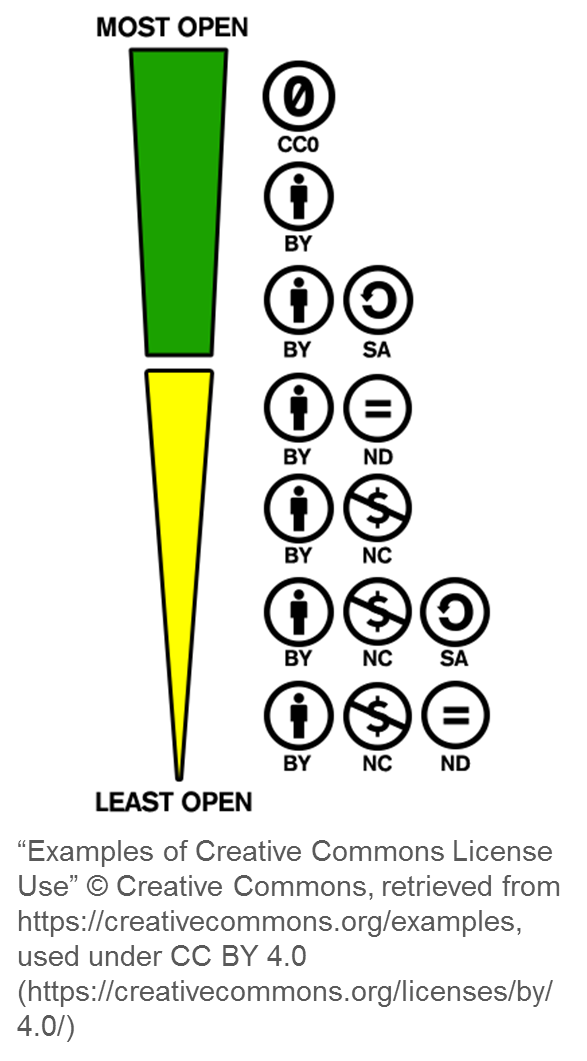
Icon badges for all six Creative Commons license options and the Public Domain tool.

Creative Commons licenses provide copyright owners with a great degree of flexibility in how open they would like to make their work. The various license terms define the ways in which users may freely and legally share, modify, or build upon a copyrighted work.

All CC licenses require attribution. Beyond attribution, copyright owners may choose among a combination of licensing terms. Copyright owners may specify that their work not be used for the primary purpose of monetary compensation (NonCommercial) or that their work not be modified or adapted in any way (NoDerivs). Alternatively, a copyright owner may permit a user to modify, adapt, or build upon their work but specify that any new work created be made available under similar open licensing terms (ShareAlike). Creative Commons also provides a Public Domain Dedication (CC0) tool. This tool allows a copyright owner to dedicate their work to the public domain by waiving all of their copyright and related rights in a work, to the extent allowed under the law. While attribution is not required for CC0 works, it is recommended as a best practice in order to acknowledge the intellectual work of others and to avoid accusations of plagiarism.

Spectrum of openness for Creative Commons licensesFinally, if you are looking for CC works to use, a good place to start your search is with the search function on the Creative Commons website. You may also look through the Creative Commons content directories to view organizations and projects using CC licenses. Many services, including Flickr, SoundCloud, Google, Bing, and Vimeo, provide their own advanced search feature, making the search for CC licensed works quick and easy.

In conclusion, CC licenses are a great resource for copyright owners and users of copyrighted content. As with any license agreement, however, be sure you are clear about the scope and limitations of the license before using a protected work or making your own works available for use by others.

Interested in learning more about Creative Commons? Contact the Copyright Resources Center for answers to your questions or to schedule a Creative Commons workshop.

___________________________________________________________________________________________________________________________________

By Maria Scheid, Rights Management Specialist at the Copyright Resources Center, The Ohio State University Libraries

Navigating the TEACH Act in Distance Education

Distance education is a thriving field, supported by the swift evolution and progress of technologies that promote access to and interaction with educational materials. The Technology, Education, and Copyright Harmonization Act of 2002 (“TEACH Act”), an amendment to Section 110 of U.S. Copyright Act, seeks to encourage these educational experiences by providing a specific carve out for distance education. The TEACH Act, codified in § 110(2), was signed into law and became effective on November 2, 2002 and amended existing copyright law to permit certain performances and displays of copyrighted materials in distance education settings.

A Brief History

In 1976, the time that the original language was enacted, § 110(2) provided an exemption for certain performances or displays of copyrighted works in the course of a transmission. At the time, a transmission referred to an instructional television or radio broadcast. With the expansion of digital technologies and development of distance learning, however, concerns arose over the adequacy of the existing copyright law in promoting digital distance education and protecting the rights of copyright owners. To address this concern, Section 403 of the Digital Millennium Copyright Act of 1998 (DMCA) required the Register of Copyrights to submit recommendations to Congress on “how to promote distance education through digital technologies, while maintaining an appropriate balance between the rights of copyright owners and the needs of users.”[1] In their 1999 report “Report on Copyright and Digital Distance Education” the U.S. Copyright Office provided a number of recommendations after consultation with representatives of copyright owners, nonprofit educational institutions, and nonprofit libraries and archives. The original TEACH Act bill implemented a number of the recommendations set forth in the Copyright Office’s report.[2]

Requirements of the TEACH Act

You must comply with a rather lengthy list of requirements in order to receive the protection the TEACH Act provides. To guide you through these various requirements, we have created a new handout: Using Materials in Distance Learning: A Guide to § 110(2) (TEACH Act).

In many ways the TEACH Act broadened the scope of § 110(2). Transmissions of works were no longer confined to physical classrooms, all type of works could now be performed or displayed (subject to certain limitations), and transmitting organizations were now permitted to reproduce copies of the works in order to perform or display them (again, subject to certain limitations). At the same time, the TEACH Act introduced additional institutional, teaching, and technology requirements to address concerns over how a work may be accessed and shared in a digital environment. All of the following requirements must be met:

□ General Scope: 

The TEACH Act only applies to the performance and display of copyrighted works. It does not cover the remaining exclusive rights held by a copyright owner, including the rights of distribution or creation of a derivative work. Under § 112(f)(1), however, a work may be reproduced in order to be performed or displayed within the requirements of the TEACH Act. See our handout, Using Materials in Distance Learning: A Guide to § 110(2) (TEACH Act), to see under which conditions reproduction would be permissible.

The TEACH Act amended § 110(2) to expand the scope of works that may be performed or displayed. You are permitted to perform a full nondramatic literary or musical work or reasonable and limited portions of all other types of works. You are permitted to display any type of work so long as you do so in an amount comparable to what would be displayed in a traditional classroom setting.

Finally, all copies of works that are being performed or displayed must be lawfully made and acquired—illegally obtained copies are not permitted—and the copy performed or displayed cannot be a work that is produced or marketed primarily as eLearning or distance learning materials.

□ Institutional Requirements: 

Eligible transmitting entities include government bodies and nonprofit educational institutions. Nonprofit educational institutions must be accredited. The institution must also provide a number of safeguards to counteract the risk of widespread dissemination of works. These safeguards include instituting policies regarding copyright, providing notice to students or recipients of the materials that the works may be subject to copyright protection, and providing copyright information to faculty, staff, and students to promote compliance with copyright law.

□ Teaching Requirements:

Performance or display of a work must be made by, at the direction of, or under the actual supervision of an instructor. The performance or display of the work must be made as an integral part of a classroom session offered as a regular part of systematic mediated instructional activity. In other words, an instructor must either initiate or actually supervise the performance or display, though real-time supervision is not required. Additionally, the performance or display must be an actual part of the class itself, not ancillary to the class, and it must be analogous to the type of performance or display that would take place in a live classroom setting. The performance must also be directly related and of material assistance to the teaching content. Works cannot be performed or displayed as unrelated background materials or simply for entertainment—they must be tied to the curriculum.

□ Technology Requirements:

At the time the law was being amended and distance education was gaining popularity, copyright owners were expressing their concerns over the ease of reproduction and dissemination of the works in a digital environment. Such activities, they argued, would have a large impact on their ability to license or otherwise exploit their rights as copyright owners. To address this concern, the TEACH Act imposes a number of technology requirements and limits the receipt of transmissions, to the extent technologically feasible, to students officially enrolled in the course or governmental employees as part of their official duties or employment.

In the case of digital transmissions, the transmitting body must apply technological measures to reasonably prevent retention of the copyrighted work beyond the duration of a particular class session and to reasonably prevent unauthorized further dissemination of the work. This may include performance or display via streaming services or limiting access though adoption of a closed content management system.

Finally, the TEACH Act supports the anti-circumvention language of the Digital Millennium Copyright Act and prevents a transmitting body from engaging in conduct that could reasonably be expected to interfere with technological protection measures that are already in place for copyrighted works.

What to Do if You Don’t Satisfy All Requirements

It may be the case that your intended use doesn’t satisfy all requirements of the TEACH Act. Maybe you would like to share materials to students beyond those officially enrolled in your class, or maybe you are performing or displaying materials through a service that does not allow for any sort of downstream control. In such situations, you may consider whether your intended use is likely to be considered a fair use. Fair use is a defense against a claim of copyright infringement and would allow you to perform or display the work without permission from the copyright owner. A fair use analysis is fact specific and should be considered for each individual piece of work you intend to perform or display.

You may also explore options for using alternative works that are in the public domain or available through more flexible open license terms. Works that are in the public domain are free to use without restriction. To use works available under an open license, you must comply with the license terms.

Finally, if you would like to use a particular work and you cannot rely on fair use, you may seek the permission from the copyright owner to use the work.

▪▪▪

In summary, the TEACH Act was a result of years of discussion and debate between copyright owners and individual and institutional users of copyrighted content. The final product was a compromise designed to promote distance education through digital technologies, addressing the holes created through rapid growth of technology and proliferation of distance learning. Because of its many limitations and restrictions, the TEACH Act has been accused of being too narrow in applicability, prompting many instructors to rely instead on fair use or pursue licensing options. But for those transmitting bodies that meet all of its requirements, the TEACH Act serves as an important statutory exemption.

[1] Digital Millennium Copyright Act, Pub. L. 105-304, 112 Stat. 2860 (1998).

[2] Technology, Education and Copyright Harmonization Act of 2001, S. 487, 107th Cong. (2001).

________________________________________________________________________________________

By Maria Scheid, Rights Management Specialist at the Copyright Resources Center, The Ohio State University Libraries

Copyright: It’s Not Just for Artists, or, Why Copyright Education in the Health Sciences?

When I went to law school in mid-life, some people were admiring, some excited, some horrified.  Law elicits strong emotions, and sometimes mere acquaintances actively encouraged me or beseeched me to stop!  Some of the people who have been the most encouraging have been my doctors, perhaps because they identified with the impulse to follow a course of study that is rigorous and demanding.

Recently, I saw my optometrist for the first time since I’d gone to work for the Health Sciences Copyright Management Office and passed the bar.  He asked how the bar was (awful, but it’s over) and then about my work.  When I explained that I worked with copyright education for the Health Sciences at OSU, he asked what many wonder but seldom come out and ask:  Why copyright in the health sciences?   Patents are prevalent in the biomedical world to protect intellectual property, and trademarks are important in some areas of health-related business, but what does copyright, which people often associate with the arts and humanities, have to do with the health sciences?

As I went on to explain to my optometrist, copyright protects creative expression that is fixed in tangible form.  That expression can take the form of a painting, short story, or song, but it can also take the form of a paper describing a clinical trial, a medical illustration, or a podcast for continuing medical education.  Although the ideas behind the creative expression cannot be copyrighted, and inventions are protected by patent, not copyright, almost anyone who communicates with others creates and consumes copyrighted material.

Why Copyright Education?

In May of this year, American Libraries published a letter I wrote about copyright education.  I wrote the letter in response to an opinion piece called “The Copyright Mummies” that Melanie Schlosser, also of OSU, had written in the March issue  about the harm of long copyright terms.  In it, Schlosser argued that we should stop “fetishizing the artist” and recognize that today’s longer copyright terms mostly enrich large entertainment companies and the few, most successful artists, not the average creator and his or her family.  She concluded with a call “to honor the creative process by ensuring a meaningful dialogue between creators—past, present, and future.”

My letter was a partial answer to this question:  Given the reality of long copyright terms and my own pessimism that those terms will get shorter, how do we honor the creative process and have that meaningful dialogue?  Although my answer was aimed toward librarians, it is relevant for all of us.  We need to start that dialogue by knowing something about current copyright law and its impact on our lives and work.

Copyright terms are long these days  (The U.S. Copyright Office has a good circular explaining the complicated laws of copyright duration), and they aren’t likely to be shortened in the foreseeable future.  (See, for example, Eldred v. Ashcroft , holding that a retroactive extension of copyright terms is not unconstitutional.)  Although many postulate about the desirability of going back to shorter copyright terms, long terms are the reality of the copyright world in the U.S. today.

Schlosser is correct that these long terms primarily benefit entertainment and publishing companies.  They also benefit the few creators—and their heirs—who are talented, lucky, and persistent enough to make significant money from their creative work.  As work stays in copyright longer, creators die and their heirs can’t be found.  This problem with orphan works and the lag before work enters the public domain has an effect on the work we do in the future.

Whether or not most of us think of ourselves as artists, we are making copyrighted work all the time when we write papers, make videos for YouTube, or write blog posts.  We’re also reusing copyrighted work as we do these things.  We’re remixing content, quoting books and papers other people have written, trying to get permission to include a chart or diagram in a scholarly paper.  Long copyright terms make all these reuses more problematic.

How do we deal with our position as creators and copyright holders?  How do we decide how relate to other copyright holders?  What can we do with their work legally?  What do we think it is right to do ethically with another’s work?  How do the norms of our professions fit in?  There are a lot of thorny questions with regard to copyright, and the answers are often not clear cut.  But, since we all participate in copyright, let’s start by trying to get a sense of what the law actually says and what are options are at present, and then move on to think about what we wish copyright would be.    The dialogue we hold is between us and the creators of the past, present, and future, and some of that dialogue is with ourselves, as people who participate in both sides of the copyright coin.

Newer posts