Category: Copyright Education (page 4 of 7)

Copyright in the Libraries: Preservation and Reformatting

Copyright touches many library services because we collect, share and loan original works fixed in a wide variety of tangible media. The Copyright Resources Center conducted a series of informational interviews with faculty and staff from various areas of The Ohio State University Libraries to discuss the ways in which they engage with copyright issues. This blog series documents those conversations, and highlights how copyright law helps to shape services provided by the Libraries. See all available posts in the series here.

Photo of Emily Shaw

Emily Shaw,
Head of Preservation & Reformatting

Preservation and reformatting at The OSU Libraries encompass a wide variety of activities, some of which are not as affected by copyright while others engage with copyright issues on a regular basis. Reformatting primarily means digitization, and preservation efforts include systematically preserving print collections by repairing damaged collections, binding journals and paperbacks, monitoring collection environments, and more. Emily Shaw is Head of the Preservation and Reformatting Department at The OSU Libraries, and she met with me to discuss the ways in which copyright affects her department.

Continue reading

Copyright in the Libraries: Interlibrary Services

Copyright touches many library services because we collect, share and loan original works fixed in a wide variety of tangible media. The Copyright Resources Center conducted a series of informational interviews with faculty and staff from various areas of The Ohio State University Libraries to discuss the ways in which they engage with copyright issues. This blog series documents those conversations, and highlights how copyright law helps to shape services provided by the Libraries. See all available posts in the series here.

Photo of Brian Miller

Brian Miller, Head of Interlibrary Services

Interlibrary services at The OSU Libraries comprise three categories: lending, borrowing, and document delivery. Lending services consist of loaning physical copies and scans of shorter materials to other institutions, while borrowing activities involve obtaining copies from other institutions to fulfill requests from OSU-affiliated patrons.  Document delivery is a service where we provide scans from our own locally held print collections to members of the OSU community. Brian Miller, Head of Interlibrary Services, met with me to discuss how copyright weaves through all three services. Interlibrary services are influenced by community practices established in the National Commission on New Technological Uses of Copyright Works (CONTU) final report from 1978, known as the CONTU guidelines, and the statutory provisions of U.S. Copyright Law.

Continue reading

Creative Commons Licenses: What You Need to Know as a Creator and User

As one of the major open licensing options for copyright owners, Creative Commons (CC) is likely a familiar name to many of our readers. For those that are unfamiliar, CC is a nonprofit organization that offers a number of different copyright license options to copyright owners. A CC license allows a copyright owner to choose how they would like others to be able to use their work, and anybody may use the work for free, so long as they follow the terms of the license. Before using a CC licensed work or deciding to apply a CC license to your own work, you should have an understanding of the scope of the license you are working with. This blog will provide more information on some important points to keep in mind about CC licenses and provide an overview of the license options.

What Do You Need to Know About Creative Commons Licenses?

Whether you are applying a CC license to your own work or using a work covered by a CC license, here are some important things to keep in mind:

9 million websites use Creative Commons licenses

  1. Creative Commons licenses are not an alternative to copyright—a work must be copyrighted in order to be licensed under a CC license. Copyright owners have a bundle of rights that allow them exclusive control over how their work may be reproduced, adapted, distributed and publicly performed or displayed. A copyright owner may decide to transfer some or all of these rights to another or permit others to use the work through a licensing agreement. If a copyright owner chooses to license their work under a CC license, they are not giving up ownership of their work—they are permitting others to exercise one of the copyright owner’s exclusive rights under the terms and conditions listed in the language of the license.
  1. Creative Commons licenses do not limit or restrict any rights granted through statutory exceptions, including fair use. If your use of a copyright protected work would otherwise be allowed through a statutory exception (such as the face-to-face teaching exception, the TEACH Act, or fair use), you may still rely on those statutory exceptions.
  1. Only the copyright owner can place a CC license on the work or authorize another to do so. If third party material  is being used in a new work under a statutory exception or limitation or through permission of the copyright owner, the author of the new work can only license the part of the work to which they claim ownership. In this type of situation, it is important for the author to mark third party content to let others know that the entire new work may not be available under the selected CC license. An author of a new work may avoid this situation by seeking permission from the copyright owner to make the third party material available under a CC license, allowing others to then use the entire work according to the license terms.
  1. Creative Commons licenses are non-exclusive and non-revocable. Anyone is free to use a CC licensed work so long as they abide by the terms of the license. A copyright owner is also free to continue to exercise their exclusive rights, meaning they may simultaneously enter into separate agreements for the use of their works. A copyright owner may decide to no longer distribute their work under a CC license, but because CC licenses are non-revocable, anybody who already has access to the work may continue to use the work under the original license terms.

What Are the License Options?

Icon badges for all six Creative Commons license options and the Public Domain tool.

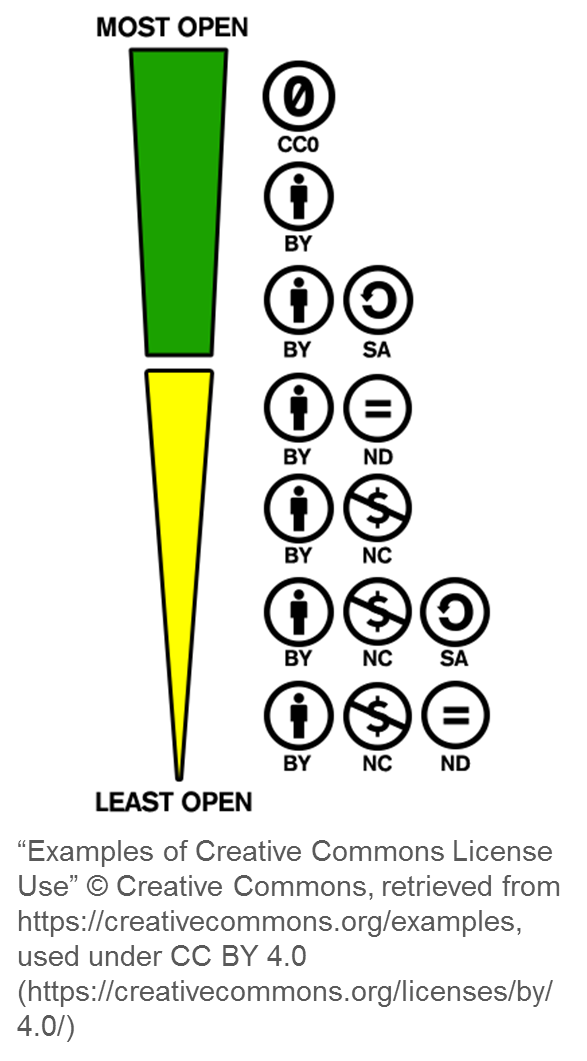
Creative Commons licenses provide copyright owners with a great degree of flexibility in how open they would like to make their work. The various license terms define the ways in which users may freely and legally share, modify, or build upon a copyrighted work.

All CC licenses require attribution. Beyond attribution, copyright owners may choose among a combination of licensing terms. Copyright owners may specify that their work not be used for the primary purpose of monetary compensation (NonCommercial) or that their work not be modified or adapted in any way (NoDerivs). Alternatively, a copyright owner may permit a user to modify, adapt, or build upon their work but specify that any new work created be made available under similar open licensing terms (ShareAlike). Creative Commons also provides a Public Domain Dedication (CC0) tool. This tool allows a copyright owner to dedicate their work to the public domain by waiving all of their copyright and related rights in a work, to the extent allowed under the law. While attribution is not required for CC0 works, it is recommended as a best practice in order to acknowledge the intellectual work of others and to avoid accusations of plagiarism.

Spectrum of openness for Creative Commons licensesFinally, if you are looking for CC works to use, a good place to start your search is with the search function on the Creative Commons website. You may also look through the Creative Commons content directories to view organizations and projects using CC licenses. Many services, including Flickr, SoundCloud, Google, Bing, and Vimeo, provide their own advanced search feature, making the search for CC licensed works quick and easy.

In conclusion, CC licenses are a great resource for copyright owners and users of copyrighted content. As with any license agreement, however, be sure you are clear about the scope and limitations of the license before using a protected work or making your own works available for use by others.

Interested in learning more about Creative Commons? Contact the Copyright Resources Center for answers to your questions or to schedule a Creative Commons workshop.

___________________________________________________________________________________________________________________________________

By Maria Scheid, Rights Management Specialist at the Copyright Resources Center, The Ohio State University Libraries


Navigating the TEACH Act in Distance Education

Distance education is a thriving field, supported by the swift evolution and progress of technologies that promote access to and interaction with educational materials. The Technology, Education, and Copyright Harmonization Act of 2002 (“TEACH Act”), an amendment to Section 110 of U.S. Copyright Act, seeks to encourage these educational experiences by providing a specific carve out for distance education. The TEACH Act, codified in § 110(2), was signed into law and became effective on November 2, 2002 and amended existing copyright law to permit certain performances and displays of copyrighted materials in distance education settings.

A Brief History

In 1976, the time that the original language was enacted, § 110(2) provided an exemption for certain performances or displays of copyrighted works in the course of a transmission. At the time, a transmission referred to an instructional television or radio broadcast. With the expansion of digital technologies and development of distance learning, however, concerns arose over the adequacy of the existing copyright law in promoting digital distance education and protecting the rights of copyright owners. To address this concern, Section 403 of the Digital Millennium Copyright Act of 1998 (DMCA) required the Register of Copyrights to submit recommendations to Congress on “how to promote distance education through digital technologies, while maintaining an appropriate balance between the rights of copyright owners and the needs of users.”[1] In their 1999 report “Report on Copyright and Digital Distance Education” the U.S. Copyright Office provided a number of recommendations after consultation with representatives of copyright owners, nonprofit educational institutions, and nonprofit libraries and archives. The original TEACH Act bill implemented a number of the recommendations set forth in the Copyright Office’s report.[2]

Requirements of the TEACH Act

You must comply with a rather lengthy list of requirements in order to receive the protection the TEACH Act provides. To guide you through these various requirements, we have created a new handout: Using Materials in Distance Learning: A Guide to § 110(2) (TEACH Act).

In many ways the TEACH Act broadened the scope of § 110(2). Transmissions of works were no longer confined to physical classrooms, all type of works could now be performed or displayed (subject to certain limitations), and transmitting organizations were now permitted to reproduce copies of the works in order to perform or display them (again, subject to certain limitations). At the same time, the TEACH Act introduced additional institutional, teaching, and technology requirements to address concerns over how a work may be accessed and shared in a digital environment. All of the following requirements must be met:

□ General Scope: 

The TEACH Act only applies to the performance and display of copyrighted works. It does not cover the remaining exclusive rights held by a copyright owner, including the rights of distribution or creation of a derivative work. Under § 112(f)(1), however, a work may be reproduced in order to be performed or displayed within the requirements of the TEACH Act. See our handout, Using Materials in Distance Learning: A Guide to § 110(2) (TEACH Act), to see under which conditions reproduction would be permissible.

The TEACH Act amended § 110(2) to expand the scope of works that may be performed or displayed. You are permitted to perform a full nondramatic literary or musical work or reasonable and limited portions of all other types of works. You are permitted to display any type of work so long as you do so in an amount comparable to what would be displayed in a traditional classroom setting.

Finally, all copies of works that are being performed or displayed must be lawfully made and acquired—illegally obtained copies are not permitted—and the copy performed or displayed cannot be a work that is produced or marketed primarily as eLearning or distance learning materials.

□ Institutional Requirements: 

Eligible transmitting entities include government bodies and nonprofit educational institutions. Nonprofit educational institutions must be accredited. The institution must also provide a number of safeguards to counteract the risk of widespread dissemination of works. These safeguards include instituting policies regarding copyright, providing notice to students or recipients of the materials that the works may be subject to copyright protection, and providing copyright information to faculty, staff, and students to promote compliance with copyright law.

□ Teaching Requirements:

Performance or display of a work must be made by, at the direction of, or under the actual supervision of an instructor. The performance or display of the work must be made as an integral part of a classroom session offered as a regular part of systematic mediated instructional activity. In other words, an instructor must either initiate or actually supervise the performance or display, though real-time supervision is not required. Additionally, the performance or display must be an actual part of the class itself, not ancillary to the class, and it must be analogous to the type of performance or display that would take place in a live classroom setting. The performance must also be directly related and of material assistance to the teaching content. Works cannot be performed or displayed as unrelated background materials or simply for entertainment—they must be tied to the curriculum.

□ Technology Requirements:

At the time the law was being amended and distance education was gaining popularity, copyright owners were expressing their concerns over the ease of reproduction and dissemination of the works in a digital environment. Such activities, they argued, would have a large impact on their ability to license or otherwise exploit their rights as copyright owners. To address this concern, the TEACH Act imposes a number of technology requirements and limits the receipt of transmissions, to the extent technologically feasible, to students officially enrolled in the course or governmental employees as part of their official duties or employment.

In the case of digital transmissions, the transmitting body must apply technological measures to reasonably prevent retention of the copyrighted work beyond the duration of a particular class session and to reasonably prevent unauthorized further dissemination of the work. This may include performance or display via streaming services or limiting access though adoption of a closed content management system.

Finally, the TEACH Act supports the anti-circumvention language of the Digital Millennium Copyright Act and prevents a transmitting body from engaging in conduct that could reasonably be expected to interfere with technological protection measures that are already in place for copyrighted works.

What to Do if You Don’t Satisfy All Requirements

It may be the case that your intended use doesn’t satisfy all requirements of the TEACH Act. Maybe you would like to share materials to students beyond those officially enrolled in your class, or maybe you are performing or displaying materials through a service that does not allow for any sort of downstream control. In such situations, you may consider whether your intended use is likely to be considered a fair use. Fair use is a defense against a claim of copyright infringement and would allow you to perform or display the work without permission from the copyright owner. A fair use analysis is fact specific and should be considered for each individual piece of work you intend to perform or display.

You may also explore options for using alternative works that are in the public domain or available through more flexible open license terms. Works that are in the public domain are free to use without restriction. To use works available under an open license, you must comply with the license terms.

Finally, if you would like to use a particular work and you cannot rely on fair use, you may seek the permission from the copyright owner to use the work.

▪▪▪

In summary, the TEACH Act was a result of years of discussion and debate between copyright owners and individual and institutional users of copyrighted content. The final product was a compromise designed to promote distance education through digital technologies, addressing the holes created through rapid growth of technology and proliferation of distance learning. Because of its many limitations and restrictions, the TEACH Act has been accused of being too narrow in applicability, prompting many instructors to rely instead on fair use or pursue licensing options. But for those transmitting bodies that meet all of its requirements, the TEACH Act serves as an important statutory exemption.

[1] Digital Millennium Copyright Act, Pub. L. 105-304, 112 Stat. 2860 (1998).

[2] Technology, Education and Copyright Harmonization Act of 2001, S. 487, 107th Cong. (2001).

________________________________________________________________________________________

By Maria Scheid, Rights Management Specialist at the Copyright Resources Center, The Ohio State University Libraries

World IP Day 2015 Celebrates Music

On April 26, 1970, the Convention Establishing World Intellectual Property Organization (WIPO Convention) entered into force. The event is celebrated annually through the World Intellectual Property Day. The theme for this year’s World IP Day is “Get up, stand up. For music.”

Music plays a critical role in our lives—it is an essential defining element of our culture and society.  And through the changing of technology, consumer preferences, and industry standards, the demand for music has remained.  This past year has seen a lot of activity surrounding music creators and their rights under copyright law. Parties on all sides have questioned our current systems and laws, seeking changes designed to fairly support the value that musicians contribute to our lives and adequately encourage society’s access to and use of music.

Keeping with the theme of this year’s World IP Day 2015, we are highlighting a few out of many interesting and important recent developments and the resulting impact on copyright owners of musical compositions and sound recordings.


The Fair Play, Fair Pay Act of 2015

While musical compositions have long been protected under federal copyright, the inclusion of sound recordings under federal copyright law has been a relatively recent development (sound recordings fixed before February 15, 1972 are still governed by state law). In 1995, through the Digital Performance Right in Sound Recordings Act (DPRSRA), Congress provided copyright owners an exclusive public performance right in their sound recordings, but limited the exclusive right to public performances of sound recordings via digital audio transmission. This limitation means satellite and music subscription services need to pay a licensing fee to perform a sound recording, but terrestrial (AM/FM) radio stations do not. Why the exception for traditional over-the-air broadcasts? In short, Congress didn’t believe radio and television broadcasters posed a threat to copyright owners. Terrestrial radio stations, it has been argued, enjoy a symbiotic relationship with copyright owners. Terrestrial stations play music to increase their listenership and increase advertising revenue and in return create exposure for artists, promoting record and other sales for the sound recording owner.

Introduced in Congress earlier this month, the Fair Play, Fair Pay Act of 2015, H.R. 1733, 114th Cong. (2015) would require terrestrial broadcasters to pay royalties for the public performance of sound recordings, a requirement that is currently only applicable to services that perform a song via digital audio transmission. This public performance right would also extend to sound recordings fixed before February 15, 1972.  Special protections exist for small broadcasters, public broadcasters, college radio, noncommercial radio, and religious services. The bill also includes pieces from the Allocation for Music Producers (AMP) Act, discussed below.

Why it matters: Under the current law, owners of a musical composition (songwriters or music publishers) are compensated if their song is played on terrestrial radio but owners of the sound recording (performing artist or record label) are not. If that same song is transmitted through a service like Pandora, both copyright owners will be compensated. If enacted, the Fair Play, Fair Pay Act of 2015 would result in terrestrial broadcasters operating under the same system that newer digital broadcasters are required to operate under. Overall, this would create more harmonization in copyright law by bringing platform parity to radio and would establish an additional revenue stream for both current artists and older artists.


Local Radio Freedom Act

The Local Radio Freedom Act, a resolution reintroduced into the House and Senate earlier this year, declares that “Congress should not impose any new performance fee, tax, royalty, or other charge” to terrestrial broadcasters for the public performance of sound recordings. The National Association of Broadcasters has backed the resolution, which does not carry the force of law. The resolution highlights the “mutually beneficial relationship between local radio and the recording industry,” in which radio stations have provided publicity and promotion to artists, which has benefitted the careers of many performers. The resolution also cautions the economic hardship local radio stations and small businesses will face at the imposition of any new performance fee.

Why it matters: While artists have thrown a lot of support behind the Fair Play, Fair Pay Act (discussed above), broadcasters believe the Local Radio Freedom Act provides a better solution. The Local Radio Freedom Act, is non-binding, but functions to express the sentiment of Congress. This resolution would preserve the status quo for public performance of sound recordings. There are currently 165 co-sponsors in the House and 12 co-sponsors in the Senate.


Allocation for Music Producers (AMP) Act

Traditionally, record producers have received compensation for their work through the negotiation of a flat fee for their services and/or points (typically 3-4% of the wholesale price of an album). The Allocation for Music Producers (AMP) Act, H.R. 1457, 114th Cong. (2015), introduced in March of this year, would amend copyright law to provide a statutory right for producers, sound engineers, or mixers involved in the creative process of creating the sound recording to receive royalties for the digital transmission of the work.

Current law requires that royalties paid for the public performance of a sound recording by digital audio transmission be split between featured artists (45%), non-featured artists (5%), and sound recording copyright owners (50%). A featured artist may provide a Letter of Direction to SoundExchange, the entity responsible for collecting and distributing such royalties, requesting that a portion of their royalties be paid to the producer. Under the AMP Act, this informal process would be recognized through a statutory amendment.

In addition, the bill creates a new process for setting aside royalties for sound recordings fixed before November 1, 1995. In the absence of a Letter of Direction, SoundExchange may set aside 2% of featured artist royalties to be paid to the producer, mixer, or sound engineer of the relevant sound recording, so long as the artist does not object within a given period of time.

Why it matters: Producers, sound engineers, and mixers play an important role in the creative development of sound recordings. The AMP Acts acknowledges the importance of these individuals in the overall creative process and seeks to establish a permanent procedure by which these professionals can fairly be compensated for their contributions.


Songwriter Equity Act

Re-introduced into both houses on March 4, 2015, the Songwriter Equity Act of 2015 (SEA) would amend Sections 114 and 115 of the Copyright Act to allow the calculation of statutory royalty rates for musical compositions based on fair market value.

The SEA would change the way royalties are calculated for the reproduction of musical compositions. There is currently a compulsory mechanical license for the reproduction of musical compositions. The initial rate set by Congress in 1909 was 2¢ per song. In 2015, it is 9.1¢ per song. The SEA would now allow Copyright Royalty Judges to establish rates that “most clearly represent the rates and terms that would have been negotiated in the marketplace between a willing buyer and a willing seller.” In addition, Judges may now consider the royalty rates set for the public performance of sound recordings in their determination of rates for the public performance of musical compositions.

Why it matters: The intent of this bill, as with the other bills we have discussed, is to even the playing field. By adopting rates that reflect free market conditions, songwriters may receive fair compensation for their works.


Calculation of digital royalties for pre-digital artists

It is difficult to predict how technology will change in the future, as a result, older recording agreements are silent on how to handle payments for digital downloads. The major record labels have historically treated downloads as equivalent to physical sales (meaning artists get 12-20% of net receipt of sales) but artists have argued that digital downloads are more appropriately treated as licenses (meaning the artist would receive 50% of net receipts).

The approach taken by major labels has resulted in major class action lawsuits against Sony, Warner, and Universal. On April 14, 2015, Universal submitted a preliminary settlement of $11.5 million, to be paid to artists signed with UMG or Capitol Records between 1965 and 2004. Universal does not, however, admit wrongdoing in the payment of royalties. Going forward, an increase of 10% has been applied to the royalty rate for digital downloads. Settlements have already been reached in the Sony and Warner Music Group lawsuits.

Why it matters: Compensation. There is a substantial difference in royalty rates between traditional physical sales and licenses. In cases where digital downloads have not been anticipated, it has been up to the court to determine what is just based on the technology of today.

As you can see from just these examples, this past year has been full of activity surrounding music and copyright issues. Following calls for comprehensive copyright reform and talks of a “music omnibus bill” to overhaul the music licensing system, we can expect this important dialogue to continue. Only time will tell how some of these issues will ultimately be resolved and the impact any changes will have on artists, consumers, and facilitators of music.

Interested in learning more about music copyright? Be sure to check out our 4-part series on music copyright: What is music copyright?, Copyright duration for musical compositions and sound recordings, Termination of transfer for music copyright, and Licensing opportunities for music copyright.

________________________________________________________________________________________

By Maria Scheid, Rights Management Specialist at the Copyright Resources Center, The Ohio State University Libraries

How the public domain promotes scholarship: Engaging Columbus uses 1922 OSU thesis to map Columbus neighborhoods

Engaging Columbus, a collaboration between Ohio Wesleyan University, the Ohio Five Libraries, the City of Columbus Department of Technology / Geographic Information Systems, and other partners in central Ohio, has generated an interactive map of historic panoramic images from the City of Columbus using digitized photographs from a 1922 Ohio State University master’s thesis. The thesis, “An introduction to the economic and social geography of Columbus, Ohio” was written by Forest Ira Blanchard, OSU Department of Geography’s first graduate-level alumnus. The use of Mr. Blanchard’s photographs is a great example of the way digitization of works can spur new scholarship. Mr. Blanchard’s thesis photographs, published ninety-three years ago, provide important historical information on urban neighborhoods and development in Columbus, Ohio. As Engaging Columbus notes, “Blanchard’s photographs are remarkable for their depiction of typical streets, railroad corridors, and neighborhoods (rather than the more typical images of important buildings or events).” Engaging Columbus was able to freely use the valuable resource contributed by Mr. Blanchard to inform and shape its own work in geocoding historical photographs. The information they have generated is fully available for the benefit of the public and will in turn be used in a variety of ways.

Engaging Columbus was able to use Mr. Blanchard’s photographs without having to ask permission or pay fees to Mr. Blanchard’s estate. Original photographs such as the ones taken by Mr. Blanchard are subject to copyright protection, so how did Engaging Columbus use the photographs without permission? The answer comes from the law surrounding copyright duration and expiration. Mr. Blanchard’s photos were published prior to 1923; the photographs are in the public domain and therefore no longer protected by copyright.

What is the public domain?

In the United States, copyright law seeks “to promote the Progress of Science and useful Arts” by providing copyright owners with a number of exclusive rights over their works, for a limited time. By limiting the time in which a work may fall under copyright protection, the law seeks to find the right balance between incentivizing creators to create works and opening works up for the use and benefit of the public. In addition to establishing duration for copyright protection, the law also provides that certain works never receive copyright protection to begin with. The public domain includes works that fall into both of these categories: those in which the copyright has expired and those which never had copyright protection. Works in the public domain can be used by anyone in any way, without any permission required.

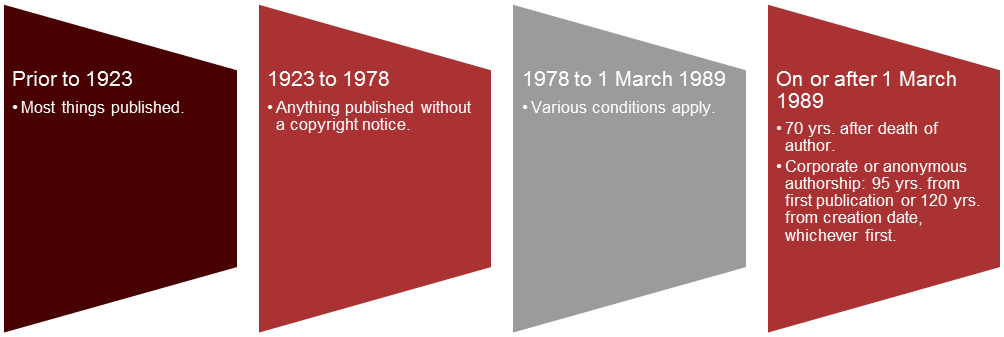
Copyright duration has been extended a number of times over the years, and calculating when exactly a work falls into the public domain due to expiration of its copyright can be tricky. The graphic can provide some general guidance. For more information on the public domain, visit our resources page.

When does a work fall within the public domain?

Four trapeziods, positioned sideways and all of a different color, depicting general guidelines for determining when a work falls into the public domain.Trapeziod 1 reads: Prior to 1923, most things published. Trapezoid 2 reads: 1923 to 1978, anything published without a copyright notice. Trapezoid 3 reads: 1978 to 1 March 1989, various conditions apply. Trapezoid 4 reads: On or after 1 March 1989, 70 yrs. after death of author, corporate or anonymous authorship: 95 yrs. from first publication or 120 yrs. from creation date, whichever first.


Digitization as a tool for new scholarship

Scholars around the world are creating tools, digital platforms, websites and documents to help society learn about ourselves. Many like Engaging Columbus are linking the arts, geography, history and sociology, among others, in new and innovative ways. By digitizing works in the public domain, we can provide access to previously unavailable historical, cultural and educational resources, which can have a positive impact on academia. Works such as Mr. Blanchard’s photographs may now reach new audiences and serve as the catalyst for creation and dissemination of new information and perspectives. Building upon and promoting of scholarship is at the heart of the mission of universities and libraries across the country, including The Ohio State University, to advance discovery and learning.

An introduction to the economic and social geography of Columbus, Ohio” is available for viewing in the Architecture Library at the Austin E. Knowlton School of Architecture and will soon be available online through the OhioLINK ETD Center.

________________________________________________________________________________________

By Maria Scheid, Rights Management Specialist at the Copyright Resources Center, The Ohio State University Libraries

Fair Use in Digital Storytelling

 “…(A) digital story is a short (3-5 minute) movie which uses images, voice, and music to tell a story. There are a variety of media that can be used to create digital stories and a variety of reasons for creating them. ” – The Ohio State University Digital Storytelling Program

Authors of digital stories remix and reuse materials to create something new: a short video with a personal narrative. Authors write and record their own narration and often use personal photos, video, and sound; however, they frequently incorporate copyrighted materials from other sources in order to develop powerful digital stories. For example, a narrative may require abstract images to help convey a particular idea or emotion, or a specific element of meaningful culture such as a quote from a favorite book or photo of a particular event.

The stories produced in connection with the OSU Digital Storytelling Program are posted on YouTube and shared on campus through occasional viewings. In order to promote legal use of third party materials and avoid takedown requests, participants in the OSU Digital Storytelling Program are encouraged to source materials as much as possible from the public domain, licensed collections (e.g. Creative Commons photos on Flickr), or create things themselves. However, there are times when an author wants or needs to use copyrighted material, and wants to rely on fair use or seek permission in order to proceed.

As defined in Section 107 of the U.S. Copyright Act, fair use is a defense against charges of copyright infringement determined through the analysis and application of the four fair use factors:

  1. the purpose and character of the use, including whether such use is of a commercial nature or is for nonprofit educational purposes;
  2. the nature of the copyrighted work;
  3. the amount and substantiality of the portion used in relation to the copyrighted work as a whole; and
  4. the effect of the use upon the potential market for or value of the copyrighted work.

The fair use exception is quite broad and can apply to a wide variety of uses (which could include digital storytelling) but the lack of specificity can make it difficult to ascertain whether or not a particular use may qualify as fair use.  Those considering fair use, should employ a fair use checklist to conduct an analysis and weigh the criteria favoring and opposing fair use (our video provides more information and an example of doing a fair use analysis).

Fair use and your role as a digital storyteller

As a digital storyteller, you may have the option to rely on fair use depending on what material you are using, and how and why you are using it. A fair use analysis will help you evaluate your answers to those questions.

The first factor of fair use is concerned with the purpose and character of a proposed use. As an author, you should think carefully about the purpose of your digital story. Is it educational? Are you commenting on, criticizing, or parodying the copyrighted work you wish to use? These types of purposes favor fair use.  Transformative use also weighs in favor of fair use. If you use a copyrighted work in your digital story for a purpose other than which it was originally intended for, you may be able to make an argument for transformative use of that material. Using your favorite song as a soundtrack to your digital story is not a transformative use, but criticizing the lyrics of another song for its message of oppression or intolerance could be a transformative use.

Ask yourself whether you need a particular work in order to accomplish the purpose of your digital story. If you simply need some piece of material that depicts archery as a recreational activity, then you do not need to use a clip of Katniss Everdeen from The Hunger Games.  You can likely find a public domain or Creative Commons licensed photo, or even take your own photo. On the other hand, if your digital story critiques or comments on the character of Katniss Everdeen specifically and how she contributes to the reversal of traditional gender roles in the Hunger Games, then you may actually need a clip or photo from the films to support your narrative.

The second factor of fair use requires you to assess the nature of the work you are using. Is it factual or fiction? Published or unpublished? Is it highly creative? Many materials likely to appear in a digital story, such as music and photos, are considered highly creative works; this weighs against fair use, but it could potentially be balanced out by the other factors.

The third factor of fair use considers the amount and substantiality of the portion of the copyrighted work being used. Ask yourself how much of a particular work you need to use in order to accomplish your purpose. In your digital story about how the television show The Walking Dead saved your life because it inspired you to prepare for emergencies, will a still image from the show suffice, or does your story comment on a particular scene that you need to show as a video clip in order to fulfill your purpose? To strengthen your argument in favor of fair use, use only the amount necessary to fulfill the purpose of your story.

The “substantiality” component of the third fair use factor refers to the significance of the material you want to use in relation to the entire copyrighted work. Could the scene you want to use from The Walking Dead be considered particularly significant to the show or a particular episode? This is sometimes referred to as using the “heart of the work”. Another way to phrase this could be: “how big of a spoiler is it?” Showing the death of a main character or major events from a season finale could be considered the heart of the work and weaken your argument for fair use (particularly if you did not necessarily need to use that particular scene to accomplish the purpose of your digital story).

The fourth factor of fair use considers the effect your use of the material could have on the potential market for or value of the original work. Could your use impact the copyright owner’s ability to profit from his or her work? Digital stories have the potential to cause a detrimental effect on the market for a work because they are accessible to the public online, and they will remain available for a long time. For example, using a popular copyrighted song as a soundtrack for your video could impair the market for that song by providing a substitute for purchasing the song as an MP3. Viewers could simply play the digital story whenever they wanted to listen to the song, as opposed to going out to buy their own copy.

You must consider all four factors of fair use when evaluating whether or not you have a strong argument in favor of fair use. No single factor is more important than the others; for example, an educational purpose does not automatically qualify a proposed use as fair use. Additionally, although each factor is equally important to a fair use analysis, checklist criteria should not be tallied up with a simple “majority rules” determination. You should keep an eye out for significant problems that could outweigh other criteria, such as a particularly damaging effect on the market for a work.

Still have questions about fair use? Contact the OSU Libraries’ Copyright Resources Center for assistance:

Email: libcopyright@osu.edu

Phone: 614-688-5849

Website: go.osu.edu/copyright

Twitter: @OSUCopyright

________________________________________________________________________________________

By Jessica Meindertsma, Rights Management Specialist at the Copyright Resources Center, The Ohio State University Libraries


Public Domain Day – 2015

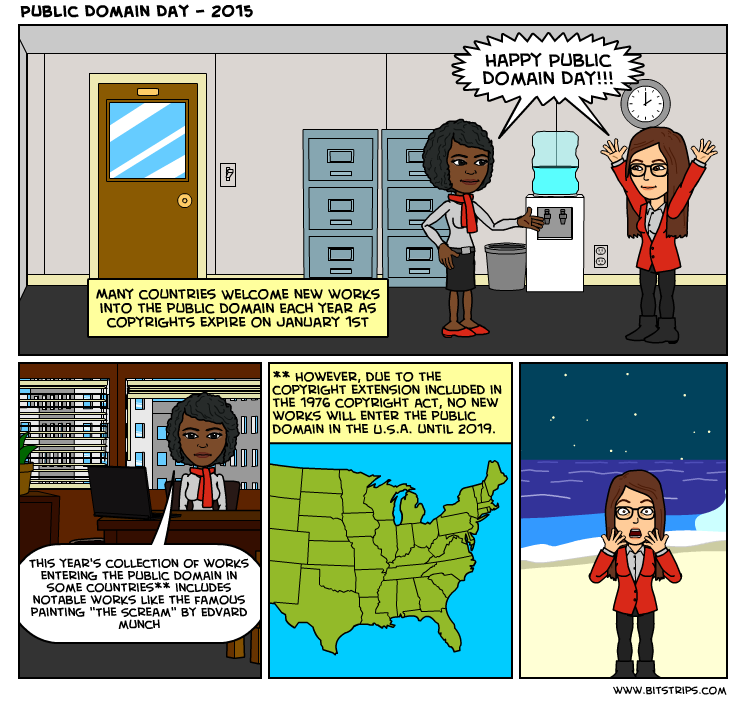
Image is a four panel comic strip titled “Public Domain Day – 2015”. First panel: Two people in an office setting exclaim: “Happy Public Domain Day!!!” and a caption states: “Many countries welcome new works into the public domain each year as copyrights expire on January 1st.” Second panel: One of the people from the first panel says: “This year’s collection of works entering the public domain in some countries** includes notable works like the famous painting “The Scream” by Edvard Munch.” Third panel: Shows a map of the United States with a caption that says: “However, due to the copyright extension included in the 1976 Copyright Act, no new works will enter the public domain in the USA until 2019. Fourth Panel: The other person from the first panel is shown in a posture and setting reminiscent of the painting “The Scream.”

It’s that time again! We celebrate Public Domain Day each year as many countries welcome new works into their public domain when the copyrights  for those works expire on January 1st.

Read our blog post on the public domain and its cultural importance, and visit these sites around the Web for more coverage of Public Domain Day 2015 and the works entering the public domain for various countries around the world:


________________________________________________________________________________________

By Jessica Meindertsma, Rights Management Specialist at the Copyright Resources Center, The Ohio State University Libraries
Identifying United States federal government documents in the public domain

According to the Office of Management and Budget, the United States government “is the largest single producer, collector, consumer and disseminator of information in the United States.”  United States copyright law places works of the U.S. federal government in the public domain in the United States upon creation.

Works in the public domain are not protected by copyright; either copyright has expired or the work was never protected by copyright.  Changes to copyright law have increasingly limited the amount of works entering the public domain in the United States, which increases the importance of U.S. government documents as a source of new public domain materials.

At first glance, 17 U.S.C. §105, the section of the United States Copyright law that places works of the U.S. federal government in the public domain seems straightforward: “Copyright protection under this title is not available for any work of the United States Government”; but, as with many aspects of this law, things are rarely as simple as they seem.

Online Sources of U.S. Government Materials

As more United States government works become available digitally, many are conveniently made available online for public use. As always, just because a work is publicly available (e.g. online) it is not necessarily in the public domain.  Many websites providing access to U.S. government works also provide rights and permissions information that may indicate whether the works are in the public domain.

A few resources for finding U.S. government public domain materials are listed below; however, as always, be sure to check the copyright information for any specific item you want to use because many of these sites also contain materials that are not in the public domain.

I.   What the law says

17 U.S.C. §105 places “any work of the United States Government” in the public domain.  The law defines “work of the United States Government” in 17 U.S.C. §101 as (1) a work prepared by “an officer or employee of the United States Government” (2) “as part of that person’s official duties.”  A United States government work does not enter the public domain unless it satisfies both parts of this definition.

Section 105 is subject to several additional restrictions. It only applies to United States federal government works – it does not place state, local or foreign government works in the public domain.  And §105 only places U.S. government works into the public domain within the United States. Other countries are subject to their own copyright laws, which may provide copyright protection to United States government works in those countries.  Nor does §105 mean that all U.S. government works are available for use within the United States without restriction.  Even if a work meets the §105 requirements for entering the public domain, other limitations may apply such as an individual’s publicity or privacy rights, trademark limitations, Freedom of Information Act restrictions, or a prohibition against using information the materials to imply a government endorsement.

II.   Exploring the Definition

Even though §105 places many U.S. government works in the public domain, many other U.S. government works do not meet the statutory definition “work of the United States government” and receive copyright protection.  How could a United States government work fail to satisfy this definition?

Not all government works are created by employees or officials of the government.  If someone other than a U.S. government officer or employee, like a contractor, prepared a work for the agency, the work would not enter the public domain under §105.

Another situation where a possible U.S. government work does not enter the public domain under §105 occurs when a U.S. government official or employee prepares a work outside of their official duties.  In that instance, the U.S. government official or employee receives the same copyright protection as anyone else, since §105 only applies to those works prepared by a government officer or employee as part of their official duties.

For example, a U.S. Admiral received copyright protection for a speech he prepared on his own time while employed by the government because “the writing and delivery of the speeches formed no part of Admiral Rickover’s official duties and that the speeches are the Admiral’s private property which he was entitled to copyright” Public Affairs Associates, Inc. v. Rickover, 268 F.Supp. 444, 450 (1967).  Section 105 also does not apply to “personal narratives written by public servants after they leave Government service” Harper & Row Publishers v. Nation Enterprises, 471 U.S. 559, fn. 6 (1985).

III.   Applying the Definition

As a practical matter, it can be difficult to tell whether a United States government work falls within §105 and therefore belongs to the public domain.  Some documents do explicitly indicate whether the contents are in the public domain.  Many do not.

If a document does not indicate whether it is in the public domain, someone wanting to use the document in a way that might implicate copyright must try to make an informed decision about whether or not the document is in the public domain.  The following bullet points provide suggestions on what to look for and things to think about when investigating the copyright status of a U.S. government document.

  • Look for a copyright notice on the work. A notice indicates that someone is claiming a copyright in the work, whether the copyright is claimed by the government or a third party.  Section 105 does not prohibit the U.S. government from holding a copyright in the United States.  Although §105 places items created by the government in the public domain, the law also permits the United States government to hold copyrights “transferred to it by assignment, bequest, or otherwise” (17 U.S.C. §105).
  • Look for a statement indicating that the work is in the public domain (as seen in the image below), but keep in mind that the government is not required to put a public domain notice on works, and not all works with public domain status under §105 will display a notice.

    Photograph of a public domain notice on a US federal government publication: Public Domain Notice: All material appearing in this publication is in the public domain and may be reproduced or copied without permission from SAMHSA. Citation of the source is appreciated. However, this publication may not be reproduced or distributed for a fee without the specific, written authorization of the Office of Communications, SAMHSA, HHS.

    Center for Substance Abuse Prevention (U.S.), & ICF International (Firm). (2010). Focus on prevention. Rockville, MD: U.S. Dept. of Health and Human Services, Substance Abuse and Mental Health Services Administration, Center for Substance Abuse Prevention.

  • Are the authors identified as employees or staff of the government agency? This may be an indication that the work qualifies as a “work of the United States Government” and belongs to the public domain.
  • Look for information indicating that the author(s) was not a government employee or official. For example, works prepared by a contractor, commissioned by the agency from another organization, or created by some other third party. Author affiliations and biographies may provide additional clues.If the document provides the authors’ names, but not their affiliation(s), researching the author(s) may reveal whether they work for the government.
  • Contact the government agency and ask for additional information about the document.  Even if they are not able or willing to tell you whether it is in the public domain, they may be able to provide additional information about the creation of the document that will help you determine its status.

IV.   Conclusion

Government information is a valuable national resource.  Section 105 places U.S. government works in the public domain to facilitate use of this important resource.   If users cannot clearly determine that a U.S. government document belongs in the public domain, they may have to treat the work as protected by copyright – which seems contrary to the reason Congress placed such works in the public domain.

Ideally, U.S government agencies would clearly indicate whether a work belongs in the public domain. Historically, this has not been the case; however as more works become available digitally, U.S. government agencies may increasingly provide rights information indicating whether the works fall within the public domain.

Despite the challenges involved in determining the copyright status of some U.S. government works, it is possible to identify many U.S. government works as part of the public domain.  Although it may not be as simple as it should be to identify public domain “work[s] of the United States Government”, the U.S. government remains an important source of public domain material.

——————————————————————————————————————————————

Marc Jaffy is a graduate of the Kent State University School of Library and Information Science and former practicum student at the OSU Libraries Copyright Resources Center 

Patterns and copyright protections

In the United States, patterns are generally not eligible for copyright protection as copyright does not apply to methods or “procedures for doing, making, or building things.” Additionally, an item created from a pattern also lacks copyright protection if it is considered to be a functional object. Under the Useful Article doctrine in US copyright law, if an object has a practical or useful function, copyright protection applies only to the original, creative elements “that can be identified separately from the utilitarian aspects of an object”, but does not extend to the underlying design of the functional object.

photo of vintage sewing pattern

Photo: Butterick Dress 5579 Instr (c) Allison Marchant, CC BY-NC-SA 2.0
Here, while the drawing of the dress may be considered a creative expression of the author and therefore eligible for copyright protection, the pattern instructions and any dress made from the pattern would not be protected by copyright.

In the absence of copyright protection for functional objects, a user of a pattern may be able to use whatever she makes from that pattern for any purpose, including selling the items. However, accompanying materials included with the pattern, such as images, may be eligible for copyright protection (see image above). The United States Copyright Office provides the example that while a drawing or photo of a dress may be copyrighted, that does not give the artist the exclusive right to make a dress of that particular design.

Despite this legal landscape, copyright notices and terms of use such as the following are still commonly found on patterns:

“Copyright 2014. All Rights Reserved. Pattern is for personal, non-commercial use only. Selling items made from this pattern is prohibited.”

What does this mean for designers and those wanting to use the pattern? Are the copyright notices and accompanying terms of use legally binding? Some designers believe that the notice they put onto their patterns provides them with legal protection, but because copyright law does not protect the pattern itself, are the terms of use stipulating personal, non-commercial use legally enforceable?

When it comes to what can be done with the final product made from a pattern, there is a conflict between the desires of those who want to use the pattern and those who designed the pattern. With no relevant case law available as a guide, there really are no definitive answers. Despite the lack of legal precedent, those wanting to use patterns and the items made from those patterns should be aware of how they can legally make use of these materials. In the same vein, designers should understand to what extent and how they can protect their work.

The view commonly held by designers is relatively simple: follow the restrictions set in the pattern’s disclaimer. For example, if a knitting pattern you downloaded was accompanied by a disclaimer that read “personal, non-commercial use only” you could make as many items as you wanted using that pattern, but you could not sell any of them because that would constitute a non-personal, commercial use. However, when designers place notices on their patterns, they may be exaggerating copyright protections and licenses. But it is important to remember that even if copyright protection is not available, a user may be agreeing to a license that restricts the way he may use the pattern when he consents to the terms and conditions set by the designer.

Pattern users should be aware of what they are agreeing to when purchasing or downloading a pattern. By clicking a box that reads, “I agree to the terms & conditions”, a user may be entering into a legally binding agreement that can restrict what she may do with the pattern. Under US law, terms that parties consent to in a contract can trump copyright law, leaving designers with possible legal recourse for misuse of a pattern.

Seeking clear legislative guidance and wanting protection for their work, the fashion industry lobbied Congress to create legislation that would protect unique designs. First introduced in 2007, the Innovate Design Protection and Piracy Prohibition Act (IDPPPA) sought to protect designs for a period of three years if registered with the US Copyright Office within three months of being made available to the public. While similar legislation to limit design piracy has been enacted in Europe, India and Japan, legislative progress of the IDPPPA has stalled as of 2014, and patterns are still generally not copyrightable in the United States.

Unless and until moves are made in Congress, answers about copyright protection and designs still lie in a gray area. Whether you are a designer or a user of patterns, it is important to remain informed about your legal rights and understand the possible ramifications that can come along with something as simple as a pattern.

________________________________________________________________________________________________

Morgan Cheek is a legal intern at the OSU Libraries’ Copyright Resources Center and is currently a student at The Ohio State University Moritz College of Law

Older posts Newer posts