Month: September 2011

Ohio State Hospital

Ohio State Hospital

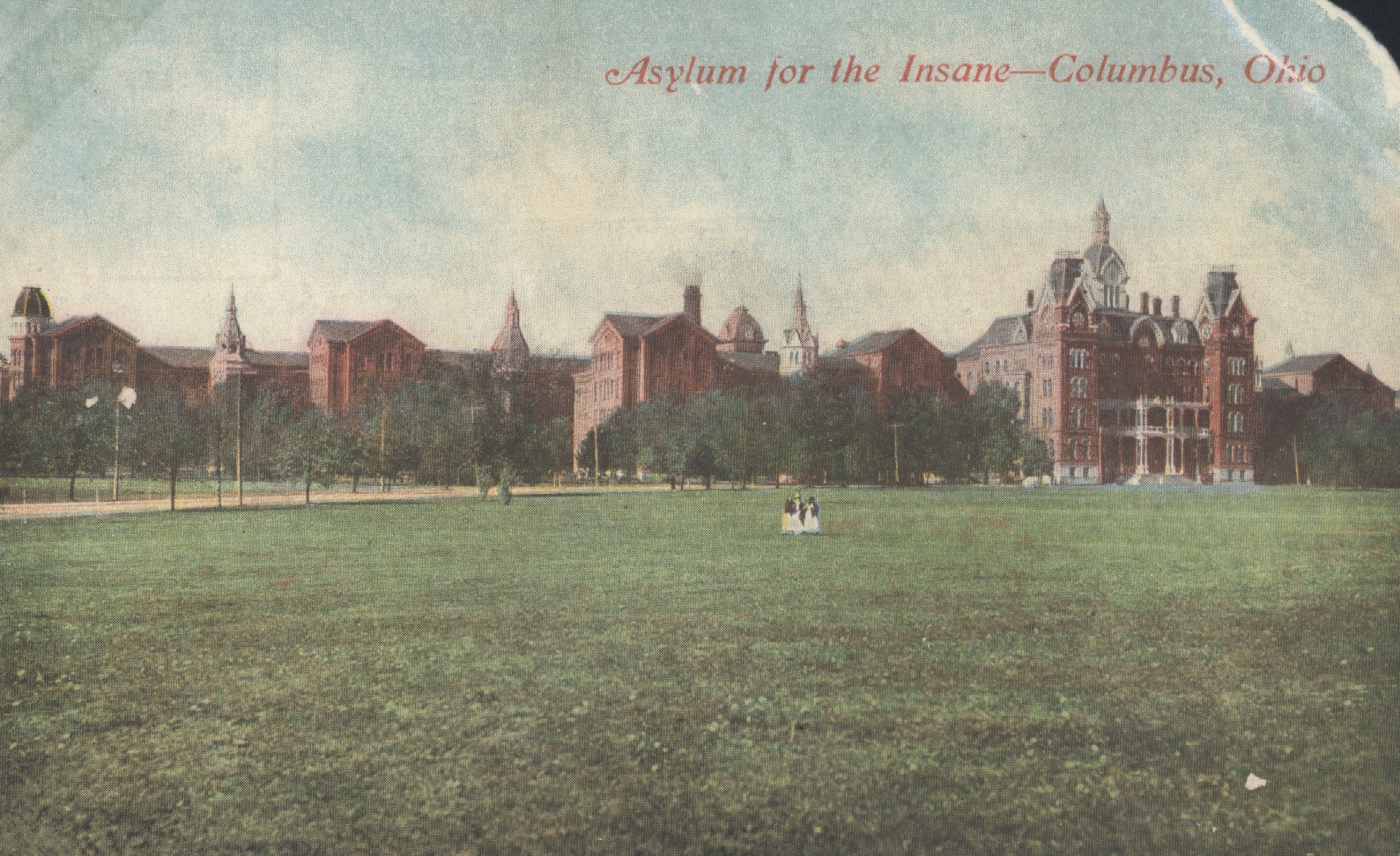
Ohio State Hospital (Ohio Institution for Feeble Minded; State Hospital for Insane; Asylum for the Insane)

The following is a summary about the Institution from Hilltop: A Hospital and a Sanctuary for Healing, its Past and its Future by George W. Paulson, MD and Marion E. Sherman, MD. Copies of this book are available for purchase from NAMI Ohio for $15 each at amiohio@amiohio.org or 1-800-686-2646.

By 1838 William Awl, MD persuaded the legislature to build the first state-supported hospital in Ohio. It was called the Ohio Lunatic Asylum and was designed solely to treat the mentally ill. It was located one mile from the capitol on 35 acres, north of East Broad Street. It was bordered on the east by Parsons Avenue, an avenue named for one of the early directors of the Asylum, Samuel Parsons. In contrast to similar medical units in New York and Philadelphia, payment was not a criterion for admission.

Built with convict labor, the Waverly marble-coated building housed as many as 328 patients by 1850. It burned down in 1868, with the loss of six patients and displacement of 314 others. Rebuilding began at the same site, but following the urging by then-Governor Rutherford B. Hayes the land on East Broad Street was sold for $25,000 and a new hospital was built on the hill to the west of the capitol. The new hospital, dedicated by Hayes in 1870, embodied the famous Kirkbride design, intended as a “moral architecture” to match the contemporary dream of “moral therapy.” The facility was originally designed to house up to 800 patients, with most living in private rooms. The building housed 1,350 patients by 1900 and by 1935 was home to 2,932 patients. It became an almost self-supporting campus where the patients worked, walked the grounds, or just “set” waiting to live out their days in the slowly decaying hospital. Many patients were sheltered for decades in the hospital, and in any one year, over 100 patients might have died.

They received whatever was considered the best therapy at the time, including the administration of over 100 lobotomies in the 1950s, and 14,275 individual electroconvulsive therapies in 1955. The patients were protected while they were confined. Since poor, elderly, frail, and helpless persons were particularly likely to need admission, some patients received adequate basic medical care for the first time in their lives. Among the active members of the staff were respected doctors in private practice as well as academic physicians. Many of the full-time staff lived on the grounds with their families.

In addition to the education of residents, students, nurses, and chaplains, other accomplishments deserve to be remembered. Probably no other state hospital had three superintendents who went on to become president of the American Psychiatric Association. Dr. Awl was a founder of the Association. Another staff member, Samuel M. Smith, MD, never held the position of superintendent, but became the first Professor of Psychiatry in America. He was twice chosen as the Dean of Medicine at Starling Medical College and was the Surgeon General of Ohio during the Civil War.

Lithium was first approved as a therapy for use in Ohio at Hilltop. The concept of the limbic system was propounded at the state hospital by one of its several excellent pathologists. For many years 90% of all psychiatric care in Columbus was offered at the Hilltop. At least 35,000 patients were treated through the years, and most were returned, improved, back into the community.

Deinstitutionalization was a major trend in psychiatric care in the last half of the twentieth century. It meant both the demolition of the large state hospitals and the release of the patients back into the public sector. The old Kirkbride hospital was torn down in the 1980s and early 1990s.

Is there still a presence on that ridge where so much delivery of humane care once occurred? Indeed there is. In 2006 over 1,000 patients, now referred to as “clients,” were admitted to the 175 beds in the combined civil and forensic units called Kosar, and another 82 persons were referred to the forensic prison unit on the same grounds. For non-forensic clients the stay tends to be 14 days or less, and frequent readmission (also known as recidivism) is a major concern. Once there were over 800 aged patients at Hilltop, at Kosar now less than 3% are over 65.
New MHC Website

The Medical Heritage Center has a new website! As the special collections of the Health Sciences Library (HSL), our website was integrated with the redesign of the new HSL website. Please visit https://hsl.osu.edu/mhc to check it out.

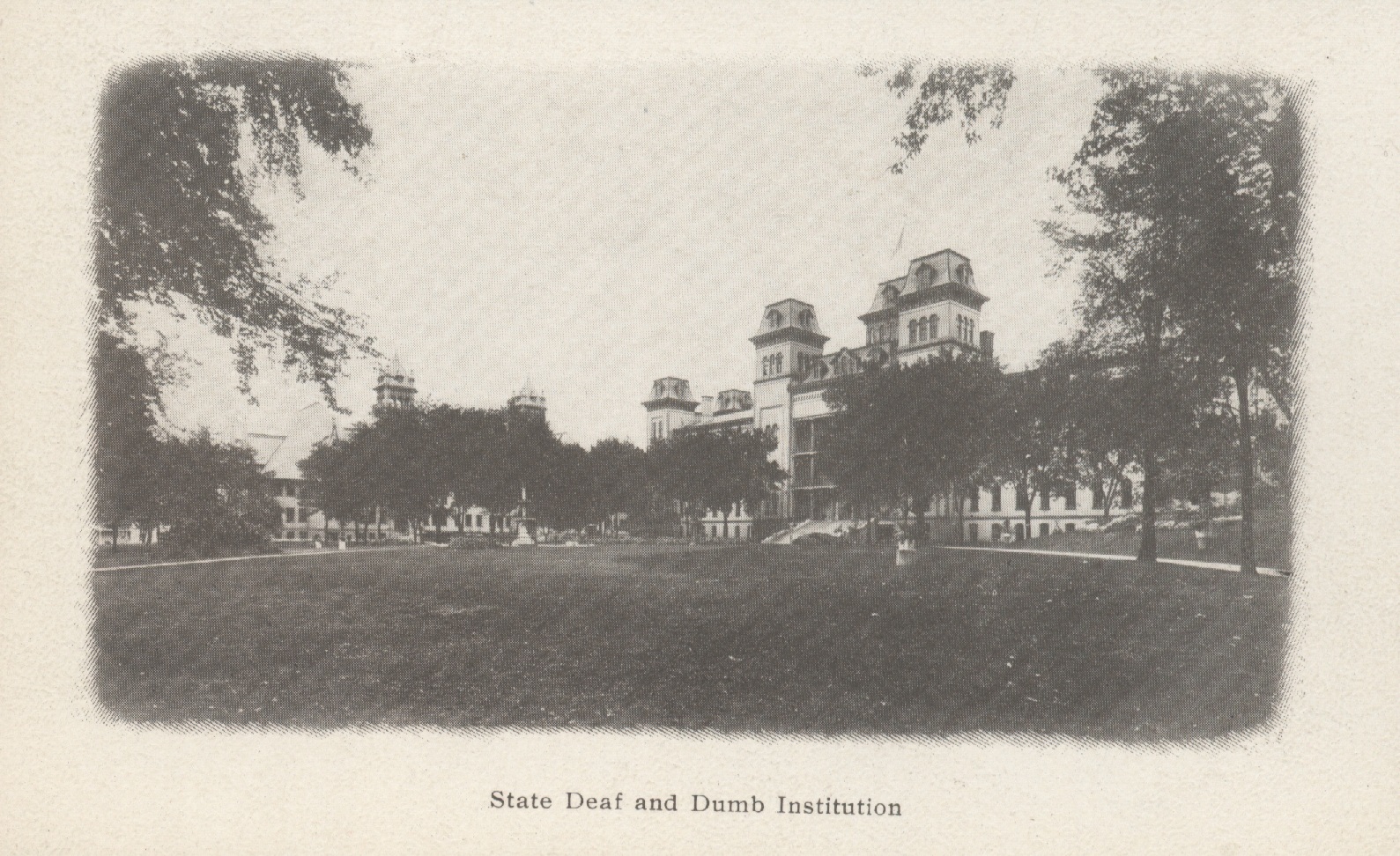
Ohio Institution for the Education of the Deaf

Ohio Institution for the Education of the Deaf

The following is an excerpt about the Institution from The Second Blessing: Columbus Medicine and Health, The Early Years by Charles F. Wooley and Barbara A. Van Brimmer. Copies of these books are available for purchase from the Medical Heritage Center for $45 (plus applicable sales tax).

The first school for the deaf in the United States was established in Hartford, Connecticut. It owed its origins to Thomas Hopkins Gallaudet, a Congregational minister who traveled to Europe in 1815 to study methods of communicating with deaf people. The Connecticut Asylum for the Education of Deaf and Dumb Persons opened its doors in 1817 in Hartford, with Laurent Clerc as sign-language teacher.

The Ohio Deaf and Dumb Asylum Act was passed during the 1826-1827 legislative session and the first annual report of the board of trustees of the Ohio Institution for the Education of the Deaf and Dumb was submitted to the Ohio Legislature in 1827. Lucas Sullivant’s third son Michael was a member of the board; physician members of the board were Lincoln Goodale, Robert Thompson, and Samuel Parsons. The early institution began in 1829, operating from rented quarters on North High Street in Columbus. A legislative appropriation in 1828 was followed by purchase of a ten-acre site about half a mile east of the center of the city on Town Street. By 1830 permanent-building plans were in pace, and the school principal, Horatio N. Hubbell, who had been sent to the Hartford Asylum for 18 months of training – was at work with two assistants, both educated at Hartford.

The annual reports of the institution are comprehensive and include lists of the pupils’ names, their places of residence, and how they were supported – whether by their families, friends, or (if indigent) by the state. By 1834 the main buildings were finished and occupied, and Hubbell was working with four assistants, three of whom were themselves deaf mutes who had been educated at Hartford. Hubbell’s 1834 principal’s report included a summary of the history of teaching the deaf and a discussion of sign language as the natural language of the deaf, as opposed to articulation as taught at some schools. Education of the deaf was entering a controversial era as authoritative proponents of two major systems of communication – sign language, and the oralism or articulation system – took sides in battles over the control of the institution of the deaf. In one form or another, the conflicts surrounding language, linguistic expression, and the education of deaf children have persisted and even heightened during the second half of the 20th century.

Robert Thompson was the physician to the Ohio Institution for the Education of Deaf and Dumb from 1833 to 1857. During the later years of his appointment, the annual reports contained Thompson’s detailed physician’s reports to the board of trustees regarding the health of the residents of the institution, along with his recommendations to the board. Topics included smallpox vaccination and causes of death among the residents in 1844; repeated requests for the completion of sewers in 1849; the need for a separate building for the sick (“for want of a hospital”) with an outbreak of cholera in 1852; his continuing concerns about “a want of capacity and adaptation in the buildings” in 1853.

Most of the deaf students were of school age. They received vocational training that include bookbinding in the deaf-school bindery, sewing, cooking, and housekeeping. Over the years the school for deaf was variously known as the Ohio Deaf and Dumb Asylum, Ohio State School for the Deaf, and the Ohio Institution for the Education of the Deaf and Dumb. The next school for deaf was at 450 East Town Street. It was completed in 1868 to a design by George W. Bellows, Sr., father of George Bellows, the well-known Columbus artist. The latest school, the Ohio State School for the Deaf, was built at 500 Morse Road in Columbus in 1953.

Lincoln Memorial Hospital

This hospital was built in 1958 and closed in 1971. Located on East Livingston Avenue, it was opened as a for-profit primary surgical care center by a group of local surgeons. Due to government regulations and a rejection for Medicare coverage in 1971, the facility could no longer provide service. Today, it is the site of Grant Hospital Ambulatory Service.

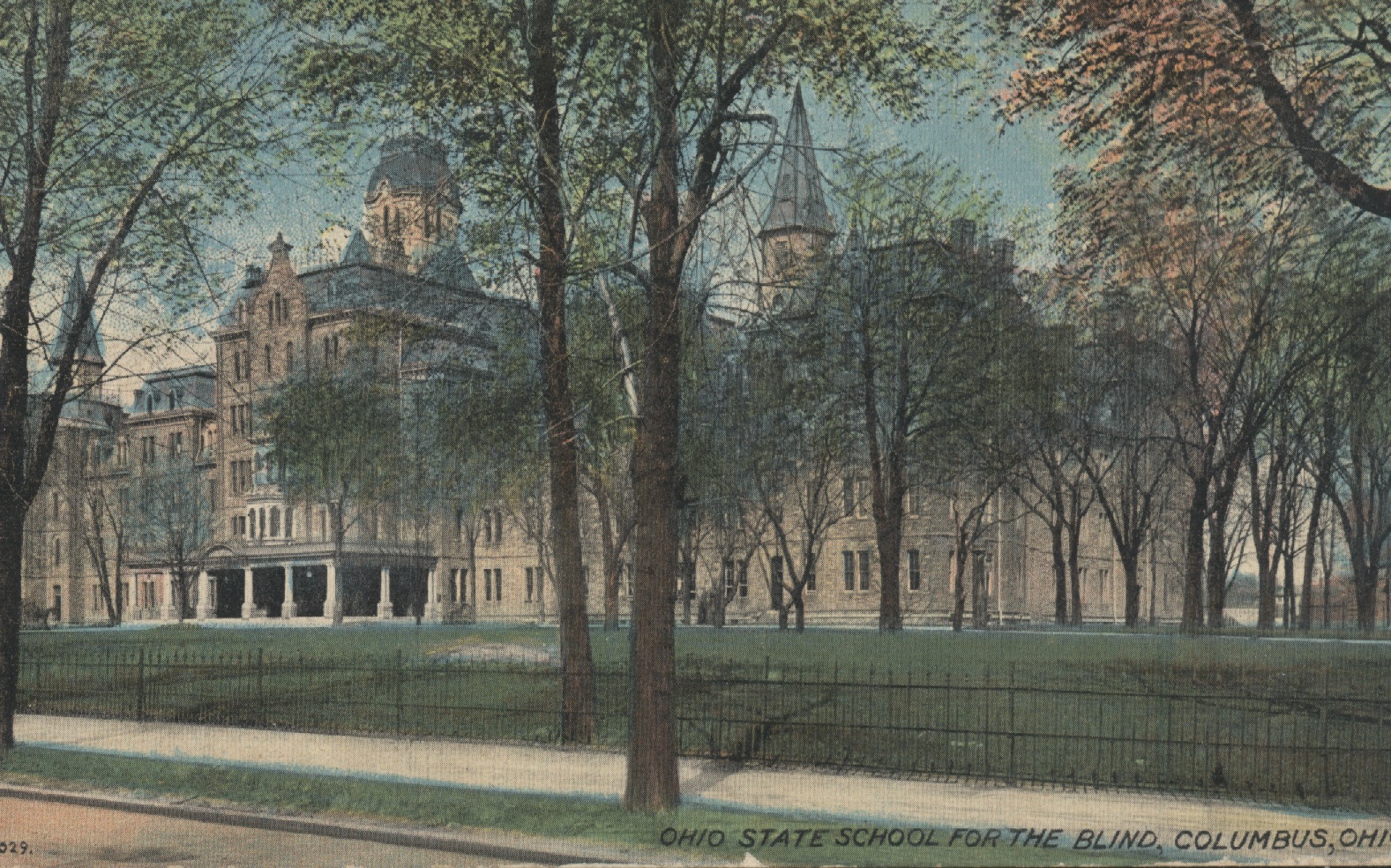
The Ohio Institution for the Education of the Blind

The Ohio Institution for the Education of the Blind (AKA Ohio State School for the Blind)

The following is an excerpt about the Institution from The Second Blessing: Columbus Medicine and Health, The Early Years by Charles F. Wooley and Barbara A. Van Brimmer. Copies of these books are available for purchase from the Medical Heritage Center for $45 (plus applicable sales tax).

At the first session of the influential Ohio physician’ meeting held in Columbus in 1835 – the Medical Convention of Ohio – a resolution was adopted “that Dr. Daniel Drake be requested to deliver an address on the subject of the Instruction of the Blind, tomorrow (Wednesday) evening, at half past 6 o’clock, and that both houses of the Legislature of Ohio be respectfully invited to attend.”  Drake fulfilled his task and the General Assembly appointed a commission to collect information relative to the education of the blind.  The group consisted of the Reverend James Hoge, Columbus minister; N.H. Swayne, a Columbus lawyer; and Dr. William Awl. Their report was a comprehensive and persuasive document.  The act establishing the Ohio Institution for the Education of the Blind was passed April 3, 1837.

The first trustees of the institution were N.H. Swayne, William Awl, and the Reverend James Hoge; the physician was Dr. R. L. Howard.  Located on East Main Street, the institute opened in October 1839 and soon gained a reputation as a progressive school with many successful alumni that provided pupils and training in a number of areas and disciplines. In 1873 Governor Tod appointed Dr. Awl as a physician to the blind asylum, a position he held until his death in 1876.

The annual reports placed emphasis on the history of such institutions and the instruction of the blind according to the standards of the day. Dr. Howard wrote the physicians’ and oculist’s reports in the annual reports; in the twelfth annual report he noted that many of the pupils never enjoyed good health. He examined the eyes of all the pupils in 1848 and found three cases of cataract; in 1849 he operated on four individuals with cataracts.  Chronic disease remained prevalent among the residents, and one death from pulmonary consumption occurred in a twenty-four year-old after a long and prolonged illness.