A Fotonovela on Predatory Lending

August 13, 2012 By LeighAnna Hidalgo During my undergraduate years at Arizona State University I worked on a diverse range of research projects for the South Phoenix Collaborative, studying current and historic risk factors such as migrant status, poor quality of neighborhood amenities, lack of access to affordable healthcare and healthy food, and erratic income. My commitment to South Mountain families led me to become a politically active researcher in solidarity with the segments of the community most affected by anti-immigrant legislation. I became painfully aware of the differential socio-spatial distribution of banks and predatory lenders in Phoenix area urban spaces. Under the tutelage of Dr. Seline Szkupinski Quiroga, I undertook a historical and spatial analysis on the access to credit and finance in South Phoenix for an undergraduate seminar class. This work demonstrated how space in the city is constructed and functions to produce economic and social inequality. After graduating from ASU, I entered the Applied Anthropology Masters of Arts program at California State University Long Beach (CSULB). While there, I expanded on my undergraduate thesis research on fringe financial services and followed my principle of democratizing anthropology by designing a multimedia interactive fotonovela using maps generated from GIS, archival and contemporary photographs, and video taped interviews in order to make my research knowledge accessible to the public and provoke dialogue on salient economic and immigration issues. My fotonovela comes from the tradition of rasquachismo,relying on resourcefulness to learn ‘just enough, but not too much’ GIS & Final Cut Pro and repurposing and reinventing western technologies like YouTube and Calameo from their original intent or function into a creative improvisation. My next goal is to recreate this fotonovela in Spanish and make it available for illiterate Spanish speaking populations. Currently I am experimenting with a printed version of the fotonovela with embedded videos procurable for those with smart phones. This fotonovela has been requested by ASU’s Morrison Institute for Public Policy, it has been presented in undergraduate level courses at ASU and CSULB, and in the future I hope to share it with the civil rights and advocacy organization Arizona Hispanic Community Forum. [calameo code=000553314fbaac851f9af width=420 height=272] LeighAnna Hidalgo is a first year Ph.D. student at UCLA Cesar E. Chavez Department of Chicana/o Studies. This is her fourth year as a MALCSista. Comment(s):

  1. Sara Ramirez  August 14, 2012 at 10:20 AM Wow! This is a fierce project can certainly bring attention to systemic reproductions of economic inequality. I appreciate LeighAnna’s care and thoughtfulness to provide access to those who don’t have computers and/or smartphones as well as those who can’t read. I’m super excited that I’m part of a generation of Chicana/Latina thinkers who understand the value of multi-media to effect change.I wonder in what other ways today’s generation of Latina/o feminist dissertators can make our work accessible to those subjects about whom we write.Best of luck to you, LeighAnna. I’m in your cheering section!
  2. La Chica Mas Fina  August 14, 2012 at 3:29 PM Thank you very much for your thoughtful and encouraging comment Sara Ramirez! I really appreciate it! Auto-title loans and the predatory nature of these businesses is something that affected my family and me personally when I was a chamaca. I too am very excited by the possibility of multi-media for effecting change and I hope that more Chican@s will start to think about how we can start democratizing our research, so that it truly serves the communities where we come from. Writing an article or a thesis is not enough when what we want is justice for our communities! Not only does it benefit our communities when we work hard to create accessible research, but it also benefits us as researchers to be humbled, to remember our own humanity, and give back to the places that raised us.
  3. Theresa (Mujeres Talk Co-Moderator)  August 14, 2012 at 1:03 PM LeighAnna, Thank you for sharing this careful work in interviewing community residents and collecting and analyzing data to show trends in financial services available to minority communities. Hope this finds many, many readers! A few years back there was a campaign here in Ohio to limit the amount that payday lenders could charge in interest which I believe was successful, but your research points to a deeper problem of inequalities in financial services more broadly.
  4. Sandra D. Garza   August 15, 2012 at 8:09 PM I love this Fotonovela! What a creative use of technology! Have you thought about submitting some of your written work to the MALCS journal?
  5. La Chica Mas Fina  August 16, 2012 at 11:13 AM Thank you Dr Delgadillo! Thats great to hear about the law that passed in Ohio. In Arizona a law passed in the summer of 2010 making payday lending illegal, but since then all the payday loan places turned into auto-title loan or income-tax loan outlets. My data was collected before this change occurred, so I would like to do a re-study to reflect all these changes. You are right that there is a deeper problem of inequalities that allow these financial service disparities to continue multiplying and mutating and I am glad that was clear in my fotonovela. Gracias for letting me share my work. -LeighAnna Hidalgo
  6. Theresa (Mujeres Talk Co-Moderator)  August 16, 2012 at 4:36 PM Yes! The same thing happened here: they morphed into other “financial services” that weren’t covered by the changed legislation. I wonder if banks that got bailout money could be required to provide services in low-income areas?
  7. Theresa (Mujeres Talk Co-Moderator)  August 17, 2012 at 12:49 PM I agree with Sandra, too, the Chicana/Latina Studies Journal will be a great venue for dissemination of your research work!
  8. Monica Russel y Rodriguez August 23, 2012 at 1:03 PM LeighAnna, Thank you for sharing your excellent work with us. I find the nature of your work and the mode of communication fierce indeed. I am so encouraged by the possibility of a broad readership here. That is to say, getting our research into the hands of people who can use the information powerfully. Additionally, I am encouraged by the possibilities of moving away from the narrowly constructed essay. Your work and this blog (props to Theresa!) move us in a better direction.
  9. La Chica Mas Fina   November 12, 2012 at 12:29 PM Monica Russel y Rodriguez, Thank you so much for your encouragement! I apologize for responding so late to your message. I am only now seeing it. I am very excited about the possibilities of using this digital fotonovela methodology in my other research projects, specifically my work with taco vendors in Arizona. As you say, these methodologies can allow us to “get our research into the hands of people who can use the information powerfully”. Exactly! Gracias por tu apoyo!
  10. Alicia Gaspar de Alba   November 6, 2012 at 11:40 AM LeighAna, I think this would make a fascinating subject for a lecture in 10A, and hence your final paper in 200. Let me just clarify, however, that the name of our department is the Cesar E. Chavez Department of Chicana and Chicano Studies. We do not have Latina/o Studies in our title, and we are very proud of the Chavez name. Profe Gaspar de Alba
  11. La Chica Mas Fina  November 12, 2012 at 12:21 PM Thank you Dr. Gaspar de Alba for reading and commenting on the digital fotonovela and for welcoming me into the Cesar E. Chavez Department of Chicana/o Studies program. I really value your work and look forward to incorporating the Alter-Native perspective into my final paper. Gracias!

Chicano’s in Amsterdam

July 11, 2012

From Catherine Ramirez:

Amsterdam, July 2010. Photo Credit: Catherine Ramirez.

Amsterdam, July 2010. Photo Credit: Catherine Ramirez.

I liked your latest blog entry from Barcelona.  Here’s a photo I took of an Argentinean restaurant in Amsterdam a couple of summers ago.  I also have photos of restaurants in Sweden and Denmark, but none are called Chicano’s.

Catherine Ramirez is on the faculty at University of California, Santa Cruz.

Latino/a in Spain?

July 10, 2012

By Theresa Delgadillo

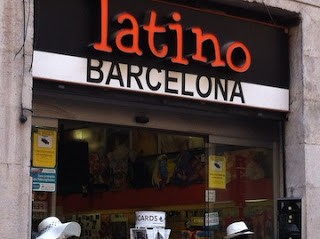
Storefront, July 2012. Photo Credit: Theresa Delgadillo

Storefront, July 2012. Photo Credit: Theresa Delgadillo

In Barcelona, Spain, while speaking with friends over lunch at a communal picnic table – switching from Spanish to English and back again – I heard the woman in the family sitting next to us say, in a whispered voice, “son Latinos.” She was referring to us, of course, answering what seemed to be a confused query from her partner about who or what we were. The term “Latino” has most definitely taken hold here to describe Latin American immigrants and their children, and it seems that just as in the U.S. it reflects a growing demographic that is welcomed by many and feared by some. 

Both Madrid and Barcelona have significant Latino/a populations and neighborhoods which have begun to appear in contemporary Spanish visual culture. The recent, very popular telenovela in the U.S. La Reina del Sur seems to acknowledge the issue of Mexican migration to Spain in the story of its protagonist Teresa, who flees drug violence in Mexico only to become an international drug smuggler herself in Spain. Latinos/as in Spain come from many different Latin American countries and some do have ties to U.S. Latinos/as, making the Latino/a connection global. As my colleague Dr. Miroslava Chávez-Garcia notes, the globalization of Latinos/as has its down side: Latinos/as and gangs are often linked in the popular discourse of both the U.S. and Spain. However, Spanish scholars Dr. and Prof. Carme Panchón Iglesias and Prof. Isaac Ravetllat Ballesté of the University of Barcelona suggest that Barcelona and Catalonia’s unique history and experience as a bilingual, bicultural people suggests that it may be well-equipped to create from these demographic and cultural shifts a society where difference is valued, where culture and language is shared rather than imposed, a society where inclusion and integration rather than assimilation predominates. If Catalonia is a particularly apt place for enacting that vision, let’s hope it spreads far beyond the borders of this region.

For many years, I have employed the pan-ethnic label “Latino” or “Latina” to refer to citizens of the U.S. who are Mexican American, Puerto Rican or of Latin American background. The term also generally refers to permanent residents of the U.S. from Latin American backgrounds, though individuals in this latter group often retain their identities as Latin Americans and prefer to be known as Latin Americans rather than Latinos/as, making it important to distinguish between Latin American and Latinos/as. My understanding has been the same as that of Marcelo Suarez-Orozco and Mariela Paez, who suggest in Latinos Remaking America that Latinos are “made in the U.S.A.” However, “Latino/a” is no longer only a U.S. identity, as this recent experience revealed to me.

What research or leisure travel are you doing this summer? What is the Latino/a experience you have or are encountering in your travels? How are Latin@s seen and understood where you are?

Theresa Delgadillo is on the faculty of Ohio State University and is a Co-Moderator of Mujeres Talk.

Juan Crow: Alive and Kicking in Arizona

July 2, 2012

By Seline Szkupinski Quiroga

Last week, the US Supreme Court ruled on the constitutionality of Arizona’s notorious SB 1070.  I was profoundly interested in the outcome not only because I am an Arizona resident and aware of the human rights implications if this law was allowed to stand, but also because I have been doing ethnographic research with a Phoenix Latino community over the past 5 years and I have witnessed first-hand how the lead-up to, passage and aftermath of SB 1070 has negatively affected the community and its members.

The Court upheld the most egregious provision of SB1070: the “show me your papers“ provision which requires law enforcement to determine the immigration status of anyone they stop in the course of routine policing if they have a “reasonable suspicion” that person is undocumented. The ability of authorities to treat others differently based on appearance was not declared unconstitutional, as were three other provisions of the bill.

At the time the Arizona v. United States decision was handed down, I was not in Arizona but in North Carolina for a family emergency. I was monitoring the progress of the proceedings via Facebook, live blogs, CNN and texting with a colleague who had been attending the vigils held in Phoenix. Given that North Carolina has a significant Latino population (more than 800,000 people) and is considered to be the hub of Latino migration to the South, I was surprised that so many around me didn’t seem to grasp the importance of what was happening – even though South Carolina, the state next door, passed similar anti-immigrant legislation last summer and it too included a “show me your papers“ provision.

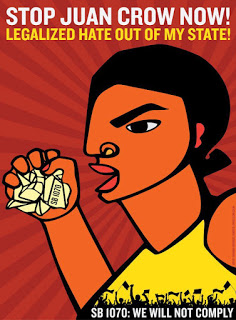
Being in the South at the time of the ruling highlighted the parallels with Jim Crow, the de jure institutionalized racism that prevailed one hundred years ago. (I was not the only one who made this connection as this powerful poster by artists Favianna Rodriguez, Roberto Lovato and Gan Golan began circulating the next day).

Juan Crow

Listening to the media responses to the ruling was like listening to someone from another reality. I heard conservative commentators pooh pooh the idea that racial profiling would flourish under the allowed provision. I live in Maricopa County where, under Sheriff Arpaio’s guidance, racial profiling thrives.  He and his office are being sued by the Department of Justice for, among other things, targeting Latinos for traffic stops. In my own work, I have heard multiple stories from men and women of being targets of hostility and suspicion for speaking Spanish in public, for having the Mexican eagle on their truck, for waiting at a bus stop late at night.

Justice Kennedy, writing for the majority, acknowledged that police offers may resort to racial profiling, but that would raise constitutional concerns. In other words, eyes will be on Arizona; if you don’t behave, you will face more court challenges about civil rights violations. Really? We have to go through MORE instances of discrimination and differential treatment before the injustices are addressed in the courts?

Other commentators have pointed out that the provision upheld already exists in federal law as if that is sufficient justification to roll over and play dead. What about working to change the law at the federal level? What about recognizing the immorality of the law itself? The commodification and dehumanization of people so that they are no more than “aliens”?  Where pundits claim the moral high ground of preserving rule of law, I see violation of human rights. The appeals to “protect our communities from illegals” as if immigrants are not part of our communities angers and saddens me.

At the same time, I look forward to the next steps. I have been a witness to the changes in Arizona, to the slow and steady encroachment of hate and hostility towards Latinos in general, and immigrants in particular. But alongside this, I have also witnessed the conscientización of a new generation of community-based activists. The chilly climate created by the passage of SB1070, the ban of ethnic studies, the expansion of the 287(g) program, etc. has been a catalyst for a Phoenix-based Latino grassroots protest to mature. In a future essay, I’ll write about the multiple ways resistance manifests here in the desert.

For now, quiero decir algo: 

MALCS participated in the Arizona boycott called two summers ago when Jan Brewer signed SB1070 into law. The politically correct thing to do then was to boycott Arizona, to refuse to spend money here and thus economically undermine the state, since tourism is one of Arizona’s major source of tax revenue. MALCS has always been dear to my heart – I credit MALCistas with getting me through graduate school – but to be honest, I felt abandoned when the national Summer Institute was cancelled. We were on the frontlines, and where was our support? How hard was it to refuse to come to a state where the thermometer hits 115? But I had no time to explore those feelings as we here in Arizona quickly re-organized the Institute into a State Conference, bringing together local activists and scholars, and growing in the process. This year, the theme of the Summer Institute in Santa Barbara is Todos somos Arizona. As we prepare to juntarnos once again, I ask you to reflect on what that means for your scholarship, your activism, and your corazón.

As new co-moderator of Mujeres Talk, this essay was written not as an intellectual exercise, but as a rumination entre hermanas. Responses welcome.

Seline Szkupinski Quiroga is a child of immigrants and a medical anthropologist living in Phoenix, Arizona.

 Comments:

  1. Theresa (Mujeres Talk Co-Moderator)  July 3, 2012 at 1:07 PM

    Seline,
    I appreciate your reflections at this moment because there has been little written about the decision that addresses the racial profiling it leaves in place — and in a way that reminds us that our communities are now all across the U.S. Thank you, too, for asking us to reflect on what we can and might do to further support our compañeras in Arizona.

  2. Marivel Danielson  July 11, 2012 at 12:38 AM

    Yes! Thank you Seline for vocalizing what many of us in Arizona feel on a daily basis–abandoned. The focus of the 2012 MALCS Summer Institute is a wonderful place to begin to discuss how each of us might transform our outrage and indignation into action and change in Arizona and other places around the country and the globe in dire need of intervention. As we head into Santa Barbara and this precious time of gathering, nurturing, personal and professional growth, I echo Seline’s prompt to all Institute attendees and MALCS members broadly to think about the ways your resistance to the hate and ignorance in Arizona can become and visible part of the powerful wave of activism, art, and scholarship we continue to engage with every day here in Arizona. Our presence and voice in Arizona are so much more valuable than absence or silence will ever be.