
Decolonize Your Diet!

September 10, 2012

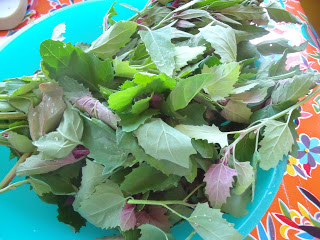
Quelites Harvest

Quelites Harvest

By Luz Calvo and Catriona R. Esquibel

We have a passion for Mexican food. We have a passion for gardens, for healthy food, for food justice, and for people of color reclaiming our histories. All of this has led us to our current project, Decolonize Your Diet. This is a project to reclaim the heritage foods of greater Mexico and Central America as a way improving the physical, emotional, and spiritual health of US Latinos/as.

SOME BACKGROUND

In the US, a person’s health is almost pre-determined by their socio-economic status. For the most part, upper and middle class people, who have access to health care, higher education, healthy foods, and safe spaces to exercise, have significantly better health than poor folks who lack health insurance, education, access to grocery stores, and who live in poor and often dangerous neighborhoods. Public health scholars evaluate the health of demographic groups by looking at mortality, infant mortality, obesity, heart disease, high blood pressure, diabetes, and cancer rates. Poor people have worse health on all these measures. This is not surprising: Social inequality affects people’s health and lifespan.

However, there is one notable exception to the equation of poverty = poor health—public health scholars have found that recent immigrants from Mexico have very low rates of mortality, infant mortality, and illness compared to other groups. Public health scholars have dubbed this phenomenon “The Latino/a Paradox.”(1) Recent Latino/a immigrants, mainly from Mexico and Central America, have better health than Latinos and Latinas who were born in the US. The health of recent immigrants rivals the health of the [w]healthiest Americans! This fact is somewhat astounding given that Latino/a immigrants face so many challenges: in general, Latino/a immigrants arrive to this country with very few economic resources. They don’t have access to preventative health care and are often afraid to seek care when they are sick. They work in difficult and dangerous jobs and they are under extremely high levels of social, spiritual, and economic stress. One would expect their health to suffer under these circumstances.

Public health scholars have not been able to explain Latino/a immigrants’ health; but there is significant evidence supporting the health benefits of traditional diets of Mexico and Central America. We believe that these food traditions protect Latino/a immigrants from disease, including diabetes, heart disease, obesity, and some cancers. Unfortunately, the health of immigrants declines over time. The longer immigrants stay in the US and the more they assimilate into US culture, the worse their health becomes. By the second generation, Latinos/as face the same issues as other poor folks in the US, with skyrocketing rates of diabetes, obesity, and heart disease. Cancer rates also start to increase.

DECOLONIZE YOUR DIET

We feel it is imperative that Chicano/a Studies engage food justice in research and teaching. We call to our comrades, colleagues, and students to look at their personal food choices as political acts. Resist cultural imperialism by reclaiming ancestral foods. Honor our ancestors and their wisdom by learning how to cook beans, make corn tortillas, and grow food.  Above all, share your knowledge!

The following chart outlines some of the differences between what we think is a Colonized Standard American Diet (¡Qué SAD!) and a decolonized approach:

WESTERN DIET
DECOLONIZED DIET
Advertising and Fads
Ancestral Knowledge/Oral Tradition
Hybrid Seeds and GMO
Heritage Seeds and Seed Saving
White Supremacy
Respect for Mexican and Indigenous Knowledge and Traditions
White sugar, White flour, White rice
Brown is Beautiful: Honey, Whole Wheat, Brown Rice
Assimilation, Submission, Capitulation
Resistance, Resilience
No connection to the land. Reliance on Chain Grocery Stores.
Community Gardens, Guerilla Gardening, Urban Farming,
Boredom
Creativity
Conspicuous consumption
Simple, accessible food
Disavowal, Thoughtlessness
Intentions, Blessings and Ceremony
Processed Foods
Real, whole food
Anti-union/anti-immigrant
Fair labor practices, Worker cooperatives
Pesticides and Monoculture
Permaculture and Biodiversity
Pharmaceutical industry
La Comida es Medicina, Herbal remedies
Wasteful
Resourceful

As part of our project, we are collecting and sharing knowledge and recipes. We are inspired by Native food activists like Winona LaDuke (2,3,4), Devon Abbott Mihesuah (5) and the Tohono O’odham Nation (6). We’re very excited by the significant health benefits to be gained from eating cooked dried beans (7,8,9), nopales (10,11), chia (10), quelites (12), and verdolagas (13, 14, 15).

JOIN US AND LEARN MORE!

We invite you to join us in the reclamation of Mexican heritage foods: join “Luz’s Decolonial Cooking Club” on Facebook or follow our blog at decolonizeyourdiet.blogspot.com

CITATIONS
  1. Viruell-Fuentes, Edna A. 2007. Beyond acculturation: immigration, discrimination, and health research among Mexicans in the United States. Social science & medicine (1982) 65 (7): 1524–35.
  2. LaDuke, Winona. 1999. All Our Relations: Native Struggles for Land and Life. Cambridge, MA; Minneapolis, MN: South End Press; Honor the Earth.
  3. LaDuke, Winona. 2005. Recovering the Sacred: The Power of Naming and Claiming. Cambridge, MA: South End Press.
  4. LaDuke, Winona, and Sarah Alexander. n.d. Food is Medicine: Recovering Traditional Foods to Heal the People. Honor the Earth/White Earth Land Recovery Project.
  5. Mihesuah, Devon Abbot. 2005. Recovering Our Ancestor’s Gardens: Indigenous Recipes and Guide to Diet and Fitness. University of Nebraska Press.
  6. Tohono O’odham Community Action with Mary Pagnelli Votto and Frances Manuel. 2010. From I’Itoi’s Garden: Tohono O’Odham Food Traditions.Blurb.com.
  7. Reynoso, Camacho, R. 2007. El consumo de frijol común (Phaseolus vulgaris L.) y su efecto sobre el cáncer de colon en ratas Sprague-Dawley. Agricultura técnica en México 33 (1): 43–52.
  8. Guevara, Lara, F. 2006. Phenolics, Flavonoids and Other Nutraceuticals in Mexican Wild Common Beans {(Phaseolus} Vulgaris).
  9. Serrano, José, and Isabel Goñi. 2004. [Role of black bean Phaseolus vulgaris on the nutritional status of Guatemalan population]. Archivos latinoamericanos de nutrición 54 (1): 36–44.
  10. Guevara-Cruz, Martha et al. 2012. A dietary pattern including nopal, chia seed, soy protein, and oat reduces serum triglycerides and glucose intolerance in patients with metabolic syndrome. The Journal of nutrition 142 (1): 64–69.
  11. Gutierrez, Miguel Angel. 1998. Medicinal Use of the Latin Food Staple Nopales: The Prickly Pear Cactus. Nutrition Bytes 4
  12. Barakat, Lamiaa A A, and Rasha Hamed Mahmoud. 2011. The antiatherogenic, renal protective and immunomodulatory effects of purslane, pumpkin and flax seeds on hypercholesterolemic rats. North American journal of medical sciences3 (9): 411–17.
  13. Huang, Yun, and Lei Dong. 2011. Protective effect of purslane in a rat model of ulcerative colitis. Zhongguo Zhong yao za zhi = Zhongguo zhongyao zazhi = China journal of Chinese materia medica 36 (19): 2727–30.
  14. Huang, Zhiliang, et al. 2009. Total phenolics and antioxidant capacity of indigenous vegetables in the southeast United States: Alabama Collaboration for Cardiovascular Equality Project. International journal of food sciences and nutrition 60 (2): 100–08.
  15. Shobeiri, S F, et al. 2009. Portulaca oleracea L. in the treatment of patients with abnormal uterine bleeding: a pilot clinical trial. Phytotherapy research: {PTR} 23 (10): 1411–14.

Luz Calvo is an associate professor of Ethnic Studies at Cal State East Bay.  After their breast cancer diagnosis in 2006, Calvo became interested in food justice activism.

Catriona R. Esquibel is an associate professor of Race and Resistance Studies at San Francisco State University. Esquibel started writing about ancestral foods after she and Calvo ate verdolagas at her father’s morada on Good Friday in Holman, New Mexico.

Comment(s):

  1. Elena Gutierrez  September 11, 2012 at 5:46 PM

    Verdolagas grow in the sidewalk cracks here in Chicago and I have more than once excavated and cooked them with friends. We get a few stares but they are so yummy and worth it! Thanks too for these references- not I can show my mom the “proof” that nopales really will help her diabetes. Excited to hear about your further works in this area.

  2. Theresa (Mujeres Talk Co-Moderator)  September 12, 2012 at 12:33 PM

    When my dad became diabetic i started looking into healthier traditional foods and yes, nopales are, indeed, good for diabetes! Luz and Catriona, thank you for sharing some of this exciting new work, and your emphasis not on the pricey and expensive and hard to find ingredients but on the readily available and traditional prepared in healthy ways. I am curious if anyone has done studies on the practices of keeping milpas that are mentioned in fiction that describes early and mid 20th century Chican@ life and health.

  3. Dianna Ching  November 21, 2012 at 5:06 PM

    I want to get rid of my tummy fats but I can’t deprive myself on foods so I never considered diet. But this one sounds so easy so I think I’ll give it a shot. Instead of having a liposculpture right away, why not try this. Thanks a lot!

Las Madres Profesoras in the Academy

September 3, 2012

Castañeda and son, Miguel Angel

Castañeda and son, Miguel Angel

By Mari Castañeda

For the past twelve years, I’ve lived in Amherst, Massachusetts, an iconic New England college town that has a high-income and predominantly white population that often boasts about a family lineage that dates back to the first pilgrim settlers. Luckily for my son Miguel Angel, who is now a seventeen-year-old and about to enter is senior year at the local high school, he’s learned to meet such boasting with his own story of a family lineage that pre-dates those settlers and is tied to the Yaqui Indians of California and Mexico. It has not always been smooth sailing—such as the time his elementary school teacher called me because my son upset his white classmates by telling them with a typical nine-year-old bluntness that “they didn’t belong in this land.” We worked through the incident together, making it the prototypical “learning moment” with his class. For my son Miguel Angel, such historical positioning became necessary in order for him to claim a space in a place that was not originally intended for him. Yet we learned from other friends of color who had a longer history of making space for themselves in the region, and over time built a diverse community of family friends. The making of home and community are indeed socially constructed, in addition to being passed on from generation to generation.

At the 2012 MALCS Institute, Susana Gallardo and I organized a roundtable titled, “Las Madres Profesoras in the Academy” in an effort to create a space to discuss the joys and challenges of working in academic environments while also being a mother/parent. What we found most enjoyable about the roundtable was sharing about how each of us were succeeding and struggling with creating such a balance. In doing so, we learning from each other’s strategies and sabiduria, especially since most of us were the first mujeres in our families to forge this professorial path. We also discussed the institutional realities of faculty positions, which often causes us to be far away from our extended families, thus forcing us to rear our children in communities that are regionally, culturally, and even economically radically different than the ones we grew up in.

When we introduced ourselves at the beginning of the session, we also noted the ages and names of our children—something which often doesn’t happen at conference panels. Although the ages of our kids ranged from four years old to seventeen, it was clear that despite the age differences, we were all trying to figure out how to reconcile our lives in academia (which often negates the personal lives of students, staff, and faculty) with the fact that our children and broader families were at the forefront of our lives.

At the roundtable, we discussed the importance of building such homes and communities on our own terms, regardless of where we were located. Each of us had stories of the lengths we went—whether driving across town, or flying across the country—to make sure our children had a range of experiences that would help them develop a healthy and well-grounded sense of identity. We also discussed ways in which we could influence our institutions to be more sensitive to motherhood/parenthood issues so that we can be in a work environment that allows us to be successful in all the areas of our lives. Increasingly (although perhaps grudgingly), academic institutions are recognizing that they must change their insensitive practices and unrealistic expectations if they are to remain as cutting edge and relevant scholarly environments in the twenty-first century. Creating a work place where mother-scholars are welcomed, encouraged and expected to succeed is central to this shift. For instance, the chair of my department when I first started at UMass Amherst (a white male) was incredibly sympathetic when I told him I needed to teach between 9am-3pm because my son’s inability to be in an after school program as a five-year-old. Not only did he schedule my courses T/Th between those hours, but the faculty meeting was also scheduled between 12-2pm. These seemingly simple accommodations made a world of a difference in mine and my son’s happiness and success.

When I was a graduate student mother in the early-1990s, virtually no conferences held panels, workshops, or roundtables on the topic of balancing motherhood with academia. At this Summer Institute, our panel was one among several on mother-related topics including Danielle Barrazza’s “My Baby Bump” and Karleen Pendleton-Jimenez’ wonderful reading of her memoir on butch pregnancy and motherhood (http://labloga.blogspot.com/2011/11/how-to-get-girl-pregnant.html).

Things are starting to change and it’s great to see that MALCS is once again at the forefront of this important discussion. At the roundtable, it became clear that we wanted to continue the conversation outside of the institute, and thus we are starting a queer-friendly parenting list for MALCS members and affiliates. We hope you will join us in our effort to share experiences, best practices, and a safe space to get advice.  Please join us on our new email discussion list!  To join the “Madres Profesoras” email list, please email Susana@malcs.org

Mari Castañeda is an Associate Professor of Communication Studies at the University of Massachusetts, Amherst.  She studies new media and telecommunication policy, Latina/ethnic media studies, and transcultural political economy of communication industries. Her latest book is Mothers’ Lives in Academia, a collection of essays co-edited with Kirsten Isgro, forthcoming from Columbia University Press.

Comment(s):

Theresa (Mujeres Talk Co-Moderator)  September 5, 2012 at 7:54 AM

Mari, Your essay highlights how much the question of Chicana/Latina/Native American women’s inclusion in the academy is not only about whether an institution provides affordable and quality child care – which is vitally important, but also about the practices of the profession and the services that we can all make use of to help that next generation. I like how much your essay emphasizes that even the seemingly small gestures matter. Thank you!

Corrido de Norma Cantú

By Rita Urquijo-Ruiz and David Garcia Video by Larissa Mercado-Lopez August 31, 2012, is the last day that renowned Chicana, feminist scholar Dr. Norma E. Cantú will be at the University of Texas, San Antonio’s English Department. To honor her work, Dr. Larissa Mercado-López (one of her former students) led a group of volunteers who organized an amazing mini-symposium on the life and work of Dr. Cantú. Other Chicana scholars and some of Dr. Cantú’s former students presented papers highlighting the multi-faceted aspects of Cantú’s work. As part of the panel on “Chicana Literary Expressions,” David F. García, and Dr. Rita E. Urquijo-Ruiz collaborated by writing her a corrido entitled “Destino al andar.” The day closed with an after party at the Esperanza Peace and Justice Center co-organized by another one of Dr. Cantú’s former students, Dr. V. June Pedraza, and Dr. Antonia I. Castañeda, Dr. Elsa Cantú Ruiz and another group of volunteers. People visited from all over the country to honor and thank Dr. Norma E. Cantú for all the work, passion and love that she has shared with thousands of people in her communities. This corrido is just a little “regalito” for her. Mil gracias, Norma! De todo corazón.

Written and performed by Rita E. Urquijo-Ruiz and David Garcia at UT San Antonio on Friday, August 24.  Video by conference organizer Larissa Mercado-Lopez.

“DESTINO AL ANDAR”
Al empezar a cantar
Pedimos permiso ahora
Para rendir homenaje
A una ilustre doctora.Ella es de la frontera
En los dos Laredos criada
Chicana de tal carrera
Por todos muy apreciada

Norma Cantú es su nombre
Y le vengo a saludar
Le brindo mi canto alegre
Un regalo musical

Es persona de renombre
Con buen don de la palabra
Maestra en todo sentido
En cualquier lengua que habla.

Esta doctora sí cura
Con esa pluma en la mano
Escribe de la cultura
De chicanas y chicanos

Para ayudar a estudiantes
Nunca nadie la mejora
Todos ellos son brillantes
Es la ideal profesora

Escribe nuevas historias
Que hablan del feminismo.
Y con una pluma zurda
De un pájaro fronterizo

Brindamos a la maestro
En el lindo San Antonio
Por la cultura tejana
Sigue dando testimonio

Al andar se hace el destino
Por donde no hubo ni huella
Peregrina de caminos
Yo le saludo, ¡Ultreya!

Vuela, vuela golondrina
Por el cielo tan azul
Protege a nuestra madrina
La profesora Cantú

¡Viva la Dra. Norma Cantú!

“DESTINY AS WE WALK”
As we begin singing
We now ask for your permission
To pay tribute
To an illustrious doctorShe is from the border
Raised in the two Laredos
A Chicana with such a career
Respected by everyone

Norma Cantú is her name
And I come here to salute her
I offer her my happy song
A musical gift

She is a renowned person
Gifted with words
Knowledgeable in every sense
In any language she speaks

This doctor does cure
With her pen in her hand
She writes about
Chicana and Chicano cultures

At working with students
No one can be better
They are all brilliant
Because she’s the ideal professor

She writes about new (hi)stories
That speak of feminisms
And with the left-handed plume
From a borderlands bird

We toast our teacher
In our beautiful San Antonio
She continues to give testimony
On Chicana/o culture

Destiny is created as we walk
Where there wasn’t a footprint
Pilgrim of the roads
I salute you, “-Go forth!

Fly, fly away, swallow
Throughout the deep blue sky
Protect our godmother
Professor Cantú

¡Viva la Dra. Norma Cantú!

Dr. Rita E. Urquijo-Ruiz is a professor of Spanish and Transnational Mexican Popular Cultures at Trinity University in San Antonio, TX. Her book entitled Wild Tongues: Transnational Mexican Popular Culture was published in July 2012 in the UT Press Chicana Matters Series.   David Garcia is a musician/composer of Chicano/Mexican music from northern New Mexico. He is a Queer Xicano/Manito anthropologist who studies popular culture, foodways and the production of public space. Garcia is currently a Ph.D. student in the in the Department of Anthropology at the University of Texas at Austin.

Learning from Mexican and Native Women

August 20, 2012

Photo Credit: Pepe Rivera. Taken June 26, 2011. From Flickr.

Photo Credit: Pepe Rivera. Taken June 26, 2011. From Flickr.

By Theresa Delgadillo

Yesterday, as I continued my work on translating an oral history interview from Spanish into English, I was struck by something that this particular participant in the project said – as I often am in this work. I’ve had the honor of interviewing some very wise and determined Latinas in the project that I began in 2008 to collect the oral histories of Latina leaders in Milwaukee, Wisconsin. These are some very interesting women! Fortunately, I am near the end of the editing and looking forward to sending it off the publisher soon. To get back to my point: my interviewee, commenting on the social customs of Mexico and the U.S., says at one point, “There it is the same as here, exactly the same as here. The only difference is that there is still a fiction that in Mexico it’s different.” She was talking about the acceptability of divorce, but it resonated with me on other levels, such as the changes in daily life, work and environment, partially because there was some interesting news from Mexico recently in the The New York Times about a group of indigenous women in Cherán, Michoacoán, who mobilized against armed illegal loggers and are now defending their town from violence and their forest from deforestation. To readers of Latina/o literatures, or literature about migration, the name Cherán might be familiar, since it was one of the sites of migration to the U.S. portrayed in Ruben Martinez’s Crossing Over: A Mexican Family on the Migrant Trail(2001). The August 2, 2012 article by Karla Zabludovsky titled “Reclaiming the Forests and the Right to Feel Safe,” describes the events in Cherán and the women’s actions as “extraordinary” as it details their effectiveness. Motivated in part by the loss of the beautiful forest that was once their patrimony, a loss that must be visible to them on a daily basis, the women see themselves acting not only for themselves but for future generations. When I read it, I wondered, and not for the first time, if Luis Urrea’s novelInto the Beautiful North (2009) hadn’t come to life – because this is not the first instance in recent years of Mexican women taking the lead to end violence and environmental destruction. Meanwhile, New York State is set to join the ranks of states allowing fracking. In an August 19, 2012 CBS News Report, “New York State to Allow Fracking,” Jeff Glor’s article notes that the process of fracking releases dangerous contaminants that have high potential to endanger air and water supplies, yet quotes local farmers who need the money. The women of Cherán, Michoacán, also need money to live and they are supported in part, according to the article, by remittances from residents who have migrated to the U.S., yet it seems they are living in the aftermath of a disastrous environmental decision and working to make it right. Like the people of Cherán, Michoacán, Mexico, we face some very difficult decisions in these energy-gobbling times, and we might consider what we can productively learn through a comparative perspective that doesn’t consign indigenous women to a lost past, but instead examines the experience of both residents and migrants from particular regions about what doesn’t work – because as my interviewee says: “There it is the same as here, exactly the same as here. The only difference is that there is still a fiction that in Mexico it’s different.”

Theresa Delgadillo is on the faculty at Ohio State University.

  1. María Antonietta Berriozábal  August 20, 2012 at 4:27 PM

    Dear Theresa:

    I find your work fascinating. I am a lover of oral history. Next month my book, María, Daughter of Immigrants, will be published. The first chapters include the stories that my parents told me as a child. With just their stories – no genealogical searches for me – I was able to share the story of my great grand mother and grandparents going back one hundred years. That is rather astounding. To think that these women can share a story, you chronicle them and one hundred years from now someone will be sharing them.

    Another reason for my interest in your work is that in 1995 I attended the Fourth World Conference on Women in China as a member of the US delegation. During the conference I met with women from Central America and some from Peru. Some could not even speak Spanish. They spoke their native dialects, but they had leaders who had learned Spanish and they were our interpreters. One of the reasons they had gone to the Beigjing conference, through great sacrifice, was to tell their stories of how their ancestral lands were being taken by businesses. It is the same story that continues to this day of multi-national corporations raping the environment in other countries so they can provide goods and food for the developed countries like the US and others. But the women were fighting; they were organizing and using their voices. I found it interesting that the leaders of the movements, at least of the ones I met, were mujeres. They wore their colorful clothing almost as the shield of warriors.

    In any event, I appreciate what you are doing very much.

    Sincerely,

    María Antonietta Berriozábal
    San Antonio, Texas

  2. Theresa (Mujeres Talk Co-Moderator)  August 20, 2012 at 6:14 PM

    Dear María Antonietta,

    I am looking forward to reading the preview of your book that appeared in Frontiers, and to your new book. Please send us an announcement for it as soon as it appears. My project was motivated, too, by the desire to record and share the life stories of Latinas whose experiences don’t appear elsewhere.

    Research in the U.S. has shown that indigenous migrants to the U.S. from Latin America often face difficulties precisely because of the language assumptions that you noted in your experience. Despite language differences, we are all struggling with the same difficult questions about how we use our natural resources.

    Thank you so much for your comments and encouragement, and thank you for sharing your work.

    Take care, Theresa

  3. Lourdes Alberto  August 28, 2012 at 8:31 PM

    In reading this post I am reminded that indigenous people think of themselves as planetary citizens–they fight for their people, their cultures, their history, but also all of our well-being and that of future generations.
    As an indigenous person myself (Oaxaqueña), I struggle with my own part in the depletion of the Earth’s natural resources.
    You know, three seasons ago I started growing a garden with the goal of eventually meeting all of my family’s summertime food needs. It was so fulfilling, so liberating, so unexpected. I know now that my challenge is to remember and live the knowledge my grandparents left me about the land, about plants and about the importance of well-being. As you mentioned, there are tens of thousands of indigenous people from Latin America in CA. Growing up we had an informal plant co-op/exchange. Someone would manage to bring over a plant, flower, hierba, from Oaxaca and we would literally share cuttings–yerba santa, varieties of avocado, ruda. It was amazing! A kind of urban indigenous transnational environmentalism!

  4. Theresa (Mujeres Talk Co-Moderator)  September 3, 2012 at 5:25 AM

    Dear Lourdes,

    It’s good to hear from those that grow gardens for sustainability, and I appreciate the work you’ve put into this important task for three seasons, which, as you say, is a combination of memory work, and living a connection to others and growing food. Thank you for your beautiful note!

    Take care, Theresa