Chapina 2.0: Reflections of A Central American Solidarity Baby

May 13, 2013

Guatemalan activist Rigoberta Menchú visits Los Angeles, CA, and tells her story at an event organized by the Guatemalan Information Center. Norma Chinchilla, the author’s mother, translates. Circa 1982. (Photo courtesy of Maya Chinchilla.)

Guatemalan activist Rigoberta Menchú visits Los Angeles, CA, and tells her story at an event organized by the Guatemalan Information Center. Norma Chinchilla, the author’s mother, translates. Circa 1982. (Photo courtesy of Maya Chinchilla.)

By Maya Chinchilla

“Knowing the truth may be painful, but it is without any doubt, highly healthy and liberating” –Slain Guatemalan Bishop Juan Gerardi, 1998

In the 1980s, my parents and a group of Guatemalan exiles founded the Guatemalan Information Center, a human rights and solidarity organization focused on international solidarity with Central America. They showed documentaries like When the Mountains Tremble and slide shows to raise awareness about the extreme human rights violations in Guatemala, which were enacted with the complicity of the U.S. government under the Regan administration. They spent nights and weekends organizing events and staffing literature tables all over Los Angeles, often accompanied by guest speakers, music, art and food.  I vividly remember the leaflets and flyers, permeated with the smell of mimeograph ink, and small newsletters that they learned to typeset themselves. Like other dedicated organizers, my parents didn’t have a regular bedtime.  I remember my sister and I found places to sleep in corners of the room when meetings would go on late into the night. I have written about this experience in my poem, “Solidarity Baby,” in which I call my home a “Central American underground railroad,” or a place where refugees and exiles rested after running for their lives.

I grew up hearing about dictators such as Jose Efraín Ríos Montt, a cruel army general who, after leading an internal coup became the de-facto president in 1982. He is only one of many U.S. supported military regimes that took leadership after the years following a U.S.-backed military coup in 1954. This same general and former president was recently on trial for crimes against humanity and for helping to design and execute the scorched earth policy that resulted in the Maya genocide during the 1980s, the most brutal period of Guatemala’s 36-year war. This historic trial marks the first time a former head of state has been convicted of genocide in his own country and is the result of years of struggle from many, like my parents, who never thought they would see this day.

I was five or six years old the first time I saw When the Mountains Tremble, a powerful documentary about the repression of indigenous Guatemalans by the military dictatorship and the ways in which Mayan and Ladino Guatemalans organized themselves to resist repression and to work for much-needed fundamental social and economic reforms. We watched it in my living room, where organizers and friends sat on couches, folding chairs, and even on the floor and leaning up against each other in anticipation of the story of the film. As a dreamy yet observant kid, tiny for my age, I would casually slip in and out of the room without much notice. Curled up in my mother or my father’s lap, I would listen to the rise and fall of their breathing, their hearts pounding as their words echoed through their chest discussing the issues at hand.

Then there he was, Ríos Montt, his face huge on the screen, smiling, overly confident, invoking the name of God and talking as though Jesus himself had blessed his crusade to protect the US and Guatemalan elite interests from the poverty-stricken masses. What I remember most vividly from the film was the sound of the military helicopters: chocka chocka chocka chocka. They were the same grayish green ones I saw in the TV show M.A.S.H. and in movies about the U.S. military in Korea or Vietnam.  I still jump at the sound of thunderous helicopter blades, not because of their use by police in Long Beach, where I grew up, or in the Bay Area, where I now live; it is because of images and sounds of helicopters used by repressive armies against Mayan villagers that are so deeply engraved in my memory.

These memories come in bits and pieces, but what is always present is the feeling of anxiety, the intensity of the silences, the power of the personal testimonies, and the sense of the life and death urgency of the times. While I may not have understood the complexities of dictatorship, repression, organized resistance, and the U.S.’s assistance to authoritarian governments at a young age, I did understand that there were things that should not or could not be said at school or with other family members because they might not understand or, worse, might think of us as “commie sympathizers” and potentially disclose things that might endanger others’ lives.  These included horrific stories of torture, mutilation, death squads, disappearances, and images of bodies left in public places—that is what happened to people who spoke out, and this filled me with fear.  Of course, there were stories of heroism and bravery and stories about the importance of individual sacrifice for a better life for future generations. Yet the images of repression were so powerful they accompanied me as I went back and forth from the refuge of my home into the world.

At times I feel I absorbed my parents’ anxieties and none of their political training or coping skills. This is the trauma that I believe has been inherited by many of us who are second-generation Central Americans, who were either born over there and left very young or born in the U.S. like me, who did not experience the violence first hand. The impact of the war lives on in our silences and is only healed by knowing the truth, telling our stories in all their complexities and cultivating our creative imagining of a more just and boundless future.

It was not until I had the opportunity to research and write about my family history in college that I was finally able to articulate the weight I had felt all my life and the urgency to put the pieces of my memory together. I found other Central American students—or rather they found me—the majority 1.5-ers who came very young from Guate or El Salvador, who shared their stories and asked me about mine. It was the first time people asked me questions about what I thought about my identity and history and the first time I felt they wanted to listen. I read Central American, Chicano/a, Puerto Rican and other Latin American poets. I found myself in the margins between Spanish and English. It was then that I first wrote a poem called “Central American-American,” yearning for my own cultural movement to find names for this 2nd generation experience.

As Guatemalans are apt to do with their corny and dark multilayered humor-coping mechanism, I often joke about our collective skittish Central American paranoia or the worry, the caution, the mistrust: the way I was taught to always know where my shoes were at night in case we had to just get up and go; the lectures from my parents on how to answer the phone and who was allowed to pick me up at school; my training to remember specific numbers for emergencies, to avoid saying too much; that everyone was shady until proven otherwise and the way every time we went to Guate, I was told that being too “Gringa” could get me in trouble, but how the act of forgetting and not asking too many questions could also keep me safe. Some of this was the usual conversation for cautious parents to have with their elementary-school-aged, latch-key kids, but I knew for us it was more than that.

Today, just hearing any little thing about Guatemala in the news as a 2.0 Chapina causes my body to tense in places. Some of that tension is actually excitement that we will finally be able to hear more of the truth, that others will understand our collective intensity around the need to know more, the hunger to find justice and move beyond only speaking of the violence to never forget, so as to never let it happen again. And now, more recently, I continue to put the pieces together when I share my writing with others and show my own students’ documentaries like When the Mountains Tremble.  Showing films like this one still cause me anxiety and sadness; but, more than anything now, I choke up with emotion when I think about the incredible strength and resiliencies of those that have survived to tell these stories.

I still remember the sound of the Quiché-Maya accented Spanish of Rigoberta Menchú, the young narrator of the documentary, with her bright, focused eyes and hands folded calmly in her lap. Her words were interspersed with the sounds of the boots of the fresh–faced, idealistic guerilla fighters, mostly indigenous men and women, hiking through the mountains, sharing their dreams about the more peaceful and humane world they hoped to create for future generations. I remember the deep baritones of the cocky generals explaining the importance of resisting the supposedly Cuban-influenced “subversives” and the face of the often Mayan-descended young military soldiers with their M-15 rifles, looking like they could be the children or brothers of the dead villagers and the wailing mothers.

It is with the same combination of pride and deep sorrow that I watched the trial against Rios Montt, an unprecedented historic event, in which survivors of the violence and genocide, along with hundreds of expert witnesses, have been documenting their stories and presenting evidence for crimes against humanity in a court of law and as a matter of public record, in hopes of finally bringing the perpetrators of the violence to justice.
There have been many moments of frustration and dramatic attempts at disrupting the proceedings of this trial. But the trial and what it symbolizes for so many people in Guatemala and outside the country who have remained persistent—from those who experienced the violence first hand–to the documentarians, the forensic investigators, the writers, the scholars, the organizations such as the ones my parents were involved in—this day feels like a small yet definite triumph. One of the most powerful moments of the trial came when more than 30 Mayan-Ixil women, with their heads half covered in traditional weavings to protect their identity, testified in court to the systematic rape they experienced and witnessed, the dismemberment, murder of children, family and wiping out entire villages. They had survived to tell the truth and were willing to continue risking their lives to do so.

This trial is not about revenge. Nothing can bring back the dead or heal the trauma inflicted upon a generation of people.  Instead, this is an opportunity to record the truth as public record in a Latin American country that has never witnessed anyone brought to justice within its own borders, where perpetrators continue to act with impunity. This is an opportunity to break the silence, however long it takes, to declare, as has been repeated over and over: Sí hubo genocidio. Yes. There was a genocide in Guatemala.

As physically and emotionally hard as it has been to write this, I feel that by telling my story, I access a ounce of the strength of the many people I saw give their personal testimony over the years. This is an act of bearing witness, telling you, “I experienced this with my own eyes.” It disrupts the silences and the official stories that seek to erase the personal toll, each of the individual human beings and their suffering. It also testifies to the generations of colonial violence and racism that continues today.  Finally, it accounts for the feelings of madness that come along when you are obsessed with telling the truth and hoping someone will hear you; hoping that more people will act, yet realizing that you can’t wait for anyone to tell your story for future generations.  So many overwhelming feelings after the announcement that Rios Montt has indeed been sentenced and found guilty. After so much time and so much struggle I feel a sense of a momentary relief, a moment of justice after so much sorrow and loss at such a high human cost. All this fighting for truth, reconciliation and justice has not been in vain.

BEFORE THE SCALES, TOMORROW

By Otto Rene Castillo
(Guatemalan Poet of the Committed Generation)

And when the enthusiastic
story of our time
is told,
for those
who are yet to be born
but announce themselves
with more generous face,
we will come out ahead
—those who have suffered most from it.
And that
being ahead of your time
means suffering much from it.
But it’s beautiful to love the world
with eyes
that have not yet
been born.
And splendid
to know yourself victorious
when all around you
it’s all still so cold,
so dark.

Maya Chinchilla is a poet, filmmaker, and educator, who has taught English at the Peralta Colleges and Latina/o Studies at San Francisco State University. Currently, she is working on her first poetry manuscript for Kórima Press. www.mayachapina.com

Comment(s):

  1. Miriam    May 21, 2013 at 1:01 PM

    thank you for writing this, maya. putting together the puzzle of who you are. where you come from. the mountain trembling weight your name hefts. linked to the blood chilling images from the dictator’s trial. all power to the women & men of fire and heart who would not be silenced or shamed. wishing them & their babies & their dreams bulletproof protection. wishing you love & delight in your newfound voice. xoxo, miriam

  2. Sara Ramirez    May 13, 2013 at 6:42 PM
    Maya, thank you for your beautiful words of wisdom and for the corazón you put into this piece.
  3. Rio Yañez    May 13, 2013 at 7:23 PM
    Maya, thank you for showing your reflections on this profound moment in history. International solidarity means that our personal experiences with politics, movements, and trauma have equal weight across borders. Keep telling your story!

  4. Anonymous    May 14, 2013 at 1:55 AM
    Yes indeed! No matter what happens after this conviction was delivered in the case of Genocide in Guatemala, or whether more political recourse will be waged as a tool for perpetual impunity in Guatemala, many facts will remain true no matter what. One of them, the VOICE of Guatemalan Mayan women were spoken and heard across the world. A testament to the courage of Ixil women, proof that not even genocide was able to silent them.

  5. ¡Exactamente! No importa que pase después de esta convicción en el caso de Genocidio en Guatemala, o qué otros recursos técnico legales son usados como herramienta para perpetuar la impunidad en Guatemala, ya que los hechos son auto evidentes sin importar que hagan. Uno de estos hechos es que las VOCES de la mujeres Mayas guatemaltecas hablaron y fueron escuchadas en todo el mundo. Como testamento de la valentía de la mujer Ixil, prueba que ni siquiera el genocidio pudo apagar sus voces.

  6. Sonia    May 14, 2013 at 12:48 PM

    beautiful, honest, sad, joyful, history, beautiful

  7. Unknown    May 14, 2013 at 1:19 PM

    Maya, thank you. Thank you for existing as you are, and for openign to the sharing of your story. Please, keep story-ing.

    This piece left me speechless, and streaming sweet tears of sorrow amongst the genocide that ravages the Americas. I am grateful for the soul-heart-psychic-work you do daily, breath by breath, cuz it seems necessary to nourish the courage and genius required to weave together words as story as reprieve and inspiration to keep struggling, such as you have here.

    Also – I’m in a PhD program in Urban Planning, a place where I am exploring genocide in the Americas. That institutional program has been a seed for something else, a parallel universe Planning as Poetry PhD program, that is being birthed with coaching by Alexis Pauline Gumbs, and in collaboration with other folks. Right now, our workshops are exploring forced movement in relation to settler colonialism and being 1.5ers living in the U.S. I’d love to share this piece for us workshoppers to read together. THANK YOU!

  8. Anonymous    May 14, 2013 at 11:28 PM

    On Friday, May 10, when Efrain Rios Montt’s verdict was read, Judge Jazmin Barrios stated: “The crime of genocide affects all Guatemalans, because it damaged the social fabric of the country.” The genocide, Barrios added, caused multi-generational pain, trauma and damages. And it is this multi-generational impact of the genocide that my colleague and friend Maya Chinchilla eloquently expresses in her essay “Chapina 2.0: Reflections of A Central American Solidarity Baby”. Gracias!

  9. Pamela Yates    May 15, 2013 at 8:57 AM

    Maya, it is so gratifying to know that our film WHEN THE MOUNTAINS TREMBLE had this effect on you and helped make you the wonderful woman, the writer you are today. I wanted to let you know that WHEN THE MTS. TREMBLE and GRANITO DE ARENA (the sequel) are now streaming online free on PBS in both English and Spanish right here.
    http://www.pbs.org/pov/granito/watch-when-the-mountains-tremble-online.php#.UZOvviv72K8
    We’re doing this to commemorate the guilty verdict for Ríos Montt. We also have put up filmed moments from inside the genocide trial DICTATOR IN THE DOCK right here
    http://www.granitomem.com Please get in touch with me. I want to know you. Pamela Yates, Director, “When the Mts. Tremble” pamela@skylightpictures.com

  10. Clarissa Rojas    May 17, 2013 at 1:51 PM

    you brought us into the living words of witness.
    Ixil woman says during the trial: “even assuming that the General Rios Montt stays in jail, he will be fed every night, what about us? We still have to worry about whether we will die of hunger.”  this is a historic moment on which the work to address the legacies and continuities of colonial and neo-colonial violence in Guatemala builds. the mic is turned way up on the everyday enactments of genocide and feminicide. solidarity starts with gesturing toward listening. gracias maya. may all the words that beckon to be spoken arise and guide the tasks before us all.

  11. Luz Vazquez-Ramos    May 29, 2013 at 8:01 PM

    Well done Mayita! Keep telling your story.

  12. MARLENE LEGASPI    June 20, 2013 at 11:25 PM

    I always feel blessed when I have an opportunity to read another person’s words and how they depict such an immovable, intricate and complex aspect of their experience and identity. I really appreciate you pointing to trauma children retain into adulthood when much of their residual emotions may be based on memories and the stories they were told. My mother once told me during WWII that a special siren would go off when she was a little girl in grade school informing everyone that the Japanese military were coming to abduct children to force them into sexually slavery, and how routine it was for them to hide and when I remember her story the exact emotion I had from such a visceral account comes right back to me, as if it ever really left. But thank you for sharing this! Thank you.

  13. Cyber Chapina    June 27, 2013 at 6:29 PM

    I want to thank you all for your own powerful comments, for reading and sharing this essay, for the encouragement and incredible response, and to MALCS Mujeres Talk blog for the editorial support in the writing of this piece. Although the trial has been partially annulled and is for the time being on hold, I still believe all this work and sacrifice has not been in vain. I originally wrote this not knowing what the out come would be but still with the urgency to write and put these pieces together.I was hesitant in my own celebration but found it necessary to celebrate each victory no matter how big or small, no matter how many steps forward or back we may feel this process has taken all of us. The resilience of those who continue to fight for justice remind me that there are those of us who can not give up. Failure is a luxury. Survival is a victory in and of itself and our cultures and people deserve to heal, thrive in order to change the status quo. Please keep an eye on this important international in internal work being done in Guatemala as well as supporting the diaspora in telling their stories too. Un abrazo. http://www.riosmontt-trial.org/

  14. Roberto Lovato    July 4, 2013 at 2:49 PM

    A few months after you shared this piece,I finally took it out of bookmarks and read it. Well done, Maya. Helped me better understand the tragi-heroic drip of our very violent, very inspired political legacy on the 1.5-2.0 generations. Difficult but necessary to write. I hope it inspires other young people to write because Gerardi was and is write about painful truth. Was glad to see the pic of yer Mom w/ Rigoberta. Thanks for writing and sharing. Un abrazo, R

DICHOS: Tips on Seeking Tenure

April 29, 2013

Step Junction by Prof Shorthair. Flickr/Creative Commons License.

By Catherine Ramírez and Karen Mary Davalos

Recently, the Mujeres Talk Collective asked successful women to share tips and advice on the tenure process. Below are two insightful contributions from Dras. Catherine Ramírez and Karen Mary Davalos:

Catherine S. Ramírez
Know your institution. Familiarize yourself with its policies, procedures, and expectations.  Ask colleagues who’ve recently been promoted to tenure for their CVs. (Increasingly, CVs are available online.) If you have the opportunity to write a statement for your file, quote your institution’s policy manual directly. For example, if the manual states that candidates must demonstrate “scholarly progress and productivity,” write, “I’ve demonstrated scholarly progress and productivity by…” In other words, show your colleagues that you’ve played by the rules of the game.

Build bridges. While it’s essential to have allies within your own department, it’s equally important and often more illuminating to forge ties with colleagues beyond it. Senior colleagues at other institutions will serve as your external reviewers when you’re up for tenure. Get to know them and make sure they know you (e.g., by attending conferences and serving on professional organization committees). Meanwhile, reach out to colleagues in other departments at your university. Find a mentor outside of your department. Forging ties with colleagues across campus can prevent you from becoming isolated. And if any irregularities arise in your tenure review, you’re more likely to be made aware of them if you have friends elsewhere.

Stay focused. If your institution requires a book for tenure, then write a book. Scholarly projects can be a bit like lovers: it’s easy to get bored with an old one and be tempted by a newer, less familiar one. As tempting as it is to drop the older project for the newer one, finish the former (or the bulk of it, at least) before moving on to the latter. Avoid over-conferencing. Attending conferences can be rewarding, but it can also be distracting, exhausting, and expensive.

Publish strategically. A publication in a refereed journal generally carries more weight than the very same publication in a special issue or anthology. Academic presses are almost always deemed more legitimate than others.

Hustle. While requirements and expectations vary, it’s safe to say that those of us at research institutions should publish and present our work publicly on a regular basis.

Karen Mary Davalos
Email is not your friend. Learn this lesson early in your academic career and you will avoid many of the common structural challenges of higher education. One minute you are checking email, and the next minute three hours slipped past. Email can alter the time-space continuum and take up precious time for scholarship.

More importantly, email does not help you create relationships, and as our society adds texting to its mode of communication, we come to assume that less is more. As a chair, email used to give me a sense that I am connected to my faculty, accessible and available. At one point on my campus, the model faculty member was imagined as the one who immediately answered email—and at all hours of the day. What about those poor fools who were routed through the slower servers and their email arrived or was sent hours later? Well, they just could not be trusted with departmental governance!  But don’t be fooled! Email is not anyone’s best tool to achieve leadership, communication, or relationships.

Try these ten simple tips to protect yourself from the vortex of email and from conflict and miscommunication in your department. The tips are not listed in any particular order, but if the institution’s legal counsel has been after you, then number three is at the top of your list. Email is a paper trail, even if it exists in virtual space. It is not private and nor does it belong to you if you are using the institution’s email address. If you find that you have been devoting several hours each day to email, then numbers 1 and 2 top your list. But stick to the plan, and don’t let one hour become three.

Finally, email is not your scapegoat. Don’t allow it to control how you use your day. You would not plan a meeting without an agenda, and you certainly would not meet with a faculty member “just to kill time.” If you need a break, take a walk. The effects will get so much more mileage than a hastily written email.

1) Turn off automatic email delivery.

2) Schedule time specifically for email retrieval and reply. Try one hour in the morning and one hour at the end of the day.

3) Never use email to discuss a personnel issue.

4) Proofread your email before you send. Email is letter writing. It counts.

5) Do not forward to another party without sender’s consent.

6) If you’re writing more than five sentences in reply, then walk over to the sender’s office and talk face-to-face.

7) If it’s a complicated reply, then call the sender for an appointment.

8) Use Reply-All with caution. Some communications should be shared with all department members, but if it really is something for everyone to know or discuss, then add it to the monthly agenda. Better yet: create an email culture in your department: Does everyone receive everything? Does every email require a confirmation of receipt? What is a reasonable time frame for reply? Talk about email communication expectations, since it’s still a relatively new genre and our cultural codes are being renegotiated.

9) Model professional communication. Don’t curse or gossip.

10) If email threads are the norm in your department, then use another application to manage electronic communication.

Catherine Ramírez is an Associate Professor in Latin American and Latino Studies at the University of California, Santa Cruz.  She’s the author of The Woman in the Zoot Suit: Gender, Nationalism, and the Cultural Politics of Memory (Duke University Press, 2009) and is currently writing a history of assimilation in the United States.

Karen Mary Davalos is Chair and Professor of Chicana/o Studies at Loyola Marymount University in Los Angeles. Her book, Yolanda M. López, (UCLA CSRC Press with distribution by University of Minnesota Press, 2008), brings together her research and teaching interests in Chicana feminist scholarship, spirituality, art, exhibition practices, and oral history.

Comment(s):

Ella Diaz    April 29, 2013 at 1:24 PM

Thank you Catherine and Karen Mary for these sharp and distilled pieces of advice. Being on a tenure track and a new institution can be overwhelming and not easy to maneuver. Your direct suggestions cut through the fog. Much appreciated!
Ella Diaz

Latina/o Futures, Literatures, and Necessary Tensions

April 15, 2013

"2009-12-04 JJAY -27" by Aloucha from Flickr.

“2009-12-04 JJAY -27” by Aloucha from Flickr.

by Susan C. Méndez

Recently, I attended John Jay College of Criminal Justice’s 1st Biennial Latina/o Literary Theory & Criticism Conference entitled, “Haciendo Caminos: Mapping the Futures of U.S. Latina/o Literatures.” The conference organizers Richard Perez and Belinda Linn Rincón did a phenomenal job of arranging provocative keynote addresses by Ramón Saldívar, José Esteban Muñoz, Mary Pat Brady, and Silvio Torres-Saillant. They also assembled two days of panels on Latina/o literatures. For a conference-goer such as myself, who always has a hard time finding the one-to perhaps-three panels that actually pertain to what she researches and/or teaches at every literature conference she attends, this event was a veritable cornucopia of literary insights. As a former co-chair conference organizer for MELUS 2010, I could especially appreciate all the hard work and dedication that it took, on the parts of Perez and Rincón and their support staff, to pull off such an endeavor.

Now to turn to the ideas presented at the conference; first, let me state a disclaimer that these summaries derive from my personal and admittedly incomplete notes as a single conference participant. Please forgive any unintentional inaccuracies. Ramón Saldívar set the tone of the conference with his key note address which examined the role of speculative realism in the future of Latina/o literatures. He offered a framework for understanding how the past and the future are more intimately connected than we may think. Saldívar asserted that for Latinas/os, our relationship to the future should be to realize the history not made. Speculative realist texts can act as a set of alternative thought experiments in order to create a new imaginary for the Latina/o community.

The next day, José Esteban Muñoz and Mary Pat Brady delivered powerful meditations linking politics and art. In their presentations, there was an uneasiness stated about hyphenated identities and other identity labels such as “Hispanic” and “Latina/o”; subsequently, Muñoz suggested returning to the label “Brown.” According to my notes, Muñoz explains that in “Brownness,” there is no ranking of “Brown” individuals or conditions; there is just the grounded experience of being “Brown” based on a shared sense of harm and yet flourishing as well. I particularly liked this idea about identity because it seemed to fit so well with feminist organizations like MALCS, where we have always stressed an non-hierarchical, heterogeneous inclusion of all women who share in the grounded experience of being from or connected to the Latina/o or Latin American community or world regions, and this experience is often rooted in a history of political and social oppression but is also marked by cultural flourishing and expression as women. Aesthetic practices and places can serve in the rehearsal of this identity, allowing Latinas/os to be who we want to be in the world. For Brady and Muñoz, this led to a consideration of recent reflections on “failure” by Halberstam and others, as well as recent discussions of “negative aesthetics in art” for understanding queer Latina/o literature and performance.

Lastly, there was the closing keynote address and conversation where Silvio Torres-Saillant posed the following questions to authors Helena María Viramontes and Ernesto Quiñonez: How does one study Latina/o literature without relying on literalization? Do critics do enough to emphasize the art of literature? How do we get students to do the artistic work? These questions caused quite a stir for the panelists and the audience. Several scholars contested the implied sentiment that current scholar-teachers are not getting their students to appreciate Latina/o literature as art. The writers, including author Angie Cruz from the audience, expressed interest in the feminist and other readings of their work by literary scholars. Sadly, I missed how the chaotic stir of discussion at this last session concluded; I had my own stirring chaos to contend with in visiting my dad and brother that last night in New York before I had to return home early the next day.

Putting the rich ideas of this conference aside for a moment, this last session emphasized the types of heated yet productive discussions that happened throughout the conference. These moments seemed to happen for two reasons: generational and gender gaps. In one roundtable conversation, a senior Latina/o literature scholar took offense with the assertion that critical studies of Latina/o literature did not flourish until the late 1980s, a perspective that overlooks earlier critical work. In another instance, following a reading of Pedro Monge’s “Lagrimas del alma” (a short play about the aftermath of the flight of Pedro Pan for one Cuban-American family), another debate occurred over what language the play should be performed in: English, Spanish, or a mix of both. Many audience members expressed the view that use of both languages seemed to be realistic and audience-friendly. However, one participant, an older gentleman, favored a seemingly purist view of language: a play by a Cuban man about Cuban history should be in Spanish. At still another panel, a scholar took issue with the frequent teaching of Junot Díaz’s The Brief Wondrous Life of Oscar Wao (2007) as a feminist text. The rich discussion on all sides of this issue among the audience included more than one participant explaining how Oscar Wao is about much more than Yunior trying to score “pussy.” It escaped these audience members’ attention that by using words such as “pussy” in their discussion, they were not doing much to advance their assertion of feminism in this text. In this way, my feminist training, which is reinforced daily through my work with MALCS, reminds me of the importance of not only what I am talking about but also of how I am talking about the subject-matter at hand. “Pussy” only invokes a colonial and patriarchal legacy of violence that reduces targeted women and their communities to be mere objects and not the true subjects that they are. “Pussy” does little to flesh out a study of feminist agency, collaboration, and societal transformation in almost any work.

The take-away from all these passionate discussions is the need to keep having these important conversations about the history of Latina/o Literary Studies, language, and gender. We need to have these arguments, to be reminded of the importance of this history and these concepts, amongst our own community members engaged in Latina/o Literary and cultural production. Asking these questions of each other in our continued work and study should be a first and foremost concern for everyone involved. We need to keep each other honest and knowledgeable about our work always and most significantly before we present our work in more general venues and conferences. In this way, the new ideas, arguments, and theories presented at conferences such as this one are not the only benefit to be had; these other meaningful discussions maintain the field in a healthy state of self-awareness. Hence, conferences devoted to any facet of Latina/o Studies are crucial, should be strongly supported, and the organizers of such events deserve to be recognized for their substantial service to the professional community.

Susan C. Méndez is an Assistant Professor in the Department of English & Theatre and the Department of Latin American & Women’s Studies at the University of Scranton. She teaches courses on Multi-Ethnic American Literature and Women’s Studies. Primarily, she conducts research on novels written by Latino/a authors. Méndez is a 2011-2013 At Large Representative of MALCS.

From Pig Food to Haute Cuisine

March 25, 2013

By Catherine S. Ramírez

Many years ago, a family I knew—let’s call them the Pedrazos—invited their parish priest to their home for dinner.  Like many Mexican Americans, the Pedrazos were Catholic.  Their priest was from Spain.  In all likelihood, he’d been assigned to their church to attend to its many Spanish-speaking parishioners.  The Pedrazos made tamales for him, a sign that they held their guest in high esteem, as tamales require a fair amount of work and Mexican Americans generally serve them on special occasions.  As I picture them readying themselves and their home for their visitor, I imagine Mrs. Pedrazo spreading the creamy masa and spicy meat filling over the wet cornhusks and carefully folding the ends of each hoja to create a tidy bundle.  I picture scores of tidy bundles.  Then I imagine the astonishment, disappointment, injury, and anger she and her husband felt when their guest refused to eat the meal she had prepared for him.  “No como comida de therdos,” the priest announced in his Castilian accent.  Since the tamales were made of corn and pigs eat corn, he wouldn’t touch them.

Fig. 1

Fig. 1

Today, it appears Spaniards’ attitude toward Mexican food has changed.  In 2009, the New York Times’ Andrew Ferren surveyed a handful of Mexican restaurants in Madrid and concluded that Spaniards had “come a long way in embracing the food of their former colonies.”[1]  The 2013 Páginas Amarillas, Madrid’s equivalent of the Yellow Pages, lists 103 Mexican restaurants.  11870, an online restaurant reservation service that functions somewhat like Open Table, tallies 104.[2]  The Spanish capital also boasts 85 Argentine, 38 Peruvian, 27 Cuban, 23 Colombian, 21 Ecuadoran, ten Venezuelan, four Uruguayan, and three Chilean restaurants, not to mention 20 restaurantes sudamericanos.[3]  Stores specializing in productos latinos, like Paraguayan yerba mate and mixes for arepas, savory Colombian cornmeal patties, dot the city. [Fig. 1]

Chirimoyas, a sweet, succulent fruit native to the Andes, can be found in just about any frutería.  And many supermarkets have a small section devoted to Mexican food, complete with flour tortillas, ready-made guacamole and salsa, and kit fajitas. [Fig. 2]

Fig. 2

Fig. 2

Without a doubt, the fruits of empire are available in Madrid in huge part because of the movement of Latin Americans to the former metropolis.  According to a report published in 2010 by Network Migration in Europe, a Berlin-based think tank devoted to the study of migration and integration, a total of 2,365,364 people of Latin American origin lived in Spain in 2009.  Latin Americans comprised 37 percent of the foreign-born population, up from 24 percent ten years earlier.  Most hail (in numerical order) from Ecuador, Colombia, Argentina, Bolivia, and Peru.[4]  Relatively few are from Mexico, but of all the cuisines from Spain’s former colonies, Mexican seems to be the most prevalent and popular.  Why?

As the American daughter of a Mexican immigrant who won the Los Angeles Times Best Home Cook of the Year Award in 1992, my response to this question is a simple duh:  Mexican food is prevalent and popular in Madrid and many other places simply because it’s tasty.  This is a glib, not to mention biased, answer.  There are many reasons for the increasingly global demand for Mexican fare.  Like German, Italian, and Japanese cuisines in the United States (think hot dogs, pizza, and sushi), Mexican food has been assimilated, in the literal and sociological senses of that word.  For evidence of its absorption by and emanation from the American mainstream, one need only look at the proliferation of the Denver-based chain, Chipotle, which lays claim to restaurants in the US, Canada, the United Kingdom, and France.[5]  Despite atrocities “The Great Satan” has committed and continues to commit at home and abroad, Americana, be it in the form of jazz, Disney, Starbucks, or Mission District-style burritos, retains its allure in many places.  According to Gustavo Arellano, author of Taco USA:  How Mexican Food Conquered America, Mexican fare has even made it to outer space.  Since 1985, NASA has catapulted its astronauts into space with tortillas, which have proven more durable and less dangerous to sensitive equipment than bread.[6]  Tony restaurants like Chicago’s Topolobampo show that Mexican food has also drifted from its humble origins.  In 2010, the United Nations Educational, Scientific and Cultural Organization declared “traditional Mexican cuisine,” along with “the gastronomic meal of the French” and “Mediterranean diet,” an Intangible Cultural Heritage of Humanity.  This was the first and only time food made UNESCO’s privileged list.[7]

When I moved to Madrid in August of 2012, I was intrigued by the Mexican restaurants here and took it upon myself to eat in as many as possible before my return to the US the following year.  How is the Mexican gastronomic experience reinterpreted in its new surroundings, I wondered?  More concretely, who owns, works in, and patronizes Mexican restaurants in Madrid?  And what can the migration and assimilation of Mexican food tell us about the migration and assimilation of people, both in the US and elsewhere?  Along with an empty stomach, a full wallet, and an increasingly crammed notepad, these are some of the questions with which I’ve set out as I’ve explored Mexican cookery in my adopted city.

Fig. 3

Fig. 3

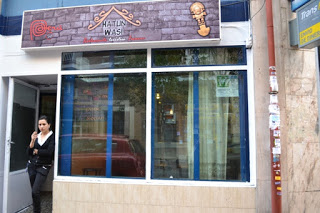
Like images of the Virgin Mary in tree trunks, Mexican eateries in the US tend to reflect migration patterns and shifting demographics.  However, the ones in Madrid—and, here, I’d wager to say in just about any other European city—testify more to that city’s elite cosmopolitanism.  In other words, Mexican restaurants in Europe signal the presence of American expats and/or well-heeled foodies.  By and large, the Mexican restaurants in Madrid have a trendier or more upscale air than their Latin American counterparts, many (but certainly not all) of which appear to be run by and for hardworking and thrifty immigrants.  For example, at Hatun Wasi, a Peruvian restaurant that recently opened in the working-class, immigrant neighborhood of Cuatro Caminos, the no-nonsense dining room consists of mismatched chairs, tables, and bar stools.  The floor is clean, but scuffed.  A simple blackboard in the window announces the restaurant’s hours and the prices of various specials. [Fig. 3]

Fig. 4

Fig. 4

A two-course menú del día or lunch special costs a mere three euros (around four dollars).  In contrast, Takeiros, a Mexican restaurant near my apartment in the middle-class neighborhood of Ríos Rosas, offers a three-course menú del día for 11 euros (roughly 14 dollars).  Dinner runs around 30 euros (40 dollars), a hefty price for many madrileños, immigrant and native-born alike, in this moment of economic crisis. Where Hatun Wasi is a modest, if not barebones, joint, many Mexican restaurants in Madrid are bedecked with colorful decorations that scream ¡MÉXICO! (or, as the Spaniards spell it, Méjico), such as papel picado, serapes, and lucha libre masks.  At Takeiros, Mexican lotería cards cover the walls and metal tooling lampshades dangle from the ceiling. [Fig. 4] And except for the live mariachi music Thursday nights at La Herradura, one of Madrid’s more established Mexican eateries, salsa music dominates the playlists in the Mexican restaurants I’ve patronized here.

Fig. 5

Fig. 5

All the meals in these restaurants begin with a small basket of totopos (what Spaniards mistakenly call nachos) and salsa.  The chips always taste a bit like reconstituted cardboard, a travesty given the ubiquity of mouthwatering fried food in Spain, most notably, churros, patatas fritas, and calamares a la romana.  And while the salsa, be it red or green, is usually flavorful, it’s never spicy enough for me.  Still, despite their less-than-promising start, the Mexican meals I’ve had in Madrid have been surprisingly satisfying.  I’ve enjoyed fresh green salads garnished with velvety avocados and tangy flores de jamaica.  Staples, like quesadillas, burritos, and flautas, can be found on nearly all menus.  However, unless I’m at a burrito or taco bar, I usually don’t bother with the more prosaic foods.  Instead, I go for more complex dishes, like pollo en mole poblanocochinita pibil, and albondigas con salsa de chipotle. [Fig. 5] Mexican beers, such as Corona and Pacífico, are widely available; Mexican sodas and aguas frescas, less so.  Impressively, Takeiros’ wine list consists exclusively of wines from Baja California.

A couple of Mexicans opened Takeiros in 2011.  They own three other eateries in Madrid, one of which, a take-away counter, also specializes in Mexican fare.  While the customers at Takeiros appear to be mostly Spaniards, the workers I’ve encountered there have all been immigrants.  Peruvian and Ecuadorian chefs have prepared my food to perfection and Argentinian and Mexican waiters have delivered it to me and put up with my many questions.  The dishwasher, like the waitress I photographed in front of Hatun Wasi, is a young immigrant from Romania.

I’ll wrap up with a brief discussion of Romania, what I’ve come to see as the Mexico of Europe.  Just as Mexico hitched its cart to the NAFTA horse in 1994, Romania, one of Europe’s poorest nations, joined the European Union in 2007.  While NAFTA failed to provide for the free movement of workers across Mexico, the US, and Canada, EU membership has allowed Romanians to move and work within member states.  Like many Mexican migrants in the US, many Romanians came to Spain, Europe’s leading country of immigration from 2000 to 2007, to work in the then booming construction, tourism, hospitality, and domestic-service industries.[8]  In 2008, they surpassed Moroccans as the largest foreign group in this country.[9]  Then Spain’s economic bubble burst and unemployment skyrocketed.  The Spanish government responded by trying to restrict Romanian immigration, a reversal of its commitment to admit rumanosas fellow members of the twenty-seven-nation EU.[10]  More recently, the prospect of Romanians and Bulgarians being able to work freely in the UK starting in 2014 has provoked protests in that country.[11]  To deter “an influx of unwanted people,” the UK’s equivalent of the Department of Homeland Security, the Home Office, has considered launching an advertising campaign in Romania and Bulgaria stressing Britain’s less attractive qualities, like its notoriously bad weather.[12]  Hardy, despised, feared, and here to stay, Romanians, not unlike Mexicans in the US, are the cockroach people of Europe.[13]

In physiology, assimilation refers to consumption and the body’s absorption of nutrients after digestion.  Like the Spanish priest who rejected the Pedrazos’ homemade tamales, Europe refuses to take in Romanians or to absorb what many of them have to offer:  their labor.  Indeed, it sees them as a contaminant, as the recent scare over horsemeat fraudulently labeled as beef has made patent.  When horsemeat was first discovered in frozen lasagna in British and French supermarkets earlier this year, Romania was immediately cast as the culprit.  French and British news media reported that new traffic laws banning horse-drawn carts in that country had led to the mass slaughter of horses and the subsequent introduction of horsemeat into the food chain.  Even though the horsemeat was ultimately traced to a factory in southern France, the perception of Romania as dirty, primitive and, therefore, thoroughly un-European endures.[14]

Fig. 6

Fig. 6

A Spaniard in LA.  Chicken mole, Romanian workers, and a Chicana scholar in Madrid.  Lasagna in France and Britain.  Clearly, people and food travel.  Far too often, the latter goes down more easily than the former, as the sign in the final illustration I’ve included in this essay indicates [Fig. 6].[15]  Whether or not people assimilate and are assimilated—incorporated, integrated, welcomed—depends on numerous factors, including access to citizenship and basic social services, particularly education and health care, possession of rights and protections as workers, and genuine tolerance and respect.


Catherine S. Ramírez, an Associate Professor of Latin American and Latino Studies at the University of California, Santa Cruz, is spending her sabbatical year in Madrid, where she’s writing a book tentatively titled Assimilation:  A Brief History.

[1] Andrew Ferren, “Mexican Hot Spots in Madrid,” New York Times, May 5, 2009, http://intransit.blogs.nytimes.com/2009/05/05/mexican-hot-spots-in-madrid/ (accessed March 18, 2013).
[2] http://11870.com/k/restaurantes/es/es/madrid (accessed March 19, 2013).
[3] http://madrid.salir.com/restaurantes (accessed March 18, 2013).
[4] Trinidad L. Vicente, Latin American Immigration to Spainhttp://migrationeducation.de/48.1.html?&rid=162&cHash=96b3134cdb899a06a8ca6e12f41eafac (accessed March 18, 2013).
[5] “Chipotle Opens Restaurant in London, First in EU,” Denver Business Journal, May 10, 2010, http://www.bizjournals.com/denver/stories/2010/05/10/daily4.html (accessed March 19, 2013).
[6] Gustavo Arellano, Taco USA:  How Mexican Food Conquered America (New York:  Scribner, 2012).
[7] http://www.unesco.org/culture/ich/index.php?lg=en&pg=00011 (accessed March 18, 2013).
[8] Michael Fix, Demetrios G. Papademetriou, Jeanne Batalova, Aaron Terrazas, Serena Yi-Ying Lin, and Michelle Mittelstadt, Migration and the Global Recession:  A Report Commissioned by the BBC World Service (Washington, DC:  Migration Policy Institute, 2009), 33-34.  Also see http://www.migrationpolicy.org/pubs/mpi-bbcreport-sept09.pdf (accessed March 19, 2013).
[9] Ibid., 38.
[10] Raphael Minder, “Amid Unemployment, Spain Aims to Limit Romanian Influx,” New York Times, July 21, 2011, http://travel.nytimes.com/2011/07/22/world/europe/22madrid.html (accessed March 19, 2013).
[11] Stephen Castle, “Britain Braces for Higher Migration from Romania and Bulgaria,” New York Times, March 4, 2013, http://www.nytimes.com/2013/03/05/world/europe/britain-braces-for-higher-migration-from-romania-and-bulgaria.html?pagewanted=all&_r=0 (accessed March 19, 2013).
[12] Sarah Lyall, “Welcome to Britain.  Our Weather Is Appalling,” New York Times, January 29, 2013, http://www.nytimes.com/2013/01/30/world/europe/welcome-to-britain-our-weather-is-appalling.html (accessed March 19, 2013).
[13] I take the term, “cockroach people,” from Oscar Zeta Acosta’s 1973 novel The Revolt of the Cockroach People (New York:  Vintage, 1989).
[14] Andrew Higgins, “Recipe for a Divided Europe:  Add Horse, Then Stir,” New York Times, March 9, 2013, http://www.nytimes.com/2013/03/10/world/europe/recipe-for-divided-europe-add-horse-then-stir.html?pagewanted=all (accessed March 19, 2013).
[15] This image is from http://imageshack.us/photo/my-images/74/r2048252209bz4.jpg/sr=1 (accessed March 19, 2013).All other photos here were taken by the author.