July 25, 2013
Dear Readers,
We’re taking a break and will be back on October 1st. Wishing you all a wonderful rest of summer!
The Mujeres Talk Editorial Collective

July 25, 2013
Dear Readers,
We’re taking a break and will be back on October 1st. Wishing you all a wonderful rest of summer!
The Mujeres Talk Editorial Collective
July 8, 2013
Credit: “Adjunct Instructor” by pixelsrzen on Creative Commons/Flickr.
By Ella Díaz
The academic career has changed dramatically over the last two decades. Some would even argue that things started to change long before the twenty-first century and for various reasons. However, it is now indisputable that junior colleagues and graduate students feel deep anxieties and pressure about their futures in the university. Finding a tenure-track job in the year that one completes her doctorate is unlikely, especially in arts and humanities fields. The alternative to the tenure-track or multi-year postdoc is to work as an adjunct instructor, which typically means to “teach on a contract basis, often booked one semester at a time” (Bradbury 2013). Making up 75% of higher ed faculty, adjuncts are the new majority in academia, but this predominance is not beneficial. This certainly was the case for me when I completed my Ph.D. in American Studies in 2010. I had been an adjunct lecturer for four years prior to completing my degree, and would continue as contingent faculty until 2012, when I accepted a tenure-track position, after two years of rigorously applying for lectureships, assistant professorships and postdoctoral fellowships.
In January 2012, MLA president Michael Bérubé reported that “adjunct, contingent faculty make up 1.5 million people teaching in American colleges and universities. Many of them working at or under the poverty line, without health insurance; they have no academic freedom worthy of the name, because they can be fired at will” (Bérubé 2012). A bleak outlook, Bérubé sums up the spiritual and psychological crises for recently graduated and unemployed or underemployed educators—who find their ideological and political commitments to research, teaching, and service, overshadowed by their need for health care, income to pay back student loans, and the intellectual resources that can only be guaranteed by a tenure-track position (library privileges, research funds, an office, etc.). Furthermore, Bérubé’s point on the lack of academic freedom for adjunct faculty has ripple effects. Adjunct instructors can feel an indescribable alienation from their labor and personal integrity because they are overburdened with the fear of unexpected dismissal and not knowing semester–to-semester if they will be employed. Subsequently, they self-censor in the classroom, avoid interpersonal relationships with students who seek mentorship, and withdrawal from the larger community of the university (O’Shaughnessy 2012). Aptly entitled Ghosts in the Classroom,Michael Dubson’s 2001 examination of the plight of contingent faculty elaborates on the dilemma of being expected to perform at a professional level while not being treated professionally.
I also can’t help but consider the scarcity of tenure-track jobs at present in the context of other changes and shifts that create greater precarity in our communities—from draconian immigration laws and enforcement, to the banning of books and dismantling of programs in U.S. Latino/a Studies. The point I hope to make by spelling out the individual impact and collective toll of an adjunct faculty majority is that the stakes are higher for those of us who work in Chicana/o-Latina/o Studies at the university level than for scholars in different fields. If we are not present in the university in viable and sustainable ways, we are not able to create, shape, and put forth the knowledge that heals and advances our communities. I have in mind Jason Richwine’s 2009 dissertation which contends that low IQs among “Hispanics” in the U.S. are a genetic failure and contribute to the intellectual deterioration of the nation. His manuscript has been mentioned recently in the press and factors in political discourse on immigration reform, reminding us that knowledge is always constructed, and we have to make sure that we are part of its production.
In what follows, I offer several insights into my transition from an adjunct lecturer of six years to a tenure-track assistant professor. I am aware that every situation is different, including mine. Nevertheless, I believe some of my experiences may offer a perspective to recent graduate students and adjunct faculty that can facilitate professionalization, whether or not one is on a tenure-track.
One of the most important insights I can offer adjunct lecturers and recent graduates is to think strategically about your labor. Sure, you are teaching classes—from writing lesson plans and assignments, to grading student work and holding office hours (at cafes, coffee shops, and the other meeting places of the adjunct lecturer with no office.) But look more closely at what you are doing. Are you conversing in multiple languages? Are you participating in reading or writing groups with other colleagues or graduate students? Are you discussing curriculum for the upcoming semester? I ask because I have recently realized that part of the problem of contingent labor in academia is the alienation one feels through the denial of professionalization, a process that is largely made up of vocabulary and official terms. Of course, the process of professionalization in academia isn’t only linguistic; it also includes levels of access that facilitate research and ultimately, scholarship, through funding, institutional privileges, and a sense of job security. But on the average day, reading and writing groups, bilingual networks, classroom instruction, and student tutorials, are the ways you labor, whether you refer to them as such. Each of these activities are essentially what tenure-track colleagues are doing; they are simply told what to call such activities: a writing group, a language enrichment meeting, a student research group, a curriculum committee and other academic service and research.
In my first year as a tenure-track assistant professor I have had several trainings in which I have been introduced to professionalizing vocabularies. I was pleasantly surprised to learn that I have been using concepts of “universal design” in my classroom and “service-learning” components in my syllabi; I have also been a longtime contributor to undergraduate curriculum planning, but now I am on an official committee with senior colleagues. In other words, I have literally been taught how to talk about what I am doing when I am lesson-planning, writing course descriptions, instructing, researching and writing. As an adjunct instructor, your reading or writing group may not be funded by your university, but the work is the same and it is important to know how you have labored when conversing with tenured faculty, interviewing for positions and networking.
In the process of identifying your labor, it is imperative to value everything you do—be it a lecture at a local history society, a public library or a community center. I didn’t realize all of my labor value until my new senior colleagues commented on how many times I popped up on Google for 2011-2012. As an adjunct lecturer, I had to hustle for venues and invitations to present my work. I inquired with galleries, community centers and public history groups for lectures and events. In doing so, I increased my public profile in ways I did not expect because most of these organizations have websites and advertise events and programming. During my job interview and campus visit, I heard several tenured faculty remark on my community activism and creative projects. Moreover, my work outside the university also inspired new academic research and took me in directions I would have never gone if I had stayed safe and entrenched in the university. But many MALCSistas already know the value of community-based work because you’re active in local organizations and causes as part of research, service-learning, civic duty or spiritual care. It’s time to merge these activities (at least on paper) with your professional profile.
Also, how are you accounting for all of your writing? For many of us in humanities fields, we must publish a book and peer-reviewed articles to achieve tenure. But, in the twenty-first-century, other genres and outlets for writing are imperative, and many of you are blogging on your own websites, or on sites like The Huffington Post, Vice, and our fledgling Mujeres Talk. While blogging is not weighted on the level that the aforementioned publications are for tenure, it offers a particular visibility that can enhance your public profile. So, if you blog, you should make note of it in a professional way, including on your CV, school profile or even business cards. Are you linking your blogs to other known sites? Are you tracking your hits? You never know who’s reading your posts. Recently a tenure-track colleague of mine sent me an email exclaiming that she was thrilled by a blog on the very topic of obtaining a Ph.D. in a humanities field, despite the shrinking pool of tenure-track opportunities. The blog she was so excited about was written by an adjunct instructor. There are two points I hope to make with my example. The first one is that name recognition is incredibly helpful for contingent faculty. If you’re writing blogs or other online commentary, you are building a reputation that may be helpful to you down the road for getting an interview, or even while on an interview, because you never know who is a fan.
The second point I want to make with this particular example is that despite our titles, we are all colleagues, whether one is an adjunct lecturer, professor, instructor, practitioner, artist, etc. It is a system of power (that grows more corporate in structure every day), which categorizes us into different positions; it is not our degrees, nor our scholarship or very persons that have done so. Remember:numerous framers of our fields, including Gloria Anzaldúa, were contingent faculty.
Bérubé touches on the issue of collegiality in his report. He comments that after referring to an adjunct instructor as his colleague, the person thanked him because it was rare when she was referred to as such by her own tenured colleagues. While I don’t want to overemphasize Bérubé’s anecdote or suggest that it is a cure-all to the hardships faced by contingent faculty, the sentiment is not lost on me because, in my six years as an adjunct lecturer, when I was treated by tenured colleagues as, well, a colleague, it made an impact on my teaching and my occupational identity. Moreover, for colleagues who are already tenured, I suggest you reach out to your adjunct colleagues. Mentoring junior colleagues who are in departments as adjuncts can be disconcerting for tenured faculty because they are sometimes unsure how to advise them on advancing. But advice is always welcome and so is friendship.
It is important to remember that the culture of silence that surrounds the changes to the academic career is not our culture. And if the changes that are happening are not ours by desire or design, our responses to them should not perpetuate the problem by not talking about them, whether we are tenured or not. In fact, our culture offers a powerful alternative to the status quo, as lecturer and blogger Annemarie Perez recently wrote in response to the flurry of online articles on the dismal state of the academic job market: “Yes, part of me reads these articles and understands. The job market / adjunct situation is bad. Rejection sucks. Uncertainty is hard. But nothing is ever certain. My family is proud of the adjuncting work I do, proud of the editing work I do, proud of me. They wouldn’t understand (or care) about the difference between a tenured and untenured position. To them all employment is uncertain, all work has dignity” (April 16, 2013) Perez’s statement is powerful for all of us to remember. It definitely reminds me of who I am on a daily basis and motivates me to speak with undergraduate and graduate students about why I wanted a Ph.D. in the first place. Ironically, the reasons that I wanted to be a professor are the very same ones for the Chicana undergraduate, who came to my office last May to ask me to be her advisor. Her reasons for wanting to become a Ph.D. aren’t innocent, naïve or overly idealistic. They are time-tested, honorable and based on tradition. With this blog, I hope more of you will weigh in and offer advice and testimony on your experiences.
Ella Diaz is an Assistant Professor of English at Cornell University. Her research is on the interdependence of Chicana/o and Latina/o literary and visual cultures.
Comment(s):
I have also had time to catch up on some of my journal reading and I recommend that folks check out George Lipsitz and Barbara Tomlinson’s brilliant essay on accompaniment in this last spring’s AMST Quarterly. My thoughts in the above blog fit nicely into this larger perspective of the stakes of our work as academics: https://muse.jhu.edu/login?auth=0&type=summary&url=/journals/american_quarterly/v065/65.1.tomlinson.pdf
Ella,
Thanks for this blog essay offering both advice and perspective on the adjunct situation. Readers might also be interested in a recent blog on this topic in the Chronicle of Higher Education titled “I’m an Adjunct, Not a Volunteer.”
A colleague recently asked me for advice about an adjunct offer she received and it occurred to me that we know much more about advising someone in negotiations for tenure-track jobs than we do about advising them on adjunct work. For example, must one accept the teaching load and salary that is offered or is there any room for negotiation? Where are better places for adjunct work? Should you try to do service as an adjunct to prove that you would make a good tenure track hire or do you stick just to your work? What can we do to diminish the reliance on adjunct faculty? I appreciate how your essay calls us to discuss these topics more openly.
I believe this is another reason why the US can’t compete in the global marketplace– an education system can hardly thrive and remain worldclass when educators have to struggle and new talent isn’t incentivized to enter and stay in academia.
June 24, 2013
by Frances R. Aparicio
For some years, the Latino/a Studies scholars who have participated in the Latin American Studies Association conferences have been disappointed at the continued marginality of the Latino Studies Section in the larger association, our vulnerability (our section was revoked one year), and the limitations of this space. Moreover, we all recognize a need to create a larger national and international space that allows all Latino/a Studies scholars to come together and share our scholarship, activism and struggles. Thus, a group of scholars have discussed the idea of forming a Latino/a Studies Association that will address our needs. They have gathered feedback and suggestions in discussions at various other conferences in the past year and are beginning to get organized. Our goal is to create the Association during the 2014 Latino Studies Conference that will be held in Chicago July 17-19. Please join us for this historic moment and participate in the groundbreaking conference that will initiate a new international space for Latino/a Studies. The Call for Papers for this event follows:
Under multiple sponsorships from various universities and Latina/o Studies Programs, Chicago will host an international Latina/o studies conference on July 17-19, 2014. We invite individual papers or group proposals from the various disciplines that contribute to Latina/o studies as well as from individuals and groups engaged in artistic, political, and intellectual work outside the academy, including writers, artists, and community activists.
Background
The Chicago conference will serve as an inaugural international Latina/o studies conference where we will launch the creation of a Latina/o studies association. During the May 2012 Latino Studies Section meeting at the Latin American Studies Association conference in San Francisco, scholars from a variety of disciplines decided to explore the feasibility of creating an international Latina/o studies association. Since then, many of these scholars have held informal meetings at other academic conferences in order to gauge interest in such an organization. To date, discussions have been held at the American Studies Association, the Puerto Rican Studies Association, the Modern Language Association, the Organization of American Historians, the Recovering the U.S. Hispanic Literary Heritage Conference, among many others.
Rationale
With this conference we hope to spotlight the dynamic work being carried out in a range of disciplines with a particular focus on the interdisciplinary impulse that shapes and motivates work produced under the banner of Latina/o studies. We recognize the decades-long history and crucial work of national-origin studies, such as Chicana/o studies and Puerto Rican studies, from which many of us have emerged; and we further ask how might we conceptualize the field so that it reflects the complex histories, social formations, and cultural production of Latinas/os even while seeking to imagine a larger sense of belonging that might transcend nationalisms?
By using this question as a benchmark for critical discussion, the conference will serve as a venue to set new research agendas and ask new questions of Latina/o studies. We seek proposals that revisit the genesis of Chicana/o and Puerto Rican studies in the 1970s as well as papers that highlight the emergence of Cuban studies, Dominican studies, Central American studies and South American studies. We invite proposals that compare the history, social formations, and cultural production of Latinas/os. Just as important, we seek imaginative proposals that critically interrogate the possibilities and limits of the category of “Latinas/os” itself.
Location
Chicago serves as a symbolic setting for our conference. Located between the historically Mexican Southwest and the Caribbean East Coast, Chicago has long embraced its diverse Latina/o communities, and is home to several universities with Latina/o studies programs. To that end, we call for scholars, artists, and activists from both within the United States and abroad to join us as we launch our inaugural conference and the founding of a Latina/o studies association, the first organization dedicated to the comparative and interdisciplinary study of Latinas/os.
Proposals
Our goal is to carve out an international space for dialogue and fruitful debate, and invite submissions from all disciplines. We welcome diverse and interactive presentation formats. We envision roundtables that explore recent publications, key developments, or major debates in Latina/o studies; workshops on mentoring, professionalization, pedagogy, or publishing; multi-media presentations such as Pecha Kucha or poster presentations; and performances along with traditional papers. Group proposals with diverse representation–including institutional affiliation, rank, and geographic region–will be given preference. All sessions are 90 minutes long, and must allot at least twenty minutes for discussion.
To submit a proposal, please email the following information to latinostudiesconference@gmail.com. All proposals are due by 11:59pm PST on December 1, 2013.
● Paper or Session Title.
● Name, institutional affiliation, discipline, position or title, and contact information of presenter including email address and phone number (for sessions: list organizer first, then each presenter providing requested information for each participant).
● Abstract of the rationale and content of the paper or session: up to 300 words for an individual submission; 600 words for a group proposal, giving specifics about what each member will contribute.
● Brief (2-3 sentence) scholarly or professional biography of each presenter.
● Describe the format of the session (for group proposals) and give indication of any audiovisual needs or special accommodations.
For more information on the Latina/o studies association initiative and the many people and institutions involved in creating it, please visit our Facebook page at https://www.facebook.com/groups/latinostudiesinitiative/.
Frances R. Aparicio is Professor of Spanish and Portuguese and Director of the Latina and Latino Studies Program at Northwestern University. She is the author of the award-winning Listening to Salsa: Gender, Latin Popular Music and Puerto Rican Cultures (Wesleyan 1998), and Co-Editor of several critical anthologies including Routledge Companion to Latino/a Literature (Routledge 2013), Tropicalizations: Transcultural Representations of Latinidad (University of New England Press 1997), Musical Migrations (Palgrave 2003), and Hibridismos culturales (Revista Iberoamericana 2006). A founding editor of the Latinos in Chicago and the Midwest Book Series at the University of Illinois Press, she has facilitated and fostered book publications and new research on Latino/as in the Midwest.
June 10, 2013
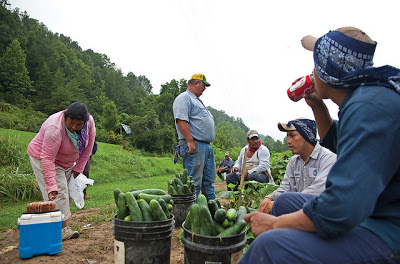
Photo by Laura Elizabeth Pohl. Flickr/Creative Commons License.
By Theresa Delgadillo
“In my mind, slavery has not yet disappeared. And in this case, we the Mexican agricultural workers are the slaves. I want to say to all of the employers that we are not machines. And I want them to consider, for just a moment, that the money they have is thanks to the work of all the Mexican agricultural workers who come to Canada to work.”
– Mexican agricultural contract worker in El Contrato (2003)
Advocates of U.S. immigration reform have long cited the importance of immigrant labor in making our daily meals possible. Immigrant labor drives all aspects of agricultural production in the U.S. — picking, packing and delivering to our local markets the vegetables and fruits we eat as well as slaughtering and processing the poultry and meats we consume. Yet, what we overlook when we focus on how much agricultural labor rests on immigrant shoulders is the wealth, income and economies the workers also produce. In Min Sook Lee’s 2003 film El Contrato, viewers hear how small family farms grew into major industries through the use of Mexican agricultural contract workers. But viewers also hear the male workers, who are at the center of this film, speak about the pain of their ordinary family and social life disrupted, their isolation and their powerlessness life as contract workers to improve the conditions of their labor. The film also shows us their efforts to support each other.
Since visas for temporary contract labor, skilled labor, and the temporary status of millions is on the table in the current immigration debate in the U.S., those interested in immigration reform might be interested in viewing Lee’s film to consider how guest worker programs affect all those involved, but also to learn about the historic and economic contributions of immigrant workers. For me, El Contrato drives a home a point that many would prefer to forget: immigrants are people, embedded in social as well as economic networks. El Contrato shows us men who are not able to both live and work among their families and social networks, but instead must forego life for work. Their labor, nonetheless, contributes to two economies: Canadian and Mexican. Though El Contrato addresses a Canadian/Mexican context, viewers might consider that the men’s voices in this film and their expressions of desire for a fuller family are sentiments shared by immigrants in the U.S. Today, we again revisit the debate between prioritizing family and social relationships in U.S. immigration law over that of worker supply and between inclusion of new immigrants via citizenship or forms of legal second-class status.
Filmmaker Min Sook Lee is at work on another film, Migrant Dreams, that focuses on women contract workers in Canada. The trailer promises even more intimate glimpses into the lives of contract workers, yet because these aspects of life are absent from El Contrato I wonder about the sources of this gendered difference — were these aspects of men’s lives not available to the woman filmmaker or a sign of the difference in men’s and women’s immigrant experience? Something to consider when Migrant Dreams is completed and published. In the meantime, view El Contrato in full online at the Canadian Film Board’s website.
Theresa Delgadillo is a Co-Editor/Moderator of Mujeres Talk and an Assistant Professor of Comparative Studies at The Ohio State University.