
Category Archives: Literature

Review of Chopper! Chopper! Poetry from Bordered Lives

by Paloma Martinez-Cruz

Verónica Reyes. Chopper! Chopper! Poetry from Bordered Lives. Pasadena, CA: Arktoi Books, 2013. 111 pages. ISBN 978-0-9890361-0-8. $18.95
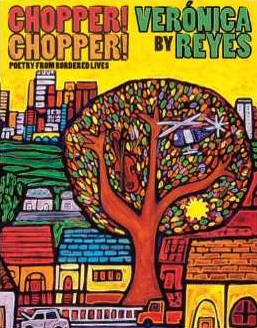
chopperchopper coverI left my hometown of Los Angeles to attend college in the Bay Area, and then I left California altogether to attend graduate school in New York City. Many denizens of the San Francisco Bay and the five boroughs of New York City have no love for my birth town, so when people asked me where I was from, I felt shy about admitting I was from the place known as “72 suburbs in search of a city.”  One day a fellow student shared with me what he loved about it: “You can feel how it’s red and brown.” After he said this, I realized that he was right, and that so many of the quips about L.A. being anti-intellectual and superficial were, in truth, about the other L.A., the tinsel L.A. that eclipses our red and brown realities, until violence erupts in the streets, or Chicana feminist jota poets like Verónica Reyes sound the thunder of our lives in verse.

The poems in Chopper! Chopper!, Reyes’ first published collection, envision East L.A. as the continuity of Mexican experience, participating fully in an Americas-based spirituality that venerates the natural world.  As with physical sacred gatherings, the volume begins with a blessing.  The poem “Desert Rain: blessing the land” [sic] surveys the desert cityscape with devotion.

The agua took her back to her childhood in México

rain that blessed her alma como copal shrouding her skin

She inhaled the desert aroma over concrete, nopales,

and limones beneath splintered street telephone wires

Socorro breathed in once and inhaled México in East L.A.

While I am exhilarated by the red and brown affirmation of Mesoamerica in Los Angeles, some of the portraits of Chicana ethnicity in this volume echo others. From my perspective as a Latin American/Latina Studies scholar, I question what seems like a nostalgia that conflates spirit, nature, and nation. Although some of the poetic turns tended toward predictability, there is also much to recommend in this volume.  Reyes is at her best when she navigates the difficulty of voicing bicultural, transnational experience by moving in for the hyper close-up, telling us what she alone is capable of observing.  In “Theoretical Discourse over ‘Sopa’ (what does it really mean?),” she playfully employs academic jargon to try to make sense of a word that has multiple meanings.

All our lives we called it “sopa”

Differentiated “sopa” from fideo

            to estrellas or melones

labels for different pastas

titles to establish subjectivity

within the hegemonic world of pasta.

The poem concludes with the narrator and her sister agreeing to use the word sopa the same way that their mother had used it – to refer to Mexican rice – thereby legitimizing local, intimate knowledge over official language usage.

As in the postmodern approach to “sopa,” Reyes’ poetry consistently repositions authority so that cholos, jotas and bus patrons are key culture makers.  In “Super Queer,” the queer Chicana becomes a supernatural champion, managing to survive homophobia, bashing and “what you thought no human being can withstand.”  Where others are tempted to perceive marginalization or victimization, Reyes tells of pride and strength, urging the listener to “take off those silly straight lenses that skew your vision.”  In “El Bus,” the narrator is proud to announce, “I speak in bus routes,” which, as Angelenos and visitors to the city are aware, is a dialect spoken almost exclusively by the poorest of the poor.  In Reyes’ poem, the speaker claims “You got it, esa or ese, I know the system/It’s in my blood to travel the calles via el bus” as if to boast of royal lineage.  Reyes’ poems invert the parameters of social inclusion, so that queer and street folk decide who belongs, and misguided wearers of “silly straight lenses” and novice bus riders become the outlanders in need of charitable assistance.

Vehicles of surveillance and pesticide application populate Reyes’ poetic universe, producing a bellicose environment in which East L.A. residents are surrounded by drone-like aerial hostility.  “Green Helicopters” describes the apple-orchard helicopter that sprays toxins on the migrant workers, and “Chopper! Chopper!” depicts the play of young neighborhood children who turn the menacing sounds and lights of police helicopters into fantastic games.

The cops announced to the convict, “We know where you are.  We know…”

And Xochitl ran out of breath chasing the big white light piercing the darkness

She stopped and stared up at the helicopter slicing the chapopote sky for a moment

It was almost as if it were stuck like the mammoths, the saber-toothed tiger, the Chumash

woman whose bones remained deep underground until the archaeologist came

The people screamed and wailed to be set free from the tar that pulled them down

that swallowed them little by little as they struggled to get out from the bottom

Still the thick goo engulfed them hole suffocating their skin, filling their mouths

Xochitl’s brown eyes stared at the chopper swirling in East L.A.’s summer sky

But the helicopter broke free, pulled back its white light and flew away to the hill

Here, the child Xochitl plays under a tar firmament where the craft hovers like a relic from California’s Pleistocene epoch, witnessing centuries of ancestors struggle against asphyxiation across the sky: just another summer night in East L.A.

While most of Chopper! Chopper! must remain unexamined here, there can be no doubt that Reyes achieves what she sets out to do. In her poem “A Xicana Theorist,” her queer protagonist moves through a lesbian, Latina social space, and yet she poses the question, “Are we really safe?” The final verse reveals the highest potential that theoretical work can aspire to achieve.

She dances with the woman from the bar

She holds her gently around the waist

She leans her body closely into hers

She wants to cry and tell her she is hurt

…tell her she is tired of fighting

…tell her she feels alone and scared

She wants to heal her wounds

These last lines of “A Xicana Theorist” leave room for interpreting whether the wounds she wishes to heal belong to her or to her dance partner, and this blurring of bodily boundaries and subjects allows the reader to interpret a more expansive notion of selfhood that includes all the Latinas who are wearied by building their lives in spaces that are racially negative and sexually oppressive. The desire that is repeated in these last lines does not hone in on sexual appetite, which would make sense given the erotically charged environment of the bar, but rather emphasizes the act of telling. The telling is the medicine the poetic voice craves in order to heal wounds.

In the tar and asphalt prism of East L.A., Reyes’ poems unearth and celebrate centuries of red and brown truths. While some of the writing resorts to idealizing Mexico as a font of political and spiritual alignment, the collection convinces readers to rethink urban spaces and witness the cunning and courage that develop under a dome of both hyper vigilance and civil neglect.  In the midst of roaring engines, slicing blades and hostile surveillance lights, her courageous act of telling manages to cultivate a space of safety and healing: a place for pride to grow.

Paloma Martinez-Cruz, PhD, works in the areas of contemporary hemispheric cultural production, women of color feminism, performance and alternative epistemologies. She is the author of Women and Knowledge in Mesoamerica: From East L.A. to Anahuac (University of Arizona Press, 2011) and the translator of Ponciá Vicencio, the debut novel by Afro-Brazilian author Conceição Evaristo, about a young Afro-Brazilian woman’s journey from the land of her enslaved ancestors to the multiple dislocations produced by urban life. Martinez-Cruz is also the editor of Rebeldes: A Proyecto Latina Anthology, a collection of stories and art from 26 Latina women from the Midwest and beyond. Currently Martinez-Cruz is at work on a book publication examining the resistance fronts found in Chicano/a popular culture. [5/1/14 post updated to correct an editorial error]

Remembering Nelson Mandela

11206285456_6b5da7bb8f_z(1)
Photo by Flickr User HelenSTB
CC BY-SA 2.O

by Inés Hernandez-Avila

I wrote this poem for Nelson Mandela in 1988 because he truly moved me, all along the path of his life as I began to know about him, and his spirit will continue to move me, always.  The poem speaks for me of what I think of him.  He was a great Spirit who came to this earth to be Nelson Mandela, and he kept the radiance he brought with him from the spirit lands of the ancestors.  With the example of his life, he “lifted us up,” as my own Nez Perce elder, Albert Andrews would say.  I have read the poem at literary events, but it has never been published.  On the occasion of Mandela’s death, my dear colleague, Jualynne Dodson asked, on the Ford Foundation Fellows listserv, what the impact of Mandela had been on the Chicana/o community.  I sent her my poem, from my own Native (Nez Perce) and Tejana perspective.  As I re-read what I had written in 1988, I saw that everything that I wrote for him all these years ago, still holds true.  And I did write the poem while listening to Abdullah Ibrahim’s piano composition, “Mandela.”  Ibrahim, moved by Mandela, composed his piece, and I was moved by the beautiful music for this great human being, this Maestro, who brought his light to the world.  It is a poem from my heart.

For Nelson–Leader, Tribal Person, Elder*

Summer 1988, on the occasion of Mandela’s 70th birthday, when the South African government offered him a six hour visit with his family

Oh Mandela, Mandela

I sing your name

in the name of all peoples locked in and up

in their very cells

weighed down by all the forces

that do not want their hearts light

and spirits lifted

Nelson, Nelson

Triumph is a sweet song

the one you know

saxaphones jubilant for your spirit

concentrating

in your space

to will your conscious waking

sleeping dreams

for all of us to see

And it is hard, Mandela, Mandela

Six hours offered you with family

with Winnie and your daughters

six hours to hold each other

gulp in every detailed facet

talk with hands eyes ears mouth

nose smiles tears

as if the heart of the very mother earth

would burst with joy at such a moment

but this joy cannot be

it is, as you say, not possible

for you are not alone

but one of oh so many whose pain like yours

meted out minutely daily

seeks to engulf you in despair

This visit offered is not to them

but to you

And what is six hours in the face of terror centuries old

horror with the face of most intentional genocide?

Six hours more or less of time

when in those same six hours

Children, little children

sit, like you, in other prison cells for their “subversion”

When heads are cracked and bodies wracked

across the landscape of a continent that is yours theirs

A motherland keeps count of each heart battered to a bloody pulp

to stop its count of life

And you know, too, that count

So you stop the maddened offer of a visit

What would you have said, Mandela, Mandela?

“Shall we have tea, Winnie?

Daughters, rub my back, I am so sore.

What shall we talk about?”

And in the next cells casually inflicting itself

in studied vehemence on seemingly countless others

the obscenity of racial/cultural boundless hatred

Nelson, Nelson

A visit?

We are visiting for you all over the world

for you and with you in our homes your face shines

from  the walls of our hearts

Poets gather to sing for you

Peoples gather to struggle with you

Workers pass the light of your name from mouth to mouth

Races, classes and sexes unite for you and for the people

Children learn of you and of the brave children

through whose eyes and spirits we find courage

Agelessness is where principled commitment is born and lives

Even in the splattered, broken bones of death

that wants so badly to detain the march of liberation

in all its splendor

Mandela, Mandela

you are real

The people you stand firm for are real and true

The visionary will outlast the cynic, the impotent and depraved

It is a matter of time

Only a small matter of time

The freedom spirit is soaring from heart to heart

around the world

To stop for six hours for convenience?

No, Nelson, Nelson

How you knew how time is precious

How you knew to keep on soaring

Oh, Mandela, Mandela

Keep on soaring

*With thanks to Abdullah Ibrahim, because this poem was written to his composition “Mandela.”

©Inés Hernández-Avila 1988

Inés Hernández-Avila is a Professor of Native American Studies at UC-Davis, where she is also Co-Director of the UC-Davis Social Justice Initiative. She has been involved in creating both the MA and PhD program in Native American Studies at UC-Davis. Her research and teaching focuses on indigenous literatures of the Americas and Chicana literature and feminism.


Dictionary for a New Century

By Kimberly Blaeser

What would housework mean

to women who haul water from springs,

use lye soap and scrub boards,

who hang flypaper on ceilings

and sew cloth cupboard curtains

on the family treadle machine?

What does kitchen appliance mean

to those toasting bread in ovens

of old wood stoves,

or bathroom appliance

to those donning snow boots

to walk to the outhouse?

Somewhere between microwave pancakes

and the state-of-the-art mixmaster

I trip over the kitchen slop pail

retch at the smell of lard rendering.

Just as my fingers settle on the dvd remote

I remember to empty the ash can.

At three my daughter kisses and releases her fish

at four she asks if chicken is a dead bird.

At forty like Billy Pilgrim I come unstuck in time

still wait to take my turn in a three-foot washtub,

then light candles and soak in a warm whirlpool

now camped uneasily between progress and nostalgia.

With a heavy duty vacuum and a lightweight canister

I cruise the air-conditioned floors of my house

sweep away unearned guilt or hire a cleaning lady.

With electric everything and my computer whirring

I work my way through memories and philosophies

Try to recollect that proverb about idle hands.

What does convenience mean in a country of prosperity?

Should we use or release our histories?

Can education repay old debts?

If science and technology are the answers

who have we hired to ask the questions?

And what was it you said about women’s work?

Kimberly Blaeser is a Professor at the University of Wisconsin-Milwaukee, where she teaches Creative Writing, Native American Literature and American Nature Writing. She has published three books of poems, including Apprenticed to Justice (Great Wilbraham, Cambridge, UK: Salt Publishing Ltd., 2007), where this poem appears; a scholarly study, Gerald Vizenor: Writing in the Oral Tradition; and numerous articles and book chapters. Blaeser is of Anishinaabe ancestry and an enrolled member of the Minnesota Chippewa Tribe who grew up on the White Earth Reservation.


Latina/o Futures, Literatures, and Necessary Tensions

April 15, 2013

"2009-12-04 JJAY -27" by Aloucha from Flickr.

“2009-12-04 JJAY -27” by Aloucha from Flickr.

by Susan C. Méndez

Recently, I attended John Jay College of Criminal Justice’s 1st Biennial Latina/o Literary Theory & Criticism Conference entitled, “Haciendo Caminos: Mapping the Futures of U.S. Latina/o Literatures.” The conference organizers Richard Perez and Belinda Linn Rincón did a phenomenal job of arranging provocative keynote addresses by Ramón Saldívar, José Esteban Muñoz, Mary Pat Brady, and Silvio Torres-Saillant. They also assembled two days of panels on Latina/o literatures. For a conference-goer such as myself, who always has a hard time finding the one-to perhaps-three panels that actually pertain to what she researches and/or teaches at every literature conference she attends, this event was a veritable cornucopia of literary insights. As a former co-chair conference organizer for MELUS 2010, I could especially appreciate all the hard work and dedication that it took, on the parts of Perez and Rincón and their support staff, to pull off such an endeavor.

Now to turn to the ideas presented at the conference; first, let me state a disclaimer that these summaries derive from my personal and admittedly incomplete notes as a single conference participant. Please forgive any unintentional inaccuracies. Ramón Saldívar set the tone of the conference with his key note address which examined the role of speculative realism in the future of Latina/o literatures. He offered a framework for understanding how the past and the future are more intimately connected than we may think. Saldívar asserted that for Latinas/os, our relationship to the future should be to realize the history not made. Speculative realist texts can act as a set of alternative thought experiments in order to create a new imaginary for the Latina/o community.

The next day, José Esteban Muñoz and Mary Pat Brady delivered powerful meditations linking politics and art. In their presentations, there was an uneasiness stated about hyphenated identities and other identity labels such as “Hispanic” and “Latina/o”; subsequently, Muñoz suggested returning to the label “Brown.” According to my notes, Muñoz explains that in “Brownness,” there is no ranking of “Brown” individuals or conditions; there is just the grounded experience of being “Brown” based on a shared sense of harm and yet flourishing as well. I particularly liked this idea about identity because it seemed to fit so well with feminist organizations like MALCS, where we have always stressed an non-hierarchical, heterogeneous inclusion of all women who share in the grounded experience of being from or connected to the Latina/o or Latin American community or world regions, and this experience is often rooted in a history of political and social oppression but is also marked by cultural flourishing and expression as women. Aesthetic practices and places can serve in the rehearsal of this identity, allowing Latinas/os to be who we want to be in the world. For Brady and Muñoz, this led to a consideration of recent reflections on “failure” by Halberstam and others, as well as recent discussions of “negative aesthetics in art” for understanding queer Latina/o literature and performance.

Lastly, there was the closing keynote address and conversation where Silvio Torres-Saillant posed the following questions to authors Helena María Viramontes and Ernesto Quiñonez: How does one study Latina/o literature without relying on literalization? Do critics do enough to emphasize the art of literature? How do we get students to do the artistic work? These questions caused quite a stir for the panelists and the audience. Several scholars contested the implied sentiment that current scholar-teachers are not getting their students to appreciate Latina/o literature as art. The writers, including author Angie Cruz from the audience, expressed interest in the feminist and other readings of their work by literary scholars. Sadly, I missed how the chaotic stir of discussion at this last session concluded; I had my own stirring chaos to contend with in visiting my dad and brother that last night in New York before I had to return home early the next day.

Putting the rich ideas of this conference aside for a moment, this last session emphasized the types of heated yet productive discussions that happened throughout the conference. These moments seemed to happen for two reasons: generational and gender gaps. In one roundtable conversation, a senior Latina/o literature scholar took offense with the assertion that critical studies of Latina/o literature did not flourish until the late 1980s, a perspective that overlooks earlier critical work. In another instance, following a reading of Pedro Monge’s “Lagrimas del alma” (a short play about the aftermath of the flight of Pedro Pan for one Cuban-American family), another debate occurred over what language the play should be performed in: English, Spanish, or a mix of both. Many audience members expressed the view that use of both languages seemed to be realistic and audience-friendly. However, one participant, an older gentleman, favored a seemingly purist view of language: a play by a Cuban man about Cuban history should be in Spanish. At still another panel, a scholar took issue with the frequent teaching of Junot Díaz’s The Brief Wondrous Life of Oscar Wao (2007) as a feminist text. The rich discussion on all sides of this issue among the audience included more than one participant explaining how Oscar Wao is about much more than Yunior trying to score “pussy.” It escaped these audience members’ attention that by using words such as “pussy” in their discussion, they were not doing much to advance their assertion of feminism in this text. In this way, my feminist training, which is reinforced daily through my work with MALCS, reminds me of the importance of not only what I am talking about but also of how I am talking about the subject-matter at hand. “Pussy” only invokes a colonial and patriarchal legacy of violence that reduces targeted women and their communities to be mere objects and not the true subjects that they are. “Pussy” does little to flesh out a study of feminist agency, collaboration, and societal transformation in almost any work.

The take-away from all these passionate discussions is the need to keep having these important conversations about the history of Latina/o Literary Studies, language, and gender. We need to have these arguments, to be reminded of the importance of this history and these concepts, amongst our own community members engaged in Latina/o Literary and cultural production. Asking these questions of each other in our continued work and study should be a first and foremost concern for everyone involved. We need to keep each other honest and knowledgeable about our work always and most significantly before we present our work in more general venues and conferences. In this way, the new ideas, arguments, and theories presented at conferences such as this one are not the only benefit to be had; these other meaningful discussions maintain the field in a healthy state of self-awareness. Hence, conferences devoted to any facet of Latina/o Studies are crucial, should be strongly supported, and the organizers of such events deserve to be recognized for their substantial service to the professional community.

Susan C. Méndez is an Assistant Professor in the Department of English & Theatre and the Department of Latin American & Women’s Studies at the University of Scranton. She teaches courses on Multi-Ethnic American Literature and Women’s Studies. Primarily, she conducts research on novels written by Latino/a authors. Méndez is a 2011-2013 At Large Representative of MALCS.