
Category Archives: Literature

Spilling the Beans: Mujeres Talk Can Be a Virtual Public Sphere

by Ella Diaz

In the first two months of 2012, there are already major crises facing Latina/o and Chicana/o communities. From Alabama’s HB56, which makes all civic participation illegal for undocumented children and their parents, to Arizona’s recent “confiscating” of certain books from public schools, the pursuit of life, liberty, and happiness in the U.S. is looking kind of bleak. If you have 35 minutes, you should listen to the first portion of the January 27, 2012 episode of This American Life, titled “Reap What You Sow.” They do an excellent job of talking about HB56 on the street level and frontlines of law enforcement.

On the MALCS listerv, we send out many emails updating each other on the status of certain legislation and movements against Latinas/os. We also update each other on general news from our campuses and professions, or ask for specific help on projects. But perhaps it’s Mujeres Talk –our blog—that can provide us with a virtual public sphere, a place that each of us may enter and speak with one another openly about many of the topics we raise in our emails. There are so many important circumstances we are facing in our schools, jobs, communities, and families. What is a major issue that you are currently facing? In 2012, what do you find to be the #1 crisis we need to confront?

For me, the next year will prove to be one of the most significant for the 21st century. We are in a political and mainstream cultural moment that will continue to push us farther away from our stories, the lives we live that make us tell them, and, as writer Wally Lamb entitled his second novel, from what we know is true. Theoretical frameworks that are not grounded in our narratives are ahistorical; and by “our narratives,” I mean the testimonios, poems, plays, fictions, and “autobioethnographies” (to use Norma Cantu’s term) that create our individual and collective memory. It is my opinion that one cannot understand Borderland Theory without knowledge of the 1845 and 1848 annexations of northern Mexico in to the U.S. Likewise, oppositional consciousness and the decolonial imaginary are also not possible without knowing the migrant chains of mujeres across geopolitical borders, historical revolutions, and tactics for survival under state policies of the twentieth- now twenty-first century. Theoretical frameworks not grounded in our narratives help create a reality that makes Shakespeare’s The Tempest a banned/confiscated text in Arizona and Helena Viramontes’s “The Moths” pornography. I am not undercutting the value of the theory and critical lenses we use to more clearly interpret our cultural production in relation to larger systems of power and the global economy. I am merely stating that theory and narrative aren’t mutually exclusive. We have to decide if, in addition to scholars, we are also story-tellers who listen, remember, and retell the stories that built the fields of Chicana/o and Latina/o Studies. That is my biggest concern, and I would love to know what others think and if they agree or disagree. What is your #1 concern going forward into March 2012?

Ella Diaz is a Visiting Faculty member at the San Francisco Art Institute. Her Ph.D. in American Studies is from the College of William and Mary. Diaz is an At Large Representative of MALCS.
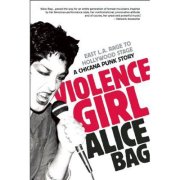
One Latina Life: Feminism, Rage, Punk Rock

by Alicia Velasquez (AKA Alice Bag)

“I’m not a writer,” I whined.

“You’ve been writing a blog for years,” my husband said.

“But I’m not a REAL writer. I can’t describe people and places in flowery detail.” My husband gave me a pained look. That settles that, I thought to myself as I walked over to my latest craft project ready to take it up again, but my husband was not finished.

“We’ll set it up as a separate blog. You have time to write while I’m at work and Sophia’s at school.” I was tempted to list all the things that housewives do during the day that are never noticed: the beds that make themselves, the laundry that appears neatly folded atop the family dressers, the cupboards magically full of organic vegetarian food choices, the Sisyphean work of women. I decided to hold my tongue, sensing my husband’s insistence was a genuine effort to support my artistic growth and not simply create more work for me.

violencegirl

The previous day, a group of my girlfriends from Los Angeles had driven down to visit me in San Diego and we’d walked over to a little neighborhood bar for a drink. Two of the girls were writing a play called The Barber of East L.A. and were doing research by gathering oral histories from women who had grown up in East L.A. during the 1960’s and 70’s. Halfway through the interview one of the playwrights, Raquefella turned to me and suggested, “You should write a book.” I laughed it off but continued to think about the idea.

I had casually mentioned the comment to my husband before going to bed and this morning he brought up the subject again with renewed enthusiasm. “I’m going to set up the blog for you,” he told me. We had recently been to Comic-con, where I discovered that a friend of mine had written her own comic book. The idea had thrilled me and my husband knew it. He had found the perfect bait. “Maybe if you start writing, an illustrator will read it and help you turn it into a graphic novel. You can call it The True Life Adventures of Violence Girl.” That did it. I had been a voracious comic book reader as a child and still enjoyed graphic novels. The succinct text in graphic novels was not intimidating yet I also knew that many graphic novels had complex themes and ideas. I thought of my story in those terms. I wanted my book to be easy to read but challenging in terms of ideas.

The following Monday morning I stared at the laptop on the kitchen table. I walked by it, grabbed a box of old photos and let the memories wash over me. I looked at an old picture of my mom and dad, took in my earliest memory and started to write.

Every morning from 10:00 to 12:00 I’d sit at the kitchen table and write. I’d send my blog post to my husband, he’d edit it for me and give me immediate feedback. The journey was therapeutic. Suddenly, scenes I had blocked out of my memory were coming back to me. On more than one occasion I called my husband at work, crying, my stomach in knots, sobbing “I can’t write this, it makes me sick.” Other times my husband would call me from work to tell me he had laughed or cried at a particular entry.

A few weeks into the process our daughter told us she was being bullied at school. I had spoken to the school administration on several occasions but the situation had not improved. Back in Arizona the prices of houses had dropped dramatically and our old house was still on the market. We decided that my daughter and I would move back into our old house so that our daughter could return to her former school while my husband applied for a transfer at work.

I continued to blog and send my entries to my husband everyday. Now that we were living apart, sharing this intimate part of myself with him made me feel close to him despite the fact that we were living in different cities. The deeper I dug into my memories the more I learned about myself. I started to see recurring themes and cause and effect because I was looking from a new perspective using my writer’s vantage point. I understood that the seeds of feminism had been planted in my childhood. I saw that my punk stage persona had been an outlet for the impotent rage I had harbored for years.

At the same time, I was picking up followers on my blog. People were reading at their desks at work or at their own kitchen tables. If I tried to take a day off from blogging, I heard about it from my readers. It dawned on me that these people were following a story and expected me to finish it. Not only that, they expected a new entry Monday through Friday. I established a routine, I wrote everyday after my daughter left for school. I would not allow myself to start any other project or leave the house until I had written the next part of the story. I pretended I was a real writer, I visualized chatting about my book on Oprah. I thought about who would play my father in the movie (Edward James Olmos).

When the story was finished, I posted a question to my readers: “Who should I send this to?” We brainstormed together; I felt like I had a think tank behind me. We decided to approach an independent publisher called Feral House. I sent them an unsolicited manuscript with an introductory letter and within the week, I received a call on my cell phone: “Alice Bag, you sent me some of your writing. You may not remember me, but I met you many years ago…” It was the head of Feral House, and he wanted my book.

Alicia Velasquez (AKA Alice Bag) is a musician, Craftivista, author, blogger, junior pastry chef and master trouble maker. Her book Violence Girl is available now at http://feralhouse.com/violence-girl/

Comments:

  1. Anonymous  September 27, 2011 at 10:02 AM

    Hey Alice Bag,

    Amazing, keep writing, I sent you a message already but lost it because I did not sign into WordPress. Anyway, you keep doing what brings you some bliss. You will inspire others to do the same.
    Juanita Suarez
    of the Latina Dance Theater Project

  2. darksidegirl77  September 28, 2011 at 12:11 PM

    I loved your Violence Girl Blog and adore the book that the blog created. You are truly an inspiring person !!!!
    Thank You for sharing your stories…

  3. Alice Bag  September 29, 2011 at 8:16 AM

    Thank you both for your supportive comments, they are much appreciated.