Category Archives: Immigration

Central American Migrant Minors: Sentimental Stories or People with Human Rights?

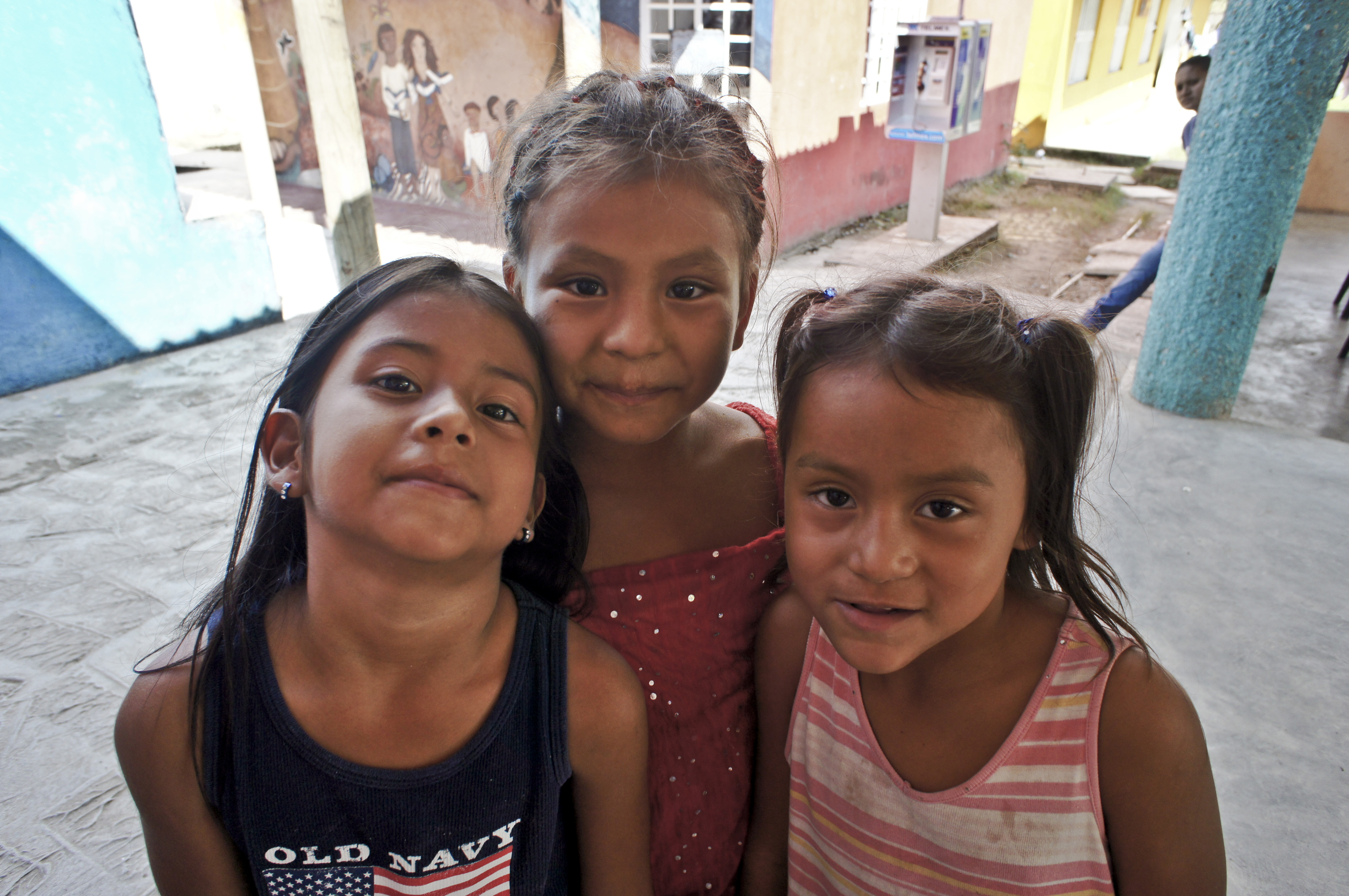
Girls at Tenosique Migrant Shelter. Photo by Víctor M. Espinosa. CC BY-NC-ND.

Girls at Tenosique Migrant Shelter. Photo by Víctor M. Espinosa. CC BY-NC-ND.

By Ana Elena Puga

What do we make of a photo of a two-year-old Honduran baby with a bandaged leg stump, the consequence of an accident on the freight train that he and his migrant mother were riding? Or the news stories about the 12-year-old Ecuadorean girl who hung herself in the shower after her attempt to reunite with her family was foiled by the arrest of her guide?

These past few months anyone in the United States who follows the news has seen a torrent of stories and images detailing the suffering of Latin American migrant minors who are brought here by their parents, or who come on their own in an attempt to work, reunite with family, or seek political asylum. As an academic who spent the last year conducting research in Mexican shelters and other facilities that help migrants, I am struck by how few people in the United States make the connection between their own comforts and the pain of others.

Every time I see a Fruit of the Loom ad, for instance, I think of the young woman I spoke to with blisters on her feet from walking for days from the Mexico-Guatemalan border to reach a shelter in Arriaga, Chiapas. In El Salvador she had left her village for a larger city to work in a Fruit of the Loom factory, sewing together my brand of underwear. She earned just enough money to stay alive and keep working, but not enough to feed, clothe, and educate her children. Having uprooted herself once for the sake of work made it easier for her to uproot herself again in hopes of an even better wage in the United States proper – instead of its exploitative outpost abroad. That six-pack of women’s underwear I can buy at Walmart for under $10 depends on the labor of people who are already working for us, even before they physically arrive on U.S. soil.

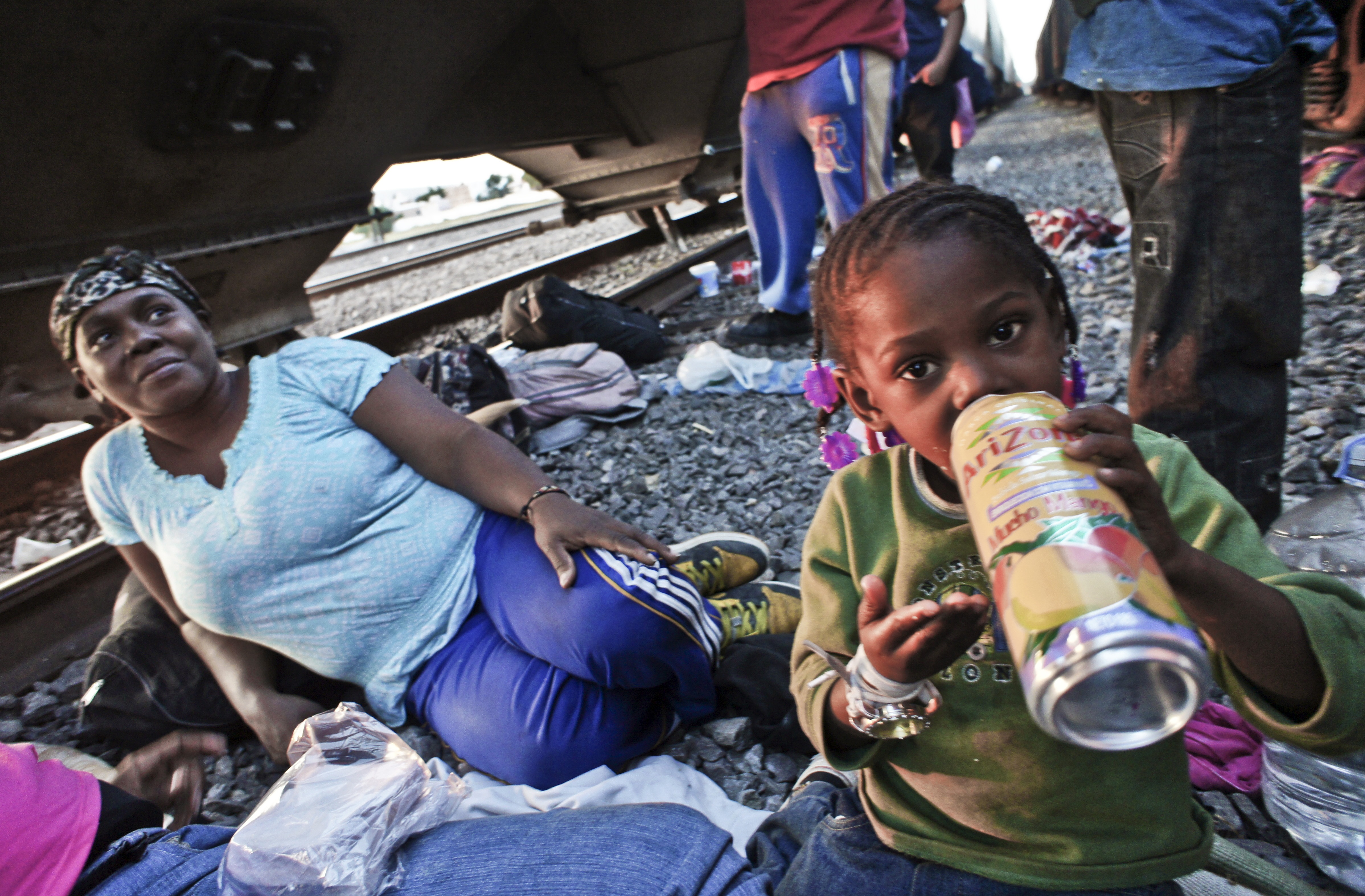
Family at Train in Celaya, Guanajuato. Photo by Víctor M. Espinosa. CC BY-NC-ND

Family at Train in Celaya, Guanajuato. Photo by Víctor M. Espinosa. CC BY-NC-ND

Emotional reactions to this year’s rise in the number of undocumented children apprehended at the U.S.-Mexico border often take one of two forms: sentimental-but-useless compassion or angry rejection. My dentist’s receptionist, like many well-intentioned people, lamented, “It just tears my heart up. I wish I could adopt them all.” Gut-twisting images and horror stories sometimes lead us to drown out the migrant experience in our own tears.

At the other extreme, The New York Times reported that protesters in Murrieta, California, shouted “Go home!” at migrant mothers and children on buses. Protesters opposed to a proposed shelter in Vassar, Michigan, presumably felt so threatened by the migrants that some of them reportedly carried semiautomatic rifles and handguns.

Even President Barack Obama adopted a stern tone: “Do not send your children to the border. If they do make it, they’ll get sent back. More importantly, they may not make it.” It’s difficult to imagine Central American parents hearing this on the news and saying, “OK, since you asked so nicely, I’ll just accept that it’s my lot in life to stay here with my kids, no matter how bad the poverty or the violence gets.” And what about the many minors who don’t ask permission before they hit the road? When we blame the parents, we ignore that most Central American mothers and fathers are doing the best they can to cope with global economic forces and structural violence that leave them on the short end of the neoliberal stick.

Central America is not an isolated, distant region of the world where the United States and its citizens bear little responsibility. Many books have been written on the long, nasty history of U.S. intervention in the region. To recall just a few highlights: in 1954 the CIA sponsored a coup in Guatemala on behalf of the United Fruit Company that destroyed a democratically elected government and plunged the country into decades of genocidal military rule; in the 1980s, the United States funded the Salvadoran military during that country’s civil war, despite the military’s links to right-wing death squads in the service of a tiny upper-class elite; in the wake of the 2009 coup that ousted President Manuel Zelaya from Honduras, the United States provided funding for the police force of Zelaya’s successor, Porfirio Lobo Sosa, despite his ties to the coup leaders and his shaky human rights record.

Not to mention that our consumer demand for illegal drugs fuels violent organized crime networks throughout the hemisphere, some of which also specialize in the human trafficking of Central American minors.

Children Playing at Tenosique Migrant Shelter. Photo by Víctor M. Espinosa. CC BY-NC-ND

Children Playing at Tenosique Migrant Shelter. Photo by Víctor M. Espinosa. CC BY-NC-ND

The United States can pressure Mexico to attempt to seal its southern border with Guatemala, but as Father Alejandro Solalinde, the director of a shelter for migrants in Ixtepec, Oaxaca reminded me, “People will migrate when they have to regardless of what governments try to decide for them, whether they pass immigration reform or build more walls.”

What if we were to think of undocumented migrant children neither as the heart-string tugging heroes of (let’s face it) entertaining melodramas featuring poor innocent, vulnerable children on dangerous adventures nor as the germ-ridden children of villainous criminals invading our country (depending on your point of view). What if we expend more of our energy on figuring out how to respect their rights? The Obama administration’s recent decision to interview some Honduran minors in their home country to determine whether they qualify for refugee status will not provide a perfect solution, since few children are likely to meet the stringent qualifications for a very limited number of visas. But at least it conceives of children less as objects of our own love or hate and more as persons with human rights under international law, persons for whom we bear an undeniable responsibility.

Ana Elena Puga is an Associate Professor in the Departments of Theatre and Spanish & Portuguese at The Ohio State University. She is working on a book, Staging Migrant Suffering: Melodrama in Latin American and Latino Activism, with sociologist Víctor M. Espinosa. Their 2013-14 research in Mexico was supported by a Fulbright fellowship.

Violence Against Latina/o Migrants

by Felicity Amaya Schaeffer

Driving down Main Street in Half Moon Bay several weeks ago, a short detour from the wealthy tourist zone into a residential apartment complex two blocks away brought me into the borderland between the middle to upper class white community and a mixed class of Latinos in this small Northern California town. We slowed the car to get a closer look at the hundreds of Latinos/as dressed in black outside a church. It was as if they were floating to the rhythmic flow of Aztec dancers, their bodies gracefully leaning back to release hundreds of white balloons into the sky, pleas for peace in a community united by rage over the recent death of an 18-year-old Latina by a white police officer. A Latino tasked with facilitating the flow of traffic walked up to us and I quickly rolled down the car window. He responded to my concerned look by explaining the events that led up to this funeral.

“The police are out of control in this country,” he said with anger rising in his voice. “They shot and killed a young Latina with mental health problems, shot her in her own home.” I found out later that the family called 911 when their daughter, Yanira Serano, would not take her medication, hoping the paramedics would arrive as they usually did. The police arrived instead. When faced with this woman running towards them with what her family say was a butter knife, a police officer shot her dead “in self defense.” The family and others wanted to know: Why didn’t the police use a Taser gun, or try to disarm this young woman? And I think to myself, this would not have happened in a white, middle class home. Is the racialized criminality of migrants so high that police are increasingly turning to guns to solve “problems” in Latino communities? The hostility of police toward migrants, like African-Americans, speaks to the disposability of certain lives, those who are criminalized, dehumanized, and stripped of the most basic protections and rights in U.S. society. At least these incidents are spawning widespread demands for rights and humanity by Latino communities. Young women and residents protested Yanira’s death, as they occupied the tourist zone where the sheriff’s office is located shouting for “Justicia!” through the bustling streets of the downtown area of Half Moon Bay.

This police shooting of a Latina is hardly an isolated event. The recent killing of a Latino migrant by police officers in Salinas and others in Anaheim similarly spawned protests, especially in cities in California where racialized tensions between Latinos and whites have a long history.[i] The Salinas murder, which happened only months before and was the third police homicide that year, ignited street protests where over a thousand people met in the streets of Salinas to demand justice, and an investigation of racially motivated police violence in the area. Unfortunately, media attention to this murder was drowned out by the shooting spree of a  Santa Barbara City college student, a wealthy young man, whose psychological profile captured attention after he tragically killed six innocent people, supposedly in response to a lack of attention from young women. It is the (racialized) innocence of the Santa Barbara victims that the media contrasts to the reporting of migrants deaths, who are criminalized as always potentially out to commit a crime. No one talks about the laws themselves that criminalize every aspect of migrant life.

Many of us are well aware of the rising deaths of migrants along the U.S.-Mexico border. Not only are migrants dying as they cross the most militarized borders, as well as deathly desert zones in Arizona, Texas, and California, but the pumping of funds into border patrol personnel and surveillance technologies are spreading this terror to cities across the United States. Secure Communities, a government sponsored program to educate and empower local police to take on the role of Immigration and Customs Enforcement (ICE), stretches how we conceptualize borders, transferring border zones from the imagined space between nations to a much more deterritorialized terrain that stretches beyond the nation and into the most intimate sphere of immigrants’ everyday life. For example, the United States contributes funding, border control strategies, and technologies to Mexico and Central American countries to slow the numbers of migrant crossings into Mexico and ultimately the United States. In exchange for negotiating a better deal for its own migrants in the United States, Mexico detains and deports Central American and other migrants crossing its Southern Border, the majority from Ecuador.[ii] In addition, drones manufactured by U.S. and Israeli companies patrol both sides of the border in the name of narcoterrorism, shifting war technologies to the U.S.-Mexico border as well as other borders around the world.[iii] We might want to think of this as another stage of global imperialism where technologies spread the power of the United State’s control over land and bodies, a form of governance I call “techno-empire.” The United States can control countries like Mexico from afar without having to literally take over another country. For example, by launching drones over Mexican territory, or selling surveillance technologies whose optics can be viewed from any Internet location, the United States keeps watch of not only migrants and drug cargo, but also the police and border patrol on the other side of the border. Given the use of militarized technologies to fight the “war on terror,” U.S. technological dominance compromises Mexico’s sovereignty to determine it’s own border policies and practices.

This militarization of the border financially supports high-tech companies as well as the prison industrial complex (as detention centers continue to expand), leading to gross profits made on policing bodies whose value relies on their de-humanization. Migrant deaths and deportations are calculated as simply the collateral damage of the war at the border. Hundreds of migrants have been killed by heat exhaustion, drones, and helicopters (especially in Texas), while surveillance cameras positioned in border patrol cars, fences, and across the border region track people like hunted animals to be detained, imprisoned, or exported from the United States. It seems as though the power to identify and police each other has spread through a state of exception that normalizes war onto racialized bodies charged with the potential to threaten, rather than enhance, American life. All are empowered – the police, hospital personnel, schools, vigilantes or “citizen border patrols,”[iv] and everyday individuals (“If you see something, say something”) – to call in (and sometimes kill) potentially undocumented individuals. In fact, Texas border patrol can legally shoot moving vehicles suspected of carrying undocumented migrants. Officers and helicopters are indeed mobilizing this right, leading to a spate of deaths, including the killing of a migrant mother who was shot through her car windshield, leaving behind her crying 18 month-year old in the front seat.

Ironically, securing the border is often justified through the protection of innocent women and children trafficked across the border, even as migrant women are demonized as irresponsible mothers due to a lack of English language skills and for breaking the law by crossing the border, among other reasons. Further aggravating the situation is the conflation of migrants with gang members, smugglers, and terrorists in the media, which has police responding to a racialized rage (and fear) that results in the death of migrants. It’s not only rage that drives these deaths, but the widespread disrespect for the rights and humanity of migrants whose very bodies have recently been found dumped in mass graves in Texas. While the law stipulates that all dead bodies must be identified in Texas, as in most states, it appears as though migrant bodies found in the border regions of Texas and other states are being dumped into mass graves without identification.[v] Similar to the lack of justice for the disappeared women in Juarez, many in Mexico and Central America search for loved ones with few resources to pay the thousands of dollars required to exhume and identify bodies discarded most efficiently in a burial site in Texas. And the rapid rise in numbers of children migrating without an adult across multiple countries en route to the United States, or left behind by a parent in detention who has been deported back to Latin America, or killed, should be evidence enough that the “war at the border” is creating many more problems than it solves. The walls erected at the border mirror the halted flow of knowledge about how migrants are being brutally stripped of humanity in the media. I am hopeful that migrants from around the world will continue to see themselves in alliance against the techno-virtual imperial state, and its militarized apparatus. And continue to rise up in defiance.

Notes

[i] A video of the Salinas killing went viral when caught on someone’s cell phone. A Latino man had entered a woman’s house in what they think was an attempted theft and rape (although nothing was taken and no one was hurt) and was caught stumbling down the street of Salinas. After the police followed him for two blocks, they shot, and killed him on the corner of a busy street in the middle of the day.

[ii] Many of these migrants come from Ecuador. See David Kyle and Christina A. Siracusa, “Seeing the State Like a Migrant” in Illicit Flows and Criminal Things: States, Borders, and the Other Side of Globalization (eds., Willem van Schendel and Itty Abraham, Bloomington: Indiana University Press, 2005), 153-176.

[iii] See Tom Barry, International Policy Report, “Drones Over the Homeland: How Politics, Money and Lack of Oversight have Sparked Drone Proliferation, and What we can do.” April 23, 2013. http://www.ciponline.org/research/html/drones-over-the-homeland.

[iv] These are citizens who take over the name Minutemen in order to patrol the border and prevent migrants from crossing, oftentimes by seriously injuring and killing those who cross their path. See the Southern Poverty Law Center article, “InvestigatingDeaths of Undocumented Immigrants on the Border,”Intelligence Report, Fall 2012, Issue Number:  147. http://www.splcenter.org/get-informed/intelligence-report/browse-all-issues/2012/fall/death-in-the-desert. Accessed June 21, 2014.

[v] FoxNews.com, “Mass graves with bodies of unidentified immigrants discovered in south Texas cemetery,” Perry Chiaramonte and The Associated Press, June 24, 2014. Accessed on June 24, 2014: http://www.foxnews.com/us/2014/06/24/mass-graves-with-bodies-unidentified-immigrants-discovered-in-south-texas/

Felicity Amaya Schaeffer is an Associate Professor in Feminist Studies at the University of California, Santa Cruz. She has a Ph.D from the American Studies Department at the University of Minnesota and an MA in Latin American Studies from the University of Arizona. Her book, Love and Empire: Cybermarriage and Citizenship Across the Americas, was recently been published by New York University Press (2013). Her new research interests examine visual and surveillance technologies, and the sexual criminalizing of immigrant bodies across the U.S. – Mexico border.

Rerun: From Pig Food to Haute Cuisine

This essay originally ran on Mujeres Talk on March 25, 2013. We are posting it again today on June 24, 2014 to offer another perspective on immigration and in recognition of a season when many are now engaged in travel for research.

By Catherine S. Ramírez

Many years ago, a family I knew—let’s call them the Pedrazos—invited their parish priest to their home for dinner.  Like many Mexican Americans, the Pedrazos were Catholic.  Their priest was from Spain.  In all likelihood, he’d been assigned to their church to attend to its many Spanish-speaking parishioners.  The Pedrazos made tamales for him, a sign that they held their guest in high esteem, as tamales require a fair amount of work and Mexican Americans generally serve them on special occasions.  As I picture them readying themselves and their home for their visitor, I imagine Mrs. Pedrazo spreading the creamy masa and spicy meat filling over the wet cornhusks and carefully folding the ends of each hoja to create a tidy bundle.  I picture scores of tidy bundles.  Then I imagine the astonishment, disappointment, injury, and anger she and her husband felt when their guest refused to eat the meal she had prepared for him.  “No como comida de therdos,” the priest announced in his Castilian accent.  Since the tamales were made of corn and pigs eat corn, he wouldn’t touch them.

Fig. 1

Fig. 1

Today, it appears Spaniards’ attitude toward Mexican food has changed.  In 2009, the New York Times’ Andrew Ferren surveyed a handful of Mexican restaurants in Madrid and concluded that Spaniards had “come a long way in embracing the food of their former colonies.”[1]  The 2013 Páginas Amarillas, Madrid’s equivalent of the Yellow Pages, lists 103 Mexican restaurants.  11870, an online restaurant reservation service that functions somewhat like Open Table, tallies 104.[2]  The Spanish capital also boasts 85 Argentine, 38 Peruvian, 27 Cuban, 23 Colombian, 21 Ecuadoran, ten Venezuelan, four Uruguayan, and three Chilean restaurants, not to mention 20 restaurantes sudamericanos.[3]  Stores specializing in productos latinos, like Paraguayan yerba mate and mixes for arepas, savory Colombian cornmeal patties, dot the city. [Fig. 1]

Chirimoyas, a sweet, succulent fruit native to the Andes, can be found in just about any frutería.  And many supermarkets have a small section devoted to Mexican food, complete with flour tortillas, ready-made guacamole and salsa, and kit fajitas. [Fig. 2]

Fig. 2

Fig. 2

Without a doubt, the fruits of empire are available in Madrid in huge part because of the movement of Latin Americans to the former metropolis.  According to a report published in 2010 by Network Migration in Europe, a Berlin-based think tank devoted to the study of migration and integration, a total of 2,365,364 people of Latin American origin lived in Spain in 2009.  Latin Americans comprised 37 percent of the foreign-born population, up from 24 percent ten years earlier.  Most hail (in numerical order) from Ecuador, Colombia, Argentina, Bolivia, and Peru.[4]  Relatively few are from Mexico, but of all the cuisines from Spain’s former colonies, Mexican seems to be the most prevalent and popular.  Why?

As the American daughter of a Mexican immigrant who won the Los Angeles Times Best Home Cook of the Year Award in 1992, my response to this question is a simple duh:  Mexican food is prevalent and popular in Madrid and many other places simply because it’s tasty.  This is a glib, not to mention biased, answer.  There are many reasons for the increasingly global demand for Mexican fare.  Like German, Italian, and Japanese cuisines in the United States (think hot dogs, pizza, and sushi), Mexican food has been assimilated, in the literal and sociological senses of that word.  For evidence of its absorption by and emanation from the American mainstream, one need only look at the proliferation of the Denver-based chain, Chipotle, which lays claim to restaurants in the US, Canada, the United Kingdom, and France.[5]  Despite atrocities “The Great Satan” has committed and continues to commit at home and abroad, Americana, be it in the form of jazz, Disney, Starbucks, or Mission District-style burritos, retains its allure in many places.  According to Gustavo Arellano, author of Taco USA:  How Mexican Food Conquered America, Mexican fare has even made it to outer space.  Since 1985, NASA has catapulted its astronauts into space with tortillas, which have proven more durable and less dangerous to sensitive equipment than bread.[6]  Tony restaurants like Chicago’s Topolobampo show that Mexican food has also drifted from its humble origins.  In 2010, the United Nations Educational, Scientific and Cultural Organization declared “traditional Mexican cuisine,” along with “the gastronomic meal of the French” and “Mediterranean diet,” an Intangible Cultural Heritage of Humanity.  This was the first and only time food made UNESCO’s privileged list.[7]

When I moved to Madrid in August of 2012, I was intrigued by the Mexican restaurants here and took it upon myself to eat in as many as possible before my return to the US the following year.  How is the Mexican gastronomic experience reinterpreted in its new surroundings, I wondered?  More concretely, who owns, works in, and patronizes Mexican restaurants in Madrid?  And what can the migration and assimilation of Mexican food tell us about the migration and assimilation of people, both in the US and elsewhere?  Along with an empty stomach, a full wallet, and an increasingly crammed notepad, these are some of the questions with which I’ve set out as I’ve explored Mexican cookery in my adopted city.
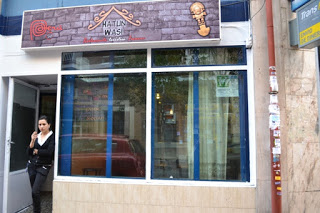
Fig. 3

Fig. 3

Like images of the Virgin Mary in tree trunks, Mexican eateries in the US tend to reflect migration patterns and shifting demographics.  However, the ones in Madrid—and, here, I’d wager to say in just about any other European city—testify more to that city’s elite cosmopolitanism.  In other words, Mexican restaurants in Europe signal the presence of American expats and/or well-heeled foodies.  By and large, the Mexican restaurants in Madrid have a trendier or more upscale air than their Latin American counterparts, many (but certainly not all) of which appear to be run by and for hardworking and thrifty immigrants.  For example, at Hatun Wasi, a Peruvian restaurant that recently opened in the working-class, immigrant neighborhood of Cuatro Caminos, the no-nonsense dining room consists of mismatched chairs, tables, and barstools. The floor is clean, but scuffed.  A simple blackboard in the window announces the restaurant’s hours and the prices of various specials. [Fig. 3]

Fig. 4

Fig. 4

A two-course menú del día or lunch special costs a mere three euros (around four dollars).  In contrast, Takeiros, a Mexican restaurant near my apartment in the middle-class neighborhood of Ríos Rosas, offers a three-course menú del día for 11 euros (roughly 14 dollars).  Dinner runs around 30 euros (40 dollars), a hefty price for many madrileños, immigrant and native-born alike, in this moment of economic crisis. Where Hatun Wasi is a modest, if not barebones, joint, many Mexican restaurants in Madrid are bedecked with colorful decorations that scream ¡MÉXICO! (or, as the Spaniards spell it, Méjico), such as papel picado, serapes, and lucha libre masks.  At Takeiros, Mexican lotería cards cover the walls and metal tooling lampshades dangle from the ceiling. [Fig. 4] And except for the live mariachi music Thursday nights at La Herradura, one of Madrid’s more established Mexican eateries, salsa music dominates the playlists in the Mexican restaurants I’ve patronized here.

Fig. 5

Fig. 5

All the meals in these restaurants begin with a small basket of totopos (what Spaniards mistakenly call nachos) and salsa.  The chips always taste a bit like reconstituted cardboard, a travesty given the ubiquity of mouthwatering fried food in Spain, most notably, churros, patatas fritas, and calamares a la romana.  And while the salsa, be it red or green, is usually flavorful, it’s never spicy enough for me.  Still, despite their less-than-promising start, the Mexican meals I’ve had in Madrid have been surprisingly satisfying.  I’ve enjoyed fresh green salads garnished with velvety avocados and tangy flores de jamaica.  Staples, like quesadillas, burritos, and flautas, can be found on nearly all menus.  However, unless I’m at a burrito or taco bar, I usually don’t bother with the more prosaic foods.  Instead, I go for more complex dishes, like pollo en mole poblanocochinita pibil, and albondigas con salsa de chipotle. [Fig. 5] Mexican beers, such as Corona and Pacífico, are widely available; Mexican sodas and aguas frescas, less so.  Impressively, Takeiros’ wine list consists exclusively of wines from Baja California.

A couple of Mexicans opened Takeiros in 2011.  They own three other eateries in Madrid, one of which, a take-away counter, also specializes in Mexican fare.  While the customers at Takeiros appear to be mostly Spaniards, the workers I’ve encountered there have all been immigrants.  Peruvian and Ecuadorian chefs have prepared my food to perfection and Argentinian and Mexican waiters have delivered it to me and put up with my many questions.  The dishwasher, like the waitress I photographed in front of Hatun Wasi, is a young immigrant from Romania.

I’ll wrap up with a brief discussion of Romania, what I’ve come to see as the Mexico of Europe.  Just as Mexico hitched its cart to the NAFTA horse in 1994, Romania, one of Europe’s poorest nations, joined the European Union in 2007.  While NAFTA failed to provide for the free movement of workers across Mexico, the US, and Canada, EU membership has allowed Romanians to move and work within member states.  Like many Mexican migrants in the US, many Romanians came to Spain, Europe’s leading country of immigration from 2000 to 2007, to work in the then booming construction, tourism, hospitality, and domestic-service industries.[8]  In 2008, they surpassed Moroccans as the largest foreign group in this country.[9]  Then Spain’s economic bubble burst and unemployment skyrocketed.  The Spanish government responded by trying to restrict Romanian immigration, a reversal of its commitment to admit rumanosas fellow members of the twenty-seven-nation EU.[10]  More recently, the prospect of Romanians and Bulgarians being able to work freely in the UK starting in 2014 has provoked protests in that country.[11]  To deter “an influx of unwanted people,” the UK’s equivalent of the Department of Homeland Security, the Home Office, has considered launching an advertising campaign in Romania and Bulgaria stressing Britain’s less attractive qualities, like its notoriously bad weather.[12]  Hardy, despised, feared, and here to stay, Romanians, not unlike Mexicans in the US, are the cockroach people of Europe.[13]

In physiology, assimilation refers to consumption and the body’s absorption of nutrients after digestion.  Like the Spanish priest who rejected the Pedrazos’ homemade tamales, Europe refuses to take in Romanians or to absorb what many of them have to offer:  their labor.  Indeed, it sees them as a contaminant, as the recent scare over horsemeat fraudulently labeled as beef has made patent.  When horsemeat was first discovered in frozen lasagna in British and French supermarkets earlier this year, Romania was immediately cast as the culprit.  French and British news media reported that new traffic laws banning horse-drawn carts in that country had led to the mass slaughter of horses and the subsequent introduction of horsemeat into the food chain.  Even though the horsemeat was ultimately traced to a factory in southern France, the perception of Romania as dirty, primitive and, therefore, thoroughly un-European endures.[14]
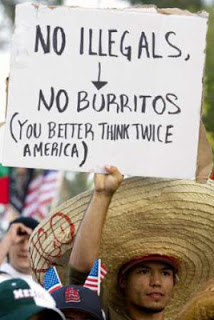
Fig. 6

Fig. 6

A Spaniard in LA.  Chicken mole, Romanian workers, and a Chicana scholar in Madrid.  Lasagna in France and Britain.  Clearly, people and food travel.  Far too often, the latter goes down more easily than the former, as the sign in the final illustration I’ve included in this essay indicates [Fig. 6].[15]  Whether or not people assimilate and are assimilated—incorporated, integrated, welcomed—depends on numerous factors, including access to citizenship and basic social services, particularly education and health care, possession of rights and protections as workers, and genuine tolerance and respect.


Catherine S. Ramírez, an Associate Professor of Latin American and Latino Studies at the University of California, Santa Cruz, is spending her sabbatical year in Madrid, where she’s writing a book tentatively titled Assimilation:  A Brief History.

[1] Andrew Ferren, “Mexican Hot Spots in Madrid,” New York Times, May 5, 2009, http://intransit.blogs.nytimes.com/2009/05/05/mexican-hot-spots-in-madrid/ (accessed March 18, 2013).
[2] http://11870.com/k/restaurantes/es/es/madrid (accessed March 19, 2013).
[3] http://madrid.salir.com/restaurantes (accessed March 18, 2013).
[4] Trinidad L. Vicente, Latin American Immigration to Spainhttp://migrationeducation.de/48.1.html?&rid=162&cHash=96b3134cdb899a06a8ca6e12f41eafac (accessed March 18, 2013).
[5] “Chipotle Opens Restaurant in London, First in EU,” Denver Business Journal, May 10, 2010, http://www.bizjournals.com/denver/stories/2010/05/10/daily4.html (accessed March 19, 2013).
[6] Gustavo Arellano, Taco USA:  How Mexican Food Conquered America (New York:  Scribner, 2012).
[7] http://www.unesco.org/culture/ich/index.php?lg=en&pg=00011 (accessed March 18, 2013).
[8] Michael Fix, Demetrios G. Papademetriou, Jeanne Batalova, Aaron Terrazas, Serena Yi-Ying Lin, and Michelle Mittelstadt, Migration and the Global Recession:  A Report Commissioned by the BBC World Service (Washington, DC:  Migration Policy Institute, 2009), 33-34.  Also see http://www.migrationpolicy.org/pubs/mpi-bbcreport-sept09.pdf (accessed March 19, 2013).
[9] Ibid., 38.
[10] Raphael Minder, “Amid Unemployment, Spain Aims to Limit Romanian Influx,” New York Times, July 21, 2011, http://travel.nytimes.com/2011/07/22/world/europe/22madrid.html (accessed March 19, 2013).
[11] Stephen Castle, “Britain Braces for Higher Migration from Romania and Bulgaria,” New York Times, March 4, 2013, http://www.nytimes.com/2013/03/05/world/europe/britain-braces-for-higher-migration-from-romania-and-bulgaria.html?pagewanted=all&_r=0 (accessed March 19, 2013).
[12] Sarah Lyall, “Welcome to Britain.  Our Weather Is Appalling,” New York Times, January 29, 2013, http://www.nytimes.com/2013/01/30/world/europe/welcome-to-britain-our-weather-is-appalling.html (accessed March 19, 2013).
[13] I take the term, “cockroach people,” from Oscar Zeta Acosta’s 1973 novel The Revolt of the Cockroach People (New York:  Vintage, 1989).
[14] Andrew Higgins, “Recipe for a Divided Europe:  Add Horse, Then Stir,” New York Times, March 9, 2013, http://www.nytimes.com/2013/03/10/world/europe/recipe-for-divided-europe-add-horse-then-stir.html?pagewanted=all (accessed March 19, 2013).
[15] This image is from http://imageshack.us/photo/my-images/74/r2048252209bz4.jpg/sr=1 (accessed March 19, 2013).All other photos here were taken by the author.

Reflections on Language and Identity

"Zine Study XIV: [language]" Photo by Flickr user Shawn Econo. CC BY-NC-SA 2.0
“Zine Study XIV: [language]” Photo by Flickr user Shawn Econo. CC BY-NC-SA 2.0

 by Lucila D. Ek

When my ten-year old niece was a toddler, my mother taught her to say the parts of the body in Yucatec Maya. My niece repeated the words that my mother slowly and carefully pronounced. My mother would then quiz her: “¿Dónde está tu chi?” and my niece would point to her mouth. “¿Dónde está tu pool?” and my niece would point to her head. They played this game repeatedly.  While I was glad that my mother was trying to teach her these words, as a bilingual education scholar, I knew that memorizing isolated words and phrases was not enough for my niece to acquire our Mayan language. After all, my sisters and I never really learned to speak Maya despite hearing it spoken by our parents and adult relatives who spoke it with each other. We did learn some vocabulary but cannot carry on a conversation in our heritage language. As kids growing up in Los Angeles in the 1970’s and ‘80’s, my sisters and I spoke Spanish at home and in our community while English dominated at school. There really were no resources to help us develop and maintain Maya.

I used to think that my sisters and I didn’t learn Maya because we grew up in the United States. However, the lack of support for developing and maintaining heritage languages was the same in Mexico, as my cousins who grew up and still live there did not learn to speak it either. In our native Mexico, Yucatec Maya, like many indigenous tongues, has low prestige and its speakers are stigmatized. In our pueblo, Spanish is the dominant language in town life and the language of instruction in school. The loss of Yucatec Maya in my family both in the U.S. and in Mexico is distressing because identity and culture are inextricably connected to language as Chicana feminist scholar Gloria Anzaldúa so profoundly claimed, “I am my language.” She was referring to the Spanish of the Southwest found in her native Texas, yet her assertion applies to all languages and their varieties.

Many scholars from multiple disciplines have shown that language is inextricably linked to our notions of who we are and to how we signal our identities in our everyday lives. For example, anthro-political linguist Ana Celia Zentella demonstrates how English and Spanish and their varieties are used by Nuyorican youth to signal various identities. Linguistic anthropologist Norma Gonzalez’ research on Mexican origin women and children in Tucson emphasizes the links among language, emotion and identity. My own work emphasizes youth’s use of Central American varieties of Spanish for maintaining and practicing Guatemalan and Salvadoran culture in Los Angeles. These are a few of many studies that underscore the language-identity connection.

Seeing that her daughters have lost their Mayan language, my mother struggles to keep that from happening to her granddaughter. Yet, the threat is not only to Yucatec Maya but also to Spanish, our family’s other native language. For my sisters and I, developing and maintaining Spanish was challenging enough given that there was no bilingual education program in our K-12 schooling. Then (as now), English-only ideologies and policies created a context that was hostile to the development and maintenance of languages other than English, particularly Spanish. Among immigrants in the U.S., the heritage language is lost by the third generation—unless there is some sort of intervention/maintenance effort. Knowing the propensity toward language loss, my family and I were determined that my niece be bi/multilingual. Indeed, my niece’s first language is Spanish. Both sides of her family agreed that they would speak to her and expect her to respond in Spanish.  Spanish-speaking family members include four grandparents whose dominant language is Spanish, as well as her two parents and three aunts whose first language in Spanish. Furthermore, my niece has attended a dual language program since kindergarten. In addition, she has spent two-three weeks in Yucatan every year since she was five. Nevertheless, today in the fifth grade, she is defaulting more and more to English.

No, en español no, Tía,” she pleads.

Sí en español, dímelo en español,” I tell her.

“¿Por qué?” she asks.

Porque español es el idioma de mi corazón.” I respond. “Y tú eres my corazón.”

She beams.

By connecting her to Spanish and to my heart, I emphasize the emotive dimensions of language and identity. To be a tía to my sobrinita must be done in the language best suited to express the love that I feel for her. However, the Spanish that my family and I speak is not “standard” or academic Spanish. Rather, when I am being most myself, my Spanish includes English words, phrases, and loan words, and sometimes even a Mayan phrase or two. As Ana Celia Zentella has shown, code switching is a complex identity signaling and identity building practice by bi/multilinguals. She argues for an acceptance and validation of bi/multilinguals’ linguistic realities and calls out the “bilingual language patrol” who attempt to police and contain Latina/o languages. Patrolling and policing Latino/a ways of speaking further stigmatizes certain varieties of Spanish contributing to language-identity shame and loss.

I bring these deeply personal linguistic experiences to my work as a bilingual teacher educator in San Antonio. I start by interrogating what we think of as “correct” or “good” Spanish, the kind that the Real Academia Española, would approve of. I share my stories of language and identity loss with my Latina/o students, many of whom have similar experiences. They share their experiences in Spanish courses that dubbed their Spanish—and by extension, them–as inferior. Given the hostility and violence that their non-standard ways of speaking elicited, these teacher candidates are caught in a bind: How do they accept and validate their students’ Spanish while at the same time teach them the more prestigious, academic variety? How do they accept and validate their own Spanish which they’ve pegged “mocho,” “pocho,” “pobre,” “incorrecto”? They must learn to first accept, validate and feel proud of their Spanish so that they can teach their students (and their children) to love their languages and themselves. It’s not an easy process given the continuing English-only, anti-immigrant, anti-Latino/a ideologies that are rampant in the U.S. but together we can continue to resist these beliefs and practices so that my niece and other Latina/o children do not suffer needless loss of their languages and identities.

References

Anzaldúa, G. (2007). Borderlands La Frontera: The New Mestiza (3rd ed.). San Francisco, CA:  Aunt Lute Books.

Ek, L. D. (2010). Language and identity of immigrant Central American Pentecostal youth in Southern California. In N. Cantú & M. Franquiz (Eds.), Inside the Latin@ Experience: A

Latino Studies Reader. (pp. 129-147). New York: Palgrave Macmillan.

González, N. (2001). I Am My Language: Discourses of Women and Children in the Borderlands. Tucson: The University of Arizona Press.

Zentella, A. C. (1997). Growing up Bilingual: Puerto Rican Children in New York. Malden, MA: Blackwell Publishers.

Lucila D. Ek was born in Yucatan, Mexico and immigrated to the U.S. at the age of four. She attended public schools from K-12th grade in Los Angeles, California. Before earning her PhD in Urban Education from UCLA, she was a bilingual-bicultural elementary teacher in the Los Angeles Unified School District. Currently, she is an Associate Professor in Bicultural-Bilingual Studies at the University of Texas at San Antonio. Her research centers on the language and literacy of Chicana/os and Latina/os, and bilingual teacher education. Her work has been published in Anthropology & Education Quarterly, International Multilingual Research Journal, Bilingual Research Journal, and the High School Journal.