Category Archives: Immigration

Collecting Memory: Chicana/o and Latina/o Lives Outside the Southwest

Documents from El Calendario Hispano de Michigan, from the Papers of Juana & Jesse Gonzales Held by Michigan State University Library

Documents from El Calendario Hispano de Michigan, from The Papers of Juana & Jesse Gonzales Held by Michigan State University Library

By Diana Rivera

Dr. Christine Marin’s (ASU) January essay here on Mujeres Talk brought attention to the work she and other Chicana/o and Latina/o archivists and librarians performed in building collections that document the history of our communities in the Southwestern US (21 January 2014). It brought to mind the fact that Mexican and Puerto Rican communities have also, for the past 100 years, been in areas beyond the Southwest and East Coast, including the Great Plains, the Pacific Northwest and in particular, the Great Lakes region. Their stories, their lives and sometimes their contributions have been documented through independent, government and academic narratives, reports, demographics, statistics and historical studies. Scholars such as Paul Schuster Taylor, Norman D. Humphrey and George T. Edson have written on Mexican migration and immigration to region while Lawrence R. Chenault, Clarence Senior and Abram J. Jaffe surveyed and recorded Puerto Rican migration early on. This work charted our migration routes, our living conditions and early settled-out communities. They also studied our labor and dependability patterns and sometimes touched on culture, tradition and history. None of these types of studies relied on the kept materials, keepsakes or oral histories of the Mexican and Puerto Rican communities. Instead, these reports and statistics provided a sanitized narrative of our growing presence in the early years.

Even though it should not fall only to Chicana/o or Latina/o librarians or archivists to build a Chicana/o-Latina/o Studies (CLS) collection, more often than not, it does. Regrettably, the number of Chicana/o and Latina/o graduates from Library & Information Science Degree Programs are not keeping up with a growing Latina/o  population in the US. Dr. Marin’s essay prompts the question: What is being done to preserve and conserve the history of Chicana/o and Latina/o communities not only in, but also OUTSIDE of the Southwest?

Internationally known Chicana/o-Latina/o Studies (CLS) librarians Dr. Christine Marin, Margo Gutierrez (UT-Austin), Lilly Castillo-Speed (UC Berkeley), Dr. Richard Chabran, Dr. Maria Teresa Marquez (UNM) and Nelida Perez (CUNY) laid the groundwork for me and my peers at libraries across the country to emulate. My predecessors, and some contemporaries, in libraries and archives who have built excellent collections have established a model that I have followed to develop and to build collections that document Chicana/o, Puerto Rican and Latina/o stories in the Great Lakes Region. These materials are now available for scholarly research, including government reports and academic work.

In a January comment on Dr. Marin’s essay here on Mujeres Talk, I noted that one of my first areas of responsibility as a new librarian was working with a small collection of maps stuck in the back of the Art Library at the Michigan State University Libraries (MSUL). As one of maybe two librarians of color there, I felt an affinity for this format, which seemed so out of place in a collection composed primarily of monographs. I was asked to take on Mexican Studies (mostly because I was of Mexican heritage) but went “rogue” by buying more titles on Chicana/o Studies than what was established in our collection development policy. In 1995, Chicana/o and Latina/o student protests on campus led to the university creation of a space honoring Cesar E. Chavez. The Cesar E. Chavez Collection is a multi-format and multidisciplinary collection on the life of Chavez, as well as the Mexican American and Puerto Rican presence and experience in the US.  With the assistance of Chicana/o and Puerto Rican students, we developed a healthy CLS collection unselfishly guided by Margo Gutierrez, the Mexican American and Latino Studies librarian and bibliographer at the UT Nettie Lee Benson Latin American Collection.

Our “multi-format” collection was initially a small collection of ephemeral vertical file material like flyers, brochures and newsclippings. It served a minimal role in the writing and teaching that students and faculty were doing on local and regional subjects in Chicana/o and Latina/o Studies. Instead, researchers were finding the histories, accounts and statistics in texts or in manuscript archives back in Texas, the rest of the Southwest and Mexico. There was little collected at MSUL that provided researchers with regionally unique or unpublished materials by organizations or individuals about local activities, including correspondences, speeches, pamphlets, agendas or meeting minutes. It was an apparent need and challenge to start archiving our history in  Michigan and the Great Lakes region. Although our language, culture and traditions pulled our hearts back to the Southwest, Mexico and Puerto Rico, our families, our memories and our stories began within the Great Lakes, Northeast or Great Plains regions. Now that we have more than a 100 year presence in these regions, it becomes more than important, actually critical to start gathering the histories and experiences of early Latina/o  communities in “el norte,” histories beyond the popularly understood geographic boundaries of “Aztlan” and Borinquen.

Collections of note that have included Chicana/o and Latina/o voices and materials are relatively new. These include the holdings of the University of Iowa Libraries Iowa’s Women’s Archives with the Mujeres Latinas project that includes the papers of 15 families dating from 1923, over 80 oral histories of Latinas/os, organizational records dating back to the 1960’s and other related collections; the University of Michigan Bentley Collection with a growing number of personal manuscript collections (6) and organizations (3); Hope College  (in Holland MI) with an early collection (1970s) of oral histories (many transcribed) and the MSUL  Jose F. Treviño Chicano/Latino Activism Collection with 18 manuscript collections (processed) with content dating to the 1940s. Our small vertical file at MSUL developed into the manuscript collections of donated papers of Mexican American community members in Michigan.  These collections now include photography, political buttons and other ephemera.

Although the manuscript collections donated by Michigan families are nowhere near the volume of those collections found in the Southwest (or now the Northeast at the CUNY-Hunter College Collection), they have provided a starting point for researchers focusing on Latina/os in the Great Lakes region to learn about the presence of Chicana/o and Latina/o  communities dating back to the early part of the 20th century.

Collections that encompass the range of eras, locations and subject matters that will provide a one-stop source for researchers inquiring about Latina/os in Michigan, Illinois, Ohio, Indiana or Wisconsin are hard to come by. However, we as librarians and archivists are at a pivotal point in time when the student activists, community leaders and closet archivists of the 1960’s no longer need or want their collections of papers, documents, newspaper clippings, pamphlets, scrapbooks, garage-printed-mimeograph machine of the ’60s chapbooks and publications, flyers, bumper stickers, buttons, posters and bandanas or t-shirts.  Some potential donors are not ready to entrust materials to an institution to which they have no history, affinity or connection.  Some are fearful that their long and carefully collected materials will be seen as unimportant or tossed. Others do not see their materials as important enough to donate or do not remember what is in their own collection that may unify or supplement the papers found in the collections of others.   And then some do not know how to approach an institution about archiving their materials or are confused about their ownership and access rights.

For academic or family archivists seeking a location to deposit or donate their teaching and research materials, or family papers consider these simple rules:

  1. Donate: Libraries and archives accept materials given to an institution. Once donated, materials become the property (except for the intellectual property rights / copyrights, which may be negotiated) of the institution.  A signed Gift Deed is important with the  conditions of ownership transfer and possible tax deduction opportunities clearly listed.
  2. Access and Restricted Access: Who can view materials, what they can view and when they can view them depends on the condition of the material, the institutions’ policies regarding use and duplication, the library speed in processing materials for public use, as well as any restrictions donors create on sealing sensitive materials for their and others’ protections for a specified number of years.
  3. Copyright: May be legally transferred to heirs or others.
  4. Inventory: The organization and inventory of donated materials is critically useful. It provides staff a useful guide to work from, limiting the number of hours required to process and make the manuscript collection available.
  5. Storage Expectations: The institution should re-house materials into acid-free, preservation quality boxes, folders, preservation sleeves (for fragile or aged material) and apply  appropriate curation methods.
  6. Monetary Donations: These are not a condition of having ones’ papers accepted by an archive. However, because many libraries and institutions are non-profit organizations, they might welcome any donation —  if one has the means — to be applied to the processing of donated materials.
  7. Find an Information Specialist: If you do not know of or can’t find an institution in your community to best help preserve and document our history, please do not throw it away. Please. Reach out to an information specialist (librarian, archivist or even a professor) for guidance, or even a  Mujeres Talk editor, for help on where to place potential material donations.

Diana Rivera is the Chicana/o Latina/o Studies Subject Specialist and Head of the Cesar E. Chavez Collection at the Michigan State University Libraries.
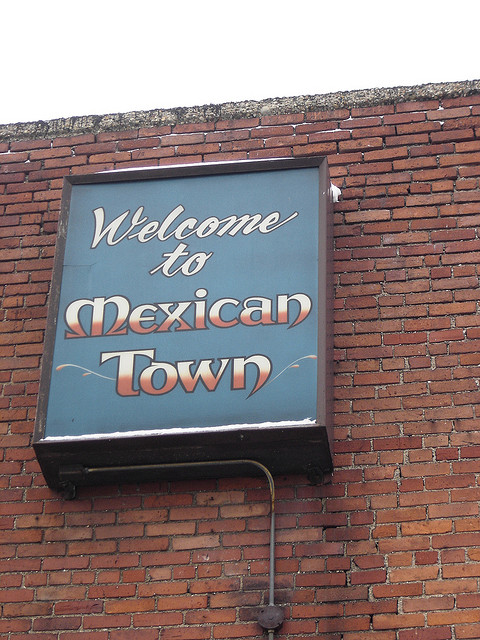
From Repatriation to Representation: Latina/o Participation in Detroit Electoral Politics

by Elena Herrada

I am an elected member of the Detroit School Board under an emergency manager. I am also a candidate for Detroit’s 6th Representative District. Entering the race is a victory in itself. I am running without the giant funding the other candidates have, but I am running as an act of public service, to speak truth, to stand up for our elders who were intimidated out of public participation and remained private. It was during the late 1970s in the Chicano Boricua Studies classes at Wayne State University (CBS-WSU) in Detroit that classmates and I began to put together the story of this intimidation. We began to understand what happened to our families and why they acted as they did. This became essential to understanding where we are now and how it came to be that we have so little political power in Detroit and Michigan.

Mexicans began arriving in Detroit en masse around 1920 to respond to a call by Henry Ford’s auto plants. The promise of $5.00 per day and the chaos of the Mexican Revolution converged to send Mexicans north.  Approximately 15,000 Mexicans came to Detroit, including my grandparents. My grandfather married my grandmother, Elisa Hernandez Carranza in San Antonio Texas where she had been working as a governess for an American family who had brought her from Mexico to care for their children.  He worked on the railroad in New York and in Kansas and was drafted into World War I.

Here in Detroit, they started their family. My grandfather was fortunate to get hired by Ford, but with uncertain times, he was laid off in 1922. He worked odd jobs to support the growing family. When the Depression hit, as we have now learned, the welfare department came knocking on Mexican’s doors. Their four children were born in Detroit already when the deportations came.

Between 1929 and 1939, one million Mexicans – 60% of who were born in the US – were “repatriated.”  This is not the word for all; many who were born here and kicked out were depatriated, a word now used in our research of this sad period. This was done through a program cooked up  and never codified into law – to scapegoat a people and blame them – the most vulnerable and conspicuous (race, culture, language), rather than an economy built on a house of cards in a system riddled with contradiction and greed. A discussion for another time, but noteworthy here, is a comparison to today’s Detroit pensioners and the privatization of our city. Nearly identical play books were used for the hate mongering justification of removal of a people through state power and theft of pensions.  Racism is an essential for carrying off such a feat.

My family, like thousands of others, went back to Mexico. I have spent my life getting this story. Mexican Detroit was hardest hit between 1930 and 1932 because of industry recruitment in the better days of the early 1920s; so there were many to seek and many to deport.  It was when I was in the CBS-WSU program in the late 1970s that I learned about the repatriation from reading  Abraham Hoffman’s “Unwanted Mexican Americans.” When our little local Detroit Oral History Committee, made up of repatriados and descendants reached out to scholars Francisco Balderrama and Raymond Rodriguez, they came to Detroit for a book signing and then wrote a second edition with much of their research on Detroit included. 

We do not know how many of those repatriated returned.  We do know that many died along the way back and that many did not come back to Detroit; they went to other cities. Others returned during the Bracero Programs and found out then that they were US born repatriados. We lost track of thousands of our people in that decade and beyond. Children born here were not always told they were US citizens and lived their entire lives without ever claiming their birthright.

It was in the 1970s that the Chicano Movement gave rise to our pride. It was a time when we realized that our elders had been treated badly for things they did nothing to deserve and that our culture and language were to be embraced, not rejected. And it was a time for a new influx of Latina/os. In 1974, there were demands for bilingual education in the schools and Michigan passed the law for bilingual education.

Because we were based in an auto industry where no formal education was needed to make a good living, we had few Chicano or Latino people to fill the jobs of bilingual teachers and administrators. Detroit was considered the Promised Land because one could come here and change one’s life without changing one’s class. Thus, we had few college grads that could be teachers. Chicanos/as arrived in Detroit from Texas, California and New Mexico to fill the need. The 60s and 70s in Detroit, like the rest of the world, ushered in a new day for many oppressed peoples. Latinos here saw the passage of the Bilingual Education Act, the creation of new community based organizations run for and by Latinos and the creation of Latino en Marcha, later to become CBS-WSU. Many of today’s agency directors came through this important leadership/ academic program.

Among the organizations that came into existence in a heavily Mexican and Latino populated southwest Detroit were:  LASED (Latin Americans for Social and Economic Development), SER, (Service, Employment, Rehabilitation), CHASS Clinic (Community Health and Social Services) and Latino Family Services.

LASED was created as an incubator to start other projects. Its mission was to get Latinos included in positions where we had previously been excluded: government, civil service and education. It was the primary advocacy agency that sued the State Department of Education for failure to provide language instruction to Spanish speaking students, thus ushering in bilingual education. There was an active Brown Beret chapter here as well as a thriving UFW boycott office. The UAW was a strong supporter of the farm workers, so our autoworker parents were part of the growing UFW movement for justice in the fields. We were part of a movement that uplifted us; no more hiding who we were.

At the same time these organizations were forming, another community organization formed called Southwest Mental Health (SMH), now known as Southwest Solutions (SS). Its director, unlike the Latino agencies, was and is non-Latino. It is important, also to note that most of the people who started these organizations in the 70s are still there, either as board members or as directors. In 1979 SMH began to expand its mission into housing. It has since acquired hundreds of properties located in the Latino community and again expanded its mission far beyond mental health. It includes its own housing office, real estate corporation, construction company, its own mortgage lender and educational contracts and has also expanded into health care, having opened its own clinic in SW Detroit.

An elder activist in our community, Sister Consuelo Alcala asked me to look into why the Latino agencies were losing so much ground to SS. She had been part of the creation of the agencies and was concerned that the existing Latino agencies were receiving very little funding now from their traditional sources: the United Way of Southeastern Michigan, the Neighborhood Opportunity Fund, etc. While the buildings and the organizations still exist, they are shadows of their former selves. The services once offered by LaSED, CHASS, SER, Latino Family Services all are now offered by the mega non-profit Southwest Solutions, who are also the largest landlord in the community.

I set out to interview the directors of the agencies, not sure how to approach an issue which many in our community had quietly complained about for years. We decided the best way to present our findings was to hold a hearing on the issue of hegemony in SW Detroit. This is where we learned how much influence the philanthropic world truly wields in Detroit and its negative impact on the Latino community as well as its impact on our ability to get our own people elected to office.

Our first Detroit Latin/o elected to office was Representative Belda Garza D-8th District in 1998. She was a determined political outsider who won, making history for Detroit. Her second term she ran unopposed, but the third term she was beat by a non-Latino, followed by his staff person who were both term-limited. The now heir apparent in the race is also non-Latina/o. Lots more money than our community has ever seen is in the mix now. Very little is left of public life in Detroit. As we speak, our trash pick up has been privatized, our water is about to be seized and pensions are up for grabs. The Detroit News reported that the heads of the foundations that rule Detroit met with the bankruptcy judge but because they are private entities, they do not have to report what they talked about. Our lives. Privatized. I mention this because our political races have been privatized; the non profits  (banks in drag) control all public life.

My first action as an elected school board member was to stop the efforts of the non-profits that went to city council and asked them to abolish the school board and put it under mayoral control, the first move before dismantling public education and parceling it out to charter schools. Jones Day, a bankruptcy law firm has replaced the government in Detroit; there is a  possibility of taking away Detroiters’ pensions to pay illegal swap loans to the banks it represents. I am running as an act of public service. To speak truth, to stand up for our elders who were intimidated out of public participation. Entering the race is a victory in itself, a victory of embracing public participation.


[1]  B alderamma, Francisco E, and Raymond Rodriguez.  Decade of Betrayal: Mexican Repatriation in the 1930s. Albuquerque: University of New

Mexico Press, 2006. 

Elena Herrada  is a lifelong, second and one half generation Detroiter and daughter of a repatriado family (Detroit-Aguas Calientes-Detroit). Herrada is the daughter, granddaughter and mother of auto workers and an urban activist, critic and feminist. She is a co-founder of Fronteras Norteñas, an organization which chronicles the life of Mexicans in Michigan and a co-founder of Centro Obrero de Detroit, an immigrant rights organization formed in 2006. Herrada teaches at Wayne County Community College, volunteers with LASED ( Latin Americans for Social and Economic Development) teaching ESL and worker rights. She is currently running for State Representative in House District 6 on a platform of defense of public education and freedom from emergency managers for all communities of color and the restoration of their voting rights.

Mute Figuration of Minikins

by María DeGuzmán

The title of this online publication, Mujeres Talk, spurred me to think about how I, as a scholar, an artist, and a scholar-artist-activist, “talk” in order to communicate with my students, my colleagues and with anyone willing to engage with me or my work. Much of the “talking” I do in an academic setting or related to academic production conforms in large measure to the usual genres: the journal article, scholarly monograph, book chapter, book review, classroom lecture and seminar-style Socratic dialogue of posing thought-inducing questions to provoke discussion that leads to a more profound comprehension of and interaction with a given text, film, photograph or other cultural artifact. Much of this communication has been concerned with issues and questions raised by the ever-expanding field of Latina/o Studies and also by the study of U.S. literature, history and culture more generally. Much of this communication has been based in words—the analysis of clusters of words on a page (a block of text or a single phrase in context) or of a segment of dialogue in a film. It has involved the translation of an aesthetic and political (“aesthetico-political,” to borrow Algerian-born French philosopher Jacques Rancière’s phrase) response to a visual and/or auditory stimulus into words—words spoken and words written in the classroom and beyond, words vibrating in the air or fixed on the printed page or embedded in an electronic document. So much of my life as a scholar and communicator has involved the encoding of synchronic thoughts into diachronic words and the decoding of those words into more words that conform to a linear, rationalist discourse. Having published two books and more than twenty-five articles, I now have the chance to review, with considerable breadth, the patterns of my own words.

One particular pattern stands out for me. That is my use of the term “figure” as in “Figures of Spain in Anglo-American Culture,” “Trafficking in the Figure of the Latino,” and “Algebra of Twisted Figures.” My own interest in this word—“figure”—catches my attention. The term “figure” and related ones such as “figurative” are complex, with a very long history in the study of language and rhetoric dating back to Aristotle and Quintilian. A “figure” designates both a model or type (something that recurs or shows up again and again and thus itself belongs to a familiar pattern) but also the site where and the operation through which the literal or the expected is exaggerated, altered or pulled away—bent, if you will—from its normal or familiar course as indicated by the phrase “figurative language.” “Literal language” designates words that do not deviate from their defined meaning. In contrast, “figurative language” understood as “non-literal language” refers to words or word clusters that do deviate from the obvious and most ostensible—that which implies a non-literal meaning, a turn or many turns away from or beyond their denotation. With regard to language as spoken and written words, figurative language can be understood as the place where words make a break away from themselves, cease to mean what they spell and mean more than what they say. This excess of meaning is indicated by the confounding of meaning and a certain silencing, hushing or muting of expected meanings at the same time that something even familiar and déjà vu (seen again or before) is expressed as with those “figures”: “Figures of Spain,” “Figure of the Latino,” and so forth. So, given my interest in “figures” and the “figurative language” that revolves around and also composes these figures—as all figures seem to be part of an extended metaphor or conceit and are highly charged with “allusions” (references beyond themselves)—I must conclude that I am fascinated by the scenarios in which words exceed themselves in ways that do not speak but carry a loaded silence, an inaudible or illegible register that nevertheless must be heard or read.

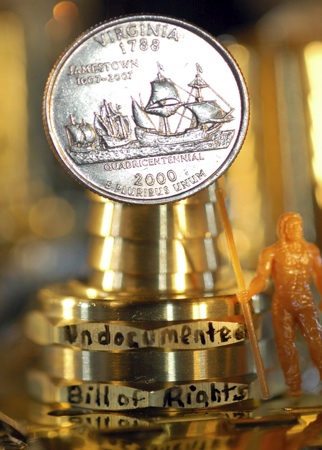
Trophy with Coin affixed and miniature man standing to side

Undocumented Bill of Rights © 2011

From the vantage point of this consideration of “figure” and “figurative language” I frame my interest in photography that has taken many forms—a second career as a conceptual photographer, a scholar studying narratives predicated on photographic situations or that textually invoke photographs, a creative writer who produces photo-text stories (stories accompanied by photographs), and a photographer who has been especially invested for the last decade in photographing literal (but also not so literal) human-model figures both as window display store mannequins and also as toy store minikins or little figurines less than an inch tall usually sold to children for the purposes of creating fantasy plays in the process of playing with them.

A photograph is said to be “mute” except for its caption or title, assuming it has one. Even though the caption or title may speak for it or anchor the silent enigma of the photograph in words that frame its mysterious content in a certain way, there is always a great deal in any photograph or series of photographs that eludes the written (or, sometimes, spoken) words. This is not to say that the photograph isn’t, in fact, some kind of text. It is, as Roland Barthes’s essay “Rhetoric of the Image” would suggest. Photographs exist within the context of their culture and participate in its image-repertoire, visual regimes and semiotic codes both in their making/taking and in their reception. But, nevertheless, there remains the mysterious silence of the visual photographic image—its ambiguity, its Sphinx-like riddle quality that implicitly poses the questions: “What do you see there? How and why? What lies within its borders? What lies beyond it?”

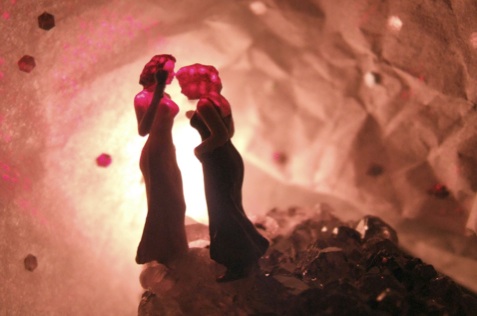
Two women in tunnel speaking

Thought Transfer © 2009

Add to this quality about photography the photography of human-model non-human and inanimate mannequins and minikins and a double dose of mutism has been introduced at the same time that viewers confront the extreme literalization of the concepts of “figure” and “figuration” via these figurines! These little figurines “speak” only a language of gesture. The photographs of them “speak” even more mutely through planes of color; reflection, refraction and diffraction of light achieved through the use of reflective surfaces, prisms, mirrors and/or split field filters; and the particular angles of perception afforded by any given image.

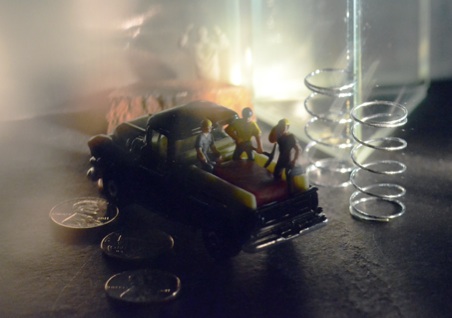
miniature figures in truck

Workers Heading to the Island of the Dead © 2012

The photographs of these miniature figurines in their perverse figuration—so figure-like (hardly abstract, almost allegorical, in fact) and yet so elusive in their muteness—lead away from words as much as they lead toward them in that to “understand” the image that very image invites us to tell a story about what these figurines might be doing. When children play with these figurines they tell themselves stories about them, but the children may also just as easily hum to themselves, audibly or under their breath, making rhythmic sounds and/or music rather than forming intelligible words.

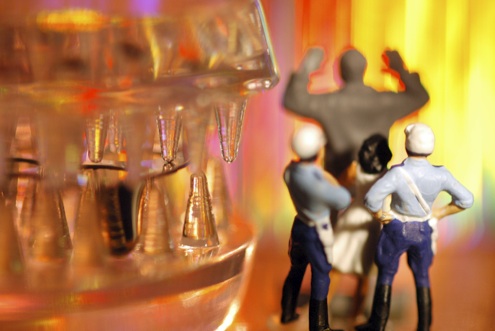
I do not allow my minikin photographs to be entirely mute. I give them titles, after all. Often these titles are designed to be provocative and obviously politically arresting, especially around issues that pertain to significant segments of the Latina/o population—farm workers, migrants, working-class Latina/os, Latina/os in socio-political or socio-economic circumstances of vulnerability. “He Saw Himself in the Gaze of the Dominant Culture,” “Woman Caught in a Corporate Water Tower,” and “Sixties Dream Followed by a Hazmat Suit” are examples of provocative, politically-pointed titles in addition to the title of the image below.

mini police figures arresting two other  mini figures

Arizona Eats Its Own © 2011

The captions or titles anchor the images in certain kinds of significations and potentially pre-dispose viewers to see these images in particular kinds of ways. But, despite this anchor, the minikin photographs—the photographs of these tiny figurines—continue to drift into the zone of the unnameable or the not easily named or the too multiply-signifying to name. And this quality constitutes the bent nature of these images. They are perverse, queer, puzzling and I would not want them to be any other way. That to me is their allure and the reason to keep making them and to keep looking at them. I say “making” and “looking” because though I have set the scene— have placed the figures in distinct relations to one another, the possibilities of these mute scenarios are not exhausted by my choreography. The possibilities exceed whatever planned scene I plotted at the time. The possibilities are produced in the incalculable interactions of viewing the scenes over time (each time somewhat differently) and also through what viewers bring to the scenes. The mute figuration of minikins contains within that muteness the possibility of rebellion against conformity to type and, thus, a space of decolonization, however small.

María DeGuzmán is Professor of English & Comparative Literature and founding Director of Latina/o Studies at the University of North Carolina at Chapel Hill. She is the author of two books: Spain’s Long Shadow: The Black Legend, Off-Whiteness, and Anglo-American Empire (University of Minnesota Press, August 2005) and Buenas Noches, American Culture: Latina/o Aesthetics of Night (Indiana University Press, June 2012). She has published many articles on Latina/o cultural production, and she writes and teaches about relationships between literature and various kinds of photographic practice. She is also a conceptual photographer who produces photos and photo-text work, both solo and in collaboration with colleagues and friends. She has published essays and photo-stories involving her photography. Her images have been chosen as the cover art for books by Cuban American writer Cristina García and the poet Glenn Sheldon and for books by academic scholars. As Camera Query (solo and in collaboration with others) and as SPIR: Conceptual Photography (with Jill H. Casid), she has shown in the Carrack Gallery, the Pleiades Gallery, and Golden Belt Art Studios in Durham, 523 East Franklin Street in Chapel Hill, the Orange County Historical Museum in Hillsborough, and the Joyner Library at East Carolina University in Greenville, North Carolina; Salisbury University Art Gallery in Salisbury, Maryland; the Institute of Contemporary Art in Boston; the Watershed Media Centre in Bristol, England; Pulse Art Gallery in New York City; the Center for Exploratory and Perceptual Art (CEPA Gallery) in Buffalo, New York; and El Progreso Gallery in Madrid, Spain. She has worked most notably with co-authors and co-producers, Jill H. Casid and Carisa R. Showden. Most recently she has teamed up with visual artist Janet Cooling and is composing original music for Cooling’s highly visual, dramatic lyrics as well as for some lyrics of her own. 

What the Film “Latino Americans” Offers and Misses

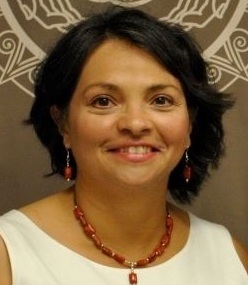
Orozco, Cynthia02

By Dr. Cynthia E. Orozco

Kudos to all the people who developed the PBS six part Latino Americans (2013) film series. The lenses of race, class, nationality, transnationalism and citizenship are successfully woven throughout six different eras. Despite the inclusive voices of Chicana and Latina historians Vicki L. Ruiz, Maria Cristina Garcia and Virginia Sánchez-Korrol, and despite excellent stories about women like Apolinaria Lorenzana, Rita Moreno, Dolores Huerta, Julia Alvarez, Gloria Estefan, and Maria Elena Salinas, the film series lacks a focused lens on gender and sexuality throughout the film. The problems of sexism, heterosexism and homophobia are ignored.

I will look at each episode highlighting key aspects of each episode and offer ideas as to what could have been included. Educators may supplement their teaching accordingly.

Episode 1: “Foreigners in Their Own Land” (1565-1880) provides a broad sweep though most attention is to post-1836. A focus on 1492 to 1821 or 1848 would have been more appropriate. The “Spanish colonial era” included Spanish presence in twenty-five states of the current U.S. and key civil settlements. Their interaction with Indian nations is essential in accounting for the pandemic that European disease brought to the Americas; Spanish genocide of Indians; Spanish slavery (encomienda system); mestizaje as well as the foundational race/caste/gendered/sexed status of Spanish, mestizo, caste and Indian peoples; and sexual violence. “Our” Spanish lands were Indian homelands.

Episode 2: “Empire of Dreams” (1880-1942) should have been two episodes. This episode provides excellent treatment of the Spanish American War and U.S. incorporation of Puerto Rico, the Mexican Revolution and resulting immigration to the U.S., and deportation of Mexican descent people in the 1930s. An 1898-1941 episode is needed to address the rise of racial segregation, the struggle for women’s suffrage, the rise of the Mexican American civil rights movement, and school desegregation cases in the 1920s and 30s. Adelina Otero Warren, suffragist and Congressional candidate is missed as was Concha Ortiz y Pino, state legislator in New Mexico in the 1930s.

Episode 3: “War and Peace” (1942 to 1954) addresses the “birth” of the Mexican American Civil Rights Movement, the rise of Dr. Hector Garcia, the Bracero Program, Operation Wetback, and Rosita the Riveter. World War II is the focus so as to provide redress for what filmmaker Ken Burns did not do in his PBS World War II series. In fact, this six part series resulted from numerous Latino and Latina protests of Burns’ film. Yet, the Mexican American Civil Rights Movement did not just emerge from World War II, the American GI Forum, and Dr. Hector Garcia. Instead, a focus on World War I is needed to explain this historical development that includes LULAC and activist/lawyer Alonso S. Perales. Garcia was a LULACer and without LULAC there would be no American G.I. Forum. Civil rights activism in the 1920s and the 1930s, including significant political activism by Ladies LULAC and in New Mexico is unfortunately ignored. Moreover, a Latina/o film focus on World War II must mention U.S. Senator Dennis Chavez and the Federal Employment Practices Commission (FEPC), the first federal civil rights agency which outlawed racially-defined wages for people of Mexican descent and Puerto Ricans.

Episode 4: “New Latinos” (1946-1965) is excellent. It addresses the second major migration of Puerto Ricans to the U.S. due to Operation Bootstrap; reveals the welcome of Cubans by anti-Communist U.S. forces; the rise of Herman Badillo, Puerto Rican Congressman; and the arrival of Dominicans in the U.S. due to the dictatorship in their country. The film mentions how women took on gender-prescribed employment. Birth control experimentation on Puerto Rican women is excluded from Latino Americans as is any mention of the Daughters of Bilitis, the first out lesbian organization.

Episode 5: “Prejudice and Pride” (1965-1980) focuses on the rise of the Chicano Movement.  Much like the 1996 documentary Chicano! the focus here is on regional movements and well-known male leaders although Latino Americans also includes Willie Velasquez. Attention to movement machismo/sexism/homophobia is, however, ignored as is the rise of Latina feminism. How are we to explain the rise of Latinas in the 1970s including Supreme Court Justice Sotomayor without this? No Stonewall Uprising either.

Episode 6: “Peril and Promise” (1980-1910) covers the second wave of Cuban immigration; the arrival of Guatemalans, El Salvadorans, and Nicaraguans; and the diaspora of Latina/os into every U.S. state. Likewise it shows the rise of English-only efforts and anti-Latina/o immigrant sentiment/policies. Linda Chavez, Republican, speaks favorably toward immigrants and Dreamers. Feminist moments and LGBT activism are ignored.

The year is 2013; filmmakers must account for sexism and homophobia in the history of communities of color. These added lenses would have made a good film great.

Dr. Cynthia E. Orozco is Chair of History, Humanities and Social Sciences at ENMU Ruidoso. She is the author of No Mexicans, Women or Dogs Allowed: The Rise of the Mexican American Civil Rights Movement; associate editor of Latinas in the United States: An Historical Encyclopedia; co-editor of Mexican Americans in Texas History; author of 80 articles in the New Handbook of Texas; and author of over 50 newspaper articles and letters. She is also co-founder of the Chicana Caucus in the National Association for Chicana and Chicano Studies and the daughter of Mexican immigrants.