
Category Archives: Immigration

Las dos alas de un pájaro: The Cuban Refugee Program and Operation Bootstrap

by Carmen R. Lugo-Lugo and Cheris Brewer Current

Cuba y Puerto Rico son
(Cuba and Puerto Rico are)

De un pájaro las dos alas,
(Two birds of a feather)

Reciben flores y balas
(They receive flowers and bullets)

Sobre el mismo corazón…
(Over the same heart…)

—From Mi libro de Cuba by Lola Rodríguez de Tió


One Bird, Two Wings

Sometimes attributed to Cuban revolutionary José Martí, the verses by Puerto Rican revolutionary Lola Rodríguez de Tió were first published in 1893, while she was exiled in Cuba. Martí and Rodríguez de Tió became good friends and avid advocates for the independence of their own and each other’s country, as Cuba and Puerto Rico remained the last bastions of Spain’s Empire in the Caribbean. The verses were a testimony of the similar histories the two islands developed under four centuries of Spanish rule. They can also be seen as a chilling presage of what was to come after the U.S. won the Spanish American War in 1898 and became a consistent presence in the future of both countries, as U.S. decisions and U.S. policies have affected the way Cubans and Puerto Ricans live their lives on both their respective islands and the US mainland as well.

The islands were forced into different routes during the 20th century with the Platt Amendment (1901) steering Cuba in one direction (i.e., eventual independence), and the Foraker Act (1900) and Jones Act (1917) gearing Puerto Rico in another (i.e., an entrenched colonial status). Later, when Puerto Rico became a Commonwealth of the U.S. in 1952 and Fidel Castro assumed power in 1959, this bifurcation seemed to be irreversible. The effects of U.S. policies toward Puerto Rico and Cuba have been critical in shaping the positions that both islands occupy globally, and in the living conditions of Cubans and Puerto Ricans on the mainland.

This essay presents a brief comparative sketch of two distinctive immigrating and incoming Caribbean groups resulting from two specific structural programs: the Cuban Refugee Program (CRP) targeting Cubans in the U.S.; and Operation Bootstrap (OB) involving Puerto Ricans on the island. Both programs had their genesis in the mid-twentieth century, at a moment when the U.S. was attempting to re-vamp its racial politics in response to both domestic and international pressures. Yet, it is noteworthy that both CRP and OB were operational before the passage of the Immigration and Nationality Act of 1965 which ended explicit race based preferences in entrants.

Thus Puerto Rican incomers and Cuban immigrants of the 1950s and 1960s are a precursor to the increasingly diverse group of immigrants who were to follow. Movement from Latin American and the Caribbean to the US contains a peculiar history shaped by individual relationships between countries of origin and the US. Immigrants from countries with closer political, economic, and social ties to the US were (and are) granted advantages in entrance, settlement, and employment that are unavailable to immigrants from countries who do not share the same intimacy with the US. This is clear when you compare Cubans with other political immigrants of the period—Haitians and Dominicans, for instance—who, because of racial and political reasons were not granted refugee status. This essay focuses on two relatively privileged groups of Latino immigrants: Puerto Ricans who entered with citizenship status, and Cubans who were granted legal status, provided financial assistance, and structural assimilation. Tracing the reception of these two groups illustrates the ways in which the U.S. government eased and aided the process of migration for some, while it outright neglected other newcomers.

Bootstrapping the Island

As an economic policy and as a development initiative, OB was not a U.S. policy per se, but rather, the effort of Puerto Rican leaders, who sought to develop Puerto Rico economically (Maldonado, 1997). The program was funded, almost entirely, by the island’s government. However, U.S. involvement was at the heart of its conception and implementation, for the companies targeted by the program were exclusively U.S. companies. U.S. policy was also at the heart of the program by way of specific tax exemptions that these companies would enjoy, as “Puerto Rico had been exempted from U.S. taxes since 1900” (Maldonado, 1997: 46). Those exemptions were the core of the program, so OB was possible, fundamentally, because of already existing U.S. policy. In addition, the massive movement of Puerto Ricans to the mainland that ensued after OB was also only possible, again, because of U.S. policy (in this case, policies ruling citizenship and territories).

Using an “industrialization by invitation” approach (Dietz, 1986; Whalen, 2005),
Operación Manos a la Obra (as it is known in Spanish) began in the 1940s, and had among its main objectives to eliminate extreme poverty on the island, and to develop the island economically (Morales-Carrión, 1983). Initially, the project included federal tax incentives and exemptions to entice American businesses with cheap and abundant labor. OB turned into an export-oriented form of absentee capitalism that overhauled the economy in Puerto Rico in unprecedented ways. By the 1950s the island had largely left its agricultural past behind, for as James Dietz (1986) tells us, agriculture came to be regarded as an obstacle to progress.

OB prompted a massive exodus of Puerto Ricans to the mainland US that has literally divided the Puerto Rican population in half, and has prompted poet Nicolasa Mohr to thoughtfully proclaim that “Puerto Ricans are no longer an island people” (in Rodríguez, 1991). The movement of Puerto Ricans alleviated the large-scale unemployment produced by the sudden shift from an agricultural to an industrial economy. The mainland Puerto Rican population went from 53,000 in 1930 (before OB), to 1.5 million in1964, roughly 20 years after OB began (Briggs, 2002). Although the set of initiatives, policies, and practices that came to be known as Operation Bootstrap did not institute or formally encourage island to mainland movement, we are suggesting (as have others before us—see, e.g., Briggs 2002; Dietz 1986; Maldonado 1997; and Whalen 2005, etc.) that Operation Bootstrap created a de facto form of movement to the U.S. by “pushing” migrants northward.

When the U.S. is Pulling the Bootstrap
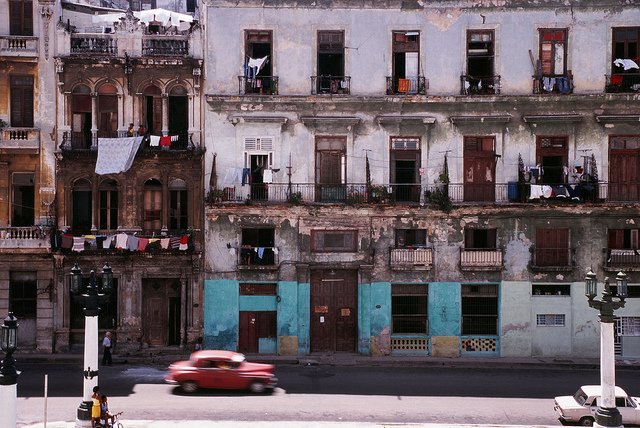
The post-1959 migration of Cubans was part of an immigration continuum that had brought Cubans to Florida whenever political or economic strife hit the island (Mirabal, 2003; Poyo, 1989). Given this history, the U.S. became a natural refuge for former supporters of Batista and other Cubans who quickly became politically and financially disillusioned with the revolution, but discerning why the U.S. chose to accept over 650,000 refugees by 1977 is a more complicated challenge (Whorton, 1997). The acceptance of Cubans, first as immigrants and then as refuges, marks an anomaly in US immigration policy, as they arrived during an era of restrictive immigration (1924-1965).

Accepting Cuban refugees was merely one aspect of the U.S.’s developing policies directed at incoming exiles. Early on, many Cubans leaving the island managed to take money and other forms of capital with them and were able to support themselves –if only temporarily– in their exile. The restrictions Castro imposed on what Cubans could take with them became increasingly stringent over time as concern grew that assets in the forms of cash and jewelry were being sent northward. Eventually luggage was limited to a change or two of clothing.
As Cubans began entering the U.S. early in 1959, private agencies and local church groups offered aid to impoverished refugees. Federal aid increased greatly in 1961 with the creation of the Cuban Refugee Program, providing the needed resources for the programs many aid-based goals. The CRP, administered by the Department of Health, Education and Welfare (HEW), provided funds for resettlement, and “monthly relief checks, health services, job training, adult educational opportunities, and surplus food distribution (canned meat, powdered eggs and milk, cheese, and oatmeal, among other food products)” (García, 1996).

Based on number of dependents, place of residence, and employment status, CRP staff calculated a monthly financial benefit for deserving refugees – primarily the unemployed – and granted refugees a maximum of $60 a month for a single person and $100 for a family (Voorhees, 1961). These payments were substantially more than the welfare payments available to U.S. citizens (including Puerto Ricans). The CRP also provided additional assistance, including medical insurance, assistance with employment readjustment, and college scholarships. This comprehensive program ensured that Cuban refugees were provided with structural assistance that extended beyond the stopgap needs of early exile.

Final Thoughts: Of Cubans, Puerto Ricans, Republicans, and Latinos

The unequal power relations that typify U.S.-Latin American exchanges mark the admittance, treatment and integration of Latin American immigrants, as all migrants from the region have been subject to the whims of the U.S.’s shifting relations with Latin America. Similarly, the complex histories that individual nations share with the U.S. have dictated the response to immigration policy and immigrants (Taft, et al, 1979 ). This in part explains that although Puerto Ricans and Cubans are all categorized as “Hispanic” in the eyes of the U.S. government or Latinos in the U.S. popular imagination, for instance, specific historical, political and perceived racial differences have produced great disparity in U.S. policy and reception of immigrants or incomers from the country and territory respectively.

This discrepancy becomes patently obvious when one compares the reception of Cuban refugees to that of Puerto Ricans workers during the mid-twentieth century. On the one hand, during the Puerto Rican movement to the U.S., the U.S. government benefited from the cheap labor that ended up manning its factories and processing plants. It was assumed that Puerto Ricans, who were U.S. citizens after all, could access welfare if needed—yet the racialized welfare system discouraged if not outright barred people of color from accessing services (DeParle, 2004). Meanwhile, unlike Cuban refugees from the same period, Puerto Ricans did not receive a hero’s welcome, or assistance to find a place to stay, or to learn English. They were given no free vocational training, or medical services. In sum, Puerto Ricans were not presented with an aid package tailored to their needs. As citizens, they were assumed to have access to the U.S. government resources, when the reality seemed that they were here only to fulfill the needs of an economic system that thrived on cheap labor. The massive migration turned out to be a “win-win” for both governments (US’ and Puerto Rico’s), while it became a “lose-lose” for Puerto Ricans, including Puerto Ricans in the U.S., who ended up at the bottom of the economic ladder.

On the other hand, the US government not only allowed Cubans entry, but it also provided direct assistance that exceeded any welfare program available to its own citizens, including Puerto Ricans. Some of the motives behind this benevolence remain unclear; what is clear is that the Cold War and anti-communist rhetoric shaped governmental discussions of Cuban immigration; ensuring the well-being and success of people fleeing communism held important ideological value. The direct assistance that Cubans received was, indeed, helpful in some form, as they still have the highest net worth of any U.S. Latino group. Puerto Ricans, on the other hand, continue to lag behind, and are experienced as a problem group, one immersed in poverty—and racialized as non-White. Regardless of the historical, social, and racial similarities shared by Cuba and Puerto Rico pre-1898 (the two birds of a feather), an act of American exceptionalism elevated (and perhaps continues to elevate) the status of Cubans, while Puerto Ricans and other Latino/as remain(ed) marginalized. This unilateral decision predisposed Puerto Ricans to a different treatment by mainstream U.S. culture, and hence, a different future from that of Cubans.

Over half a century into that future, the 2016 presidential election campaign has produced (thus far) two Republican hopefuls of Cuban descent, while not one Puerto Rican has ever made a bid for the presidency (on either party). Something to note here is that the candidates in question are both the offspring of Cubans who migrated to the U.S. before Castro took office, meaning, they are not CRP babies. This fact brings us to a crucial, final argument: the CRP seems to have “lifted the boats” of Cubans as a group, even those who did not participate in it (and perhaps even those who came after the program was terminated). This point is important, for the net effect of the CRP extends beyond the assistance granted to individuals, as the program collectively elevated the economic and social status of Cubans. The CRP argued that these heralded newcomers were capable of accessing the American Dream and political self-determination (as it was assumed that the future leaders of Cuba were temporary sojourners, who would return to the island eventually and take control). Puerto Ricans were pushed to the margins as they were denied structural assistance and viewed as political and economic dependents, creating a long-lasting, major chasm between both groups.

But now the chasm seems to be closing, and Republican candidates notwithstanding, second and third generation Cuban Americans are shifting politically, presumably joining Puerto Ricans and other Latinos in less conservative spaces (Fisher, (2015). Thus, regardless of their bifurcated histories, and their still dissimilar class status, Puerto Ricans and Cubans in the U.S. seem to be finally converging not only geographically, but in their ideals and aspirations as well. There is also the collective imagination of Americans who sees both groups as part of that collective known as Latinos/as, and whether that is a good thing or not, is a question for another essay.

References:

Briggs, Laura. 2002. Reproducing Empire: Race, Sex, Science, and U.S. Imperialism in Puerto Rico. Berkeley: University of California Press.

Boswell, Thomas and James Curtis. 1984. The Cuban American Experience: Culture,
Images and Perspectives. Totowa, New Jersey: Rowman & Allaheld Publishers.

DeParle, Jason. 2004. American Dream: Three Women, Ten Kids, and a Nation’s Drive
to End Welfare. Penguin Books: New York.

Dietz, James L. 2003. Puerto Rico: Negotiating Development and Change. Boulder:
Lynne Rienner Publishers.

Fisher, Marc. 2015. “Cuban Americans’ Shifting Identity, and Political Views Divides
Key Block.” The Washington Post. June 12. http://www.washingtonpost.com/
politics/as-time-passes-a-cuban-identity-fades-to-an-american-one/2015/04/
12/83d3346a-dfd0-11e4-a1b8-2ed88bc190d2_story.html.

García, M.C. 1996. Havana USA: Cuban Exiles and Cuban Americans in South Florida, 1959-1994. Berkley: University of California Press.

Maldonado, A.W. 1997. Teodoro Moscoso and Puerto Rico’s Operation Bootstrap.
Gainesville: University Press of Florida.

Masud-Piloto, F.R. 1996. From Welcomed Exiles to Illegal Immigrants: Cuban Migration to the US, 1959-1995. Lanham, Maryland: Rowman & Littlefield Publishers, Inc.

Mirabal, N. R. 2003.“‘Ser de Aquí’: Beyond the Cuban Exile Model.” Latino Studies vol. 1: 366-382.

Morales Carrión, Arturo. 1983. Puerto Rico: A Political and Cultural History. New
York: W. W. Norton and Company.

Poyo, G. 1989. With All, and for the Good of All: The Emergence of Popular Nationalism in the Cuban Communities of the United States, 1848-1898. Durham: Duke University Press.

Rodríguez, Clara E. 1991. Puerto Ricans: Born in the U.S. Boulder: Westview Press.

Taft, J.V., North, D.S.& Ford, D.A. 1979. Refugee Resettlement in the US: Time for a New Focus. Washington DC: New TrasCentury Foundation.

Thomas, J.F. 1963. “US Cuban Refugee Program.” (December) Records of Health, Education, and Welfare, RG 363, Carton 12, File CR 18-1, National Archives II.

Whalen, Carmen Teresa. 2005. “Colonialism, Citizenship and the Making of the Puerto
Rican Diaspora.” In The Puerto Rican Diaspora: Historical Perspectives edited by Carmen Teresa Whalen and Víctor Vázquez-Hernández. Philadelphia: Temple University Press.

Whorton, B. 1997. The Transformation of Refugee Policy: Race, Welfare, and American Political Culture, 1959-1997. PhD Dissertation. Sociology, University of Kansas.

Carmen R. Lugo-Lugo is an Associate Professor in the Department of Critical Culture, Gender,  and Race Studies at Washington State University. Her research focuses on Latinos in the US, “the War on Terror,” and the representation of Latinas/os and other minorities in popular culture. Cheris Brewer Current is Associate Professor of Sociology and Social Work
at Walla Walla University’s Wilma Hepker School of Social Work and Sociology. Her research focuses on Cuban Immigration to the U.S., and the intersections of race, class, and gender.

Mujerista in Spirit: On Being a Latina Lapsed Catholic Researching Faith during Lent

author celebrating first communion

Sujey Vega’s First Communion Celebration. Personal files of author. CC BY-NC-ND 2.0

by Sujey Vega

It is Lent and so it is that time of year when my mother pleads, “Hija, go to church this Sunday.”  For years I have tried to make my mother understand that I no longer “go to church” by choice. My repeated efforts to attend Catholic mass as an adult have yielded only unease, a sense of acting out of unfathomable obligation. What I dare not tell her, however, is how much I actually miss it. How much I wish I could believe and truly engage the Holy Spirit that she, following in the steps of my querida abuelita, so wholeheartedly embraced. Like many families from Latin America, it was the women who carried on the lived religion in my family. I remember my abuelita’s wrinkled hands moving her rose petal rosary, her thumbnail rhythmically gliding the beads that after years of use still emitted the smell of roses. Indeed, the aroma of fresh flowers continues to remind me of my own days of “ofreciendo flores” or offering flowers to the Virgin. Growing up, we attended mass every Sunday. My amá had me in catechism, I was an altar girl and took confirmation classes, even though I was confirmed in Mexico at the tender age of two (because as a Mexican Catholic I had no choice).

As a young adult, I could not personally reconcile the directives of a parish priest who barred teen girls from wearing make-up to mass or the passive reception expected of religious women toward their ministerial leader, a male priest. My mother, my abuelita, the women of the faith were the ones solely responsible for maintaining the faith at home, and yet they were hardly ever recognized by the institutional church for their commitment. Moreover, the presence of the Holy Spirit was never felt in the pews listening to yet another lecture from the pulpit. I felt spiritual presence in warm embraces, Sunday carne asadas, and the sounds of familiar alabanzas (hymns) and none of these things were ever talked about during mass. I realized now that what I was feeling was what Mujerista Theology noted as lo cotidiano, or the every day lived religion. Even though I left the organized Church, I still find light and warmth in the way people gain spiritual comfort, healing, and belonging from their faith.

Much to my mother’s surprise, I study religion and its social impact on Latino immigrant communities. Much to my own surprise, I voluntarily chose this path. I can recall the first time I felt called to voluntarily step into a church for research purposes. In 2003, Chicago was the site of national tour of the Tilma de Tepeyac religious relic, a 17th century statue of the Virgin of Guadalupe carrying a glass-encased piece of the tilma. At Our Lady of Tepeyac Parish in the Little Village neighborhood Mexican Catholics knelt down at the pews to pray for hours. As I observed their prayer I could not help but feel moved. Moved not by the presence of the relic, but the power of faith. Watching old and young, male and female pray brought me to tears. I sat there wishing I could be the Catholic my own mother wished I was.

Not long after this moment in Chicago I realized that my being agnostic does not deter from my interests in faith and Latin@ communities. I may not necessarily agree with the tenets of most organized religion, but I can appreciate the value that lived religion has on strengthening people’s lives. For the populations I study, faith provides material and emotional stability in an otherwise unstable world. This might seem crass or reductionists, but for me (a non believer) it helps to situate how religious faith serves a purpose in people’s lives. In this way, I could study faith and its role in religious communities without necessarily getting into the politics of accuracy or ranking religious beliefs.

This finessing of skepticism with appreciation has been more than valuable in my current research project on Latino Mormons. This research began in 2006 when I met Veronica, the wife of a Mormon President in a store-front rama, or Mormon branch. Here close to a dozen families gathered every Sunday to testify to their faith as Latter Day Saints. I had never met a Latino LDS member, and to be frank, did not even know such a community existed. Latino Protestants of all sorts (Baptists, Jehovah’s, and Seventh-day Adventists) were in my periphery, but Latino Mormons were completely out of my realm of possibility. Veronica invited me to her home where we bonded over her delicious pozole.  Veronica recalled the story of her crossing into the United States with her children, “fue una aventura terrible pero para ellos yo se les hice ver divertido – como que todo estaba bien… Gracias a Dios estamos aqui, que si pasamos por todo fue porque El lo quiso asi que valoremos mas las cosas, lo que tenemos, nuestro hogar, la familia” [It was a terrible adventure, but for them [her children] I made it seem entertaining, like everything would be ok. Thank God we are here, what we went through was all because He wanted us to value things, value what we have, our home, and our family].  It was women like Veronica who solidified my own interests in faith and religion as a coping mechanism for Latino immigrants. Veronica courageously faced the crossing with her children. Terrified herself, she referenced the crossing as “una aventura” an adventure to compartmentalize the fear and transform it into excitement for her children. Since then, I have continued to address the role of faith and family in Latino Mormons. Currently I am sifting through archives, conducting oral histories, and attending church events/services to understand more fully how specifically the Church of Latter Day Saints is inclusive of its Latino converts, and how Latinos have, for almost a century now, found their own spiritual belonging as Mormons.

The researcher in me wants to probe the Mormon Church’s problematic vision of a “light-skinned” God speaking to and saving indigenous communities in the Americas. I want to remain aware that the Church can be welcoming to some while extremely inhospitable to queer and gender non-conforming members. I want to point to the juxtaposition of families encouraged to grow and produce the next generation of Mormons while Latina females continuously get labeled as over-reproductive burdens on society.  I want to, and I will, but I also have to be true to the members who do feel satisfaction, who are tremendously strengthened by their faith, who remake an otherwise predominately Anglo Church in their own image. Members like Josefina who noted, “In December I turn 89 years old…and the Relief Society still fortifies me, it gives me strength so that if I have live more months, well it helps me. The Relief Society is always helping you and renews you.” These women are claiming their own way to belong, and draw strength from their Church and the Relief Society. They are moved by el espiritu, and I cannot deny them that. I cannot forget how much I was moved during the a holiday performance when I did feel something, when I almost heard my own abuelita sing “os pido posada…”. I can’t help remember the other women of the Spanish Tabernacle choir whose arms wrapped me in an embrace when they found out I wanted to do a book about their lives. The women who all surrounded me trying to take pictures and encourage my work. The 92 year old elderly woman whose wrinkled hands held onto my own and asked me “estas en el facebook” so she could keep up with my work. Every woman wanted to take a picture, tell me their conversion story, and encourage their daughters to talk to me. I can’t but account for their narratives as well. As a feminist, non-Mormon, Women and Gender Studies professor, I’ve faced questions and skepticism about my research from the Mormon women I am researching. I want to remain open to their voices rather than rush to condemnation. Perhaps what I am actually doing, what drives this work, is the search to connect to my amá and abuelita, to their faith and their willingness to assert their own roles as Mujeristas, or women who lived their faith fully in their every day. So this Easter Lenten season I will go to church, but much to my mother’s chagrin it will be for research and not spiritual reasons.

References

Isasi-Díaz, Ada María. Mujerista Theology: A Theology for the Twenty-First Century. Maryknoll, NY: Orbis Books, 1996.

Sujey Vega is on the faculty at Arizona State University and a member of the Mujeres Talk Editorial Group.

Immigration Policy in the US: It’s All About Race

by Tanya Golash-Boza

The current debate over immigration policy in the United States revolves around how many immigrants we should let in and what we should do about those immigrants that are here without authorization.

In the contemporary United States, it seems completely natural that we would enforce our borders and regulate the entry of people into this country. Many people believe that the failure to do this would result in complete chaos.

It is thus remarkable that, for the first one hundred years after the founding of the United States, there were no laws governing who could or could not enter into or remain in this country.  For the first one hundred and fifty years after the establishment of the United States in 1776, economic development in this country depended on immigration. The free movement of labor between Europe and the United States was essential to the economic growth and prosperity of the United States, particularly in the Northeast and Midwest.

Discussions over immigration restriction first became popular when large numbers of Chinese immigrants began to arrive in the United States during the 1848 Gold Rush.

The arrival of thousands of Chinese immigrants into California provoked nativist sentiments among whites and these sentiments eventually translated into public policy.

In 1875, the Page Act was passed, which prohibited the entry of “undesirable” immigrants. This law primarily was designed to prevent the entry of prostitutes and forced laborers from Asia, and effectively barred the entry of any Asian women into the United States for the next few decades.

Debates over immigration policy in the United States have always had racialized undertones – except perhaps when the laws were outright racist.  The first major piece of immigration legislation was the Chinese Exclusion Act, signed into law in 1882. In an essay titled “The Chinese Exclusion Example: Race, Immigration, and American Gatekeeping, 1882-1994,” Erika Lee argues that

“Chinese exclusion introduced a ‘gatekeeping’ ideology, politics, law, and culture that transformed the ways in which Americans viewed and thought about race, immigration, and the United States’ identity as a nation of immigration. It legalized and reinforced the need to restrict, exclude, and deport ‘undesirable’ and excludable immigrants.”

The Chinese Exclusion Act was overtly racist in that it targeted one specific group: Chinese laborers. In specifically excluding a group because of race and class, the Chinese Exclusion Act set the stage for U.S. immigration policy, which has both overt and covert racial and class biases.

The Chinese Exclusion Act initially only governed entry policies, but worries over fraud and illegal entry gave rise to the 1892 Geary Act and the 1893 McCreary Amendment, which required Chinese people who resided in the United States to possess proof of their lawful right to be in the United States. These “certificates of residence” were the first precursors to today’s legal permanent resident cards. Such documents were required only of the Chinese until 1928, when “immigrant identification cards” began to be issued to all arriving immigrants.

Nineteenth century immigration laws tended to focus on Asian immigrants. By the 1920s, however, the United States no longer depended on the large-scale influx of European labor. Technological advances, which reduced the need for labor, along with rising nativist sentiment in the context of wars with Europe led to increased support for immigration restrictions.

These sentiments translated into legislative action. The 1924 Johnson-Reed Act was the nation’s first comprehensive immigration law.  As Mae Ngai explains in Impossible Subjects, “It established for the first time numerical limits on immigration and a global racial and national hierarchy that favored some immigrants over others” (Ngai 2014: 3).

The quotas set forth in the 1924 Act were based on ideas of white superiority – particularly the superiority of Germans and people from the United Kingdom. Whereas 65,721 visas were allocated to people from Great Britain, Italians were only allocated 5,802 and the Turkish only 226. The quotas were ostensibly based on the national origins of US citizens in the 1890 Census, but they excluded people of African and Asian descent.

While Congress used quotas to exclude undesirable races from entering the country, the Courts ensured that those who were in the United States would not attain citizenship. In the early 1920s, the Supreme Court decided that Japanese and Indians in the United States were ineligible for citizenship

The restrictive quotas and laws prohibiting Asians from attaining citizenship were eventually lifted. Today, our immigration policies are ostensibly colorblind.

However, over 90 percent of immigrants in the United States today are non-white, meaning that laws that restrict or provide opportunities for immigrants will have racially disparate consequences.

A Congressional decision to provide avenues for legalization and citizenship for undocumented immigrants would go a long way towards reducing inequality between Latinos and whites insofar as about 75 percent of undocumented immigrants are from Latin America. In contrast, decisions to enhance immigration law enforcement would further restrict opportunities for Latinos insofar as 98 percent of people deported last year were from Latin America.

No matter what your opinion is on immigration law enforcement or immigrant legalization, there is no denying the fact that discussions about immigration in the United States are and have always been discussions about racial difference and racial equity.

Tanya Golash-Boza is a 2015 Contributing Blogger for Mujeres Talk. She is on the faculty of UC-Merced and has published books and articles on the topics of immigration, migration, race, racism, transnationalism, borders.

Mujeres Talk About Ferguson, and Beyond

The year 2014 ends with our eyes turned to the aftermath of the events at Ferguson, Missouri and elsewhere, where police violence against black and brown communities of color is being increasingly challenged through mass mobilizations. Angry, but also inspired, we at Mujeres Talk have collected our thoughts below, as part of the urgent discussion now surging into view about institutionalized violence against people of color.

#BlackLivesMatter

Carmen R. Lugo-Lugo
Washington State University

Black lives matter.  A statement of fact that becomes relevant in its temerity, its urgency, and its ability to express so simply a historical set of circumstances fraught with example after example revealing the opposite to be true. It is a bold response to the reality that negates it and makes its very articulation a necessity.  Black lives matter.  We must state this truth as many times as it is necessary.  Because blacks lives become fragile in the hands of a society that seeks to destroy them.  Black lives.  They should matter.  In Ferguson, MO.  In Sanford, FL.  Anywhere.  Everywhere.  Black lives matter.  And yet.  Black teenagers continue to be gunned down by police officers or vigilantes protected by a system that doubles down on them.  And Baldwin comes to mind: “All I know is, he’s got a uniform and a gun and I have to relate to him that way. That’s the only way to relate to him because one of us may have to die.”  May have to die. Poignant because we know who “the one of us” will be.  Black lives matter.  And yet.  They continue to be extinguished by our institutions.  Black lives matter.  They matter.

#BlackLivesMatter #SomosFerguson Movements

Theresa Delgadillo
The Ohio State University

The recent deaths of black men and boys at the hands of police in the U.S., and news of earlier similar events, as well as the loss of life facing migrants at the U.S.-Mexico border brings into focus the deadly shortcomings of policies that rely on criminalization, militarization, detention, harsh sentencing, and imprisonment. The harsh policing in Black and Latina/o communities of Los Angeles described by Mike Davis morphed into the mass incarceration analyzed by Michelle Alexander and the increased surveillance of Black and Latina/o communities researched by Victor Ríos.[i]  Black girls and Latinas are not exempt from prevailing policies and laws that punish their infractions more harshly – an area of research and policy that The African American Policy Forum is pursuing. Yet this increased turn to criminalization and incarceration also had its complement in U.S. immigration and border policies, where militarization and now massive criminalization and incarceration are the norm. Joseph Nevins analyzes this shift, one that grew increasingly strident post-9/11 – and that has led to the tragic loss of life at the border described by Luis Alberto Urrea.[ii]  Blanca E. Vega’s recent blog on the Latino Rebels site makes the case that Blacks and Latinas/os are allies in the struggle for greater social justice, and takes Spanish-language media to task for not covering black deaths at the hands of police more thoroughly.

We desperately need to question how and why heightened criminalization and incarceration emerge as “solutions” that disproportionately impact African Americans, Latinas/os, and migrants, and how such “solutions” can be undone. At The Ohio State University, we are involved this year in a series of events commemorating the 50th anniversaries of landmark pieces of legislation in the United States: the 1964 Civil Rights Act and the 1965 Immigration and Nationality Act.[iii] Through a series of panel discussions, lectures, and interactive workshops, students and faculty at OSU have been and will be able to re-consider the significance of these two landmark laws; reflect on the movements, events, and consciousness that made them possible; discuss the histories that made them necessary; explore the opportunities they created; and critically assess contemporary inequalities that endure. For me, commemorating both of these events in a year when grassroots movements are once again making us aware of the loss of Black and Latina/o lives reminds me that civil rights and immigration are not merely linked by a shared legislative anniversary, but that instead, that shared anniversary marks a moment of heightened consciousness about the insidious effects of racism and discrimination that can permeate all aspects of U.S. policy.

Susy Zepeda
University of California, Davis

On November 24, 2014 the Ferguson, Missouri verdict to not indict Darren Wilson in the homicide of unarmed Black teenager Michael Brown sparked a response that initially resembled the 1992 Los Angeles uprising after the Rodney King not-guilty verdict, yet has quickly erupted into a solidarity movement that surrounds the hashtag #blacklivesmatter and spans across geopolitical borders.  An important connection in building consciousness around racialized and gendered police violence is the Spanish assertion “fue el estado” that has been articulated by activists, scholars, and other social actors who are seeking justice in the September 26th disappearance of the 43 students from a rural teacher-training school in Iguala, Guerrero, Mexico.   According to Charlotte María Sáenz, the mainstay of this movement, particularly for the parents has been “Vivos se los llevaron y vivos los queremos” responding in critical disbelief to Mexican authorities declaration that the 43 are dead, similar to the way families and activists have challenged the vast “disappearance” and feminicide of mujeres in Juarez and beyond.[iv]  Another resonating and profound echo of solidarity with the disappeared students have been the words “They tried to bury us. They didn’t know we were seeds,”  which Sáenz notes was said by the former Zapatista Subcomandante Marcos in honor of “his deceased compañero” Galeano, a teacher who was murdered in Chiapas, Mexico in May of 2014. The likening to seeds illuminates the awakening minds and bodies across imposed state borders that are simultaneously enunciating #not1more deportation, ni un@ más deportación.  All together, these powerfully show the importance of solidarity movements against state violence that are not bound by imposed demarcations.

Felicity Schaeffer-Grabiel
University of California, Santa Cruz

At a recent event organized by Critical Resistance in solidarity with the protests against police violence against black men and boys, Robin Kelley reminded us that the police use the excuse of fear (of black violence) to claim they acted in self-defense. In addition to the hash tag, #blacklivesmatter, which refutes the continued devaluation of black bodies inherited since slavery, Kelley sees these murders alongside settler colonialism where white, middle class or wealthy people intrude into black neighborhoods and then claim they are simply defending themselves from blacks, rather than vice-versa.  This is similar to the scapegoating of Latino/a immigrants as perpetrators of crime and violence rather than groups displaced and killed at the hands of state and cartel violence, policies such as NAFTA, as well as the victims of abuse and death at the hands of the police and the border patrol.  The Organization, “No More Deaths/No Más Muertes” released a report in 2011 that documents over 30,000 cases of abuse and murder by the border patrol. That the state is an arbiter of violence, rather than the force to protect people of color, is at the heart of Critical Resistance’s radical move towards prison abolition that attempts to diminish the state’s intrusion into communities by empowering communities to develop practices, organizations, and new models of social and economic interaction that help people flourish.

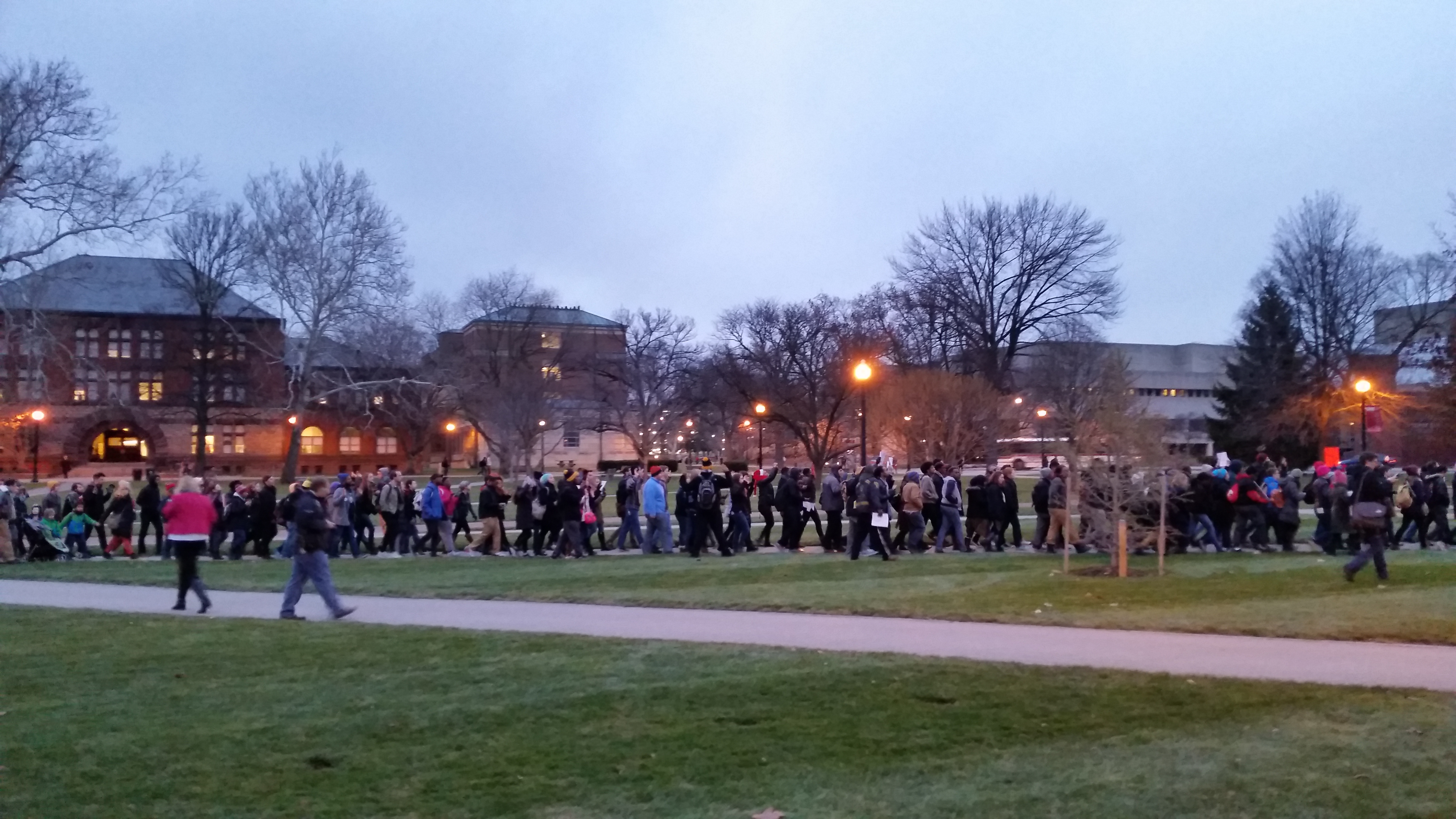
marchers with signs and placards on OSU oval

Peaceful march for Justice and End to Discrimination at Ohio State University Oval called by #CBUS2FERGUSON, December 8, 2014.

#ICantBreathe

Miranda Martinez
The Ohio State University

In New York City, right wing pundits and the head of the police union are accusing Mayor De Blasio and those who protest police violence of murder, following the murder and suicide by Ismaaiyl Brinsley of police officers Wenjian Liu and Rafael Ramos in Brooklyn. De Blasio has capitulated to these wild accusations, and requested that demonstrations pause while the city mourns the deaths of the two patrolmen.

It really does take one’s breath away.

Samir Chopra has written about the toxic self-pity that is so embedded in the policing establishment.  Psychically besieged, aggrieved and resentful, many urban police forces blame everything but the practices of law enforcement when their authority is challenged. And it seems to work!  It appears that legitimate collective action by hundreds of thousands who peacefully marched against the status quo must stop every time police representatives claim injury with the blatant aim of disciplining dissent.  Let’s hope that the protests continue going forward because we need to show that black pain matters as much as police pain, and because the campaign to defame legitimate protest by linking it with this brutal double slaying is just another outrageous example of anti-black racism. The conflation of civil rights protesters with a deranged murderer once again demonstrates (if we needed more proof) the instinctive, undiscriminating connection law enforcement officials make between blackness and violent criminality. We have to keep saying it, in the face of propaganda like this: Black lives matter.

Lucila D. Ek
University of Texas at San Antonio
University of Utah at Salt Lake City

The murders of Black children and men continue across the U.S. as Christmas Eve witnessed the shooting of yet another Black teenager by police. In Mexico, Federal Police are implicated in the disappearance and suspected murders of 43 student teachers in Guerrero. Every time I hear or read of another killing, my gut tightens and twists as I think about my Black and Brown loved ones on both sides of the border whose humanity is not recognized or valued by many. Often, I despair that things will never change, but widespread demonstrations against violence and death provide a glimmer of hope. People’s consciousness is being raised as thousands have come together to protest police violence and to proclaim that Black and Brown lives matter. I have to believe that a mass movement for social change is emerging. ¡Ni uno más, ni una más!


Endnotes

[i] Mike Davis.  City of Quartz: Excavating the Future in Los Angeles. 1990. Vintage; Michelle Alexander. The New Jim Crow: Mass Incarceration in the Age of Colorblindness. 2012. The New Press; Victor Rios. Punished: Policing the Lives of Black and Latino Boys. 2011. New York University Press.

[ii] Joseph Nevins.  Operation Gatekeeper and Beyond: The War on “Illegals”and the Remaking of the U.S.-Mexico Boundary. 2010. Routledge;  Tanya Maria Golash-Boza. Immigration Nation: Raids, Detentions, and Deportations in Post-9/11 America. 2012. Paradigm Publishers; Nicholas De Genova and Nathalie Peutz, Eds. The Deportation Regime: Sovereignty, Space, and the Freedom of Movement. 2010. Duke University Press;  Luis Alberto Urrea. The Devil’s Highway: A True Story. 2005. Back Bay Books.

[iii] Our colleague in the School of Social Work, Professor Keith Kilty, inspired these events by reaching out to faculty in Asian American and Latina/o Studies, who in turn reached out to faculty and students in History, American Indian Studies, African American Studies, Disability Studies, Sexuality Studies, Women’s Studies, Political Science, and Comparative Studies to plan and organize programs. 2015 also marks the 50th anniversary of the National Foundation on the Arts and the Humanities Act of 1965.

[iv] Rosa-Linda Fregoso and Cynthia Bejarano, Eds. Terrorizing Women: Feminicide in the Americas. 2010. Duke University Press.